Everyone can tell you what love isn’t. Relief isn’t love. Chemistry isn’t love. Needing someone so badly you can’t sleep isn’t love. There’s a whole genre of this, me included, and it’s genuinely useful. But it leaves you holding a shape cut out of the world. A love-sized hole with everything crossed out around the edges, and no idea what’s supposed to sit in the middle.
So let me try the harder version. Not what to rule out. What’s actually left when you do. Because once you take away the noise, the panic, the pull, the fireworks that every counterfeit also comes with, there are three quiet things underneath. And none of them feel like the movies.
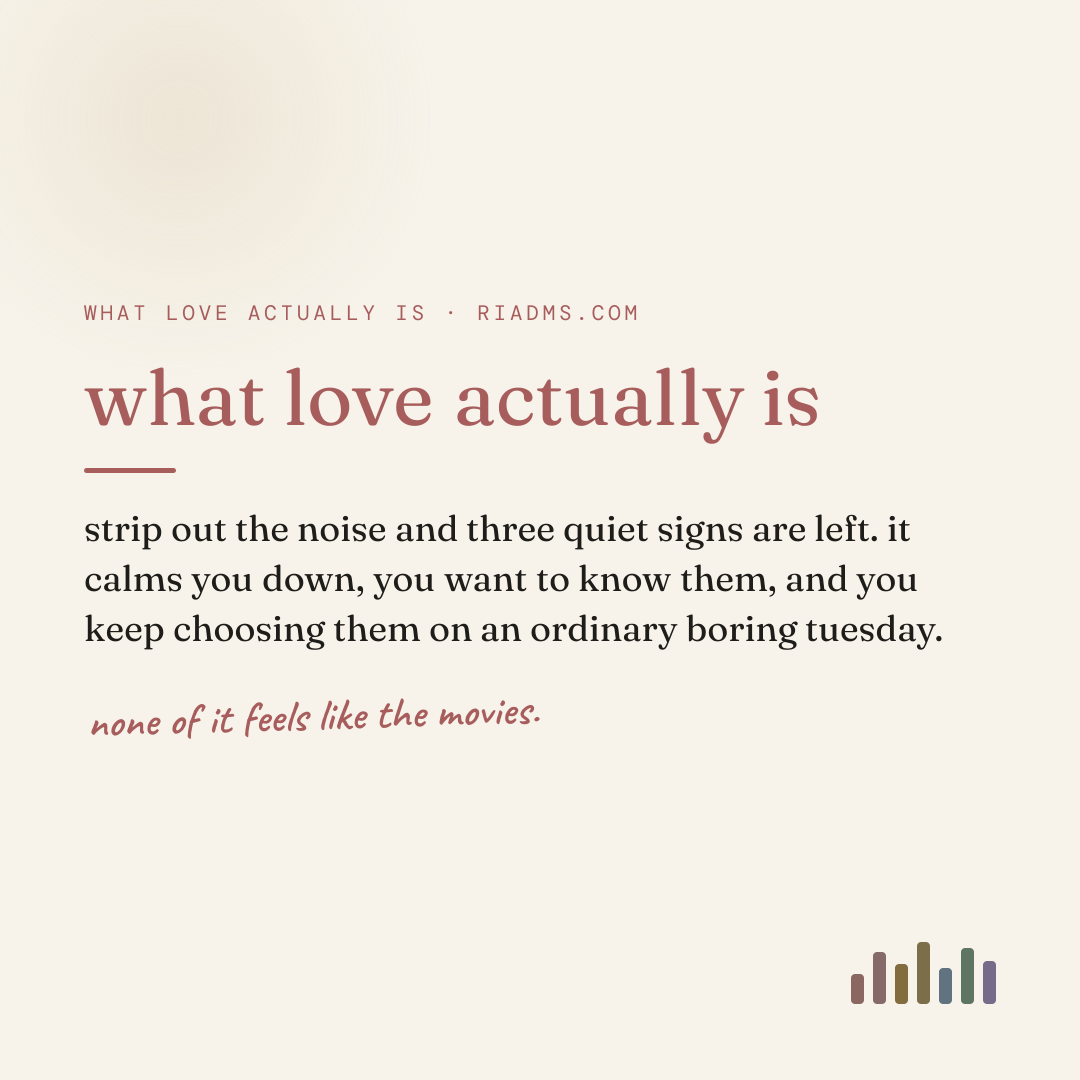
one: it calms you down
Start with your body, because it’s more honest than your feelings are.
Real love turns your nervous system down. The counterfeits turn it up. In 2006 a psychologist named James Coan ran a study where he put married women in a brain scanner and warned them they might get a small electric shock. When they held the hand of someone they trusted, the threat circuits in the brain went quiet. The fear literally turned down. And the better the relationship was, the more it turned down.
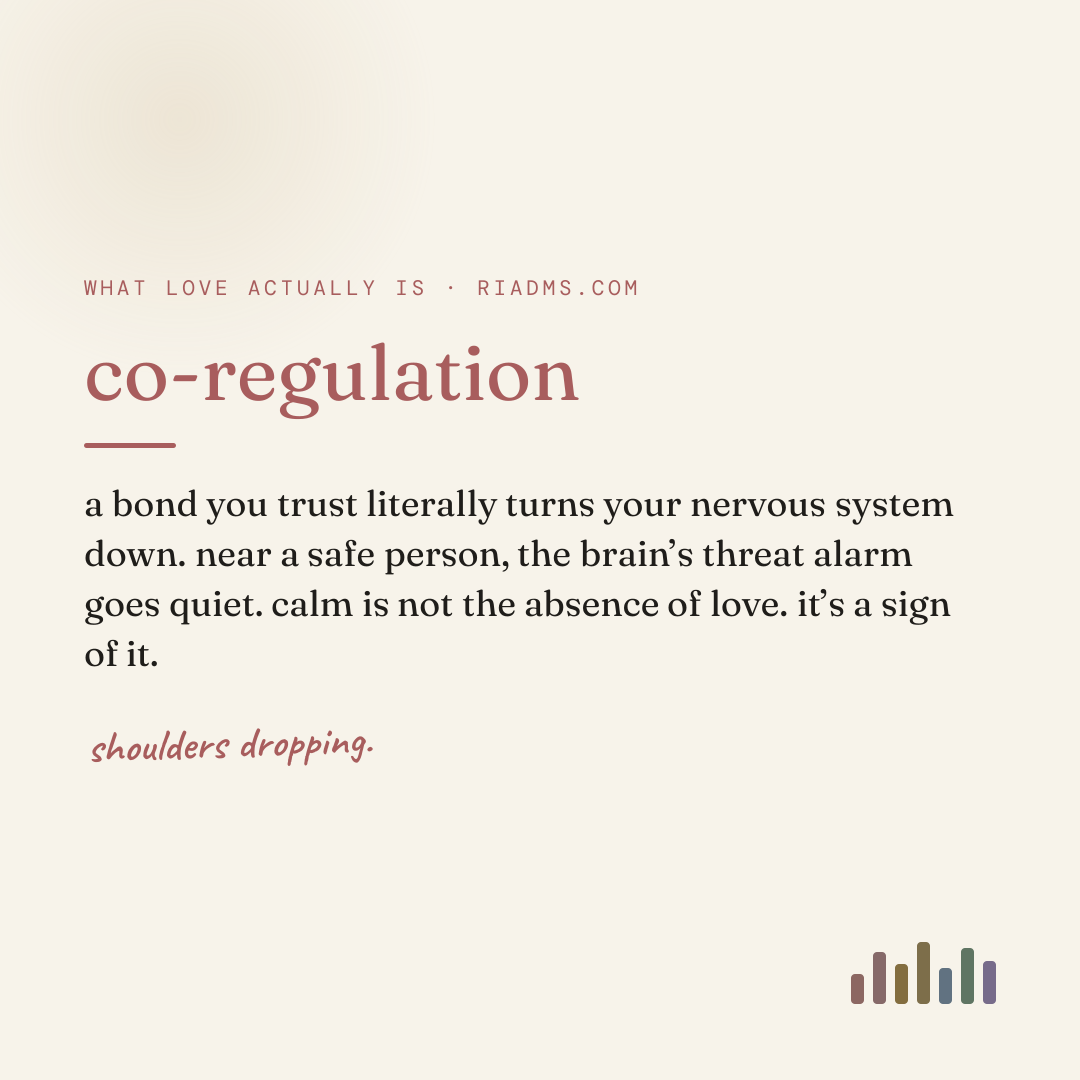
So if being around them settles you instead of spiking you, that is not boring. That is the signal. We’ve been trained to read calm as the death of love, when a lot of the time it’s the first evidence you have of it. The anxiety you keep chasing, the not-knowing, the wanting them to text back, that’s your threat system running, not your heart. It feels like love because we mislabel intensity as love constantly. But a fire alarm is not a fire.
One honest caveat, because I won’t oversell it. Coan’s study was married women holding the hand of a partner they trusted, and the calming scaled with how good the relationship already was. So it isn’t “any warm body will regulate you.” It’s a hand you actually trust. If being around them makes you more conceptanxious attachmentAn attachment style marked by a fear of abandonment and a pull toward inconsistent partners. The obsessive-thought machinery that limerence loves to borrow.what is anxious attachment? →Attachment theory ↗, not less, that difference is information worth taking seriously.
come think with me
one letter a week.
the word for one feeling you’ve had but couldn’t name, and why it works that way. the same thing you just read, in your inbox, once a week.
- one letter a week, about a ten minute read
- all nine printable workbooks, free
- the research, with its caveats kept in
- hit reply and it reaches me. i read every one
no pressure, no spam, no gatekeeping. unsubscribe anytime · riadumitrescu.substack.com
all of this is free and it stays free. if it gave you a word you didn’t have, you can buy me a coffee.
two: you want to know them, not have them
The second sign is a specific kind of curiosity. The kind that doesn’t run out.
There’s an idea in psychology called self-expansion, from the researcher Arthur Aron. The short version is that we’re drawn to love because it makes the self bigger. You take another whole person, their mind, their history, the way they see the world, and you fold it into yours, and you grow because they exist. Love wants to KNOW someone. To keep learning them. To find them specific and not just familiar.
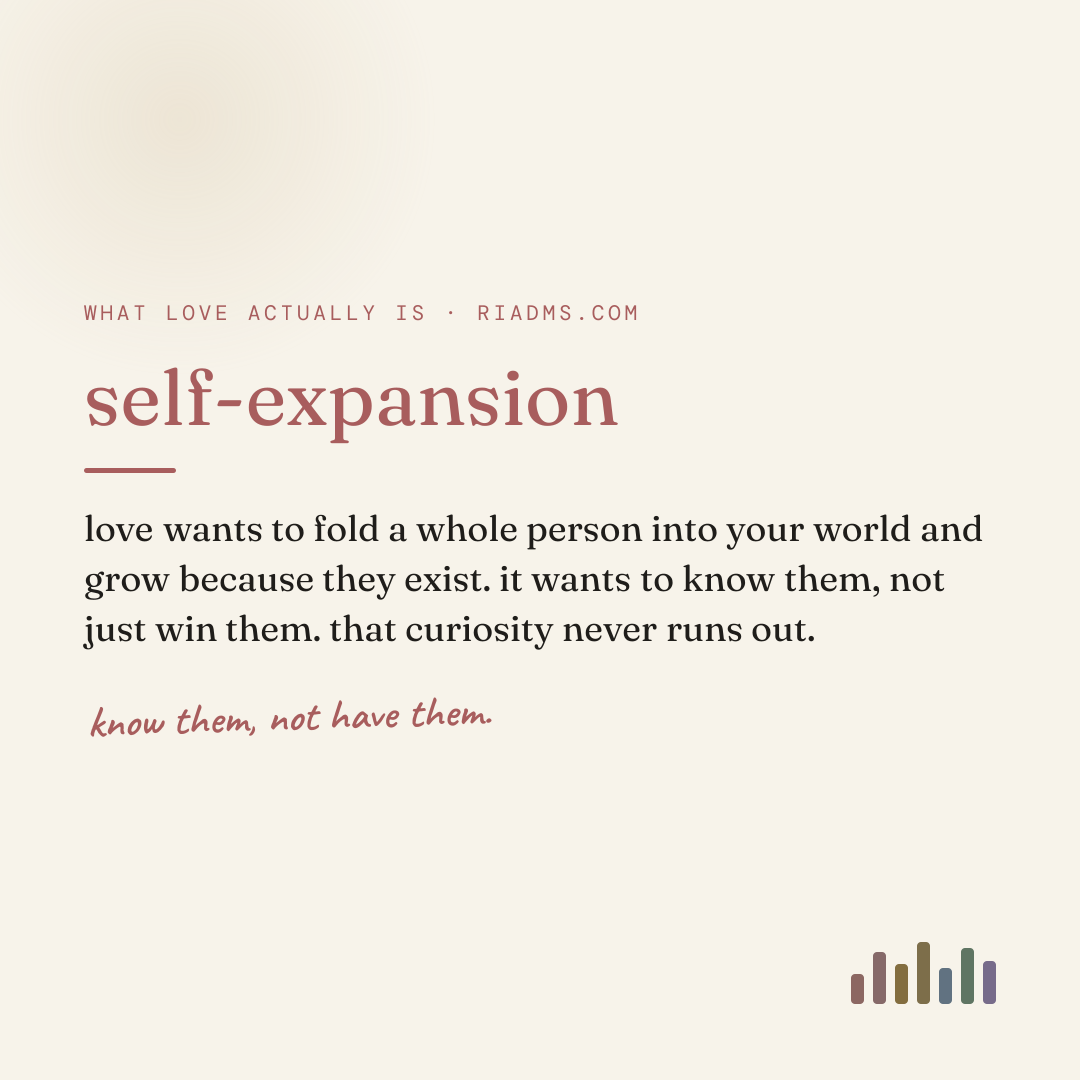
Hold that next to conceptlimerenceAn involuntary, obsessive state that feels like love: intrusive thoughts, a hunger for reciprocation, and a charge that gets stronger with uncertainty and weaker with security.what is limerence? →Tennov, Love and Limerence ↗, the obsessive kind of wanting. Limerence wants to WIN someone. To be chosen back, to resolve the not-knowing, to make the anxiety stop. And the second it gets what it wants, it tends to go looking for the next thing, because it was never really about the person. One is a chase, and a chase ends the moment you catch it. The other never really finishes. You can know someone for decades and still be curious about them. That’s not a lack of resolution. That’s the whole point.
three: it survives a boring tuesday
Here’s the one nobody wants to hear. Real love is mostly ordinary.
For decades, psychologists have split love into two kinds: passionate and companionate. Passionate love is the intense, absorbing, can’t-eat-can’t-sleep version. Companionate love is the quieter one: deep affection, trust, two lives grown together. And the tired story is that passion dies and companionship is the sad thing you’re left with.
But the research is kinder than that. A 2009 meta-analysis by Bianca Acevedo and Arthur Aron, pooling twenty-five studies and about six thousand people, found that romantic love really can last in long relationships and predicts how satisfied people are. What fades isn’t the love. It’s the obsession. The anxiety. The part that was never the good part anyway.
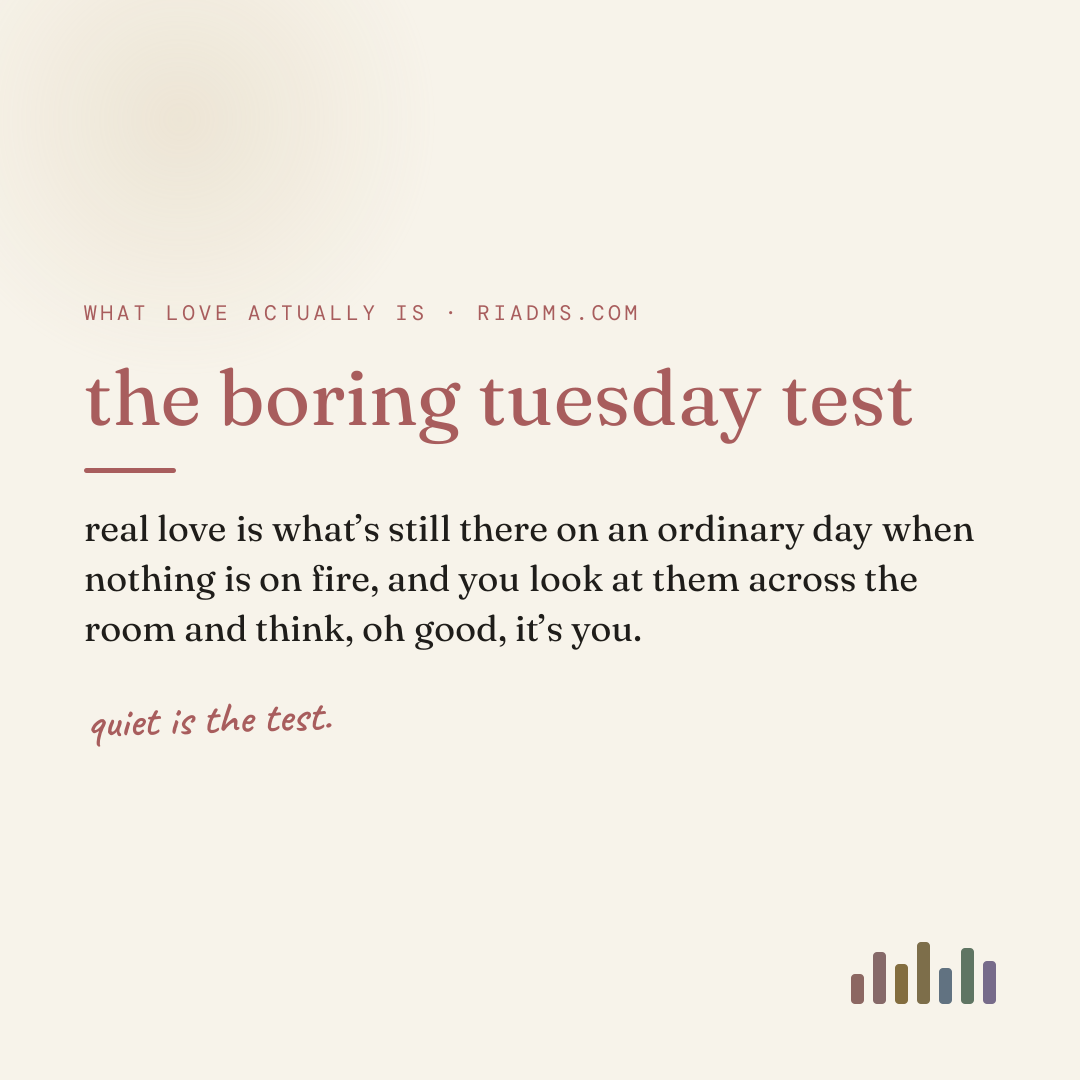
So the test isn’t the date, or the trip, or the big feeling. It’s a completely ordinary Tuesday when nothing is on fire and you look at them across the room and think, oh good, it’s you. conceptcompanionate loveIntimacy plus commitment without the fire, in Sternberg’s model. The calm, chosen, long-haul love people keep mistaking for settling. It’s not the absence of feeling, it’s a different feeling: steady instead of loud.what is companionate love? →Sternberg, triangular theory of love ↗ is not the consolation prize. It’s the thing itself, finally quiet enough to see.
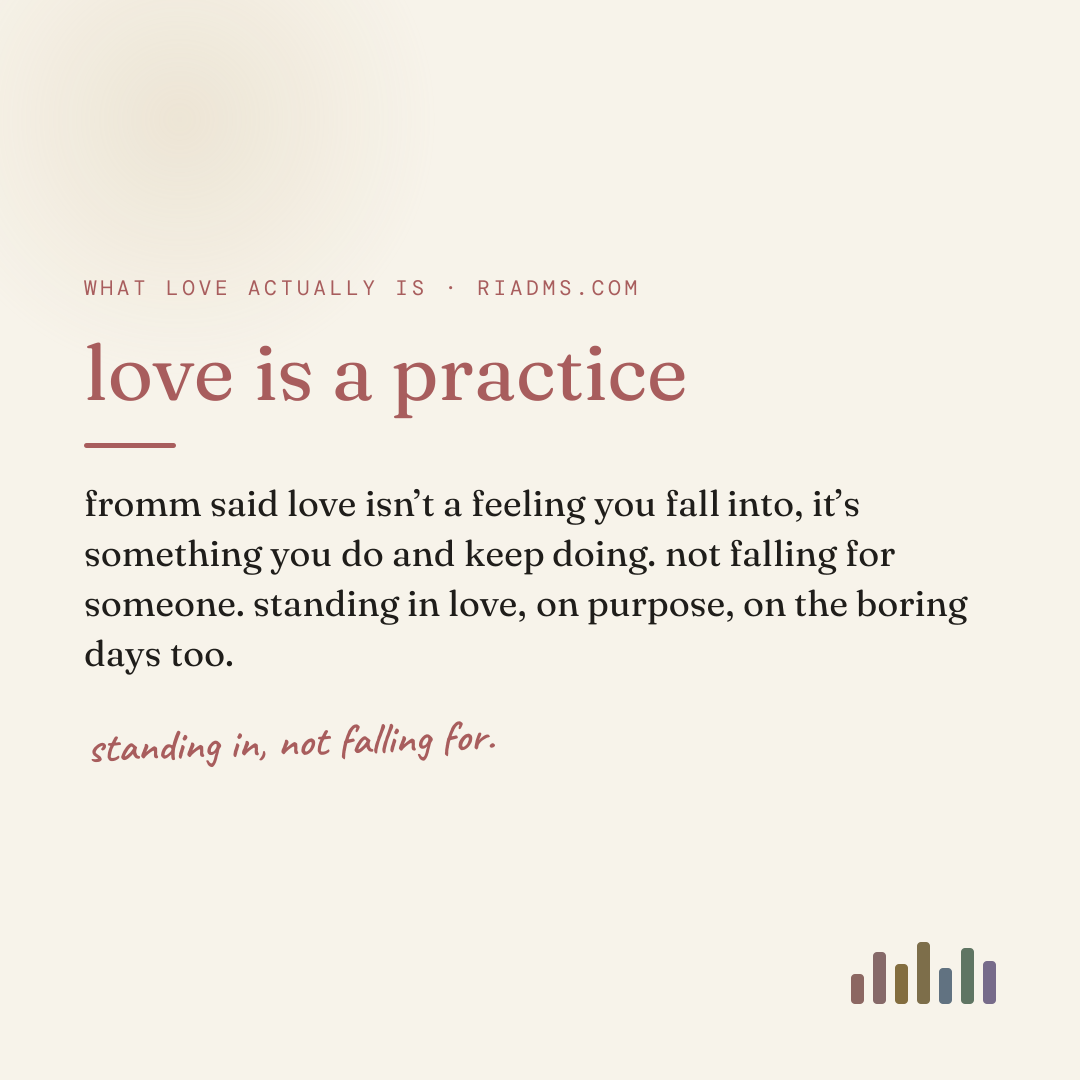
Erich Fromm wrote the cleanest version of this back in 1956, in The Art of Loving. He said we treat love as a feeling we fall into, passively, by accident, when it’s really a practice. Something you do, and keep doing. His phrase was “standing in love,” not falling for it. You don’t trip into the real thing. You choose it, on the boring Tuesday, on purpose.
what this looks like from where I’m standing
I’m asexual. So I never had the chemistry static, the passion spike, the physical pull that most people use as their whole test for “this is real.” Which sounds like a disadvantage. For a long time I thought it was.
But it meant my love was only ever these three things. It calmed me down. It made me want to know the person. And it kept choosing them on the days nothing was happening. I got the signal without the noise. So when I tell you this is what’s left when you strip everything else away, it’s not a theory to me. It’s just all I ever had. And it turned out to be more than enough.
If you want to go further, the one book to read is Fromm’s The Art of Loving, which is short and will quietly rearrange how you think about the whole thing. For the science, Coan’s hand-holding study is the clearest single piece of evidence that a safe bond changes your body, and Acevedo and Aron’s meta-analysis is the kind correction to “passion always dies.” And if you got here still unsure, the counterfeits have their own chapters: comfort, limerence, and the three feelings people confuse for love.
So no. You’re not broken because it doesn’t feel like an emergency. Love was never the emergency. It’s the thing still standing when the emergency is over. Calm, curious, chosen. If that’s what you have, you already found it. It was just quieter than they told you it would be.


