You cannot stop thinking about them. You check your phone before you are even properly awake. You replay the last thing they said on a loop, you rehearse the next conversation forty times in the shower, and one dry text can flatten your entire day. And everyone around you keeps calling it love.
It might not be love. There is a specific name for this exact state, and it is not the same thing as loving someone. And once you can tell the two apart, you stop setting your whole nervous system on fire for people who were never actually right for you.
I am asexual, so I do not get the physical pull most people use to sort “this is real” from “this is chaos.” I had to learn the difference another way. So let me hand you the difference.
the word nobody gave you
It is called conceptlimerenceAn involuntary, obsessive state that feels like love: intrusive thoughts, a hunger for reciprocation, and a charge that gets stronger with uncertainty and weaker with security.what is limerence? →Tennov, Love and Limerence ↗, and it has an author. A psychologist named Dorothy Tennov coined it in 1979, in a book called Love and Limerence, after interviewing hundreds of people about what being “in love” actually felt like from the inside. What she found is that a huge amount of what we call falling in love is really one very specific, very intense mental state. She named it so it would stop hiding inside the word love.
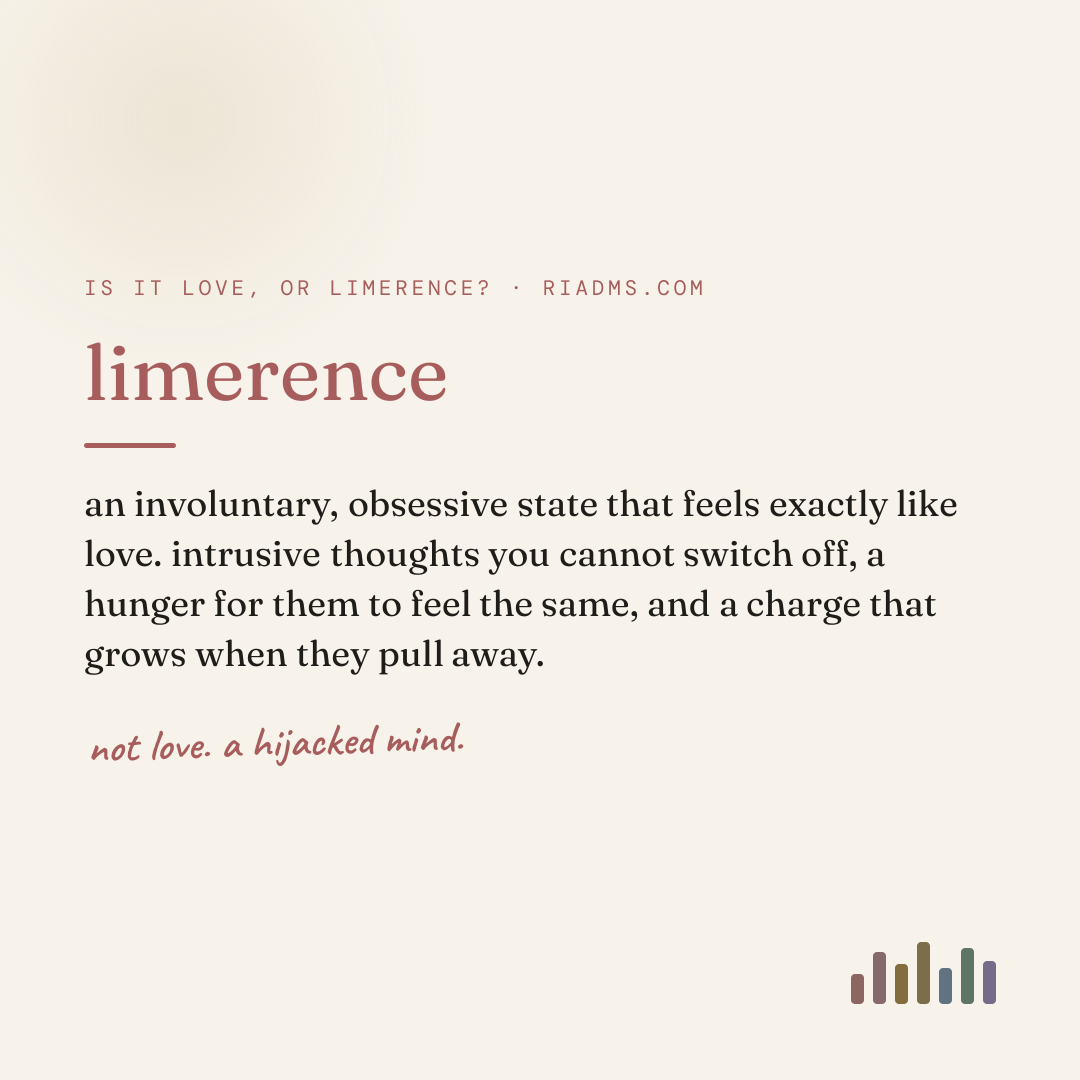
Here is how she described it. The single most important feature is intrusive thinking. Not thinking about someone a lot because you like them. Thinking about them against your own will. The thoughts invade. You do not choose them and you cannot switch them off. On top of that there is an aching need for them to feel the same way, a total dependency on the tiniest signals from them, and a constant background dread that they will reject you.
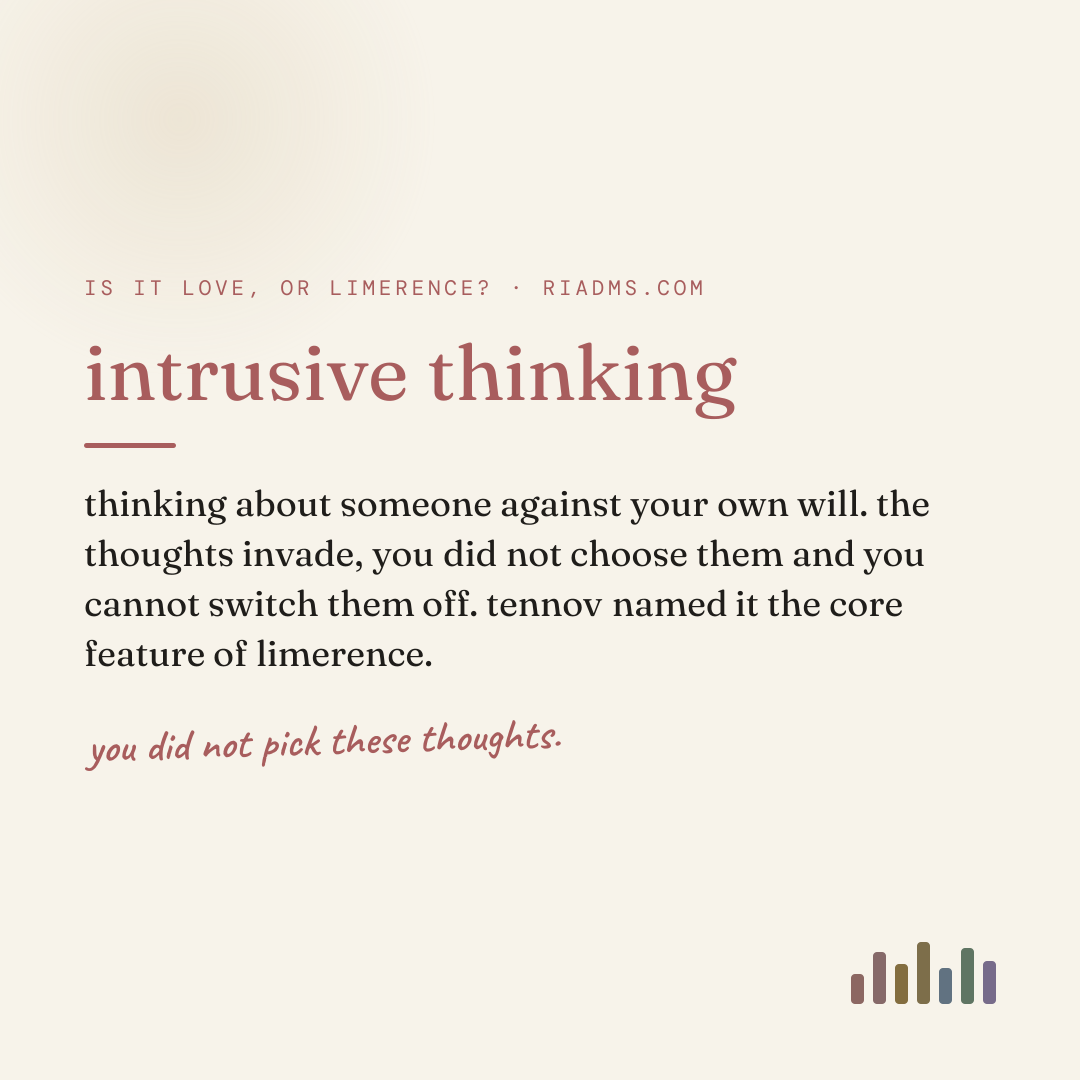
That is not a description of love. That is a description of a mind that has been hijacked. And Tennov’s whole point was that we have been calling the hijacking “love” this entire time.
come think with me
one letter a week.
the word for one feeling you’ve had but couldn’t name, and why it works that way. the same thing you just read, in your inbox, once a week.
- one letter a week, about a ten minute read
- all nine printable workbooks, free
- the research, with its caveats kept in
- hit reply and it reaches me. i read every one
no pressure, no spam, no gatekeeping. unsubscribe anytime · riadumitrescu.substack.com
all of this is free and it stays free. if it gave you a word you didn’t have, you can buy me a coffee.
it’s not love, it’s your reward system on fire
So what is actually happening in there. This is where it gets almost funny, because the science lines up scarily well with the feeling.
In 2005, a team led by Arthur Aron and Helen Fisher put people who were newly, intensely in love into an fMRI scanner and showed them a photo of the person. The parts of the brain that lit up were not soft, warm, “I cherish this human” regions. They were the ventral tegmental area and the caudate nucleus. The dopamine reward system. The exact same motivation-and-craving circuitry that drives wanting, chasing, and, yes, addiction. So early intense love does not run on affection. It runs on wanting. It is a goal-pursuit system, which is why it feels less like peace and more like hunger.
And it gets stranger. Back in 1999, a researcher named Donatella Marazziti found that people who had recently fallen in love had a serotonin marker dropped about 40% below normal. Here is the part that should stop you. It was the same drop she measured in people with obsessive compulsive disorder. On that one marker, the people in love were indistinguishable from the OCD group.
I have to be honest with you, the way I want people to be honest with me. That was a small study. It measured a proxy in the blood, not your actual brain, and the effect faded on its own after about a year to eighteen months. So I am not going to tell you love gives you OCD. But the obsessive quality you feel is not a character flaw you invented. Something real is going on down there. Limerence looks, chemically, a lot more like craving and compulsion than like calm.
Think of it like a fire alarm going off in an empty kitchen. The alarm is deafening, your whole body reacts, it feels like an emergency. But the volume of the alarm is telling you nothing about whether there is an actual fire. Intensity is not evidence.
the two loves, and only one of them stays
Here is the framework that makes all of this click, and it has been in the research for decades. Psychologists like Elaine Hatfield and Ellen Berscheid split love into two kinds.
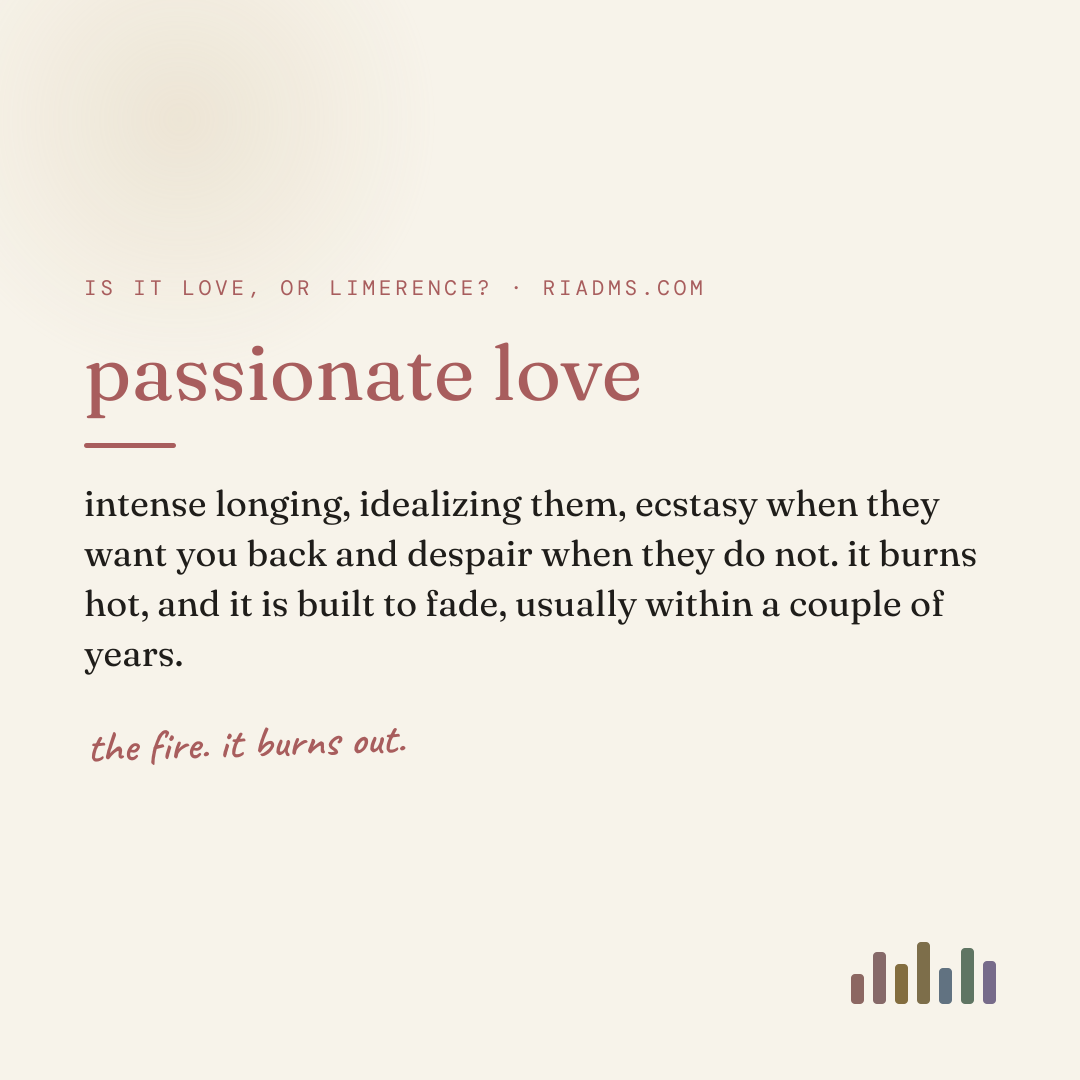
Passionate love is that state of intense longing, idealizing the person, ecstasy when they reciprocate and despair when they do not. Companionate love is quieter. Affection, trust, deep intimacy, the feeling of your life being genuinely tangled up with someone’s. Limerence is basically passionate love turned all the way up, past the point of comfort, into obsession.
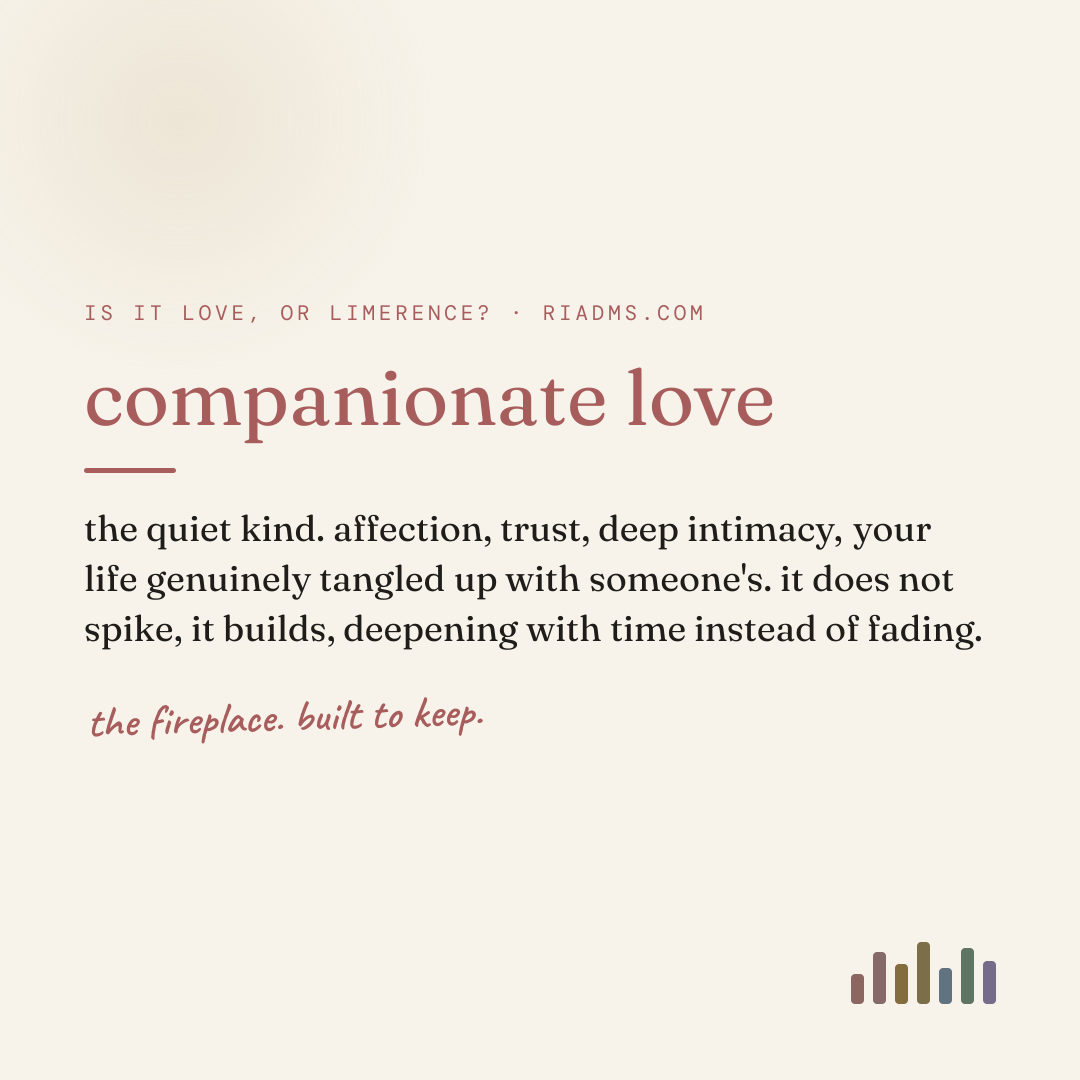
And here is the thing every study keeps finding. Passionate love fades. It is designed to. It burns hot and it burns out, usually within a couple of years, which fits Tennov’s estimate that limerence itself tends to run its course in about eighteen months to three years. Companionate love does the opposite. It builds. It deepens with time instead of thinning out.
So the cruelest mistake you can make is choosing a person based entirely on the passionate, limerent spike, and then feeling betrayed when it drops, when it was always going to drop. That drop is not the death of love. That drop is the test that tells you whether there was any companionate love underneath the fire, or just the fire.
the tell
Once you know limerence needs the fire kept guessing, you can spot it in ten seconds. Here is the part that gives it away, and once you see it you cannot unsee it: the feeling gets stronger when they pull away, and weaker when they come closer.
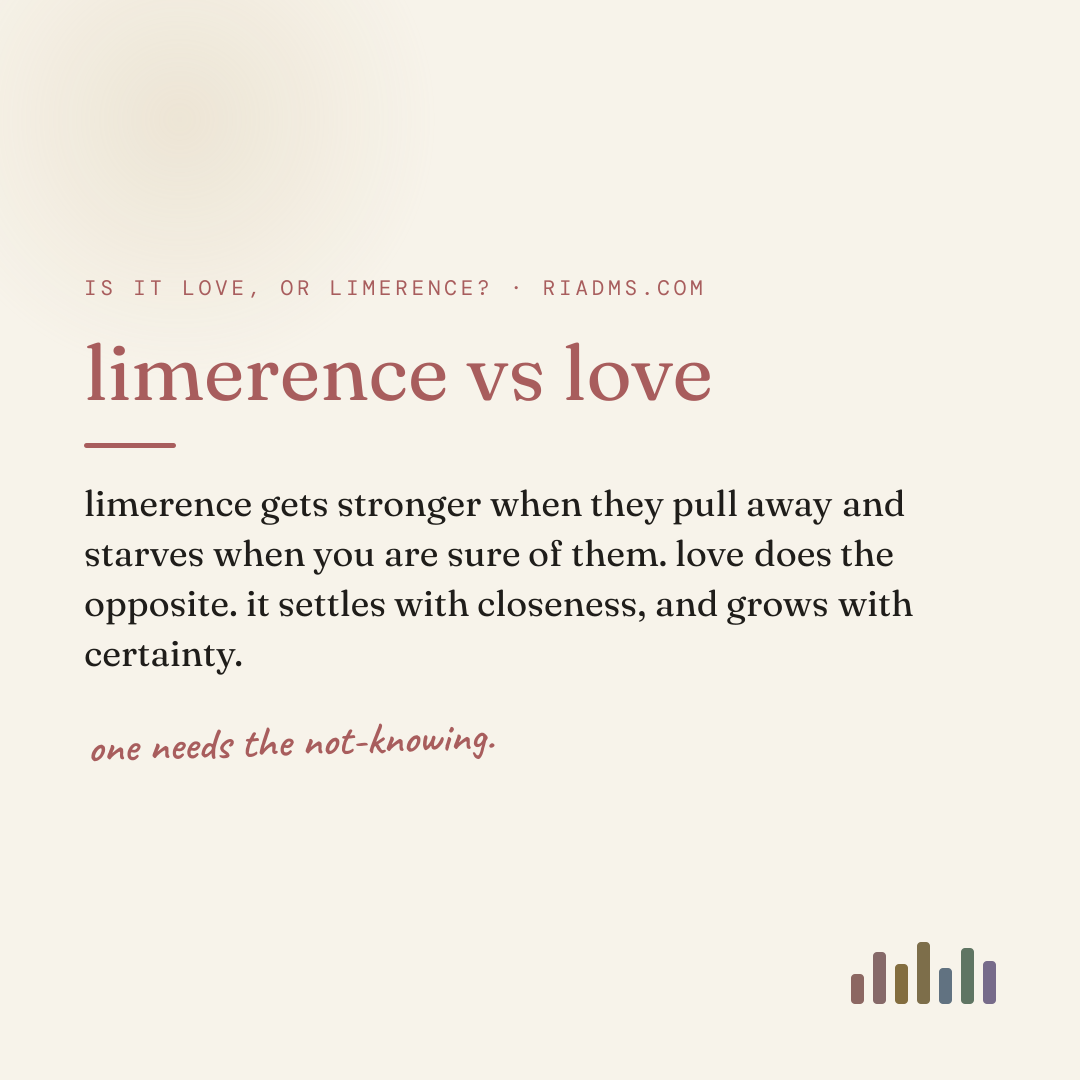
Love does not work like that. Love gets stronger with proximity. Limerence needs the wound kept open, it feeds on the not-knowing, and it starves the moment you are sure of someone. That is why it so often burns hardest for people who are a little unavailable, a little inconsistent, a little out of reach. The obsession is not measuring how right they are for you. It is measuring how much they have left you guessing.
the test
This is the one I run, and it takes about ten seconds.
Imagine they are yours. Completely. No chase, no ambiguity, no possibility of losing them. They text back immediately, every time, and they are certain about you. Now, honestly: do you still want them?
If the picture of certainty is warm, and you want to walk straight into it, that is love, or the beginning of it. If something goes flat the instant the uncertainty is removed, if the fantasy loses its charge the second there is nothing left to win, then what you have is not love. It is a nervous system in distress that has attached itself to a person.
why it keeps happening to you
If this is your pattern, it is not a character flaw. People with conceptanxious attachmentAn attachment style marked by a fear of abandonment and a pull toward inconsistent partners. The obsessive-thought machinery that limerence loves to borrow.what is anxious attachment? →Attachment theory ↗ are more prone to limerence, because the obsessive-thought machinery is already running. Limerence just hands it a target.
Which means the person is almost incidental. That is the brutal part. You are not obsessed with them. You are obsessed with resolving the uncertainty they happen to represent.
what this looks like from where I stand
Being asexual changed how I see all of this, because I never got handed the usual shortcut. Most people use physical pull and butterflies as their proof that something is real. I do not get those in the same way, so I could not lean on them, which sounds like a loss but was actually a gift. It meant I had to build my sense of “is this real” out of something other than intensity. And once you stop trusting intensity, limerence loses almost all of its power over you, because intensity was the only card it had.
The person I actually built a life with, I was not limerent about. There was no fever. It started as a friendship, slow and clear and a little boring by movie standards, and the feeling grew instead of spiking. For years I thought that meant it was lesser. It is the opposite. It meant it was companionate from the start. It meant there was never a fire to burn out, because it was never a fire. It was a fireplace. Built to be kept.
Real love is what is still there on the ordinary Tuesday when the obsession has gone quiet and you look at the person and think, oh good, it is you. Limerence could never survive a quiet Tuesday. Quiet is exactly what it cannot tolerate.
keep reading
If you want the whole map, start with the book that named it: Tennov’s Love and Limerence, which is where intrusive thinking, the ache for reciprocation, and the eighteen-month burn all come from. Then read the Aron and Fisher fMRI study if you want to watch the dopamine reward system light up in real people. And if your version of this runs on the chase and the relief more than the fantasy, the sibling chapter is 3 feelings you’re confusing for love, which pulls apart relief, familiarity, and dependency the same way.
So the next time you cannot stop thinking about someone, before you call it love, ask what it actually is. Is this affection, or is this a craving? Does this person make my nervous system settle, or set it off? When they go quiet, do I miss them, or do I panic? Because if it is the panic, that might not be love. That might be limerence. And limerence is not a sign that you found the right person. It is just a sign that your reward system found a slot machine.
You are allowed to feel it. It is one of the most intense things a human can feel. Just stop letting it be your evidence. The quiet thing, the thing that grows on an ordinary Tuesday, that is the one worth building on.


