Here’s a test you can run tonight. If you only want them at 2am. If you only miss them when the apartment is too quiet, when you’re bored, when the day is over and you just want SOMEONE to text back. Then it might not be love you’re feeling. It might be loneliness, and it just happens to be wearing their face.
This one is hard to catch because loneliness is a very good actor. It aches in the right place. It keeps you up. It makes you reach for your phone and type their name. It has every symptom love has. But it’s pointed at a different target than you think, and once you can see that, you stop handing your whole life to people just to keep a room from being empty.
the 2am test
The whole thing comes down to one honest question. Do I miss THEM, or do I miss not being alone?
Because love is specific. It wants this exact person, their voice, their particular way of being annoying, the one it could not swap out. Loneliness is general. It wants a person. Any person. Whoever happens to be available to fill the silence tonight. And here’s the tell: if you’re honest and almost anyone warm and kind would do the job just as well, then it was never really about them. It was about the empty room, and they were just standing in it.
That’s not an accusation. It’s a relief, actually. Because “I’m lonely” is a much more solvable problem than “I’m in the wrong love,” and it doesn’t require this one particular person to fix it.
come think with me
one letter a week.
the word for one feeling you’ve had but couldn’t name, and why it works that way. the same thing you just read, in your inbox, once a week.
- one letter a week, about a ten minute read
- all nine printable workbooks, free
- the research, with its caveats kept in
- hit reply and it reaches me. i read every one
no pressure, no spam, no gatekeeping. unsubscribe anytime · riadumitrescu.substack.com
all of this is free and it stays free. if it gave you a word you didn’t have, you can buy me a coffee.
loneliness is hunger, not love
The person who explained this best spent his whole career on it. John Cacioppo founded the field of social neuroscience, and his central finding was that loneliness is not a mood or a character flaw. It’s a biological alarm. The same class of signal as hunger and thirst. It evolved for exactly one job: to make being disconnected feel bad enough that you go and reconnect. With people. Any people.
So mistaking loneliness for love is like mistaking being hungry for craving one specific meal. When you’re starving, everything looks delicious, and it would be a mistake to marry the first sandwich. The ache is completely real. Your body is not lying to you that it needs something. It’s just not telling you it needs THEM. It’s telling you it needs connection, and connection is a wide word. Friends count. Family counts. A community counts. The alarm doesn’t specify a romantic partner. You do that part, usually because a partner is the only kind of closeness our culture actually respects.
the thing that actually traps you
There’s a sharper, more specific version of this, and it has a name in the research. It’s not loneliness exactly. It’s the fear of being single.
In a 2013 study, the psychologist Stephanie Spielmann and her colleagues found that people high in fear of being single will settle for less. They show romantic interest in less responsive, less available partners. They stay in relationships that aren’t working. They cling to exes who already left. Not because they love those people, but because being with them beats the thing they’re actually scared of, which is the empty room.
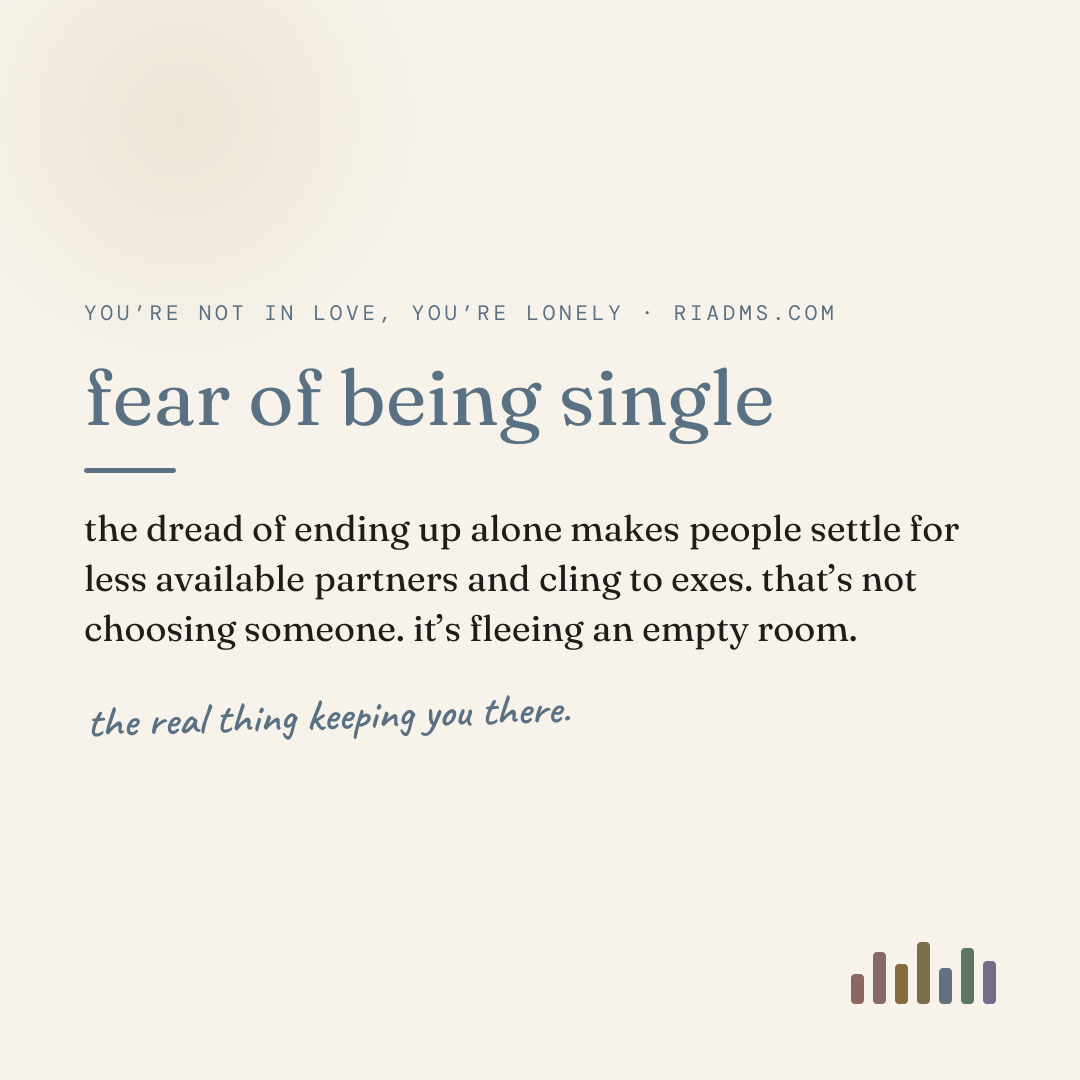
That is not choosing someone. That’s running from something. And a person you’re clinging to as an escape from your own solitude never gets to be fully seen, because you’re not really looking at them. You’re looking past them, at the alternative you’re avoiding.
I want to be careful here, because the honest version of the research points at fear of being single specifically, not loneliness in general. But they rhyme. Both are your nervous system trying to get you out of the quiet as fast as possible, and both will happily talk you into calling the nearest exit “love.”
why I had to learn this early
I’m asexual, so I never got the obvious signpost everyone else uses to sort this out. Most people can at least ask “do I want them, physically,” and get a clear yes or no that tells them something. I don’t get that reading. So I had to get good at a harder question: do I actually want THIS person in my life, or do I just not want to be alone tonight?
Untangling “I want company” from “I want you” turned into a kind of survival skill for me. And honestly it made me better at love, not worse. Because the 2am test is the only tool I had, I use it on everything. And it turns out most people would benefit from running it at least once.
If you want the fuller picture, Cacioppo and William Patrick’s Loneliness is the book that reframes the whole feeling as a signal to listen to rather than a flaw to hide. Spielmann’s research on the fear of being single is the sharpest thing on why we settle. And because loneliness is so often the real problem hiding behind a love question, the friendship and loneliness chapters are worth as much here as the love ones. If the feeling turns out to be about them after all, here’s what love actually looks like.
So before you call it love, try getting lonely on purpose for a minute. Sit in the quiet instead of texting your way out of it. Then ask if you still want them, or if you just wanted the quiet to stop. If it’s them, beautiful. If it’s the quiet, that’s okay too. You don’t need a person. You need to not be alone. Those are very different things, and telling them apart is how you stop giving your life to the wrong one.


