Rom-coms keep lying to us. The airport chase, the kiss in the rain, the boombox held over the head, the song written for you. They told us that love in a movie is a series of enormous gestures. Then you look at your own relationship and it isn’t like that. Nobody is sprinting through a terminal. Nobody is planning a grand gesture for months. And it’s easy to conclude that your relationship just isn’t as magical as the ones in the movies and the books.
What I don’t like about movies and books is that they frame romance as something big and rare. One all-consuming, explosive moment. Which means an ordinary Tuesday where nothing happens doesn’t feel romantic to us. The research says the opposite is true in real life. It made me a little sad to read, honestly, but it makes a lot of sense, and it changed how I think about my own relationship.
the small stuff is the romance
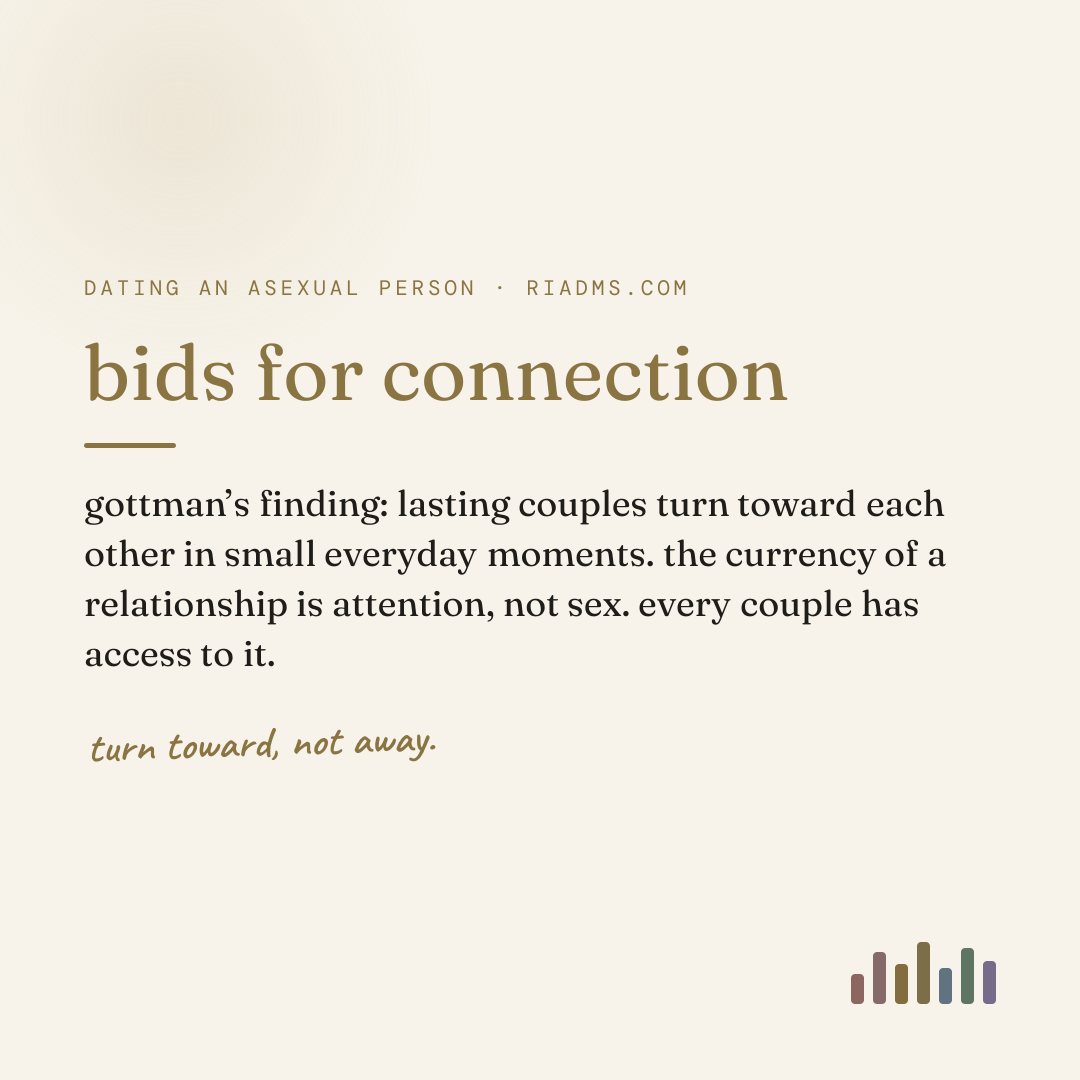
The psychologist John Gottman has studied couples in his lab for decades, and he found that love is built on tiny moments. He calls them bids for connection. A bid is “oh my god, look at that bird.” It’s “look at this email.” It’s reaching for each other’s attention. And every time it happens, you either turn toward it or turn away.
This is the part that stopped me. In his book The Relationship Cure, Gottman describes newlyweds who were still together six years later. They had turned toward each other’s bids 86% of the time. The couples who divorced had done it 33% of the time. Same small moments, completely different outcomes.
So the couples who lasted weren’t the ones with the airport moments. They were the ones who turned around when their partner said “that’s such a beautiful bird.” That’s not romance being big. That’s romance being constant.
come think with me
one letter a week.
the word for one feeling you’ve had but couldn’t name, and why it works that way. the same thing you just read, in your inbox, once a week.
- one letter a week, about a ten minute read
- all nine printable workbooks, free
- the research, with its caveats kept in
- hit reply and it reaches me. i read every one
no pressure, no spam, no gatekeeping. unsubscribe anytime · riadumitrescu.substack.com
all of this is free and it stays free. if it gave you a word you didn’t have, you can buy me a coffee.
the montage is the real part
Now the actual rom-com scenes. The couple trying pottery. The couple stuck in the library together. The two of them doing a strange task neither has done before, failing at it, being awkward, and looking at each other. Sometimes it feels like that’s the entire plot. And it turns out it makes a real difference in real life.
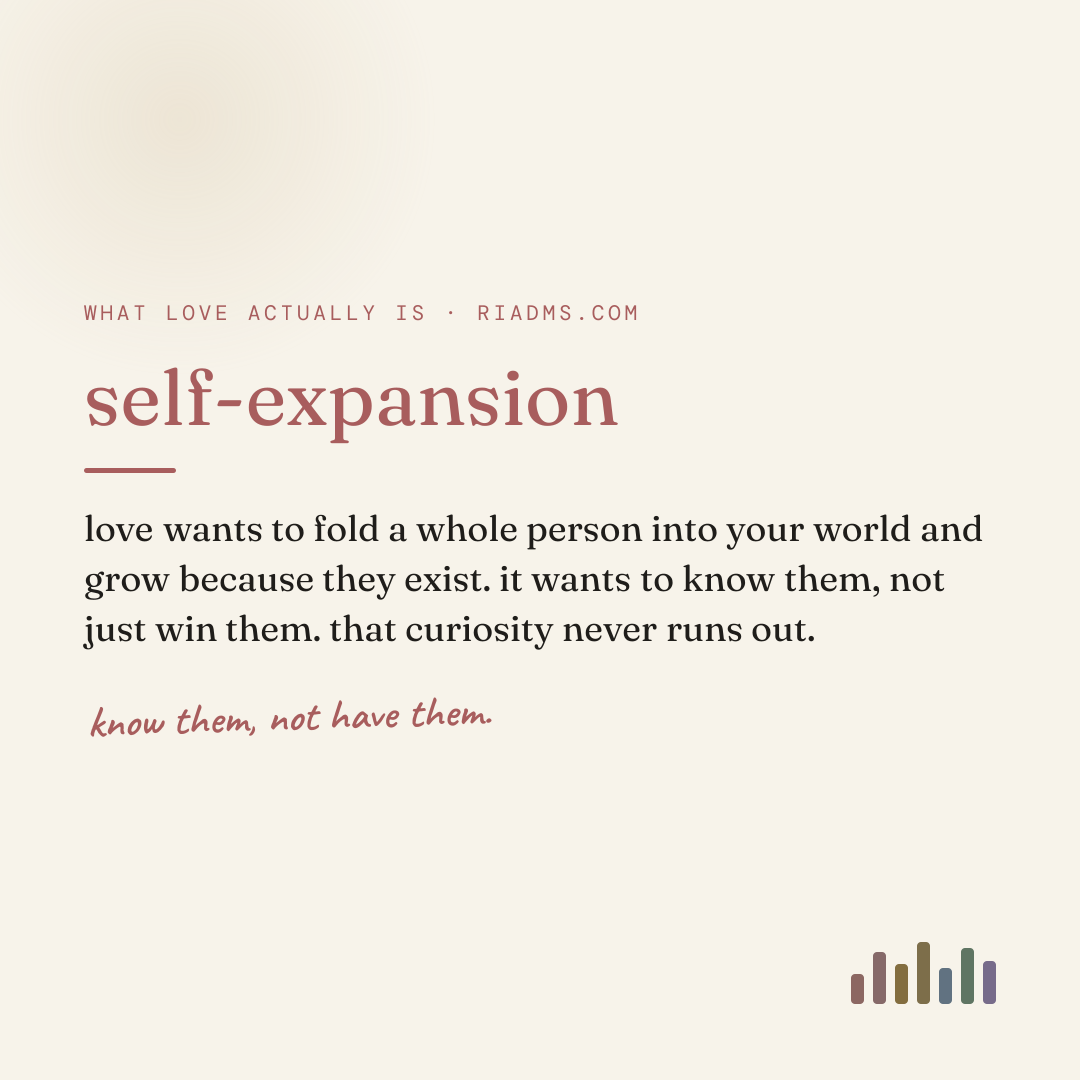
In 2000 Arthur Aron and his colleagues had couples do a task together. One group did something pleasant and ordinary. The other did something new and a bit hard. They were tied together and had to get across a gym floor without using their hands. Completely ridiculous. The couples who did the new, slightly awkward thing reported a bigger jump in how they felt about their relationship than the couples who did the easy, nice thing.
The active ingredient wasn’t money, and it wasn’t romance. It was novelty. Something new, done together, that’s a little bit hard.
Researchers call this self-expansion. It’s the feeling of your world getting bigger because the other person is in it. Doing something new together gets bundled into how you feel about them. So the montage isn’t filler. It’s kind of the romance.
The lesson is stupidly easy, and I don’t know why it’s so hard in real life. Stop doing the same dinner. Take the class. Get lost in a new city. Try a sport you’re both going to be bad at, and be bad at it together.
the ending decides the memory
There’s something in psychology called the peak-end rule, from the work of Daniel Kahneman. When we look back on an experience, we don’t remember the average of it. We mostly remember two things, the most intense moment and the ending. The boring middle evaporates.
It was studied on specific experiences, not on relationships, but I’m applying it to everything. The story you carry from a date or a night together is mostly its peak and its end. Which means you have way more control over your memories than you think.
A whole amazing evening that ends in a bad talk in the car gets filed as a bad night. The same evening that ends warm, with the two of you happy and looking at each other, gets filed as a good one. Same hours, different ending.
So end things well on purpose. I know that’s hard to picture. But you can stop before you both get frustrated. You can notice when the other person is tired and end it there. Spend the time together when you’re both at your best, and when it’s clearly going downhill, know that you can take a rest from each other.
warmth during the fight
Gottman found something else. In stable couples, even during an argument, the positive moments outnumbered the negative ones by five to one. Not because they fought less. Because they kept the warmth going while they fought.
We’re taught that a fight has to be huge, toxic, screaming at each other, because that’s probably how a lot of us were raised. But a joke in the middle of an argument, not taking each other so seriously even when the topic is serious, a hand on the arm, “I’m on your team, I’m just annoyed” or “I’m just tired.” That makes even a fight feel like you’re still with each other, not against each other.
you’re co-writing the story
A relationship isn’t only what happened to you. It’s also how you tell it.
Gottman’s team listened to couples tell the story of their relationship. They listened for whether people said “we” or “I,” whether they spoke about each other with fondness, and whether they did something he calls glorifying the struggle. That means framing the bad times as the things that bonded you, not as proof the relationship is broken. How couples told their story tracked with whether they stayed together.
The couples who see themselves as a team look back at their rough patches and think, look what we survived. They’re the ones who lasted. That’s almost word for word what a romance plot does. It takes two people and a mess and tells a beautiful story about it.
So you’re not only living inside your relationship. You’re co-writing it, all the time. At dinner with your family. Between the two of you. “We were such a disaster when we met, and look at us now.” It’s cute, and it’s also you writing each other as the leads.
what’s under the love languages
I looked into the five love languages, the ones that go viral. It turns out they don’t hold up the way everyone treats them. Most people want all five.
What’s underneath is simpler. Different people want different things from a relationship. For me it might be deep conversations, and I need those for it to feel like a romance. For you it might be being hugged a lot. It might be needing space sometimes, and needing the other person to understand that it’s not about them. Figuring out what your partner needs, and what you need, is attention again. And consistent attention is what holds a relationship together.
why I made this
I’ve been reading a lot of rom-coms recently, because I think I might write a book. And it made me think about my own relationship.
At the beginning we had a lot of rom-com moments. We were in the honeymoon part, obsessed with each other, wanting to spend all our time together. Now we’ve settled into a steadier pace. We already know basically everything about each other, even though we change every day. It’s not the same as the beginning, which is perfectly normal, and it shouldn’t be. But we don’t go out of our way to make those small sparky moments any more.
So I read the research to change that, for both of us. Our relationship can be romantic if we want it to be. The only thing stopping us is us. Four things. Turn toward the small stuff, so when one of us is excited about something, the other one actually pays attention. Add novelty, things we’re both bad at. End the night or the moment warm, and don’t end it when we’re both struggling. We don’t have to spend the whole day together, only the moments we have energy for. And tell our story as a team, not as two people struggling to be together.
Take away the sparks and the chemistry, which fade in a few years or less, and rom-com love is paying close attention to someone on purpose. The good news is that anyone can do that. If you’re curious about the person in front of you, you can do it forever. It doesn’t have to feel like a lightning bolt. But when you pay someone full attention and they pay it back, it kind of does.
And you can do this in friendships too. It’s just as important there.
Tell me in the comments under the video if you’ve tried any of this, in a relationship or a friendship. I’d love this to be a place where we talk about healthy love.