Relief is not love. When someone goes quiet for hours, or days, and then finally texts back, your whole body unclenches. And your brain files that drop as happiness. But it isn’t happiness. It’s your nervous system standing down from a threat it had been bracing against the whole time they were gone.
That’s the thing nobody tells you. A lot of what we call love is just a feeling with love’s symptoms, pointed at a person. It aches in the right place. It keeps you up at night. It looks exactly like the movies. And it still isn’t the thing. There are three of these impostors, and once you can name them, they stop being able to wear the costume.
one: relief
Start with the texting back, because it’s the most common and the most convincing.
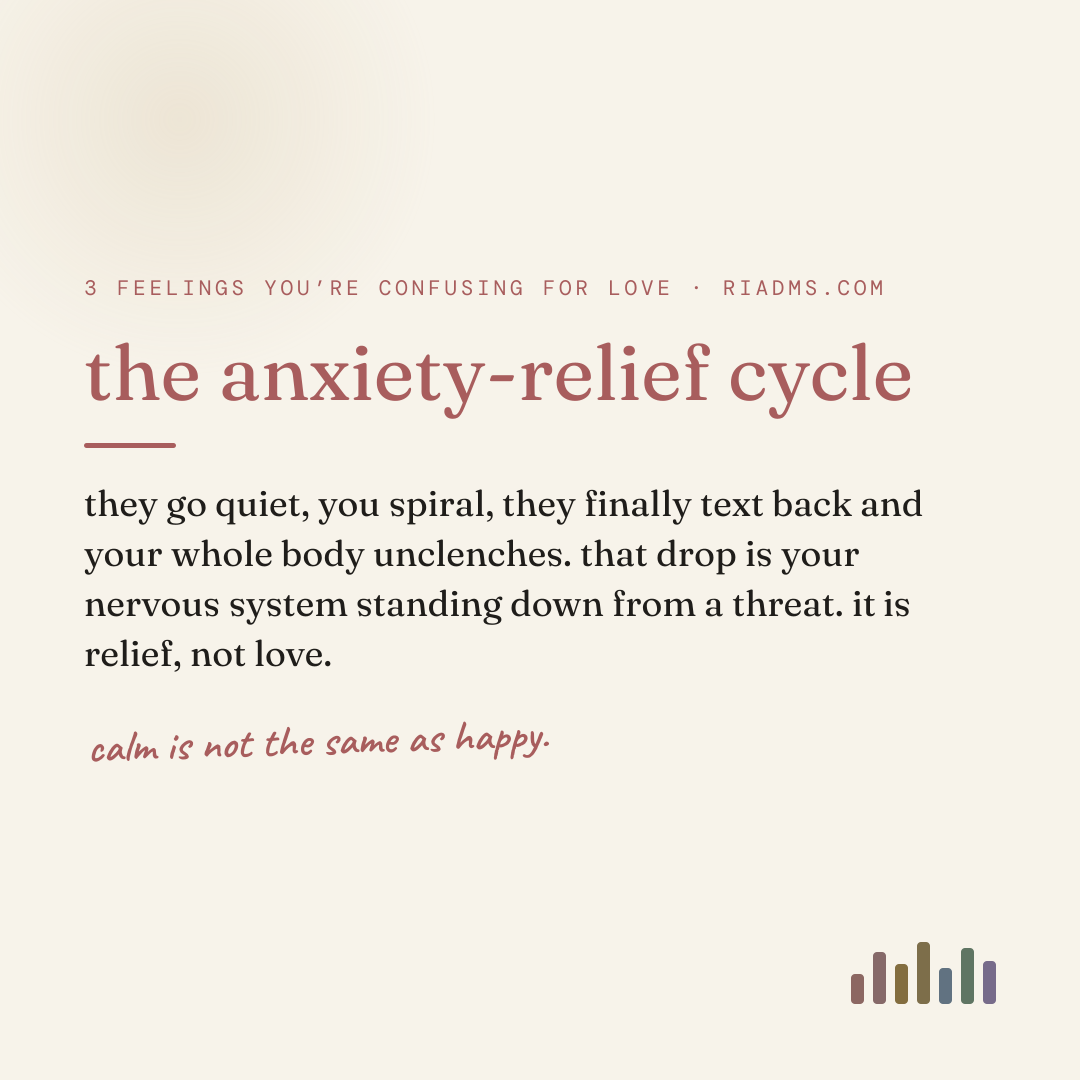
Here’s the mechanism, and it’s not romantic at all. When they pull away, your conceptanxious attachmentAn attachment style marked by a fear of abandonment and a pull toward inconsistent partners. The obsessive-thought machinery that limerence loves to borrow.what is anxious attachment? →Attachment theory ↗ reads it as danger. Not metaphorically. The same system that made you cry when your mother left the room at two years old is the one running now, and it floods you with alarm until the person comes back. When they do, the alarm switches off. That switching-off feels incredible, because anything feels incredible after panic. But you have to see what you’re actually feeling. You’re not feeling them. You’re feeling the absence of the fear they caused.
Psychologists call the reward-from-a-threat-being-removed negative reinforcement, and it’s one of the strongest ways to train a behaviour into an animal. Make the anxiety unpredictable, sometimes they text back in a minute, sometimes not for a day, and you’ve built a slot machine. The intermittent jackpot is the most addictive pattern there is. If the relief when they finally show up is the biggest feeling in the relationship, that’s not a sign of how much you love them. It’s a sign of how much they scare you.
This one has a whole chapter of its own, because when the ache runs on uncertainty it has a name. If the wanting gets stronger the less sure you are, go read is it love, or limerence? next. The tell is the same one every time: love calms down when you’re certain. The impostor deflates.
come think with me
one letter a week.
the word for one feeling you’ve had but couldn’t name, and why it works that way. the same thing you just read, in your inbox, once a week.
- one letter a week, about a ten minute read
- all nine printable workbooks, free
- the research, with its caveats kept in
- hit reply and it reaches me. i read every one
no pressure, no spam, no gatekeeping. unsubscribe anytime · riadumitrescu.substack.com
all of this is free and it stays free. if it gave you a word you didn’t have, you can buy me a coffee.
two: familiarity
The second one is quieter, and it fools the people who’ve been together longest.
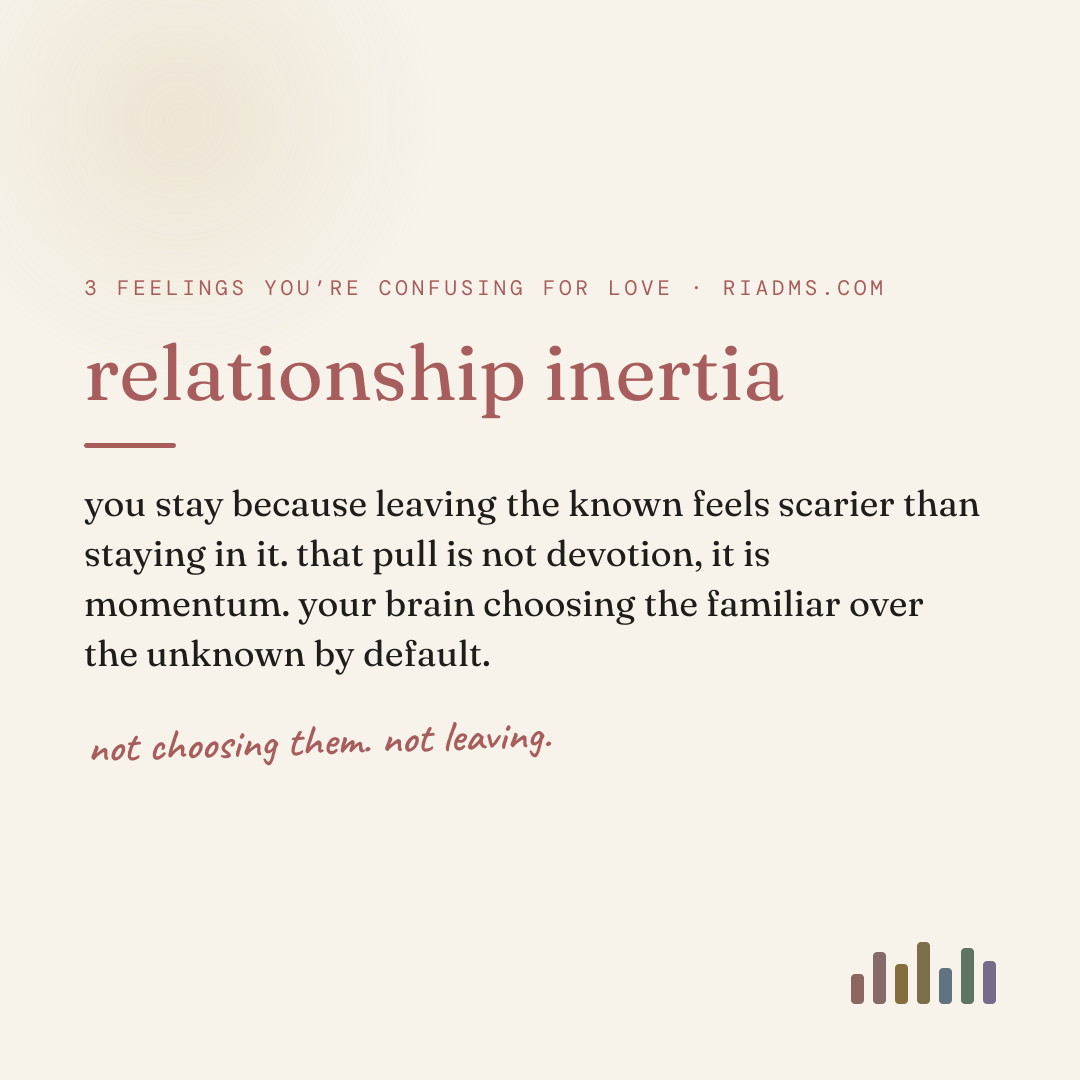
You’ve been with them for years. Leaving feels enormous, unthinkable, like tearing something out. And you read that size as the size of your love. But look closer at what the fear is actually about. It isn’t I can’t imagine my life without this specific person. It’s I can’t imagine my life without the known. Your brain runs a strong status quo bias: it will keep the default long past the point the default is good for you, because the unknown is expensive to face and the familiar is free. The same wiring that makes you reorder the same meal, mere exposure, is the wiring keeping you in the chair. You’re not staying because you want to stay. You’re staying because leaving is a door you’d have to walk through, and the known, even a known that’s gone flat, feels safer than the room on the other side.
That’s not a relationship. That’s inertia. Familiarity is just data. You can know someone all the way to the bottom, every mood and every story, and feel nothing moving.
I want to be careful here, because this is exactly where people burn down something real. Long and quiet is not automatically inertia. There’s a kind of love that deepens into calm on purpose, companionate love, intimacy and commitment without the fireworks, and it is the realest thing there is. The difference isn’t loud versus quiet. It’s whether you’d choose it again knowing everything, or whether you’re just declining to leave. If you want the long version of that fork, it’s in is it love, or just comfort?.
three: dependency
The third one is the one people defend the hardest, because it feels the most like passion.
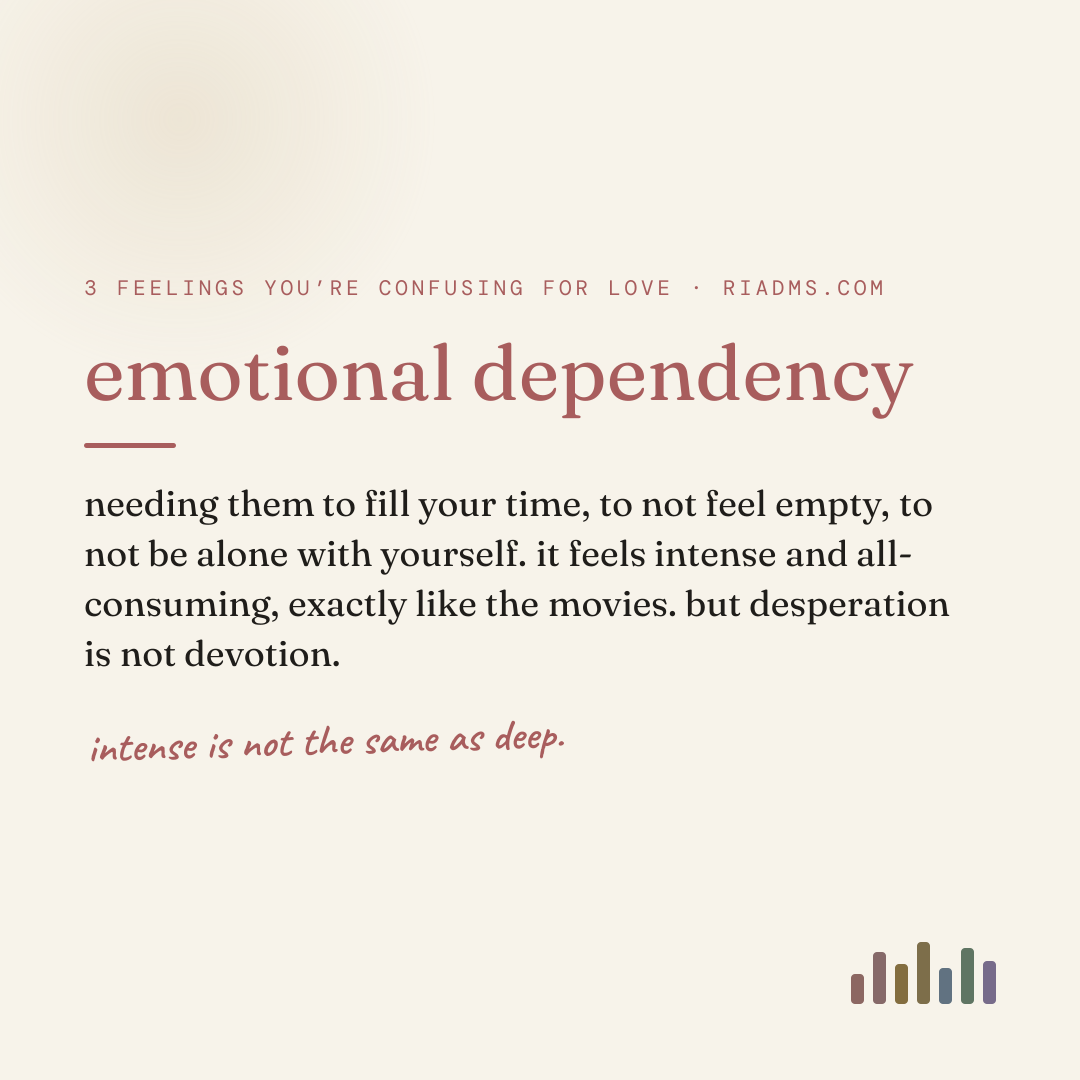
If you can’t be alone. If being without them makes you feel empty, not lonely, empty, like a room with the furniture removed. If the real reason you want a relationship is so there’s someone in the silence, so your evenings have a shape, so you don’t have to sit with yourself. That’s not love. That’s dependency, and it feels intense and total and all-consuming, which is exactly the problem. Movies taught us that all-consuming is love. That the person who can’t eat, can’t sleep, can’t function without the other one is the person who loves the most.
But desperation is not devotion. And need, real need, the kind where the other person is holding you up, tends to keep you somewhere long after it’s stopped being good for you, because leaving doesn’t feel like a choice, it feels like a fall. When your whole steadiness is loaded onto one person, you can’t actually see them anymore. You can only see what happens to you if they go. That’s not a relationship you’re in. It’s a load-bearing wall you’re terrified of removing.
The healthy version has a name too, and it isn’t fusion. It’s conceptresponsive desireSexual desire that arrives in response to arousal or closeness rather than spontaneously. It shows up after you get close, not before. A common pattern, not a dysfunction.what is responsive desire? →Basson, 2000 ↗: two people who could each stand on their own, and lean in anyway.
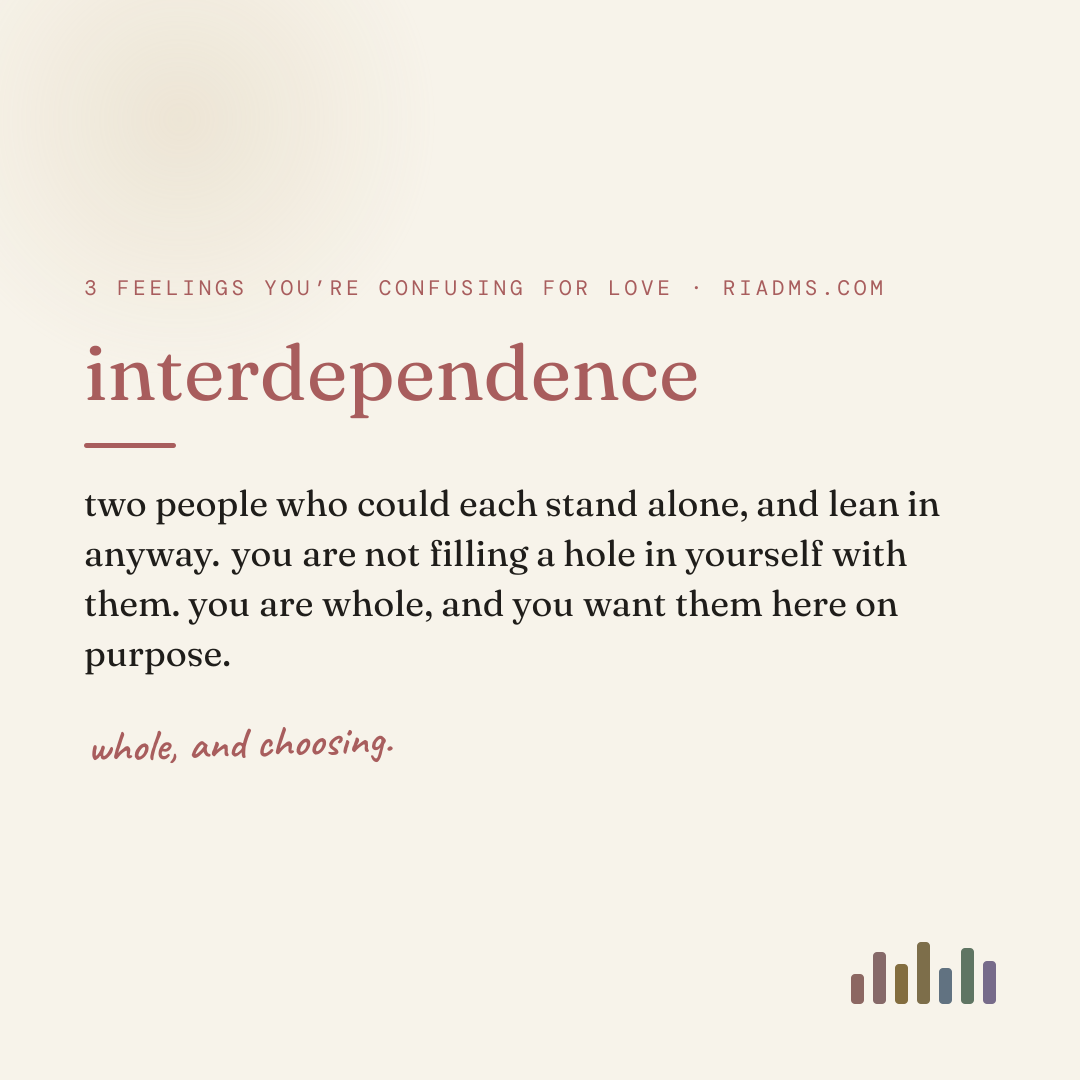
You don’t need them to function. You function. And from that solid ground, you choose them. That turns out to be the whole difference, and the research backs it plainly: relationships are healthiest when they feed your autonomy as much as your closeness. You’re supposed to still be a whole person inside it. If you disappeared into the relationship, that was never the love working. That was the self going quiet.
so what is left
Take relief away. Take familiarity away. Take dependency away. Strip out the fear, the inertia, and the need, and see if anything’s still standing. Because whatever survives that is the actual thing.
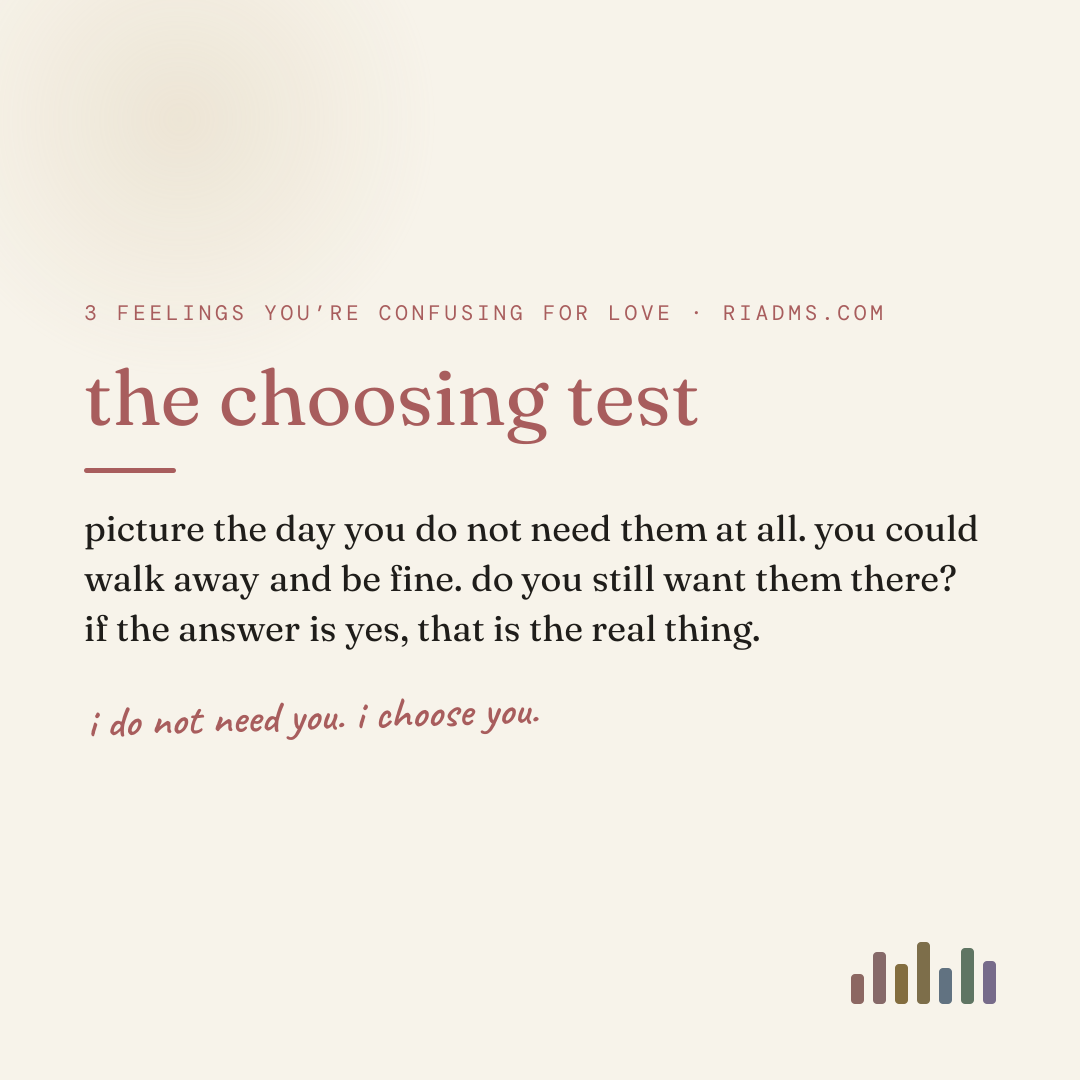
Love is choosing someone on the day you don’t need them at all. The day you’re fine on your own. The day you could walk away and be okay. And you look at them anyway and think: I don’t need you here. I want you here. I choose you here. The wanting, free of anxiety, free of habit, free of the fear of being alone, that’s the real one. Erich Fromm wrote a whole book about this in 1956, and his line for it still hasn’t been beaten. Love is a “standing in,” not a “falling for.” An activity, a choice you keep making, not a thing that happens to you and takes the wheel.
Maybe what’s left after you strip the three impostors isn’t the whole of love. But it’s the load-bearing part. Everything else was your nervous system and your brain doing what they’re built to do, which is keep you safe and keep you attached, and calling it a feeling.
what I notice, as an ace person
I had to learn all of this the slow way, because I don’t get the shortcut most people get.
I’m asexual. I don’t have a body that floods me with a clear physical yes when I look at someone, so I could never use the intensity of what I feel as my instrument, the way most people do. And that turned out to be a strange kind of luck. Because intensity is exactly what all three impostors have in common. Relief is intense. Losing the familiar is intense. Dependency is the most intense of all. If you go by the size of the feeling, they’ll fool you every single time. I never had that gauge, so I had to find a more honest one. Not how much does this hurt when they’re gone, but do I choose this when nothing’s forcing me to. It’s a colder question. It’s also the only one that’s ever been right.
keep reading
If you want to go deeper, the two books to reach for are Attached, which explains the relief loop better than anything, and Fromm’s The Art of Loving for the resolution. And the two sibling chapters are the deep dives on the first two impostors: limerence for when the ache runs on uncertainty, and comfort for when familiarity has you frozen. This chapter is the map. Those are the territory.
So, gently: next time a feeling is loud enough to convince you it must be love, ask what it’s actually made of. If it’s relief, or habit, or need, that’s real, and it’s human, and it isn’t the thing. And if what’s left when you take those away is a quiet, un-panicked I choose you, then you already have your answer. You just needed the words for the difference.

