You’re lying next to someone and you notice, halfway through noticing it, that you’re breathing at their speed. You didn’t decide to. There wasn’t a moment where you thought about it. Your lungs just went and found their rhythm and started keeping it.
That’s the thing nobody tells you about love. It shows up in your body first, and it shows up in the boring machinery: your heart rate, your lungs, your pupils, your stride. Not the butterflies. The plumbing.
I’m asexual, so I’ve had to get good at reading these, because the signal everyone else uses isn’t available to me. No desire to check against. No wanting-them-physically to confirm anything. What’s left is what my nervous system does when he walks into a room, and it turns out that’s most of it.
But I want to do this properly, because the version of this that goes around online is half real research and half things people made up and attributed to research. So here are the six, each one with what was actually measured, and the two places where the popular version has run ahead of the evidence.
1. your heart rates move together
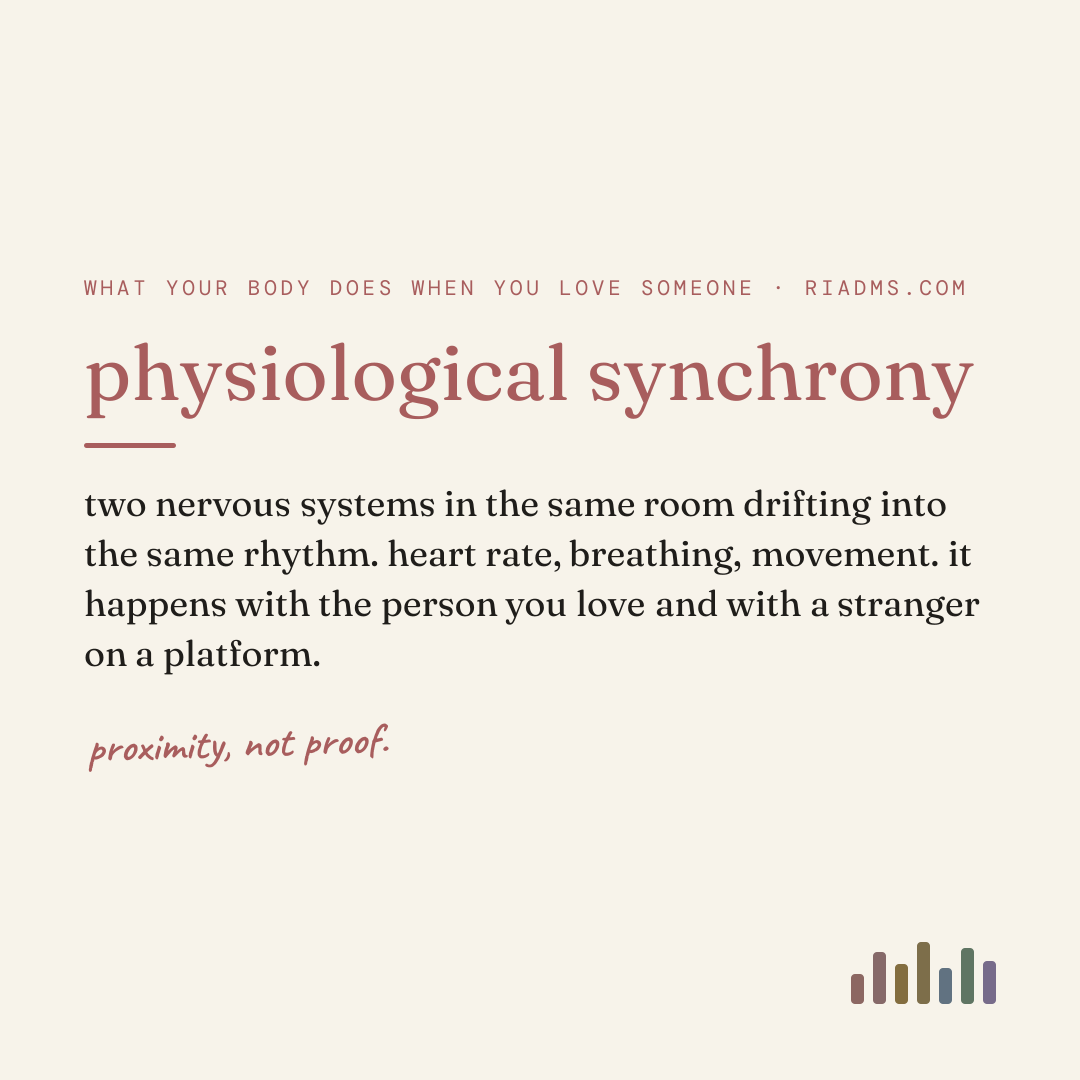
In 2021 a team at Illinois tracked ten older couples at home for two weeks, wearing heart-rate monitors and proximity sensors, doing whatever they normally do. When the two of them were physically near each other, their heart rates moved together. Not identical. Coupled. The correlation was there whenever the distance closed.
What the study did not find, and what gets said about it constantly, is that this doesn’t happen with strangers. There were no strangers in it. Ten couples, no control pairs, and the researchers were careful to say the coupling looked like a property of the interaction rather than of the couple, because it changed from day to day inside the same marriage.
So it’s real, and it’s smaller than you’ve been told. Hold both.
come think with me
one letter a week.
the word for one feeling you’ve had but couldn’t name, and why it works that way. the same thing you just read, in your inbox, once a week.
- one letter a week, about a ten minute read
- all nine printable workbooks, free
- the research, with its caveats kept in
- hit reply and it reaches me. i read every one
no pressure, no spam, no gatekeeping. unsubscribe anytime · riadumitrescu.substack.com
all of this is free and it stays free. if it gave you a word you didn’t have, you can buy me a coffee.
2. your breathing syncs, and it does something
This is the one with the best evidence, and it’s my favourite because it has an actual outcome attached instead of just a correlation.
Twenty-two couples, in a 2017 study in Scientific Reports. One partner got a controlled pain stimulus. The other partner either held their hand or didn’t. When they held hands, the two people’s breathing coupled, and the pain the first person reported went down. And it scaled: the more empathic the partner, the tighter the coupling and the bigger the drop in pain.
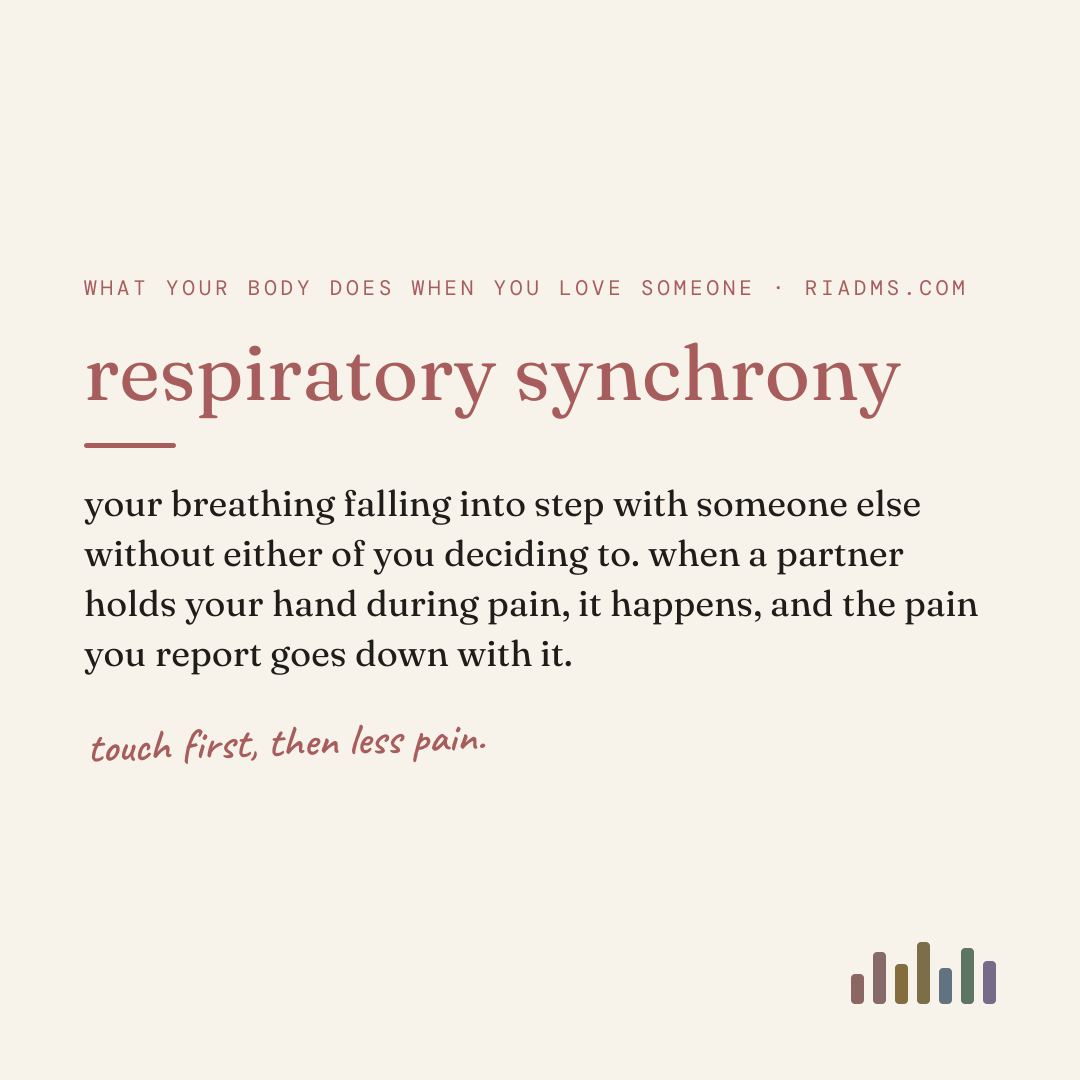
That’s touch doing something measurable to a nervous system that isn’t its own. It’s what wordsensual attractionThe desire for non-sexual physical closeness: holding, cuddling, hand-holding, being tangled up with someone. The touch is complete in itself, not a step toward sex. One of the seven types of attraction.what is sensual attraction? → is pointing at, and it has nothing to do with sex. It’s skin, and a person you trust, and a threat response coming down.
3. you copy them, and it’s not what you think
You lean forward, they lean forward. You touch your face, they touch theirs. This is real and it has a name: the chameleon effect, from Chartrand and Bargh in 1999. People unconsciously match the postures and mannerisms of whoever they’re with, and being mimicked makes the interaction go smoother and makes you like the other person more.
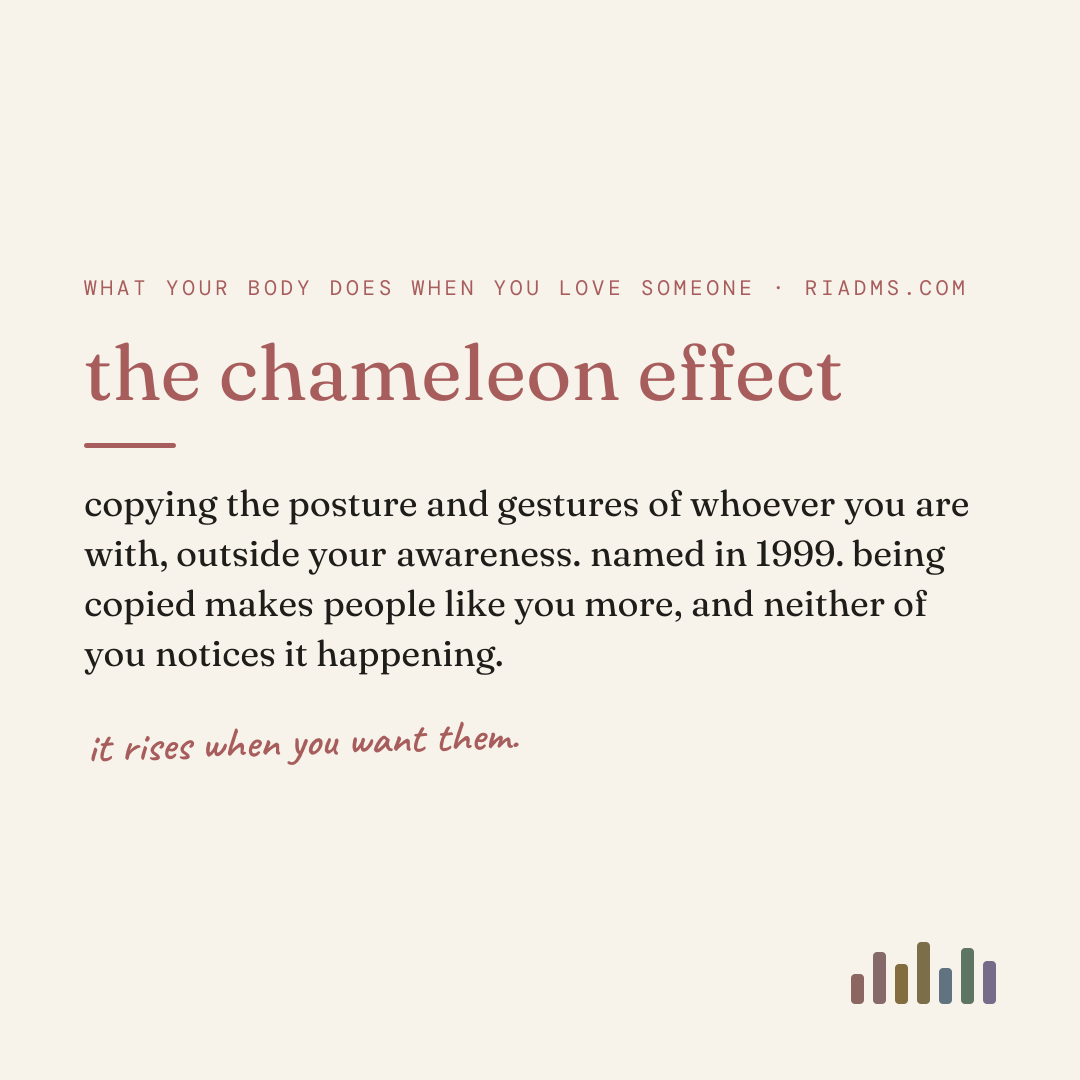
Here’s where the popular version goes sideways, and where I got it wrong in the video. The story is that mirroring rises with closeness, so more mirroring means more love. The follow-up work by Lakin and Chartrand found something more interesting and less flattering. Mimicry goes up when you want to affiliate. And it goes up most in people who have just failed to affiliate with someone else.
So is heavy mirroring the sound of a bond? Sometimes. And sometimes it’s the sound of wanting one and not having it yet.
The other thing I overclaimed is mirror neurons. They’re real, they were found in macaques, and the jump from there to “these are your empathy cells and that’s why you love people” is not something the evidence supports. Gregory Hickok wrote a whole book about it. It’s on the shelf below and you should read it before you repeat the version I gave you.
4. your pupils widen, but not for the reason in the film
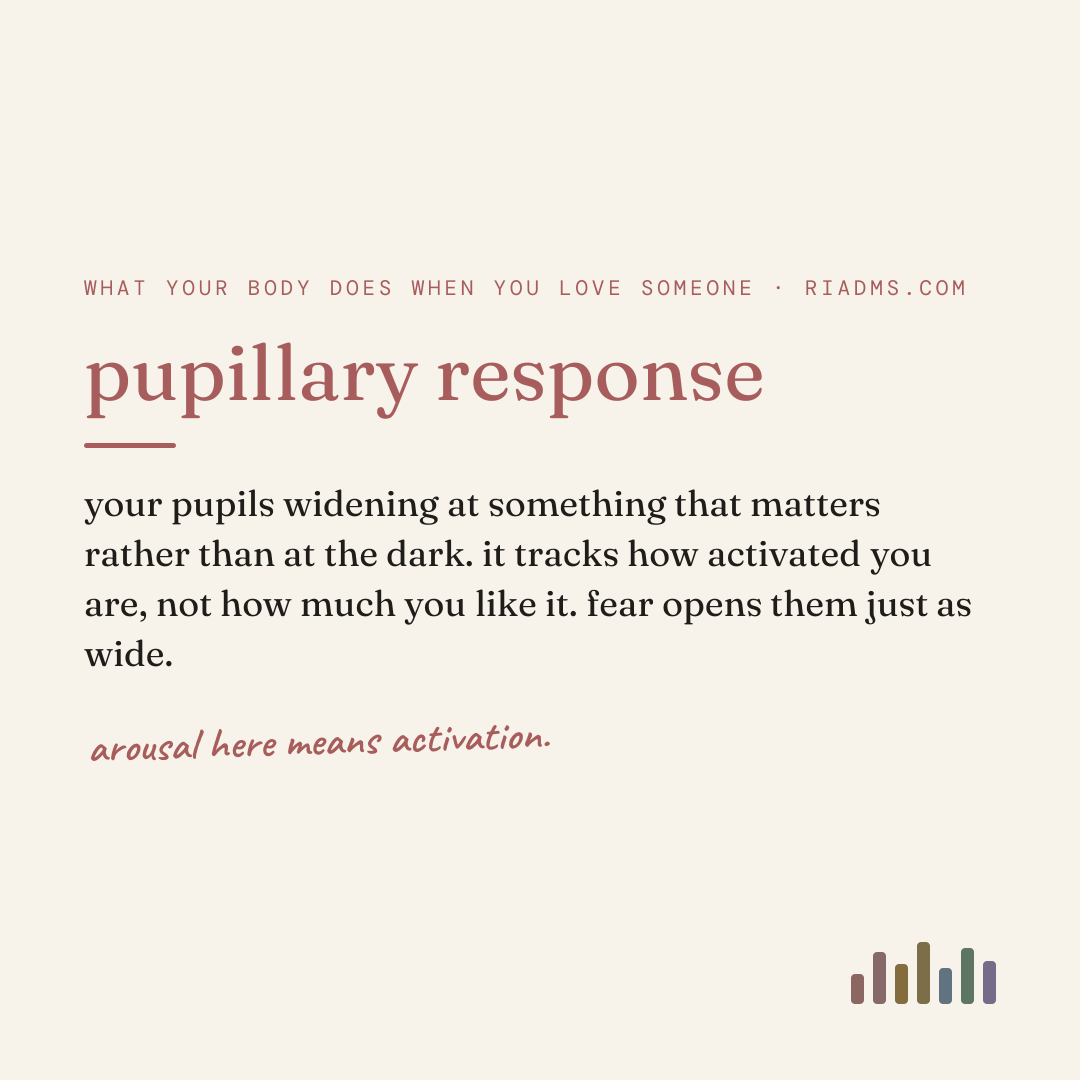
Your pupils respond to light. They also respond to emotional arousal, through the sympathetic nervous system, and this is well established: Bradley and colleagues measured it in 2008, tracking pupil diameter against skin conductance while people looked at emotionally loaded pictures. Arousing content dilates the pupil, and it tracks sympathetic activation rather than pleasantness.
Arousal in that sentence means activation, not desire. One word, two jobs. That’s why this finding gets misread as often as it does. Your pupils widen for something that matters, and mattering includes fear, and surprise, and someone walking through a door.
This is the one I can actually vouch for from the inside. I’ve never had my pupils do anything about attraction. But when he says something I didn’t expect, or laughs in a way I haven’t heard, something opens. My body responds to his presence, not his body. Same mechanism, different input.
5. the cortisol one, which is where most people get it wrong
Early love raises your stress hormone. That part is solid. Marazziti and Canale measured it in 2004: twenty-four people who’d fallen in love within the last six months had significantly higher cortisol than controls who were single or long-partnered. Which is why the beginning feels like anxiety. Neurochemically, some of it is.
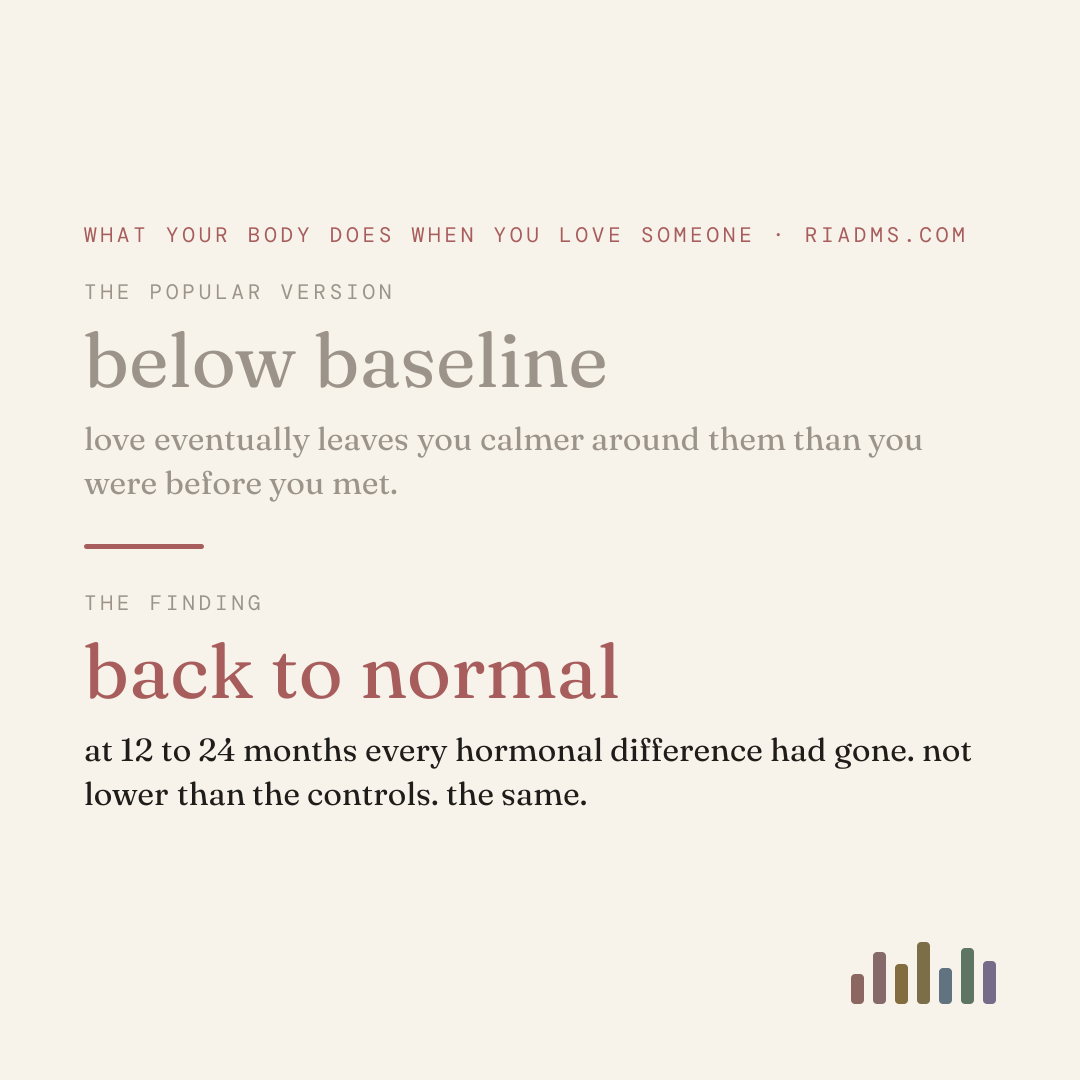
Then the same team re-tested the ones still in the relationship, 12 to 24 months later. Every hormonal difference was gone. Not inverted. Gone. Back to the level of everybody else.
I said in the video that it drops below your baseline, so being with them makes you calmer than you were before you met. That’s not what the study found and I want to correct it here rather than leave it standing. What’s true is smaller and still worth having: the alarm is temporary. The thing that felt like anxiety was the newness, and newness ends.
There is separate evidence that a trusted person damps your threat response, and it’s the best finding in this whole area. James Coan put married women in a scanner and warned them of a possible shock. Holding a trusted hand turned the threat circuits down, and the better the marriage, the further down they went. That’s the calm you’re looking for. It just isn’t a cortisol baseline, and it doesn’t arrive on a timer.
6. you fall into step, and so does everyone
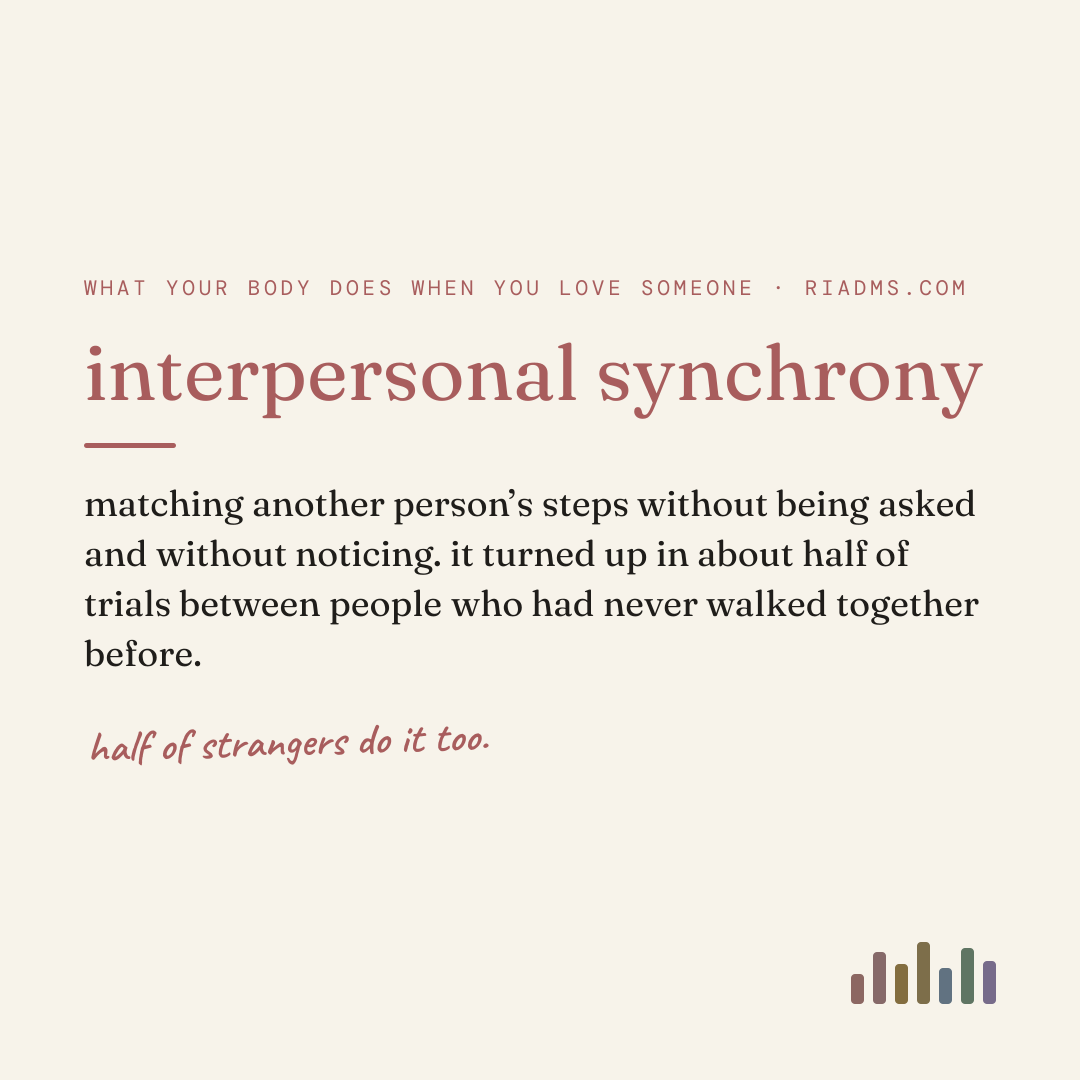
Walk beside someone and your steps drift into phase. It’s the most romantic-sounding one on the list and it’s the one where the evidence is least about love at all.
Zivotofsky and Hausdorff tested fourteen pairs walking seventy metres in 2007. Nobody was told to synchronise and nobody knew what was being measured. Almost half the trials produced synchronised walking, among people who don’t normally walk together. And a 2019 group pulled 348 walking pairs out of ordinary city footage and found phase-locking with and without hand contact. Touch helped. Touch wasn’t required.
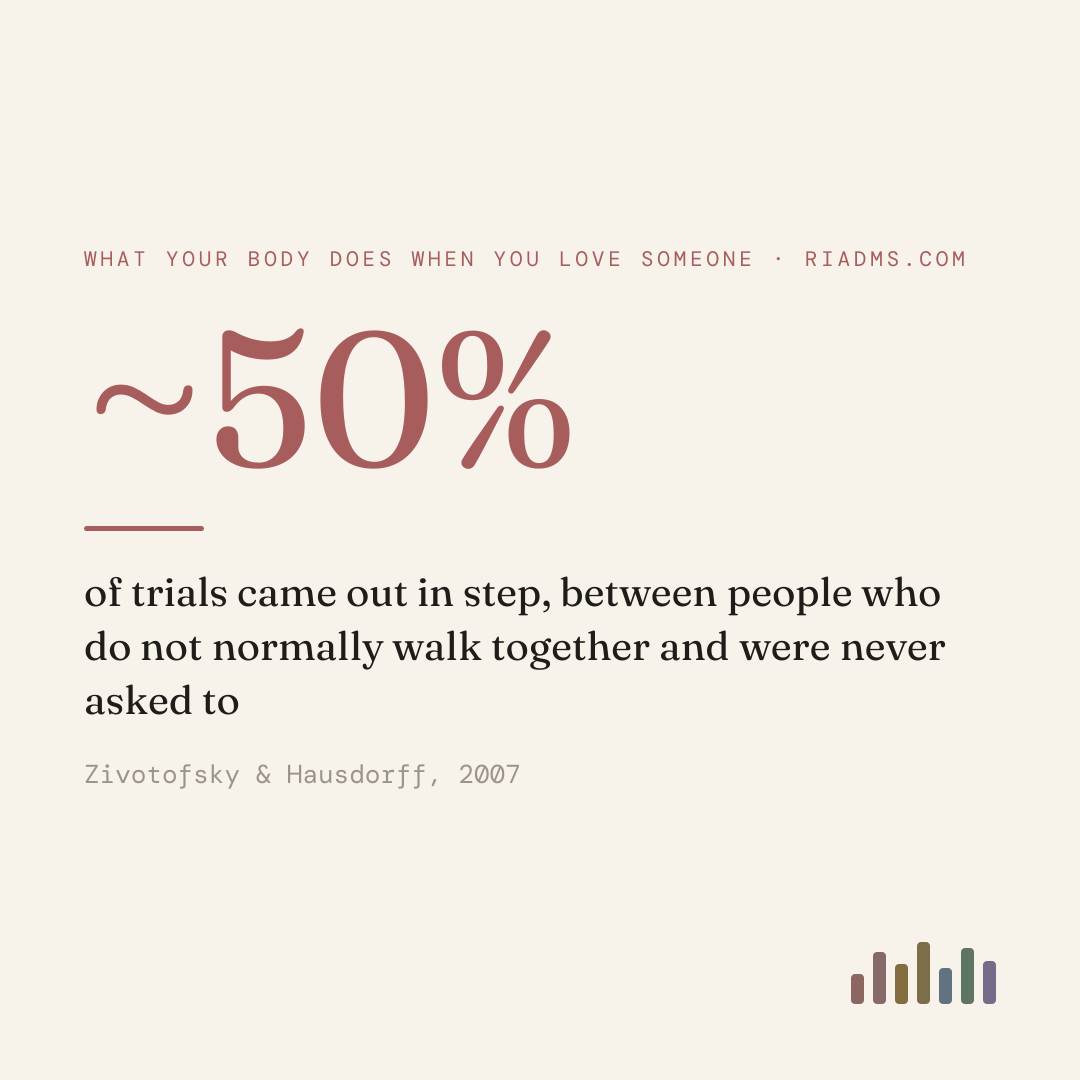
So it isn’t your legs picking them out of a crowd. It’s what legs do beside legs.
what all six are actually evidence of
Here’s the honest read, and I think it’s better than the version I gave on camera.
None of these six things is a love detector. Every one of them is a proximity effect. Two nervous systems in the same room start leaking into each other, and they do it with your partner, your friend, the stranger you fell into step with on the way to the station. Is that a disappointment? I don’t think so. It means the mechanism was never rare, and that’s the more interesting finding.
What’s rare is the choosing. Your body will sync with whoever is standing beside it. Love is which body you keep arranging to stand beside. The syncing is what happens; the arranging is what you did.
And that reframe is why I still think this list matters more for ace people than for anyone else. If you’ve spent years waiting for a signal that never comes, being handed six that don’t require it is not a consolation prize. It’s the actual instrument panel. Your heart rate near him. Your breathing when he’s asleep. Your steps on the way to the shop. That’s the readout, and it’s been running the whole time.
if you want to go further
Start with Sapolsky’s Why Zebras Don’t Get Ulcers for the cortisol, because the thing you actually want to understand is why a stress response that’s useful for ninety seconds is a problem across two years. Then Tiffany Field’s Touch for the second sign, from the person who built that field. And then Hickok’s The Myth of Mirror Neurons, specifically so you can catch the next person who tells you mirror neurons explain empathy. Possibly me.
If you only read one study, read Coan. It’s the one where love does something to a brain under threat, and you can see it.
Your body has been keeping this record since before you had a word for the person. Not a proof of anything, and not a test you can fail. Just a running note on who you’ve been standing near, and how often, and whether you kept coming back.
You get to decide what that’s worth.