Someone has asked whether you’ve a crush on somebody. Probably a lot of people, probably for years. And you answered, and you’ve never once been completely sure the answer was true.
That’s not you being bad at knowing yourself. You can’t check whether you’ve felt something by asking yourself whether you’ve felt it. You need a description sharp enough to FAIL. Sharp enough that you read it and think, no. Not that.
And every description of romantic love you’ve been handed comes pre-mixed. The songs, the films, your friends at fifteen. Sexual attraction is built into all of them, so if the thing you’re trying to isolate is which of those two you’ve, the vocabulary is useless to you.
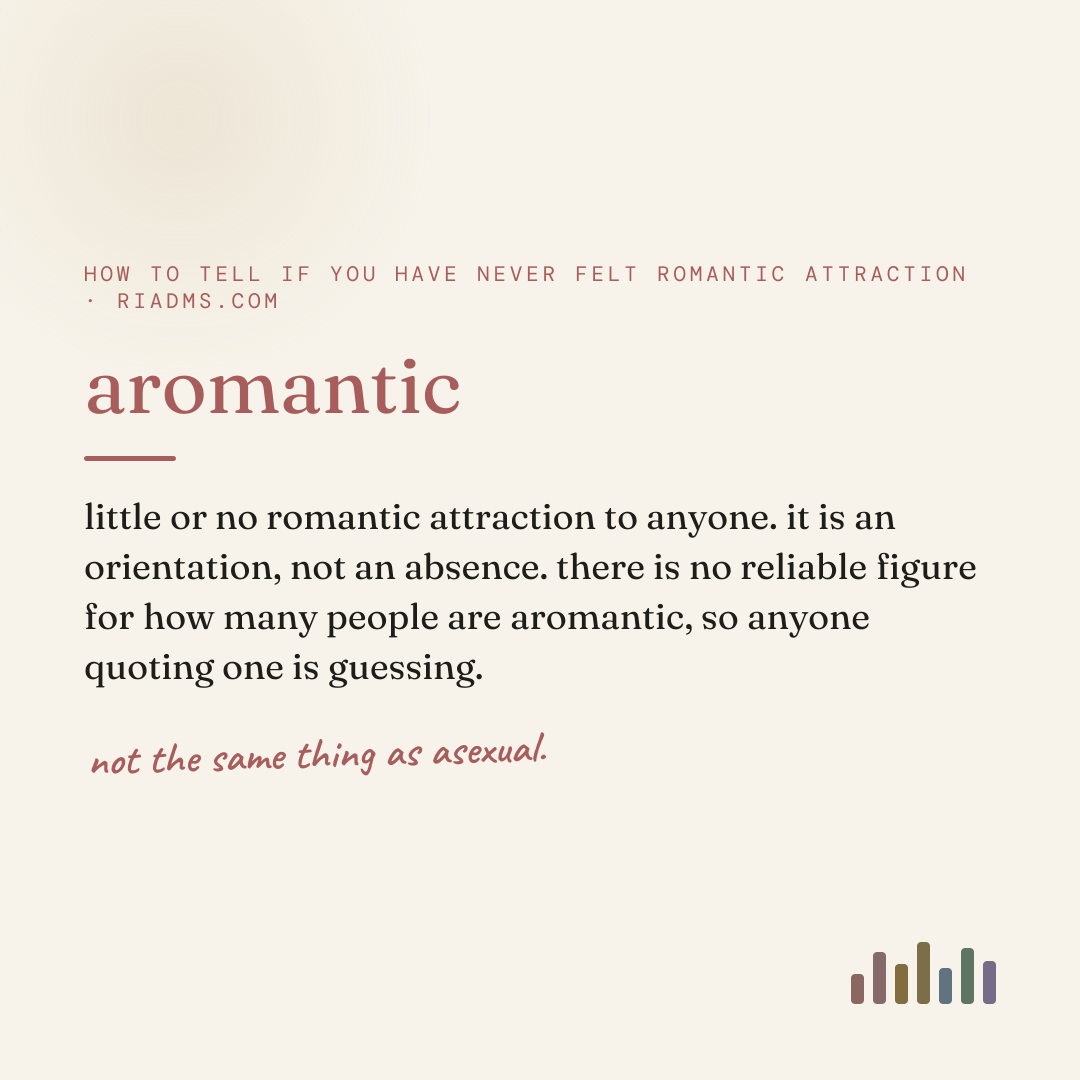
I’ve one qualification here and it’s a strange one. I’m asexual. I feel romantic attraction and I don’t feel sexual attraction, which means I’ve spent my life with one of those dials at zero and the other running. So I can hand you the romantic one on its own. I’m not wordaromantic · aroLittle or no romantic attraction. An aromantic person may still feel sexual attraction. Being aromantic and being asexual are two separate things that can come apart.what does aromantic mean? →, and that limit matters enough that this page comes back to it at the end.
why nobody can describe this to you properly
In 2003 the psychologist Lisa Diamond published a paper with the best title in the field, What does sexual orientation orient?. Her argument was that romantic love and sexual desire are two systems with two separate origins. Desire came out of mating. Pair bonding came out of infant and caregiver attachment. Evolution bolted them together because in most people they pointed the same way.
Bolted together, and not the same machine. Diamond’s model has an implication most people find startling: who you’re pulled toward sexually and who you’re able to fall in love with can genuinely differ. That’s the conceptsplit-attraction model · SAMThe idea that romantic and sexual attraction are distinct and can point in different directions, the backbone of the whole field guide.what is the split attraction model? → the asexual and aromantic communities had already been describing for years before anyone measured it.
And in 2026 somebody measured it. A Multidimensional Attraction Measure, validated on 691 people, built and tested an instrument for seven separate forms of attraction, and romantic held up as its own dimension, distinguishable from sexual. It validated a measure rather than proving seven biological drives exist, and that’s a real distinction. But it means this is no longer a folk idea with no evidence behind it.
Now put that against your problem. Most people run both systems at once, at the same person, and it all arrives as one feeling with one name. So when they describe romance to you, they’re describing the bundle. They’re not being cagey. They’ve genuinely never had to see the parts on their own, so there are no seams in their version.
It’s like trying to work out whether you can taste salt when the only food anyone has ever given you is crisps. You’ve plenty of data and none of it separates the variable.
This has a measurable cost. In 2024 a team led by James Fowler ran the largest qualitative study of aromantic experience there’s, 1,642 people. One participant put the whole problem in a sentence:
That’s not somebody being confused. That’s what happens when you’re handed the pre-mixed version and told it’s the only flavour there is.
come think with me
one letter a week.
the word for one feeling you’ve had but couldn’t name, and why it works that way. the same thing you just read, in your inbox, once a week.
- one letter a week, about a ten minute read
- all nine printable workbooks, free
- the research, with its caveats kept in
- hit reply and it reaches me. i read every one
no pressure, no spam, no gatekeeping. unsubscribe anytime · riadumitrescu.substack.com
all of this is free and it stays free. if it gave you a word you didn’t have, you can buy me a coffee.
the clean description, and it has to be able to fail
Here is mine, with the physical channel dark, described as precisely as I can. Read it actively trying to rule it out.
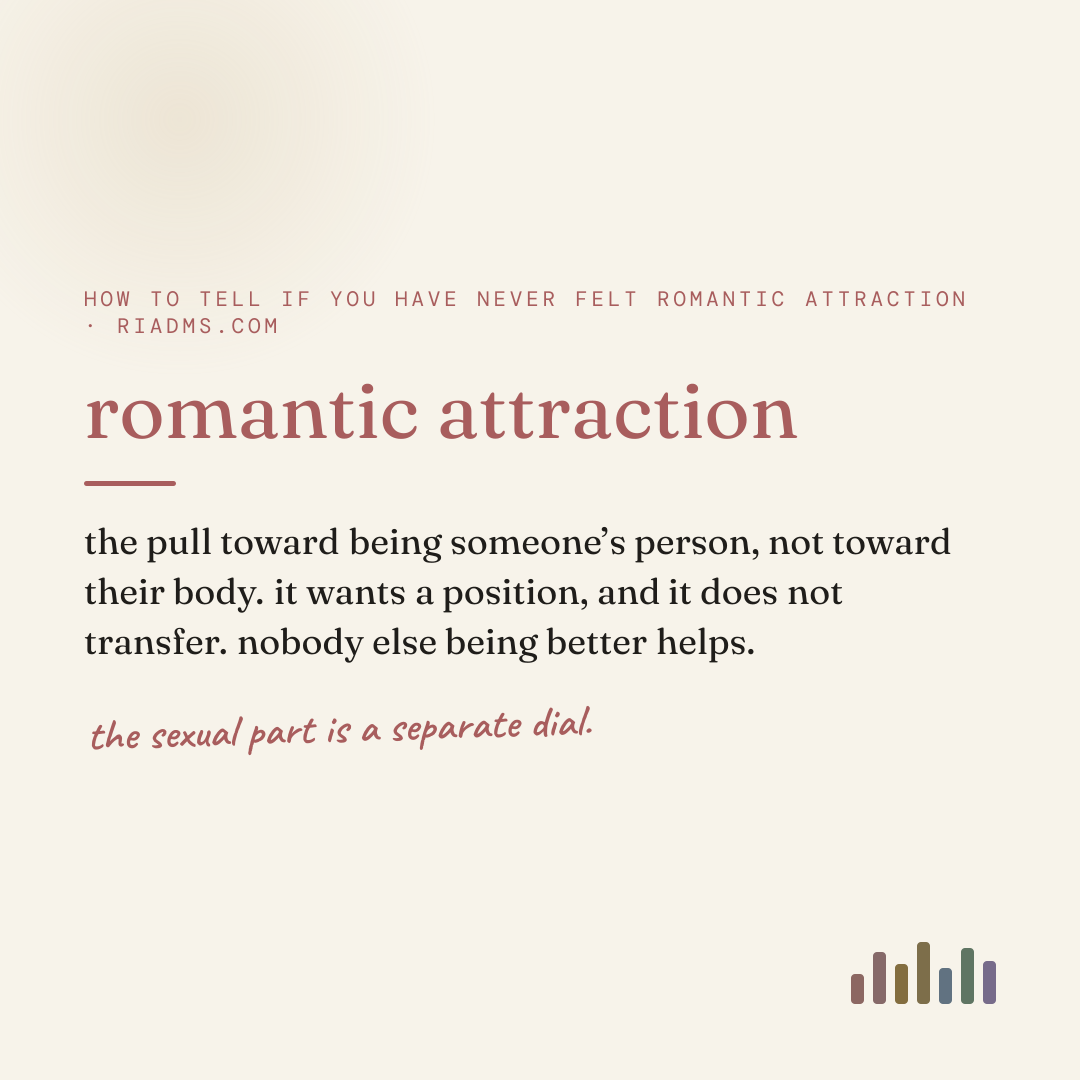
It’s a pull toward a position, not toward a body. You want to be their person. You want to be in the plans. You want a future tense with your name in it.
The sharpest edge is that it doesn’t transfer. If you swapped my person for someone objectively better looking, kinder, funnier, more available, I would want the original back. It isn’t a ranking, and nobody else being better helps. It’s a pointing.
It has a request in it, which is the uncomfortable part nobody warns you about. Aesthetic attraction never needs anything from you. You can find a stranger beautiful and walk away complete. This one doesn’t permit that. It makes you exposed in a way that looking at someone never will.
And it turns the future tense on without your permission. I don’t plan much. With him I think in years and I didn’t decide to.
If you read that and thought yes, obviously, that’s my best friend, sit with it rather than dismissing it. Plenty of people feel romantic attraction toward a friend and have never once considered it. There’s also a word for the version of that which isn’t romantic, wordalterous attractionThe desire for emotional closeness that is neither platonic nor romantic, something orthogonal to both. Contested, and useful anyway.what is alterous attraction? →, and it has its own chapter.
the four things that get mistaken for it
Almost nobody asking this question has felt nothing. They’ve felt something enormous, they can’t get it labelled, and then they use the wrong label as evidence.
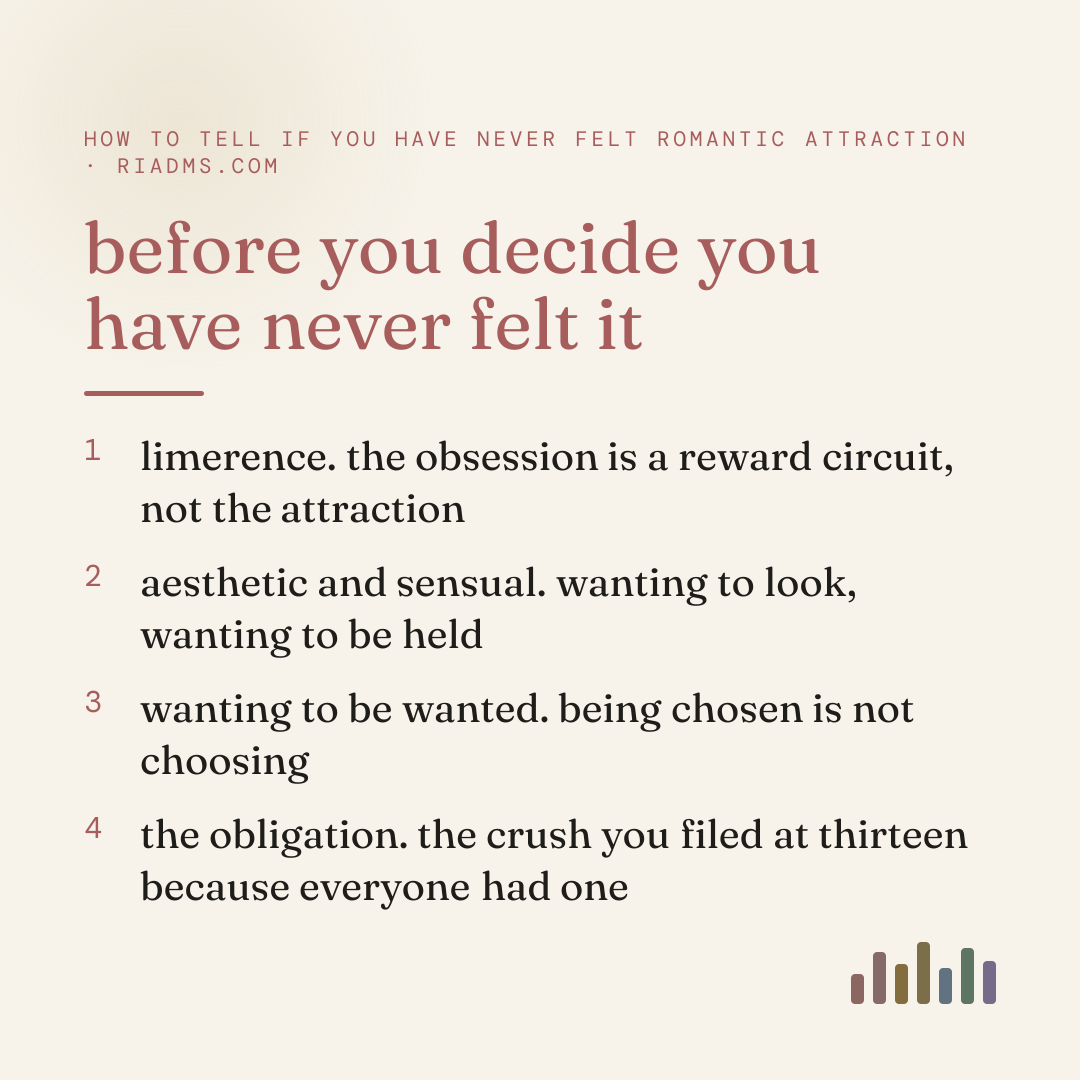
Limerence. In 1979 Dorothy Tennov interviewed and surveyed around 500 people and named the state everyone had been calling love. Her two defining features are intrusive thinking, meaning thoughts arriving against your will, and an acute need for reciprocation. Then in 2005 Arthur Aron and Helen Fisher put people who had just fallen intensely in love into a scanner. What activated was the ventral tegmental area and the caudate, which is dopamine reward circuitry. Craving and chasing machinery.
The video version of this stops there. The part worth adding is what came next. In 2009 Bianca Acevedo and Arthur Aron reviewed 25 studies covering roughly 6,000 people and pulled apart two things usually sold as one. Romantic love without obsession was strongly associated with satisfaction in long relationships. Obsession was associated against it. Helpful early, harmful later.
So the obsessive stage is a reward system doing its job, and it isn’t the part that lasts. Which cuts both ways for you, and both ways matter. Having had the sleepless checking-your-phone thing isn’t proof you felt romantic attraction. Never having had it isn’t proof you didn’t.
Aesthetic and sensual attraction. Wanting to look is aesthetic. Wanting to be physically close with no sexual component is wordsensual attractionThe desire for non-sexual physical closeness: holding, cuddling, hand-holding, being tangled up with someone. The touch is complete in itself, not a step toward sex. One of the seven types of attraction.what is sensual attraction? →. Both are separately measurable in that 2026 instrument, both feel vast, and neither is romantic attraction. This is the most common mislabel there’s.
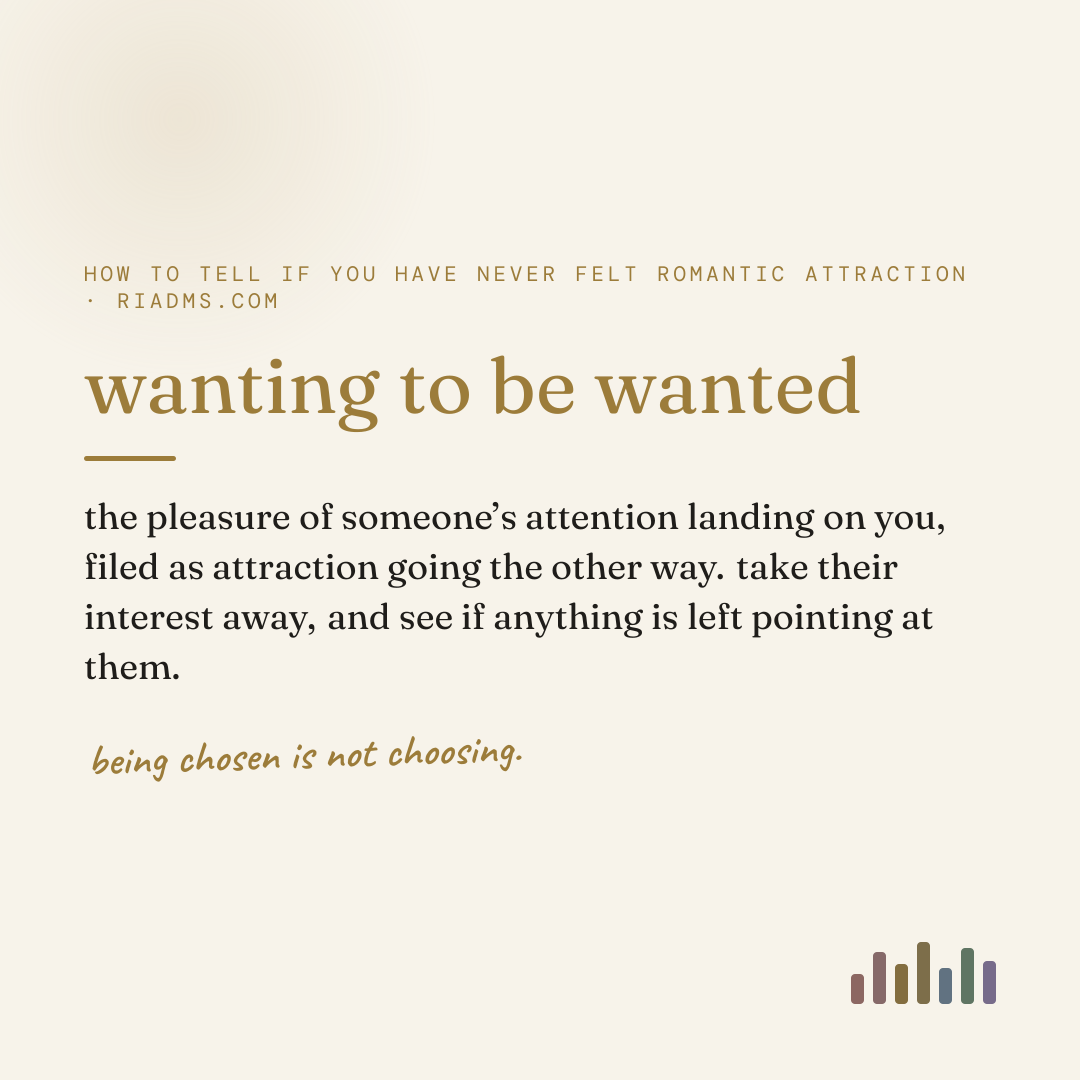
Wanting to be wanted. This one is under-discussed and I suspect it accounts for an enormous number of relationships.
The obligation. In 2012 the philosopher Elizabeth Brake named the rule in Minimizing Marriage. She called it amatonormativity: the widespread assumption that everyone is better off in an exclusive, romantic, long-term coupled relationship, and that everyone is seeking one. So at thirteen everybody around you had a crush and you were supposed to have one, and you picked somebody plausible. That’s not a lie you told. It’s a form you filled in because a form was in front of you, and it went into memory as data, and now you’re trying to use it as evidence.
”never felt it” and “never met the conditions” are different answers
Most people arrive at this question holding one box, and the box says aromantic or it says normal. That’s the wrong shape for the question, because there are at least four answers and they feel identical from the inside.
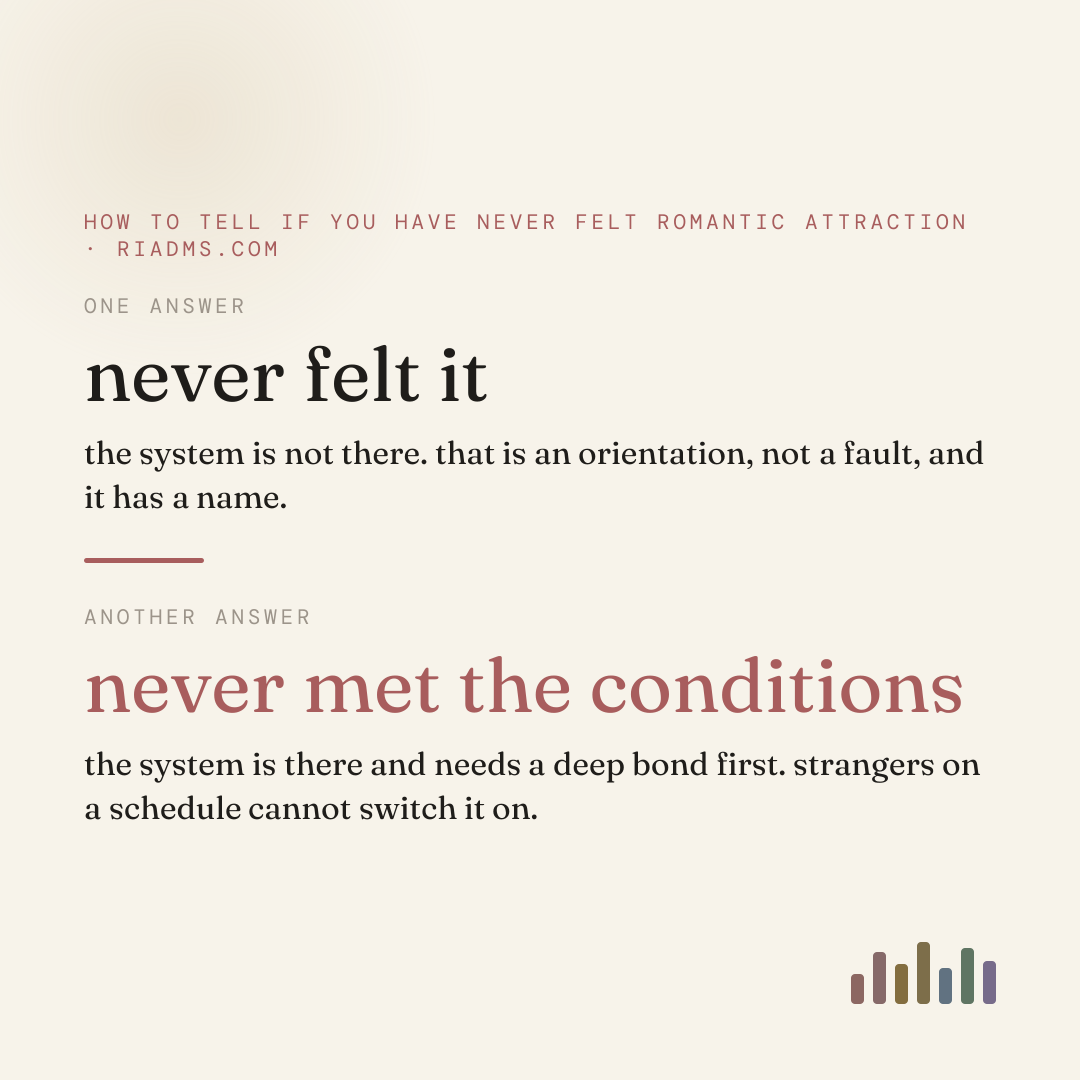
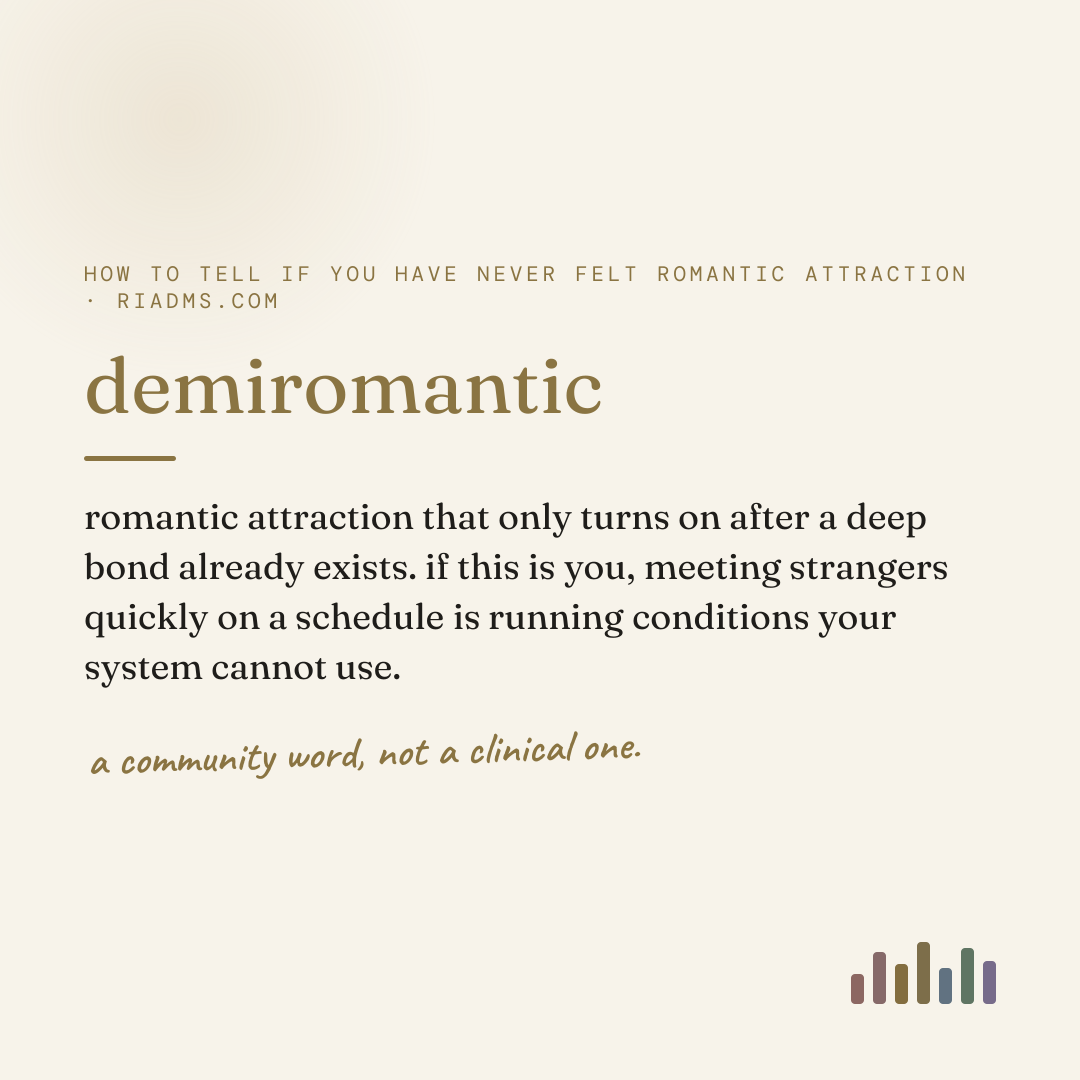
The demiromantic one is the one I most want younger readers to hear, because if it’s you, then the entire architecture of how people are supposed to meet, which is strangers, quickly, on a schedule, is running conditions your system can’t use. You would read that as never having felt it. It isn’t the same finding, and the difference is the whole rest of your life.
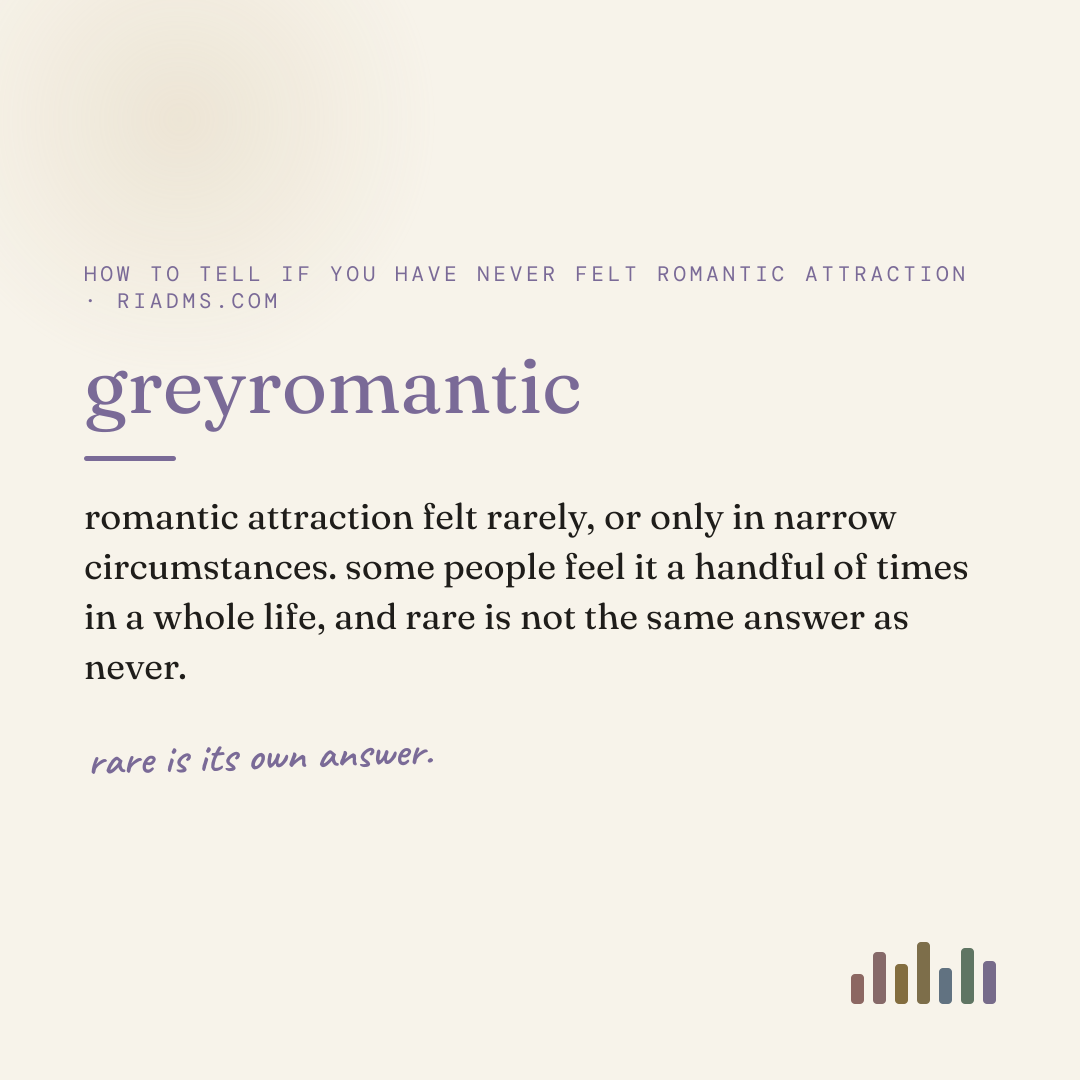
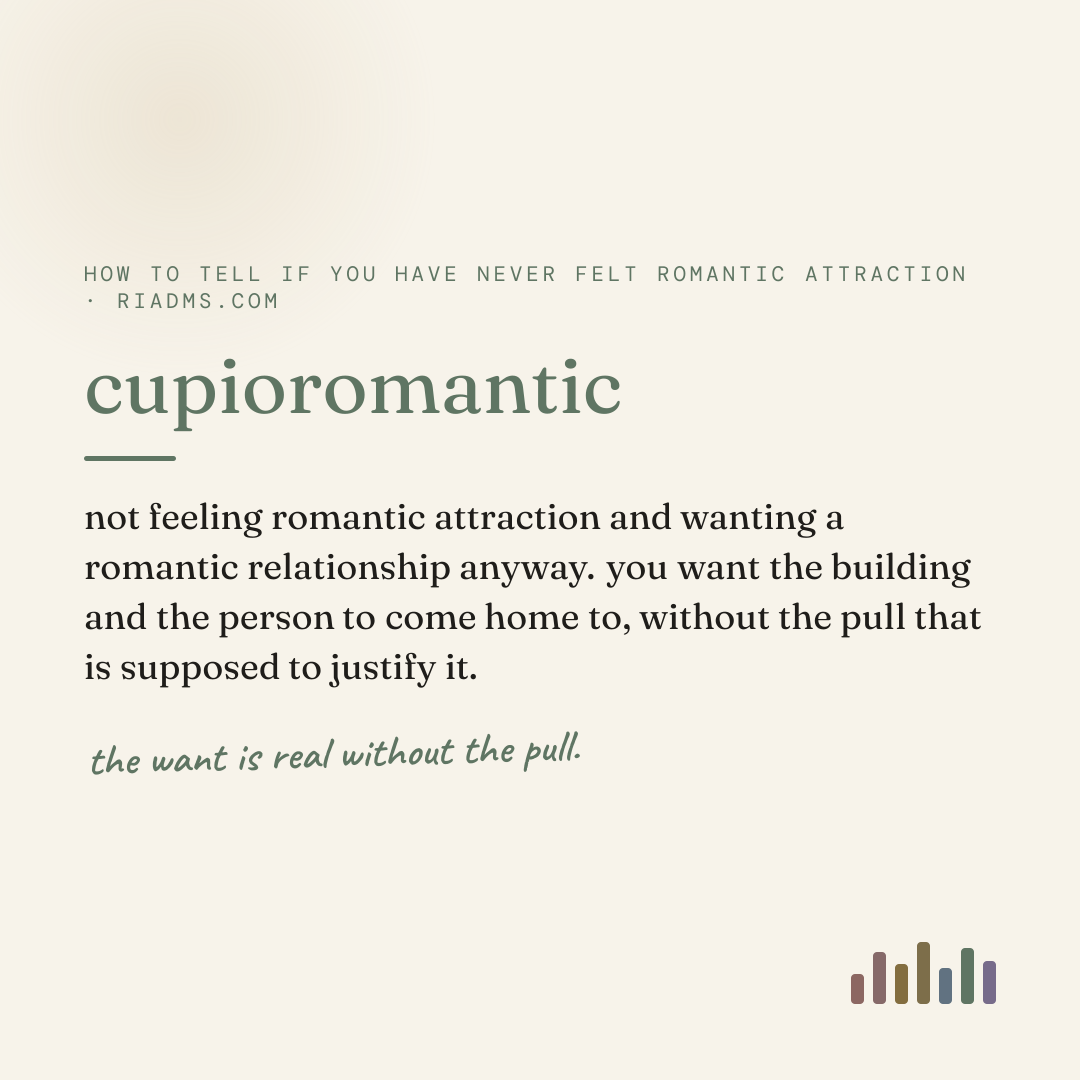
Now the part that has to be said plainly. These are community vocabulary, not clinical categories. They were built by the aromantic community because nothing in the existing language could hold the distinctions, and the main place they’re collected is AUREA, which is a volunteer advocacy organisation rather than a research body. No study validates the boundary between grey and demi. There’s no instrument that sorts you.
I don’t think that makes them less useful. A word doesn’t have to appear in a diagnostic manual to stop you believing you’re broken. That’s not a diagnosis, that’s somewhere to stand while you look.
what I can tell you, and where I stop
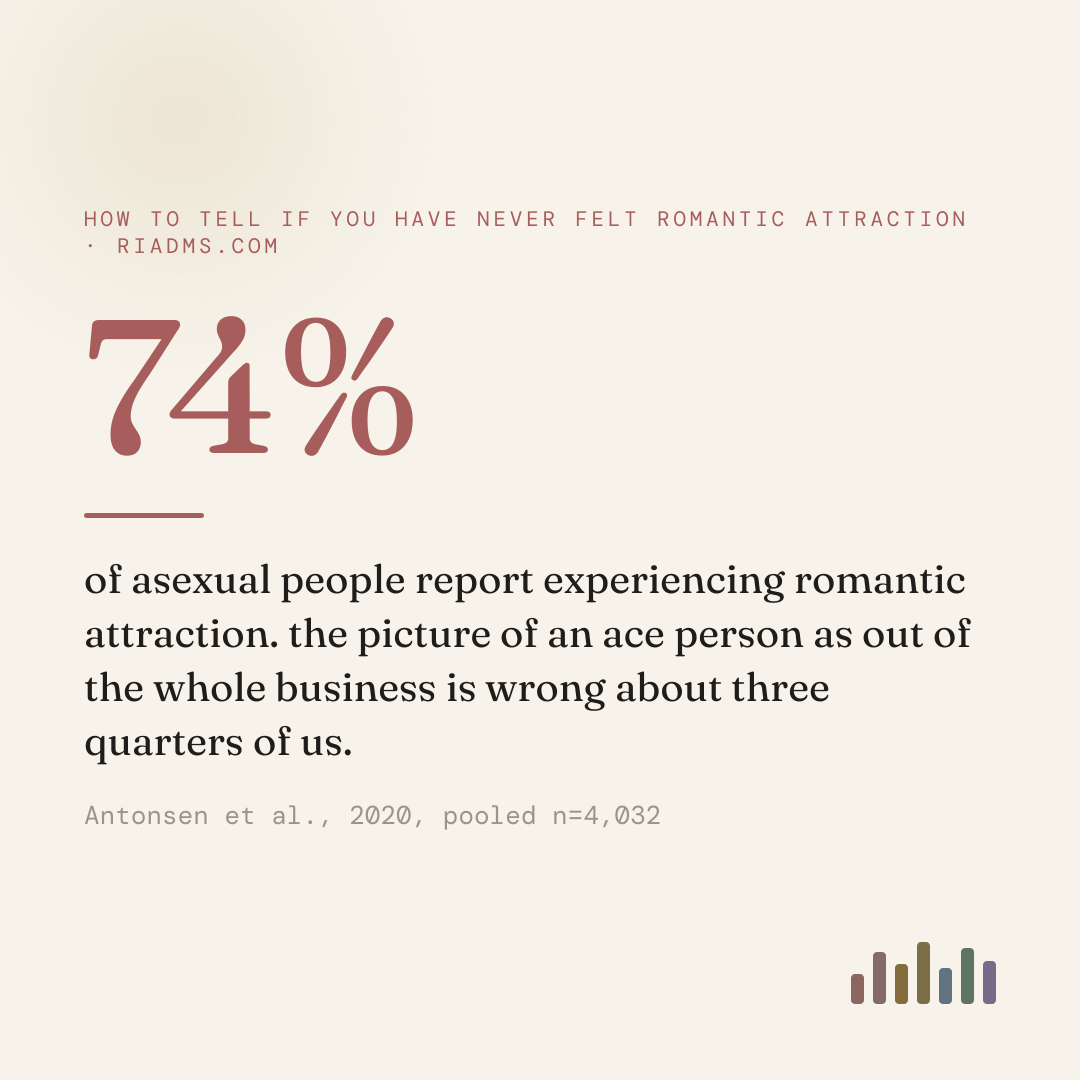
In 2020, Antonsen, Zdaniuk, Yule and Brotto pooled seven previous studies, just over four thousand asexual people, and found that 74% reported experiencing romantic attraction. Three in four. The cultural picture of an asexual person as somebody out of the whole business is wrong about most of us.
I’m in that 74%, which makes me useful for exactly one thing: I’m a working example of the romantic dial running with the sexual one at zero.
It also means the other quarter of that sample are asexual and aromantic, and they aren’t me.
I’ve never had to work out whether I felt romantic attraction. I’ve always known, in the annoying way that people who have a thing always know they have it. So I’m the wrong person to tell you what it’s to go looking and find nothing. I can describe the shape of the piece. I can’t describe the empty space.
One more thing rather than let it pass. There’s no reliable figure for how many people are aromantic. Community surveys produce numbers, and those surveys run on aromantic and asexual forums, which isn’t a representative sample of anything. If you see a confident percentage on a graphic, it isn’t standing on a study that could support it. I would rather say I don’t know.
What the Fowler study did find, from those 1,642 people, is the thing to end on. Finding the word was described as freeing, and alienating, and utterly fantastic, all at once. That phrase is in the title of the paper. It sounds like a contradiction and it isn’t, and if you’ve found a word for yourself recently you already know how all three are true on the same afternoon.
keep reading
If you read one thing after this, make it Angela Chen’s Ace, which is the best writing anywhere on what the other channels look like once the sexual one is off. If you want the research instead, the Fowler 2024 study is open about its own limits and is 1,642 people describing this in their own words, which is worth more than any explainer including this one. And AUREA’s term list is where the vocabulary actually lives, maintained by the people it belongs to.
There’s no test. Nobody can tell you, a page definitely can’t tell you, and anyone handing you a confident verdict about the inside of your own head is selling you something.
What you can do is stop measuring yourself against a description that arrived pre-mixed. Take the sexual part out. Take out the obsession, because the research says the obsession was a reward circuit and not the love. Take out being wanted, and take out the crush you filed at thirteen because everybody else had one.
Then look at what’s left, and ask whether anything in your life has ever pointed at one specific person, refused to transfer, and asked to be chosen back.
If yes, you’ve felt it. If no, you haven’t, and that’s not something missing from you. It’s a dial at zero, and I would know, because I’ve one.


