In 1691 a woman in Mexico wrote a letter explaining why she became a nun, and I have not been able to put it down since I read it.
She does not say she had a calling. She says she knew the convent had things in it she would hate, and that given how completely she refused marriage, it was the least unsuitable and the most decent thing she could choose. And then she says what she actually wanted. To live alone. To have no obligatory occupation getting in the way of her studying. And nobody making noise near her books.
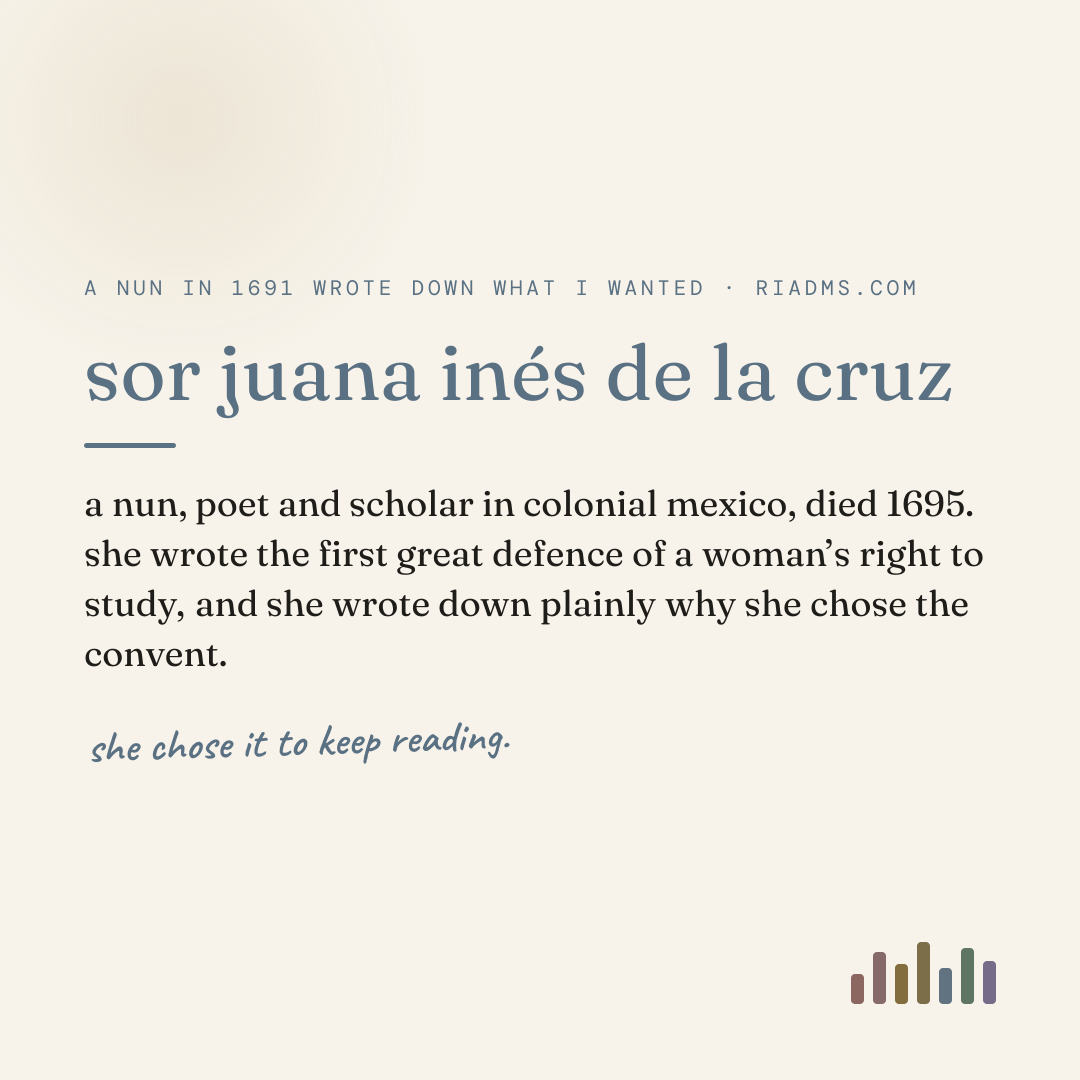
Her name was Sor Juana Inés de la Cruz and the letter is the Respuesta a Sor Filotea de la Cruz. I paraphrased her in the video, because you cannot read seventeenth century Spanish to camera and expect anyone to stay. So here she is properly, in her own words and in a published translation, because her sentence is better than my summary of it.
what she actually wrote
It helps to know what the letter is, because it changes how the sentence reads.
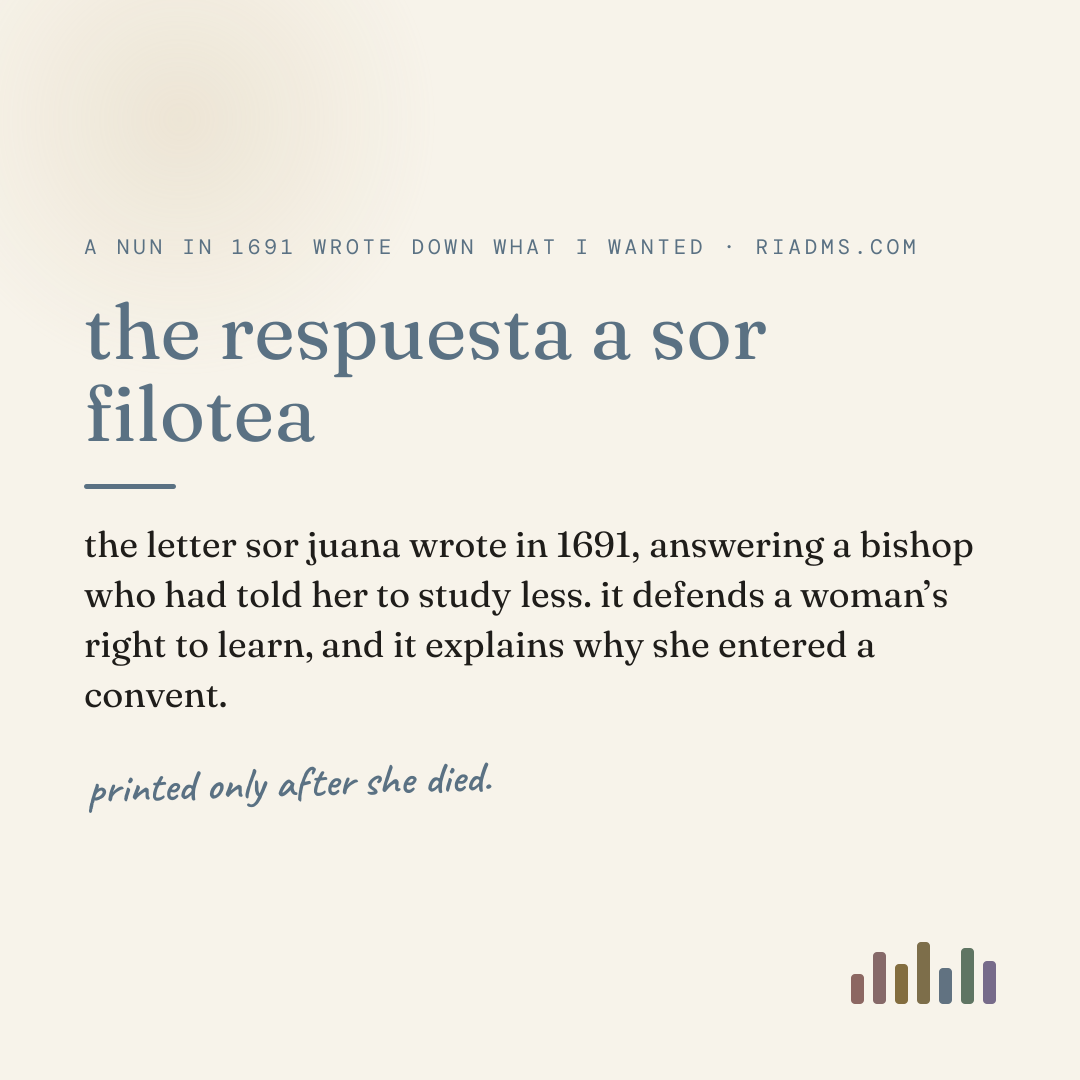
In 1690 the Bishop of Puebla, Manuel Fernández de Santa Cruz, took a private critique she had written of a famous sermon and published it without asking her. He put a letter of his own on the front of it, signed with a woman’s name, Sor Filotea de la Cruz, advising her to spend less of that mind on secular learning and more of it on devotion. The Respuesta is her answer to him. It is dated 1 March 1691.
So this is not a diary. It is a defence, written by a woman who has just been told to stop, addressed to a man with power over her, and it is doing a great deal of work. It is stacked with scripture and church fathers and every learned woman she can name. Which is what makes one sentence in the middle of it so strange.
Entréme religiosa, porque aunque conocía que tenía el estado cosas (de las accesorias hablo, no de las formales), muchas repugnantes a mi genio, con todo, para la total negación que tenía al matrimonio, era lo menos desproporcionado y lo más decente que podía elegir en materia de la seguridad que deseaba de mi salvación; a cuyo primer respeto (como al fin más importante) cedieron y sujetaron la cerviz todas las impertinencillas de mi genio, que eran de querer vivir sola; de no querer tener ocupación obligatoria que embarazase la libertad de mi estudio, ni rumor de comunidad que impidiese el sosegado silencio de mis libros.
In Alan Trueblood’s published translation:
I became a nun because, although I knew that that way of life involved much that was repellent to my nature … nevertheless, given my total disinclination to marriage, it was the least unreasonable and most becoming choice I could make to assure my ardently desired salvation.
And then the list at the end of it, which is the part that stopped me:
such as my wish to live alone, to have no fixed occupation which might curtail my freedom to study, nor the noise of a community to interfere with the tranquil stillness of my books.
That is Trueblood in A Sor Juana Anthology (Harvard, 1988), as excerpted here. The ellipsis is mine and it drops a clause where she specifies she means the incidental parts of convent life, not the central ones.
What I said in the video was a paraphrase. “The least unsuitable and the most decent thing she could choose” is my compression of lo menos desproporcionado y lo más decente. Trueblood has “least unreasonable and most becoming”. Margaret Sayers Peden, in the other standard English edition, has “the least unsuitable and the most honorable I could elect”. Take the published ones over mine.
Now, two things the ninety seconds did not have room for, and both of them are corrections to what I said out loud.
The first is that God is in the sentence. I said in the video that she does not mention him for most of it, and that is not right. The letter is thick with scripture, and the sentence itself gives her reason for choosing the convent as the security she wanted for her salvation. What is missing from it is not God. It is a calling. She never says she was called. She says she compared her options.
The second one is worse for my case, and it goes on the page anyway. She does not present that list of things she wanted as the reason she went. She calls them las impertinencillas de mi genio, the little impertinences of her temperament, and says they yielded and bowed their necks to the more important consideration. And earlier in the same letter she gives a completely different account of her motive: that no other motive brought her into religion than to bury her intellect along with her name and hand it back to the one who gave it to her. Peden renders the surrounding clause as “notwithstanding that the spiritual exercises and company of a community were repugnant to the freedom and quiet I desired for my studious endeavors.”
So the letter does not agree with itself, which is what you would expect from a document written by a woman under discipline, to the man disciplining her, arguing for her right to keep reading. And that is exactly why one line in it survives.
Everything else in that sentence is hedged, apologised for, subordinated to salvation, or contradicted somewhere else in the letter. One thing is not. La total negación que tenía al matrimonio. The total refusal of marriage that she had. She states it, gives no reason for it, and never once defends it. It is not the argument. It is the premise the argument is built on.
One more thing, and it belongs here rather than in a footnote, because leaving it out would make her sound safe. The flat sentence did not protect her. Her publishing career ended after 1692. There are documents from 1694 in which she renews her vows and gives up her library, and what those documents mean is the most contested question in the whole field: whether churchmen silenced her, whether she was still writing in secret, whether she handed the books over willingly. Nobody agrees, and the honest summaries say so. She died on 17 April 1695, in an epidemic in the convent, after nursing the sisters who had it.
come think with me
one letter a week.
the word for one feeling you’ve had but couldn’t name, and why it works that way. the same thing you just read, in your inbox, once a week.
- one letter a week, about a ten minute read
- all nine printable workbooks, free
- the research, with its caveats kept in
- hit reply and it reaches me. i read every one
no pressure, no spam, no gatekeeping. unsubscribe anytime · riadumitrescu.substack.com
all of this is free and it stays free. if it gave you a word you didn’t have, you can buy me a coffee.
there is no apology in it
Look at the verbs. She knew. She could choose. Not “called”, not “right”, but the least unreasonable and most becoming option available. That is a woman comparing what was open to her and reporting which one scored highest, the way you would report the result of comparing two flats. And the reason she gives for the score is her own refusal of marriage, stated as a fact about herself that needs no explanation beyond her having it.
There is no apology anywhere in the sentence. She is not confessing, and she is not making a case for her right to be like this. She is a person describing a practical decision about the shape of her own life, in a letter, in her own name, addressed to a bishop, and then she moves on to the next thing.
Try the same register on the last person who asked you why you are single, or why you are not seeing anyone, or when you are going to settle down. Say it flat, with no defence in it. Watch what happens next. The flatness does not survive, because the sentence you say does not close anything. It opens a file.
she is not being recruited
I am not saying she was asexual. I am not saying she was wordaromantic · aroLittle or no romantic attraction. An aromantic person may still feel sexual attraction. Being aromantic and being asexual are two separate things that can come apart.what does aromantic mean? →. I have no idea, nobody does, and she is not here to be signed up to anything.
What she wrote is a sentence about marriage, and marriage in seventeenth century New Spain was a legal and economic arrangement with a dowry attached and a household to run at the end of it. Refusing that is not the same as reporting an absence of sexual attraction. Those are two different claims and the modern habit of collapsing them is most of what this site exists to pull apart. A person can decline an institution for a dozen reasons that have nothing to do with what they feel when they look at anybody.
The other reason to be careful is that the scholarship on her is unsettled, and on this particular question it is unsettled in every direction. She wrote a body of poems to María Luisa Manrique de Lara y Gonzaga, Countess of Paredes, who was vicereine of New Spain and her patron, and who is addressed in the poems as Lysi. Octavio Paz gave that relationship a chapter of his biography. Readings of those poems differ sharply, and they differ because the same words can be a declaration or a convention: extravagant devotion to a patron was the expected form of the genre. Which one it is has been argued about for decades and it is not mine to settle from four hundred years away.
So the thing I want from her is not her orientation. It is her grammar.
She got a noun. I get a paragraph.
a word is not the same thing as a category
I got this part wrong for a long time. I used to think the problem was that nobody had the words yet. That is not true and it has not been true for a while. We have better vocabulary for this than any century before us. Asexual, aromantic, greyromantic, worddemisexualExperiencing sexual attraction only after a strong emotional bond has formed. One point on the asexual spectrum.what does demisexual mean? →, wordallosexualSomeone who does experience sexual attraction. The word exists so that "not asexual" has a name of its own, instead of being treated as the default that needs no label.what does allosexual mean? →, wordqueerplatonic relationship · QPRA committed relationship that doesn’t follow the norms of romance or ordinary friendship, its own category of closeness.what is a queerplatonic relationship? →Wikipedia ↗. Those words are precise, they were built by people describing their own lives, and I use them constantly.
What she had was not a better word. It was a word attached to a building.
Say “religious” at a table in Mexico City in 1691 and nobody needs a second sentence from you. They know where you sleep, what your day is shaped like, what you will not be doing with your life, what you will be doing instead, and how they are supposed to think about you for it. The word came with an address, a timetable, an income of sorts, a hierarchy you could be promoted inside, and a rank in the culture that was not beneath marriage.
It was above it, formally, in writing.
The Council of Trent settled that in 1563, and the wording is blunter than you would expect from a doctrinal canon. “If any one saith, that the marriage state is to be placed above the state of virginity, or of celibacy, and that it is not better and more blessed to remain in virginity, or in celibacy, than to be united in matrimony; let him be anathema.” Anathema is the formal word for cursed and cut off. So it was not only allowed to want a life with no marriage in it. Saying that marriage was the better option was the thing that got you condemned.
So her sentence closes. Not because she found an accurate description of her interior life, but because the description already had somewhere to sit.
Your word does not come with any of that. “Asexual” is an accurate account of what happens inside you and it is not a place. There is no building, no daily shape, no status, no career, and above all no agreed script for what the other person is supposed to say back. Which is why the reliable next line is almost never “oh, okay”. It is “since when”, or “how do you know”, or “have you had your hormones checked”.

That is not a vocabulary problem. It is a filing problem, and the two need separating, because if you think it is a vocabulary problem you will keep looking for a better word and the better word will keep not working.
the same institution, the same century, the other woman
Everything above is true and it is half the story, and the other half is bad enough that leaving it out would make this page a lie.
Her name was Arcangela Tarabotti, born Elena Cassandra Tarabotti in Venice in 1604. Her father decided she was unmarriageable, because she was lame, and sent her to the Benedictine convent of Sant’Anna as a boarder while she was still a child. She took the habit there at sixteen, in 1620, and made her final vows at nineteen. She never got out. She died in that building in 1652.
I said “put there by their fathers at sixteen” in the video, following her English publisher, who compresses it the same way. The placement was earlier than that and the vows were later. Sixteen is when the habit went on.
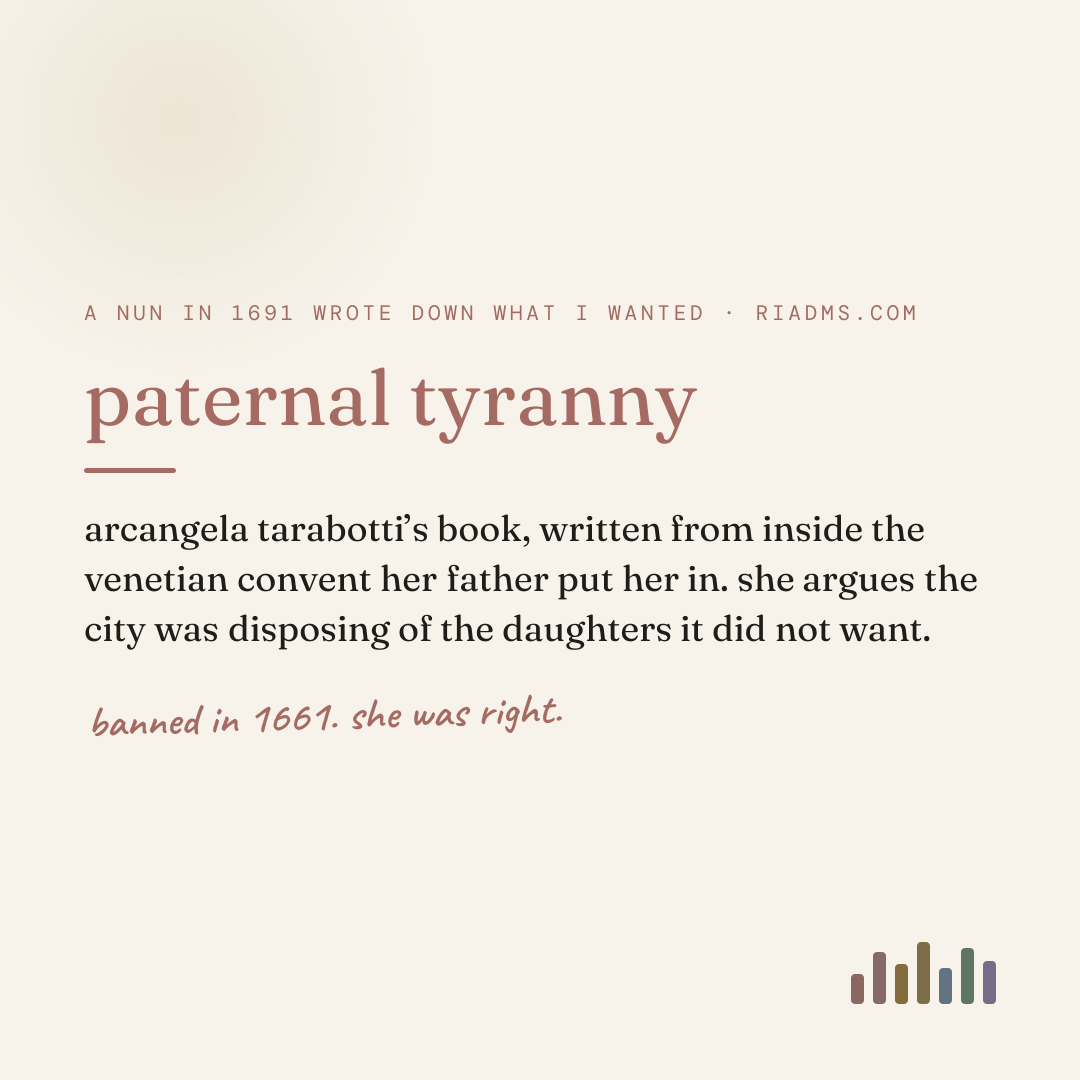
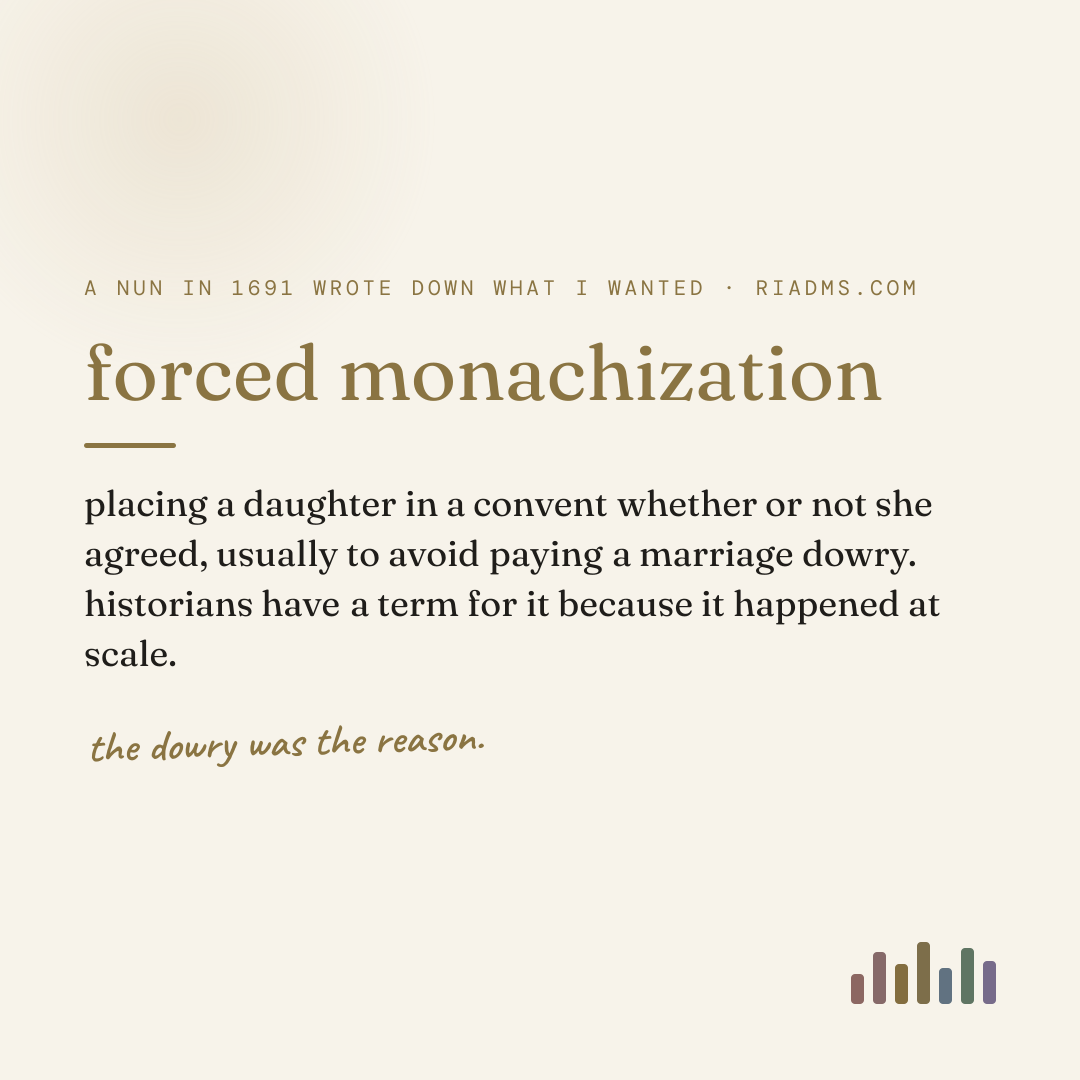
And she wrote from inside it for the rest of her life, furiously. The book is La semplicità ingannata, printed in 1654, two years after she was dead, under a false name, and put on the Index of Prohibited Books in 1661. In English it is Paternal Tyranny, edited and translated by Letizia Panizza. Her argument is that fathers were disposing of the daughters they did not want to pay a marriage dowry for, that the Venetian state was in on it, and that convents were being used as, in her publisher’s summary of her case, “dumping grounds for disabled, illegitimate, or otherwise unwanted daughters.”
In Panizza’s translation she calls it what she thinks it is: men who “force women to dwell in life-long prisons, although guilty of no fault other than being born the weaker sex.”
She is right about all of it.
And she was not an unlucky exception. She was the system working normally.
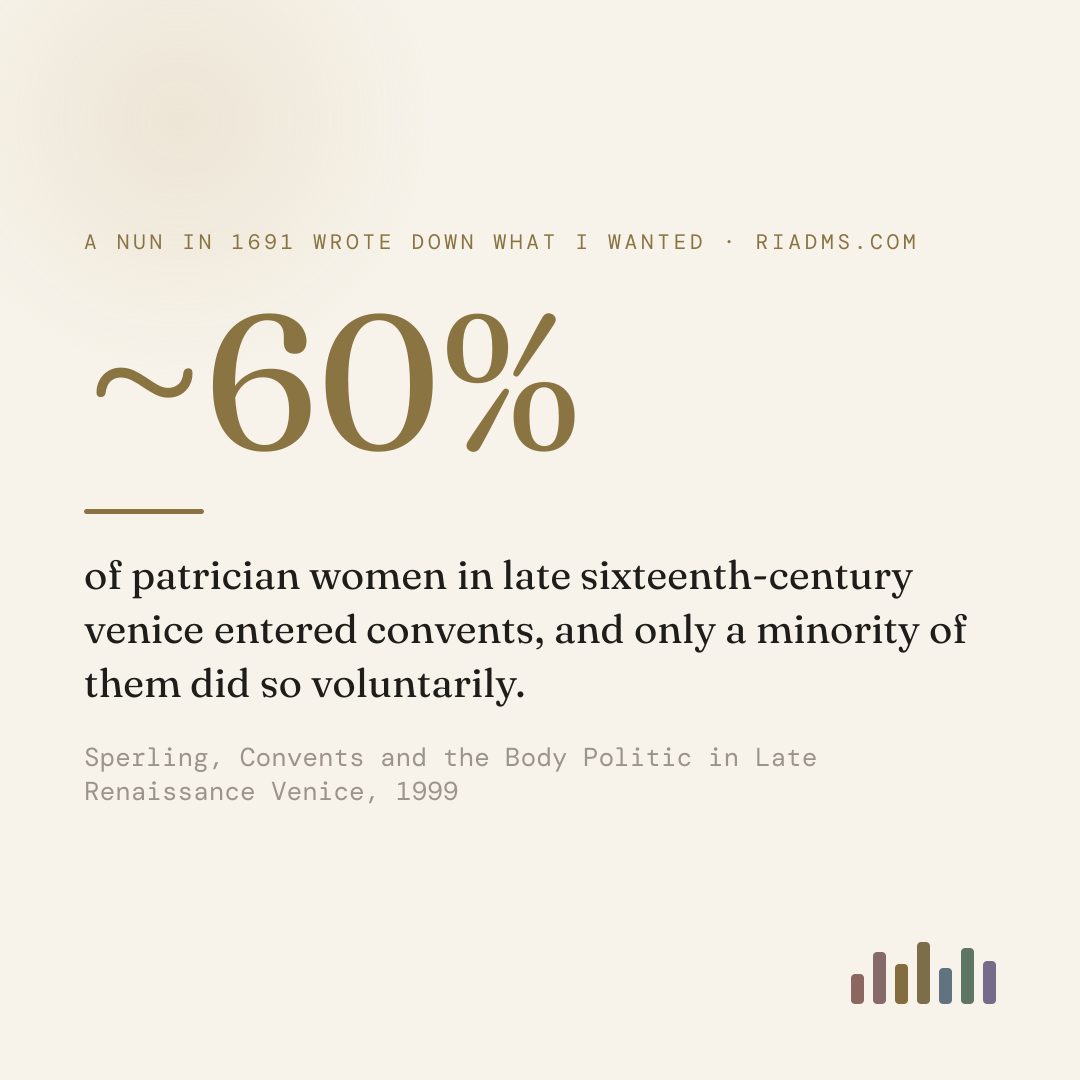
The historian Jutta Gisela Sperling went through late sixteenth century Venice and found that “nearly 60 percent of all patrician women joined convents, and only a minority of these women did so voluntarily”. Six in ten daughters of the ruling class, and most of them did not choose it.
Her explanation for why is not the one you would guess. The usual story is that dowries had inflated out of reach, so convents were the cheaper option. Sperling argues that is wrong. Patrician women could not marry beneath their rank while patrician men could marry wealth from below, so there were not enough acceptable husbands to go round, and the surplus daughters were sent in to keep the bloodlines intact. A marriage system that preserved the aristocracy by not reproducing it.
You can also count the people trying to get out. Anne Jacobson Schutte went through the petitions sent to Rome asking to have monastic vows annulled, and between 1668 and 1793 she found 978 of them. The detail nobody expects is the split: 807 of those 978 cases, about 82 percent, were men. Proportionally more of the women who asked actually got out.
There is one more piece, and it is the one that finishes off any romantic reading of the convent.
The same theology that put virginity at the top of the ladder put an obligation at the bottom of it, and it came out of the same chapter of Corinthians the whole ranking rests on. “The wife hath not power of her own body, but the husband: and likewise also the husband hath not power of his own body, but the wife.” Medieval canon lawyers built a binding legal doctrine on that sentence. Elizabeth Makowski traced how they did it: married people owed each other sex on request, formally, symmetrically, and refusing was a sin.
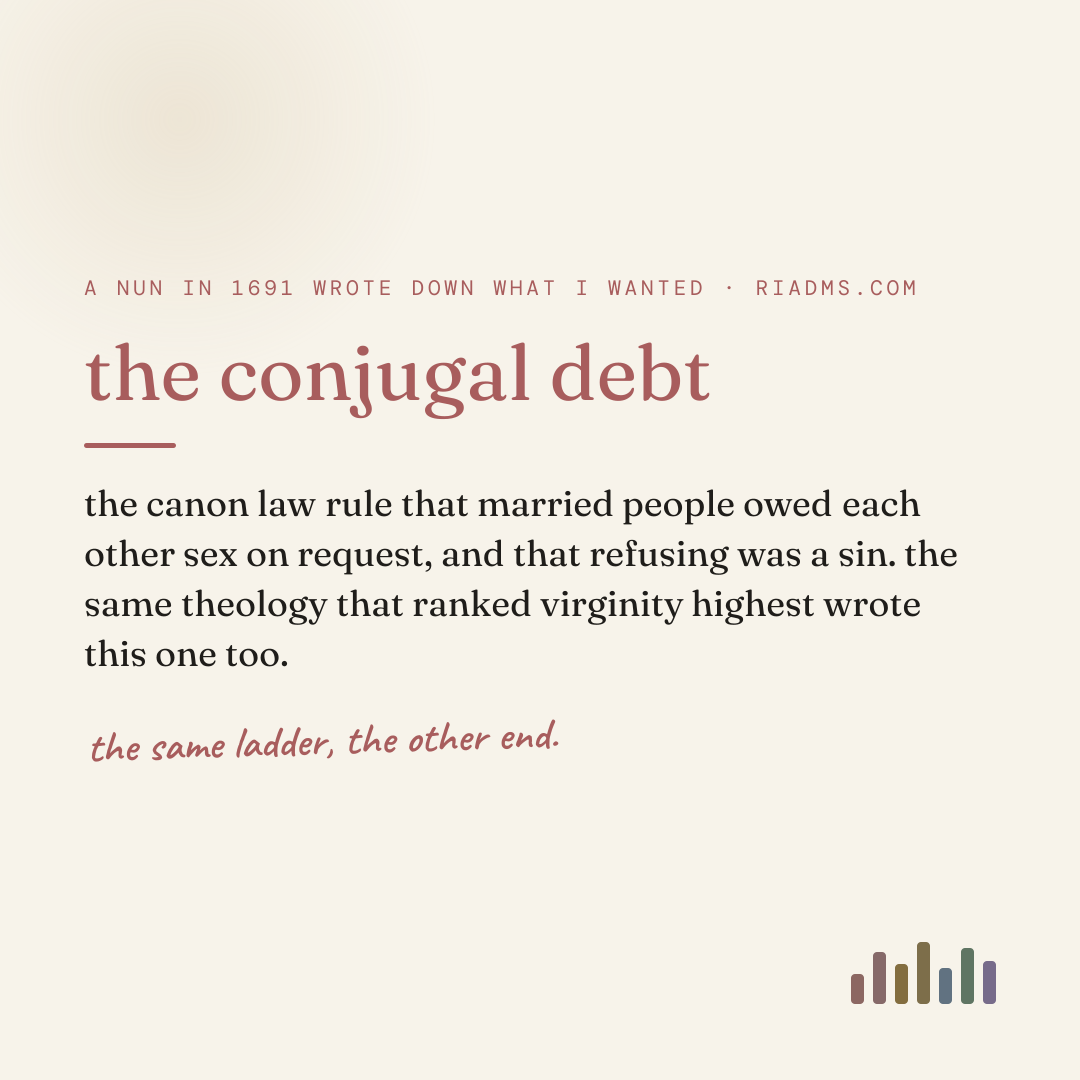
So it was never a life free of sex on offer. It was one narrow door with rank attached, a great many people were pushed through it who did not want to go, and everybody who stayed outside it signed away the right to say no.
Two women, the same century, the same institution. One found a room with a door she could close. The other was buried alive in the same building. That does not need resolving. It is what an institution is.
what you have instead
I do not want the convent, and the section above is why.
But something did leave when it went, and nobody built anything in the space. What moved in is two rules with names on them. Compulsory sexuality is the assumption that every normal person wants sex and that not wanting it is a fault to be located. Amatonormativity, which the philosopher Elizabeth Brake named in 2012, is the assumption one level over: that everyone should want a central exclusive romantic relationship, and that a life not built around one is a smaller life. Between them they cover the whole floor.
And the one category we do keep for a life with no marriage in it is “single”, which is a word defined by what is not there. It gets read as a stage rather than a shape, which is why people ask how long you have been it. Hers named a life. Yours names a gap in one.
I am not going to hand you five steps for becoming legible. There are not five steps, and you cannot build a category on your own. It took a continent centuries to build hers, and it filled it by force for most of that time.
The smaller thing is available though. When you go looking for the sentence that ends the conversation and there is not one, that is not information about you. It is information about the filing system. You are not failing to explain yourself well. There is no slot, and you have been trying to describe your way into one.
keep reading
If you read one thing off this page, read the letter. The Spanish is free, and in English there are three standard versions: Alan Trueblood’s A Sor Juana Anthology, which is quoted above, Margaret Sayers Peden’s Poems, Protest, and a Dream, and Electa Arenal and Amanda Powell’s The Answer / La Respuesta, which prints the Spanish facing the English so you can watch the translators make their choices. For the life around it, Octavio Paz’s Sor Juana, or, The Traps of Faith is the great book, and worth reading with the knowledge that its account of her last years is now argued over.
Then read Tarabotti, next and not instead. Paternal Tyranny is the correction to any warm feeling this page might have left you with. And for the modern half of it, Angela Chen’s Ace is the clearest writing there is on what it is like to hold an accurate word about yourself that nobody else knows where to put.
The chapters closest to this one are compulsory sexuality, for the rule that fills the space, and how to tell if you have never felt romantic attraction, for the vocabulary problem at close range.
I am not asking for her building back. I am pointing at the hole it left, because a lot of people are standing in it.
And if you are one of them, this is the part worth keeping. She did not get a word that described her more accurately than yours describes you. Yours is better. She got one other people already knew where to put, which is a different kind of luck entirely, and it was never about her being easier to understand.
She got to say what she was. You have been explaining what you are not.
You are allowed to want the other thing. Not a diagnosis, not a coming out, not a defence. A word, and then the conversation moving on to something else.