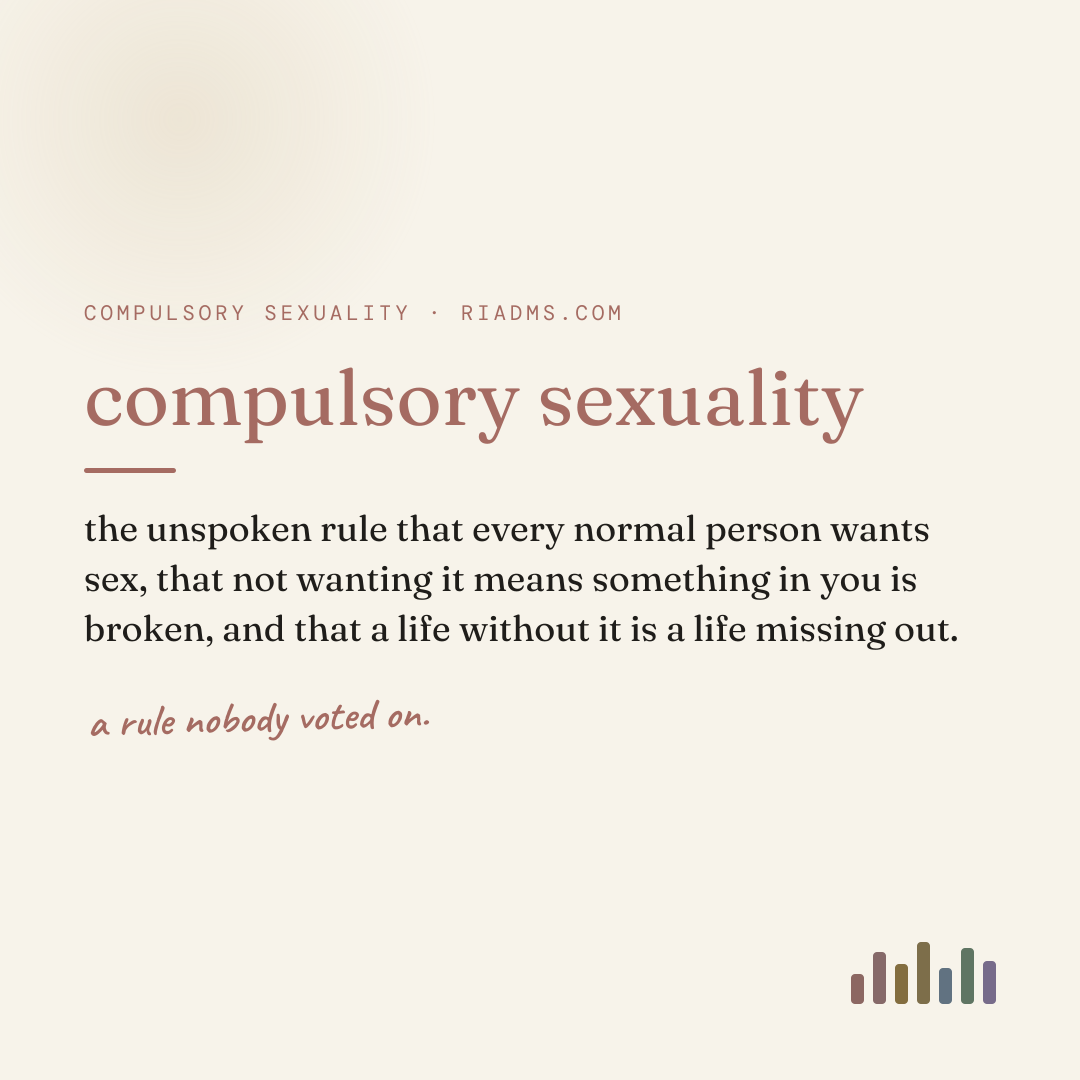
Somewhere along the way, without anyone voting on it, we all agreed on a rule. That every normal, healthy person wants sex. That wanting it is proof you’re alive and well, and that not wanting it means something in you is broken and needs fixing.
Nobody handed you that rule on paper. There was no announcement. But you’ve been graded against it your whole life, and so has everyone you know. It has a name. It’s called compulsory sexuality. And once you can see it, you can’t unsee it, because it turns out to be underneath almost everything. The ads. The medicine. The questions people ask you. The way you quietly measure yourself.
I’m asexual. Which means I’m the person this rule was quietly written against. And that gave me a strange gift. I can see the rule, because I’m the fish that got pulled out of the water long enough to notice the water was there. So let me show you the water. Not because you’re ace. Because this rule is running your life too, and nobody ever told you it existed.
the water nobody can see
Here’s the thing that makes it so hard to notice. Compulsory sexuality is invisible for the same reason water is invisible to a fish. It isn’t a wall you bump into. It’s the medium you swim in. It’s the default so deep it never announces itself as a belief. It just feels like reality.
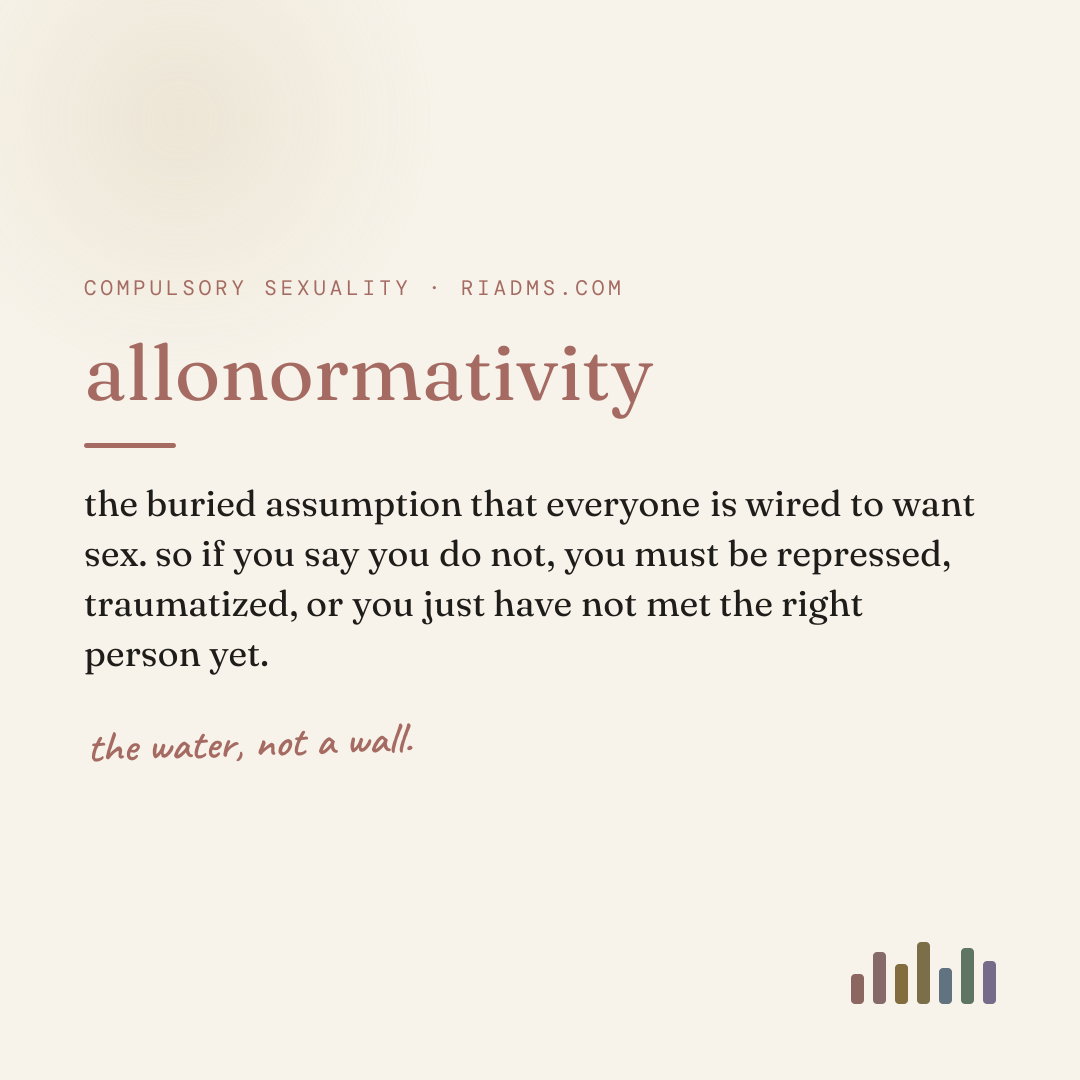
Underneath it is one background assumption: that every human being experiences sexual attraction. That desire is universal, automatic, a standard feature that comes installed in everyone. There’s a word for that assumption, and it came out of the asexual community around 2015. Allonormativity. The quiet, unquestioned belief that everyone is wired to want sex, and that if you say you don’t, you must be lying, or repressed, or damaged, or you just haven’t met the right person yet.
And because it’s an assumption and not a stated rule, you can’t argue with it, the same way you can’t argue with water. It’s just there, holding up everything else. When a belief is that deep, it stops looking like a belief. It starts looking like the truth. That’s exactly what makes it powerful.
come think with me
one letter a week.
the word for one feeling you’ve had but couldn’t name, and why it works that way. the same thing you just read, in your inbox, once a week.
- one letter a week, about a ten minute read
- all nine printable workbooks, free
- the research, with its caveats kept in
- hit reply and it reaches me. i read every one
no pressure, no spam, no gatekeeping. unsubscribe anytime · riadumitrescu.substack.com
all of this is free and it stays free. if it gave you a word you didn’t have, you can buy me a coffee.
where the name comes from
This isn’t a word I made up on the internet. It has a real lineage.
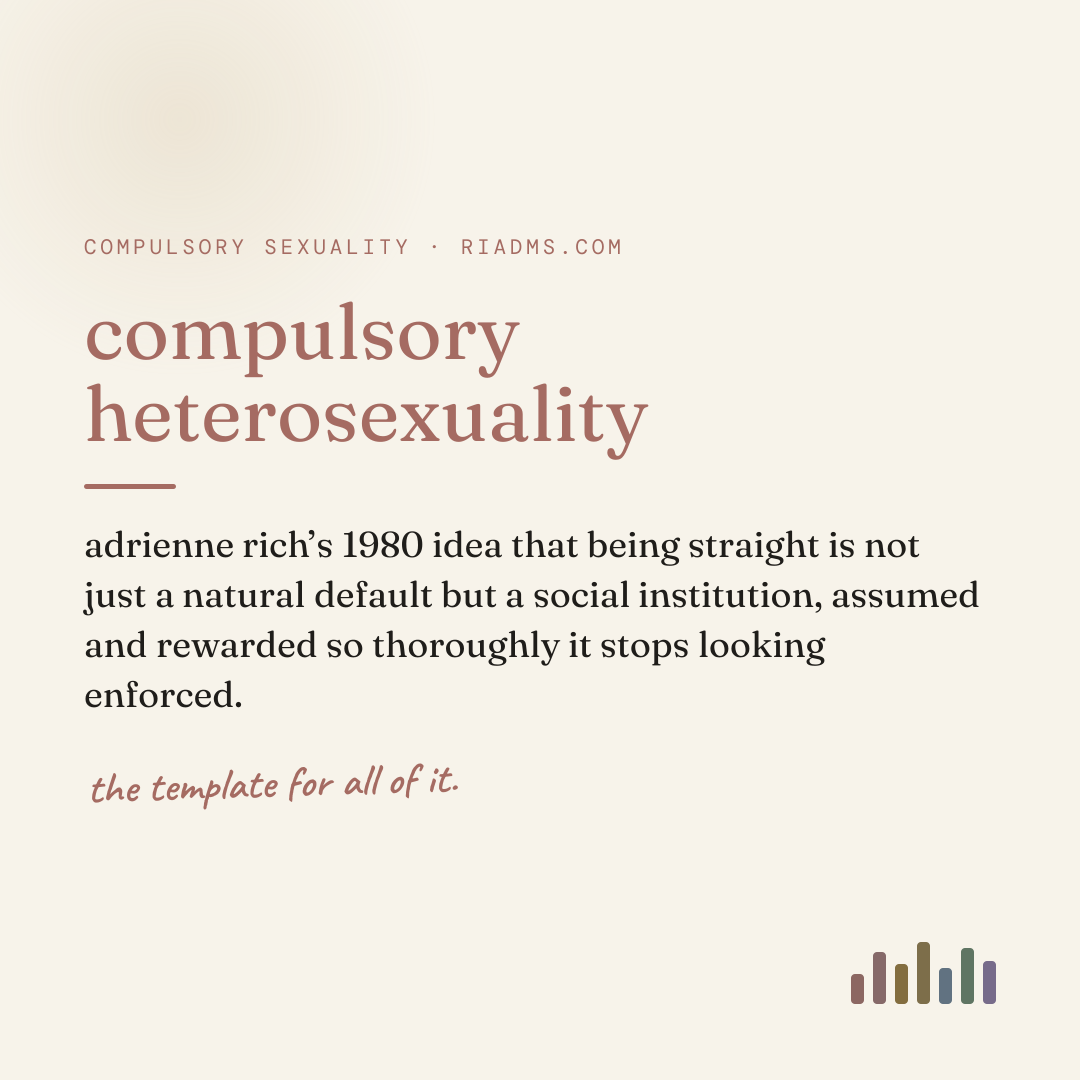
Back in 1980, the poet and thinker Adrienne Rich wrote a famous essay called Compulsory Heterosexuality and Lesbian Existence. Her move was radical for the time. She said, what if heterosexuality isn’t simply the natural default that everyone drifts into. What if it’s a political institution. Something socially enforced, assumed, and rewarded, so thoroughly that it stops looking enforced and starts looking like nature. She wasn’t saying nobody is genuinely straight. She was saying the assumption that everyone is, by default, is doing work. It’s keeping a system in place.
Now take that exact move and widen the lens by one notch. Swap heterosexuality for sexuality itself. That’s compulsory sexuality. Not just that everyone is straight. That everyone is sexual, full stop. A scholar named Kristina Gupta sharpened this in 2015, and here’s the point I want you to hold for the whole page: compulsory sexuality doesn’t just regulate ace people. It regulates everyone. The norm of “you should want sex, and the right amount, in the right way” is a standard every single person gets measured against, whether they pass it or not.
The writer who put it most cleanly is Angela Chen, in her 2020 book Ace. She describes compulsory sexuality as the set of assumptions that say every normal person is sexual, that not wanting socially approved sex is unnatural and wrong, and that people who don’t care about sex are missing out on something they absolutely need. Read that back slowly. Unnatural. Wrong. Missing out. Those are the three punishments this rule hands out, and it hands them to a lot more people than just asexuals.
how you enforce a rule you never chose
Here’s what’s wild. This rule doesn’t need police. It runs entirely on ordinary people doing ordinary things, none of whom think of themselves as enforcing anything.
Think about the script. Someone doesn’t date for a while, and the concern starts. Are you okay. Is something wrong. Have you thought about seeing someone. A teenager isn’t interested in sex yet, and instead of “great, no rush,” they get “you’ll change your mind” or a worried look. Someone says they’re just not that into sex, and the room reorganizes to fix them. Maybe it’s your hormones. Maybe it’s trauma. Maybe it’s your meds. Maybe you just haven’t met the right person. Every one of those responses, and they’re usually kind, is the rule talking. Each one assumes the wanting is supposed to be there, so its absence has to be a malfunction.
And then there’s the heavier layer, the one soaked into the whole culture. Look at how much of everything is built on the premise that sex is the most important thing a human can want. It sells the cars, the clothes, the perfume, the shows, the music. If an alien tried to understand humans through our advertising, it would conclude that sexual desire is the central organizing force of the entire species, more important than food or safety. That saturation isn’t neutral. It’s a constant, low, background broadcast telling everyone what a normal person is supposed to feel. And if you don’t feel it at that volume, the message lands as, something is wrong with you specifically.
That’s the machine. No villain. No conspiracy. Just millions of small, well-meaning corrections and a culture soaked in one assumption, all pointing the same way. That’s not persuasion. That’s a current. And it’s very hard to notice you’re being carried by a current when everyone around you is drifting the same direction.
when not wanting became a diagnosis
Now it gets serious, because the rule didn’t stay in the realm of raised eyebrows and ad campaigns. It walked into the doctor’s office and put on a white coat.
There is an actual medical diagnosis for wanting sex less than you’re “supposed” to. For a long time it was called Hypoactive Sexual Desire Disorder, low desire treated as a disorder. And in 2013, in the big diagnostic manual, the female version got folded into a category called Female Sexual Interest/Arousal Disorder. Notice something about that history. The line keeps moving. The definition of how much desire is “normal,” and how little makes you disordered, has been redrawn again and again by committees. If the healthy amount of wanting were a simple biological fact, you wouldn’t need to keep redrawing the line. The fact that it’s constantly renegotiated tells you it was never a pure fact. It’s a norm wearing the costume of a fact.
And here’s the reframe I think matters most in this whole thing. That’s not a disorder, that’s a diagnosis built on top of an assumption. The assumption that there’s a correct amount to want, and that landing below it is a medical problem in you, rather than a natural point on the range of how humans vary. When you make “less desire than average” into a sickness, you’ve quietly declared that the average is the mandatory. And that is compulsory sexuality with a prescription pad.
the pill, and who profits
If you want to see the machine at its most naked, follow the money for a second.
In 2015 the FDA approved a drug called flibanserin, brand name Addyi, the first drug approved to treat low sexual desire in premenopausal women. It got marketed in the press as the “female Viagra.” Except it works nothing like Viagra. Viagra is an on-demand blood-flow drug you take when you want it. Flibanserin is a daily drug that acts on your brain chemistry, with side effects like dangerously low blood pressure and fainting, especially if you drink. And here’s the part they don’t put in the ad. The benefit was modest. In the trials it produced something like one additional satisfying sexual event per month over placebo. A daily brain drug, real risks, for roughly one more good night a month.
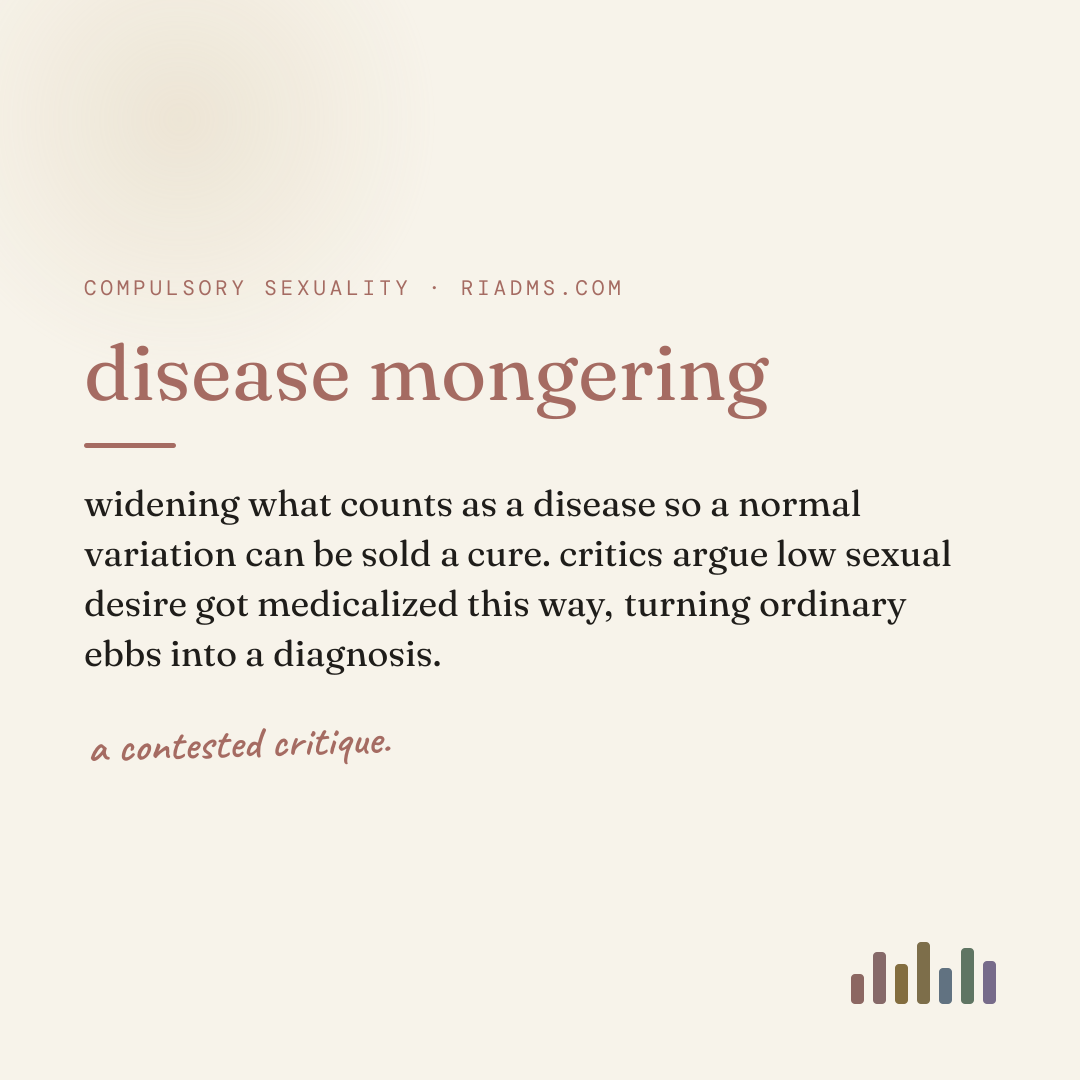
So a group of researchers and clinicians pushed back, hard. The clearest voice is a sex therapist and researcher named Leonore Tiefer, who in a 2006 paper in PLoS Medicine argued that “female sexual dysfunction” was a case study in disease mongering. I’ll frame this as her charge, because it’s contested. Her argument was that an industry took the normal, enormous variation in how much people want sex, the ordinary fact that desire goes up and down with stress and relationships and life, and repackaged that variation as a disease, so it could sell an expensive product as the cure. She helped start something called the New View Campaign to fight exactly this.
Notice the structure. First the culture installs the belief that everyone should want sex at a certain level. Then that belief gets a medical name. Then, once it’s a named disorder, there’s a market. Because you can’t sell a cure until you’ve convinced people they’re sick.
the exception that gives it away
Here’s the detail that, for me, gives the whole thing away. In that same 2013 update to the manual, there’s a small, quiet exception written into those desire disorders. It says, essentially, that if a person’s lack of desire is better explained by them identifying as asexual, then you don’t diagnose the disorder.
On the surface that’s a win, and it genuinely was one. Asexual people fought for it. An advocacy group submitted a report arguing that a whole orientation was being pathologized, and that clause is the result. It’s the manual admitting, in writing, this one isn’t a sickness.
But sit with what that exception reveals. You have to actively identify as asexual to be carved out of the disorder. Which means the default, if you don’t have that word, if you’ve never heard it, if you’re a confused sixteen-year-old with no vocabulary, is still that your lack of desire is a medical problem. The exception is a door. But you have to know the door exists, and know the password, to walk through it. Everyone who doesn’t gets left inside the diagnosis. So even the victory is shaped like the rule. That’s how deep this goes. Even its exceptions are built around it.
this was never just about us
Now here’s where I turn the whole thing toward you, the person reading who is not asexual and has generously heard me out. Because if you think this is a niche issue for a tiny minority, I need to show you that you’re standing inside this rule too, and it’s costing you.
You’ve heard the phrase “the sex recession.” Around 2018 a journalist named Kate Julian popularized it in the Atlantic, and it points to something real in the data. Peer-reviewed studies on big national samples found that people are having less sex than they used to. One analysis found American adults having sex around nine fewer times a year than a couple decades earlier. And a 2020 study in JAMA Network Open found that among young men aged eighteen to twenty-four, the share reporting no sex at all in the past year rose from about nineteen percent to about thirty-one percent in less than two decades. Nearly one in three young men.
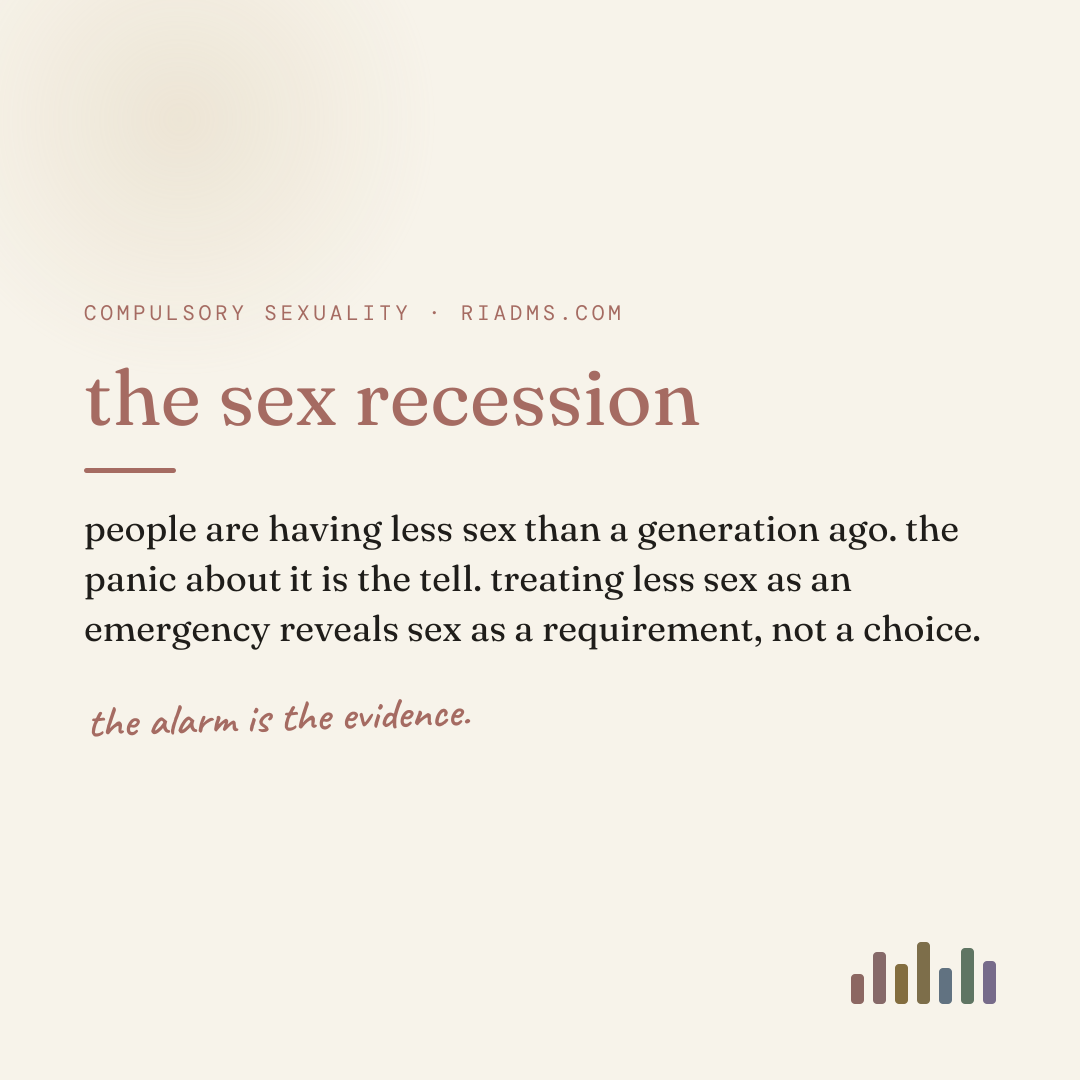
Now I need to be careful here, and I’m going to be, because the lazy version of this would panic about those numbers. I’m not going to, and here’s why. The point isn’t that less sex is a crisis we need to cure. That reaction, the alarm, the think-pieces, the “what’s wrong with young people,” is the exact thing I’m trying to show you. The panic itself is the evidence. When a whole society treats “people are having less sex” as an emergency to be solved, rather than a neutral fact about how humans are living, it’s revealing the mandate. It’s showing you that sex isn’t experienced as a choice. It’s experienced as a requirement, and falling short of it reads as a failure.
And that requirement lands on everyone. The wordallosexualSomeone who does experience sexual attraction. The word exists so that "not asexual" has a name of its own, instead of being treated as the default that needs no label.what does allosexual mean? → person who’s exhausted and just not in the mood, and feels guilty about it. The person in a long relationship where desire naturally ebbed, quietly panicking that their love is dying because the frequency dropped. The person who’d rather read than hook up, wondering if they’re broken. None of these people are asexual. All of them are getting graded by compulsory sexuality, and all of them are absorbing the same message: your worth, your health, your normalcy is measured by how much you want and have sex. Gupta’s warning comes back around here. She cautioned against the easy assumption that more sex equals more freedom. Because a culture that mandates desire isn’t sexually liberated. It just swapped one script for another. Repression said you must not. Compulsory sexuality says you must. Both are rules. Neither is freedom.
the sister rule
Being ace didn’t give me a deficiency. It gave me a vantage point. From that dry patch on the shore, you start to notice things. How much of what gets called desire is actually social pressure, performance, the fear of being the one who isn’t doing it. How often people have sex they don’t especially want, because not wanting it felt like failing a test. That the opposite of repression was never compulsion. The opposite of both is choice. Actually asking yourself, without a script screaming in the background, what do I want. Not what am I supposed to want.
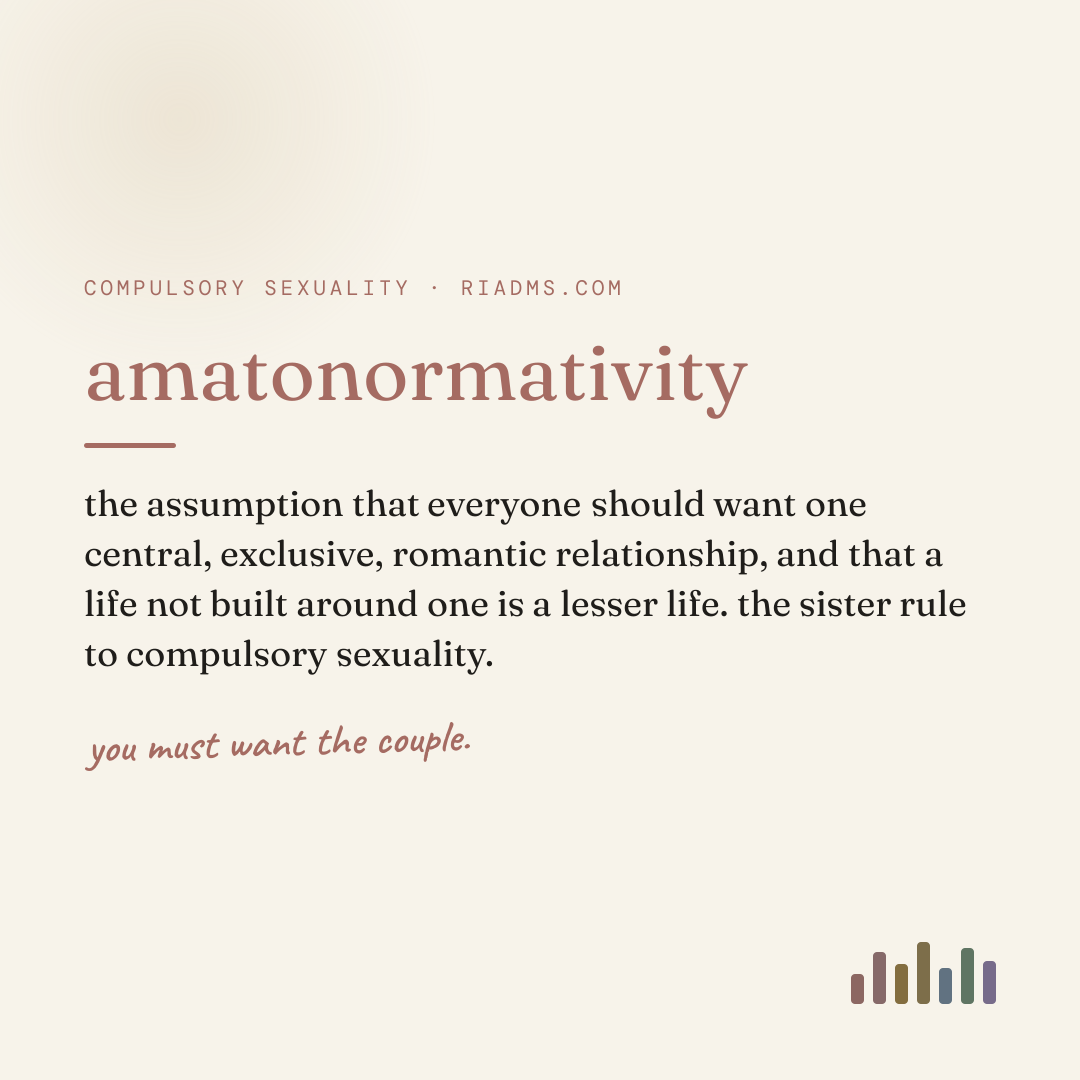
And there’s a sister concept to all of this, coined by the philosopher Elizabeth Brake in 2012, called amatonormativity. It’s the same shape, one level over. The assumption that everyone should want a central, exclusive, romantic relationship, and that a life not built around one is a lesser life. Compulsory sexuality says you must want sex. Amatonormativity says you must want the couple. And between the two of them, they’ve written a script for a human life so complete that most people never realize they’re reading from it. Wanting, coupling, in this order, at this intensity, or something’s wrong with you.
If you want to go deeper on this, the one book to read is Angela Chen’s Ace. It’s the clearest writing anywhere on how the sexual assumption shapes everyone, not just ace people, and it’s genuinely one of the most clarifying things I’ve ever read. For the scholarly spine, Kristina Gupta’s 2015 paper is the piece that lays out, carefully, how the norm regulates all of us and why more sex was never the same thing as more freedom. And if the word amatonormativity landed, Elizabeth Brake’s Minimizing Marriage is where it comes from.
I don’t get to read from the sex part of the script, so I had to write my own. And writing my own is the least broken I’ve ever felt. That’s the thing I want to hand you. Not asexuality. The pen.
You were never failing the test. The test should never have existed.