There is a person you love in a way that doesn’t fit either box. It is too much to be “just a friend.” But it isn’t romantic either. you don’t want to date them, the thought of it feels wrong. So you have spent years calling it a “really intense friendship” and quietly feeling like you are the only person who has ever felt this.
You are not. There is a word for that pull, and a word for the relationship you can build out of it. And the reason nobody handed you either one is not that they don’t exist. it is that our whole culture is built to pretend the space between friendship and romance is empty. It is not empty. some of the biggest loves of your life have been living there the whole time.
the two boxes you were handed
Here is the setup you got, same as everyone. There are two kinds of love that count. there is friendship, and there is romance. and they come with a ranking you never agreed to. friendship is the casual one, the background one, the one you are allowed to cancel on. romance is the real one, the serious one, the one you build a life around.
A philosopher named Elizabeth Brake gave that ranking its exact name in 2012, in a book called Minimizing Marriage. She calls it amatonormativity, and her definition is worth hearing word for word. it is the widespread assumption that everyone is better off in an exclusive, romantic, long-term coupled relationship, and that everyone is seeking one. That is the water we all swim in. the idea that a central romance is the finish line, the thing that makes a life complete, and everything else is a waiting room.
And here is what that assumption quietly does to you. it takes every kind of love that isn’t romance and files it under “less.” So when you feel something huge for a friend, something that doesn’t fit the friendship box, you have nowhere to put it. the culture handed you two boxes, told you one of them outranked the other, and then acted like the entire space between them was empty. It was never empty. you have been standing in it.
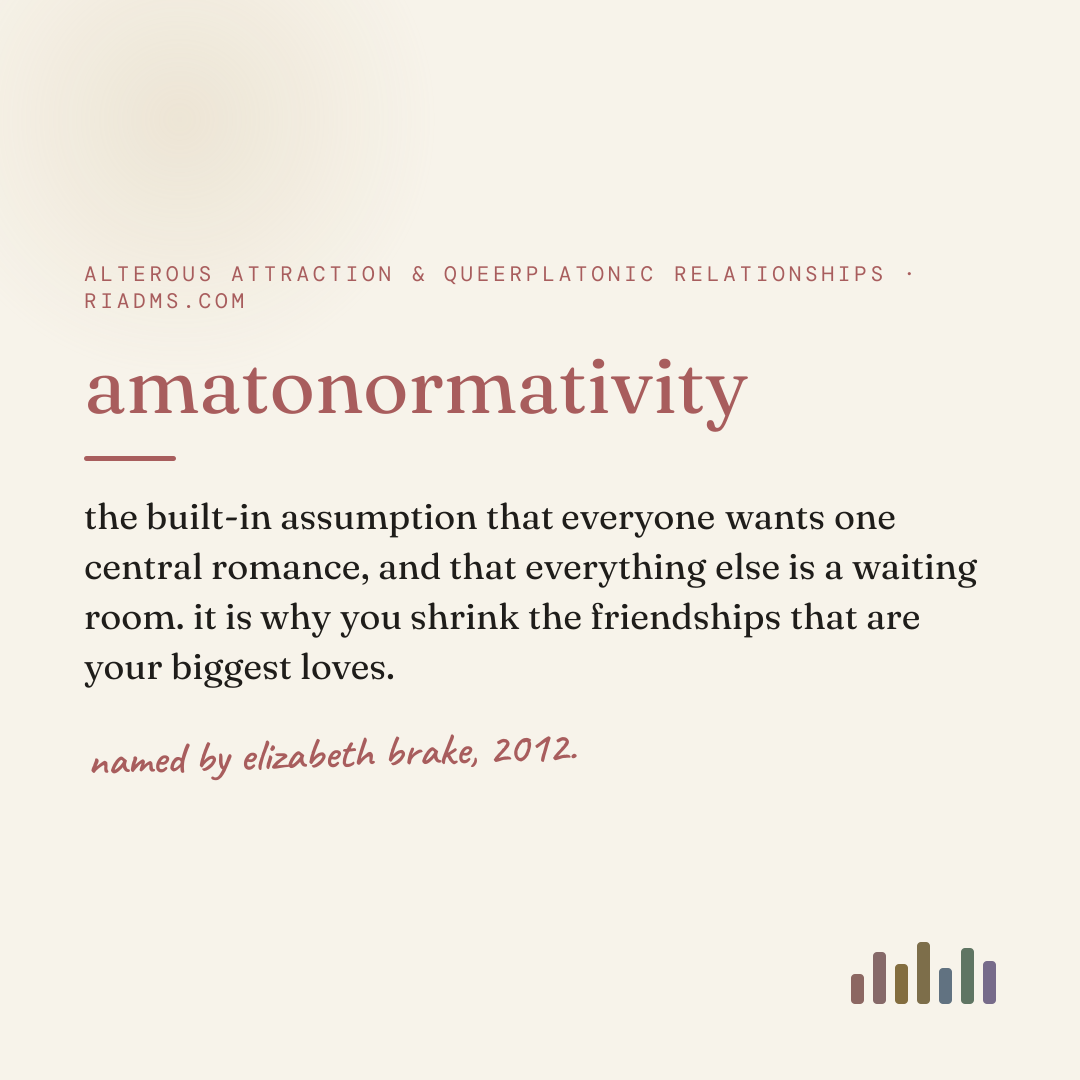
The useful thing about naming amatonormativity is that once you can see the water, you can stop blaming yourself for drowning in it. the feeling that your friendships were “too much” was never a flaw in you. it was you noticing that the size of the love did not match the size of the box the world gave it.
come think with me
one letter a week.
the word for one feeling you’ve had but couldn’t name, and why it works that way. the same thing you just read, in your inbox, once a week.
- one letter a week, about a ten minute read
- all nine printable workbooks, free
- the research, with its caveats kept in
- hit reply and it reaches me. i read every one
no pressure, no spam, no gatekeeping. unsubscribe anytime · riadumitrescu.substack.com
all of this is free and it stays free. if it gave you a word you didn’t have, you can buy me a coffee.
alterous attraction: the word for the pull
So let’s name the feeling first, and then the relationship.
The feeling is called wordalterous attractionThe desire for emotional closeness that is neither platonic nor romantic, something orthogonal to both. Contested, and useful anyway.what is alterous attraction? →. the aromantic community built this word around 2015, because people kept describing a pull that was neither clearly romantic nor clearly platonic, and the existing words just failed. the rough definition is a desire for deep emotional closeness that doesn’t fit “friend” and doesn’t fit “romance.” alterous, as in “other.” as in, other than the two options you were handed.
Let me make it concrete, because abstract is useless here. romantic attraction has a specific shape. you want to date them, you want the thing our culture calls a relationship. platonic attraction has its shape too. you want to be their friend, hang out, have them in your life. alterous is a third shape. you want to be woven into their life. you want to be one of their people, at the center, not the edge. you would reorganize your world around them. but not romantically. there is no wanting to date, no romance script. just an enormous pull to be deeply, permanently close.
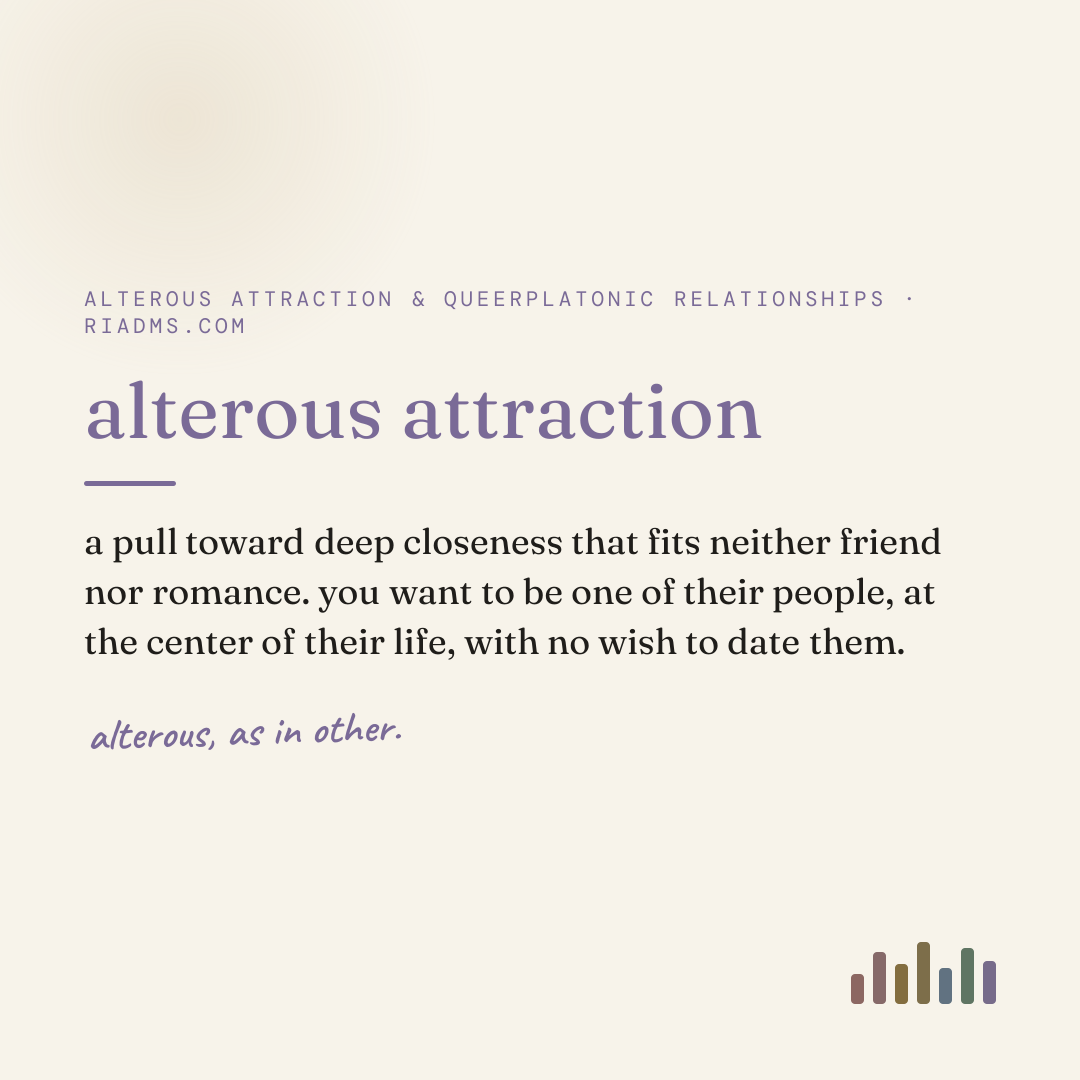
Notice what having the word does. the feeling that made you think you were broken, or too intense, becomes a normal, named thing that other people feel too. that is the whole gift of this vocabulary. it doesn’t box you in, it lets you out. and it fits inside a bigger idea the aromantic and asexual community built, the split attraction model, which is just the recognition that “attraction” was never one feeling. it was six or seven feelings we kept jamming into one word.
the queerplatonic relationship: the thing you can build
Okay, so that is the feeling. here is the relationship you can build out of it, and this one is older. it was coined around 2010, by two writers in the aromantic and asexual community, s.e. smith and Kaz.
A queerplatonic relationship, a wordqueerplatonic relationship · QPRA committed relationship that doesn’t follow the norms of romance or ordinary friendship, its own category of closeness.what is a queerplatonic relationship? →Wikipedia ↗, is a committed, central partnership that isn’t romantic. that is it. two people, or more, who are each other’s person. who might live together, share money, be each other’s emergency contact, plan their lives around each other, maybe raise kids or grow old together. and who are not dating, not romantic, and that is not a phase on the way to something else. the bond, or whatever it is, is the destination.
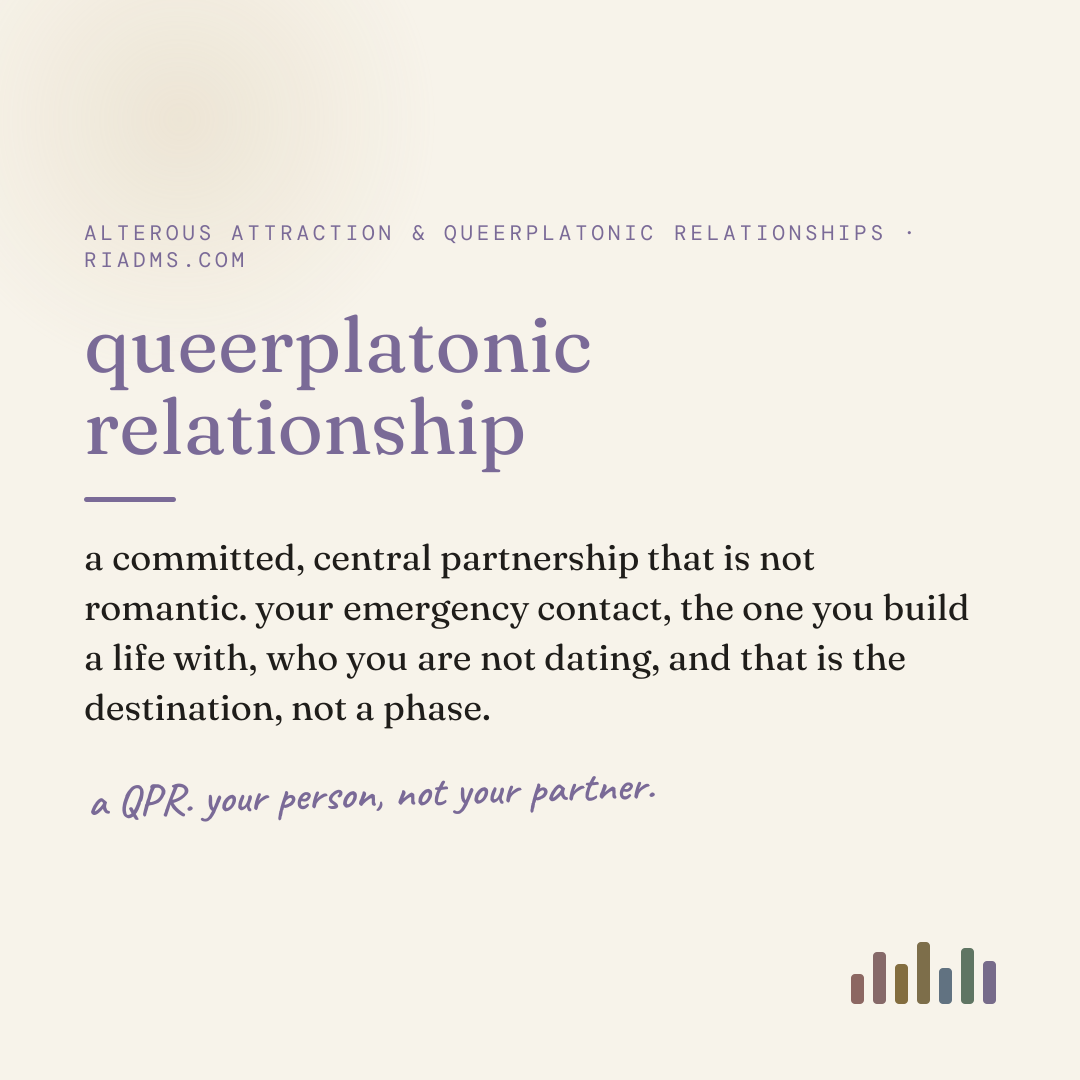
The word “queer” here doesn’t necessarily mean the people are LGBTQ, though they can be. it means the relationship queers the rules. it breaks the assumption that your number one person has to be a romantic partner. it takes a bond our culture only lets you have as a friendship, and gives it the weight and the commitment we normally reserve for romance.
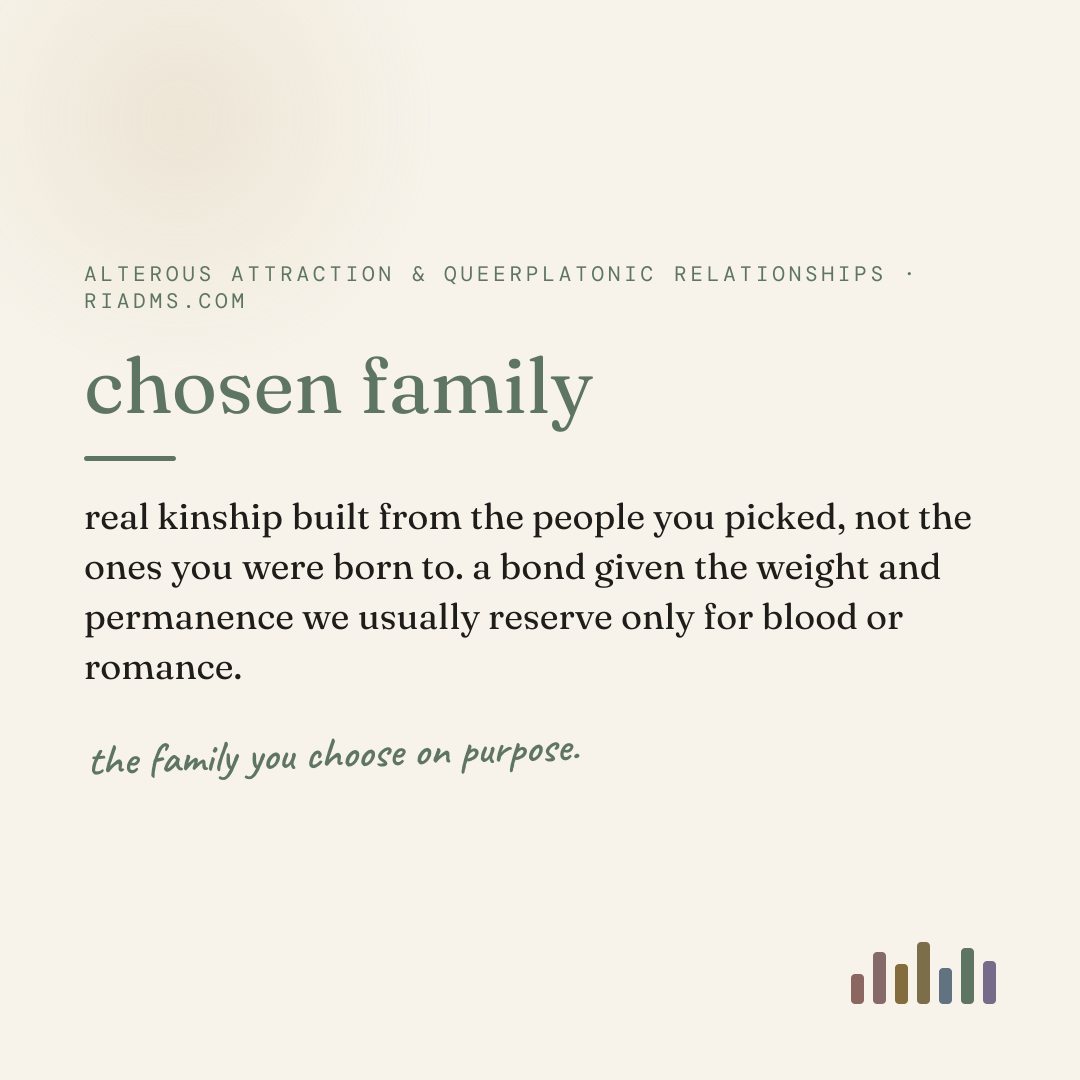
And this is not as fringe as it sounds. we already have a related idea that is decades old. the anthropologist Kath Weston wrote a whole book back in 1991 called Families We Choose, about queer communities building chosen family, real kinship out of people they weren’t born to. a QPR is that idea, pointed at one central person. the family you choose, made your anchor on purpose.
If you want to see it living and breathing rather than defined, The Other Significant Others by Rhaina Cohen is a whole book of people who built their lives around a friendship instead of a marriage. it is the closest thing there is to proof that this is a real way to live, not a consolation prize.
what this looks like from the ace side
I found all of this because I had to. being asexual, and also just being me, I always went looking for a best friend before I went looking for a romantic partner. the hierarchy that automatically puts romance at the top of the pile never made sense in my body. why would the person who knows me best, who I would build a life with, only count if I also wanted to date them.
For a long time I didn’t have the words, so I did what you probably did. I called my most intense loves “just really close friendships,” and I felt a little insane about how much they meant to me, because the size of the feeling didn’t match the size of the box the world gave it. and then I learned there was a whole vocabulary. that a pull could be alterous, that a relationship could be queerplatonic, that you were allowed to put a friendship at the absolute center of your life and call it one of the most important loves you will ever have. nothing in me changed. the feelings were always there. I just finally got words that were the right size for them.
Here is the thing though. this isn’t ace and wordaromantic · aroLittle or no romantic attraction. An aromantic person may still feel sexual attraction. Being aromantic and being asexual are two separate things that can come apart.what does aromantic mean? → people inventing exotic new feelings. everyone has a version of this. the friend you would take a bullet for. the person who is more your family than your family. the bond that outlasted every romance you have had. ace and aro people just noticed the space between the boxes first, because we are the ones it couldn’t stay hidden from.
so what do you do with this
You don’t have to relabel your whole life. that is not the point. the point is smaller and better than that.
The next time you feel a love that doesn’t fit, you don’t have to force it into “friend” and shrink it, or force it into “romance” and break it. you can let it be its own thing. you can say, out loud or just to yourself, this person is one of my people, at the center, and it doesn’t need to be romantic to be that important. and if a word helps, take it. alterous, for the feeling. queerplatonic, for the relationship. and if none of them fit, drop them, make your own, or use nothing at all.
If you want to keep pulling this thread, two places to go. for the philosophy, Elizabeth Brake’s Minimizing Marriage is where amatonormativity gets named and taken apart properly. and if you would rather feel it than study it, Loveless by Alice Oseman is the novel about discovering that a friendship can be the great love of your life. one gives you the argument, the other gives you the ache.
The only thing I want you to walk out with is permission. the space between friendship and romance was never empty. some of the biggest loves of your life have been living there the whole time, unnamed, waiting for you to stop apologizing for how much they mattered. that person you love in a way you could never explain? you don’t need to explain it anymore. you just needed to know the room they live in has a name.


