I want to be held. I want to fall asleep tangled up with someone. I want somebody to play with my hair and rub my back and hold my hand while we walk. And I don’t want sex.
For a lot of people, those two things don’t fit in the same sentence. Because we’ve been handed a rule that says wanting closeness is wanting sex, that touch is a precursor, a rung on a ladder, and the ladder only ever goes one place. So if you want to be touched, you must want the thing at the top.
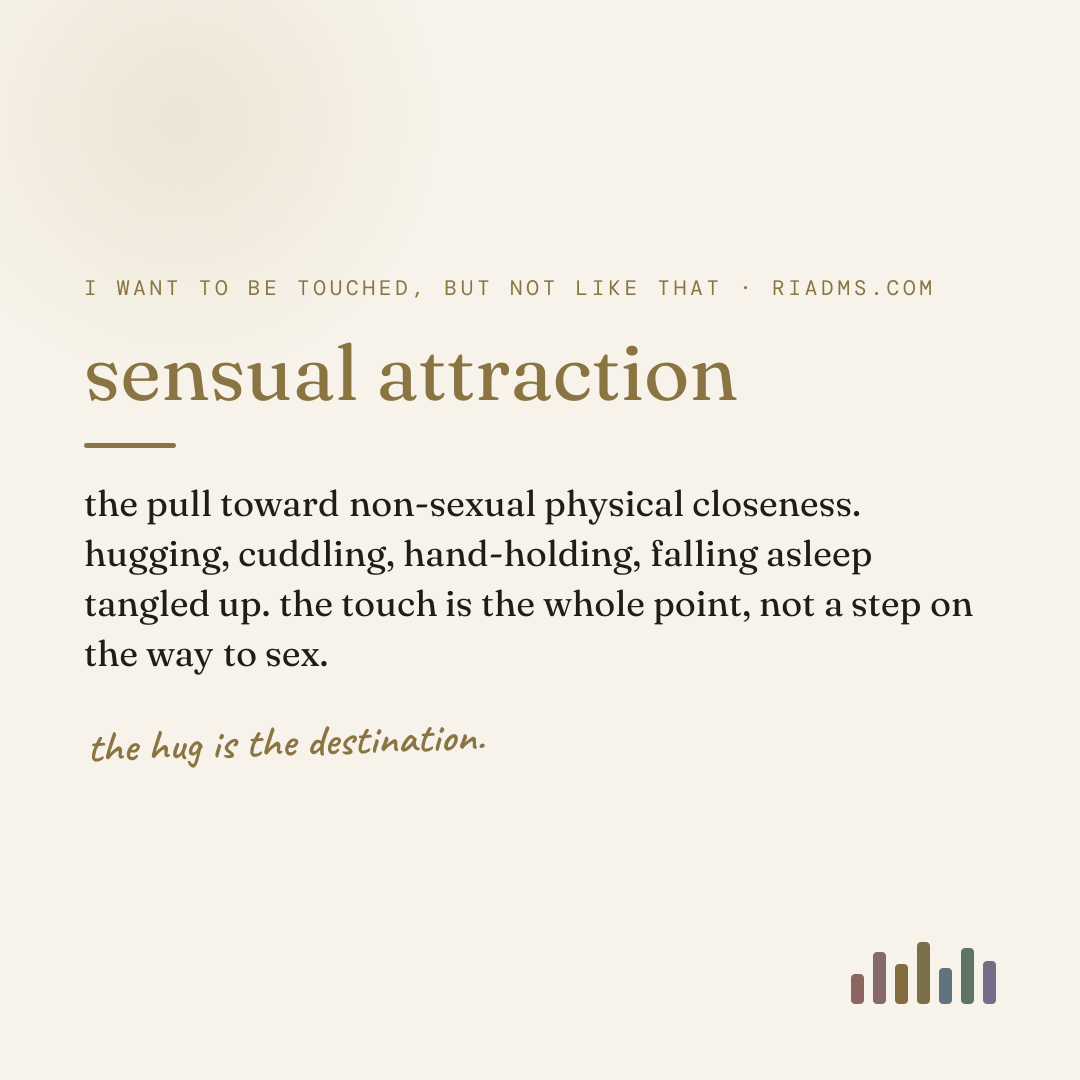
But you can want the holding and not the ladder. That’s not a contradiction, and it’s not a diluted version of desire. It’s wordsensual attractionThe desire for non-sexual physical closeness: holding, cuddling, hand-holding, being tangled up with someone. The touch is complete in itself, not a step toward sex. One of the seven types of attraction.what is sensual attraction? →, and it’s its own thing.
what sensual attraction actually is
Sensual attraction is the desire for non-sexual physical closeness. Hugging. Cuddling. Hand-holding. Leaning against someone on a sofa. The warmth of another body, the weight of an arm across your ribs while you fall asleep.
And this isn’t just a nice idea. In 2026 the first peer-reviewed instrument to validate different types of attraction confirmed sensual attraction is empirically distinct from sexual attraction. A different factor. A different scale. A different experience, measured separately and holding up as its own thing. The science finally caught up to what a lot of us have been trying to say for years.
Here’s the part that matters most. Sensual attraction is complete. It isn’t a step toward something. It isn’t foreplay. It isn’t building to a destination. The touch is the destination. The hug is the whole thing. The hand-holding is the whole thing.
For me this is one of my strongest forms of attraction. I want to be physically close to the people I love, and that closeness has nothing to do with sex. It has to do with safety. Comfort. The animal need to be near someone you trust.
come think with me
one letter a week.
the word for one feeling you’ve had but couldn’t name, and why it works that way. the same thing you just read, in your inbox, once a week.
- one letter a week, about a ten minute read
- all nine printable workbooks, free
- the research, with its caveats kept in
- hit reply and it reaches me. i read every one
no pressure, no spam, no gatekeeping. unsubscribe anytime · riadumitrescu.substack.com
all of this is free and it stays free. if it gave you a word you didn’t have, you can buy me a coffee.
why touch always seems to mean sex
Our culture drew a line and then deleted everything in the middle.
On one side, friendly touch. A handshake. A pat on the back. Brief, surface-level, a little performative. On the other side, sexual touch. Private, intimate, going somewhere. And the entire middle, the vast human middle of sustained, meaningful, non-sexual holding, got erased. There’s almost no cultural script for it.
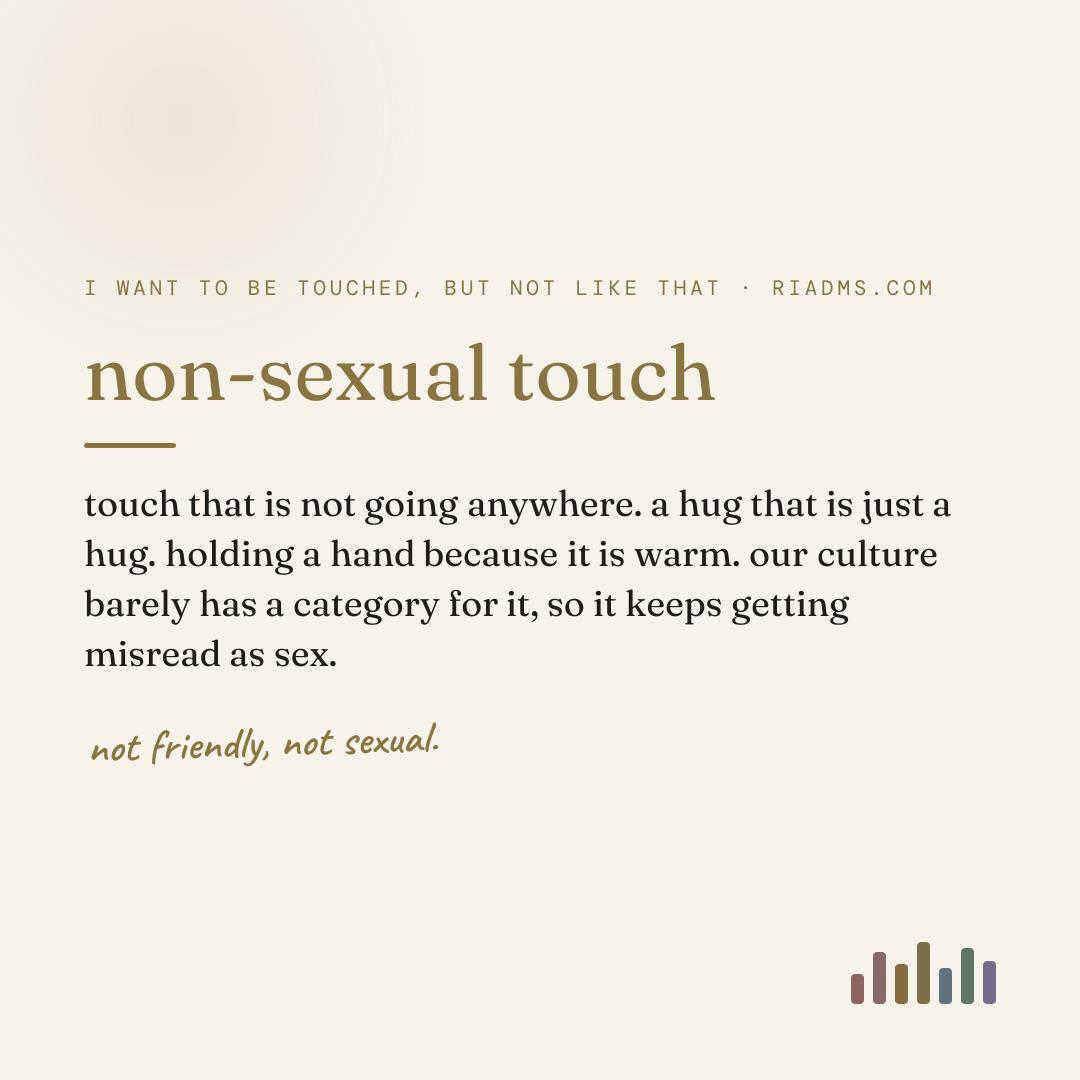
So the middle keeps getting misread. Cuddle a friend for twenty minutes and people assume you’re sleeping together. Hold a friend’s hand and people assume you’re dating. Fall asleep in someone’s arms and it gets read as a prelude. When every kind of lingering touch is filed as sexual, the people who want touch without sex are left with two bad options. Accept the sexual reading and endure the assumption, or pull away from touch altogether.
A lot of ace people, me included, chose pulling away for years. Not because we don’t want touch. Because the world made touch conditional on sex, and we couldn’t accept the condition.
what it actually does to your body
Let me describe what this feels like from the inside, because I think most people have never had it described separately from sexual desire.
When I’m being held by someone I trust, and neither of us is going anywhere, my whole nervous system changes. My breathing slows. My muscles let go. My brain stops its constant processing. It’s the closest thing I have to meditation. Not because of the person, exactly. Because of the contact. The contact itself is the medicine.
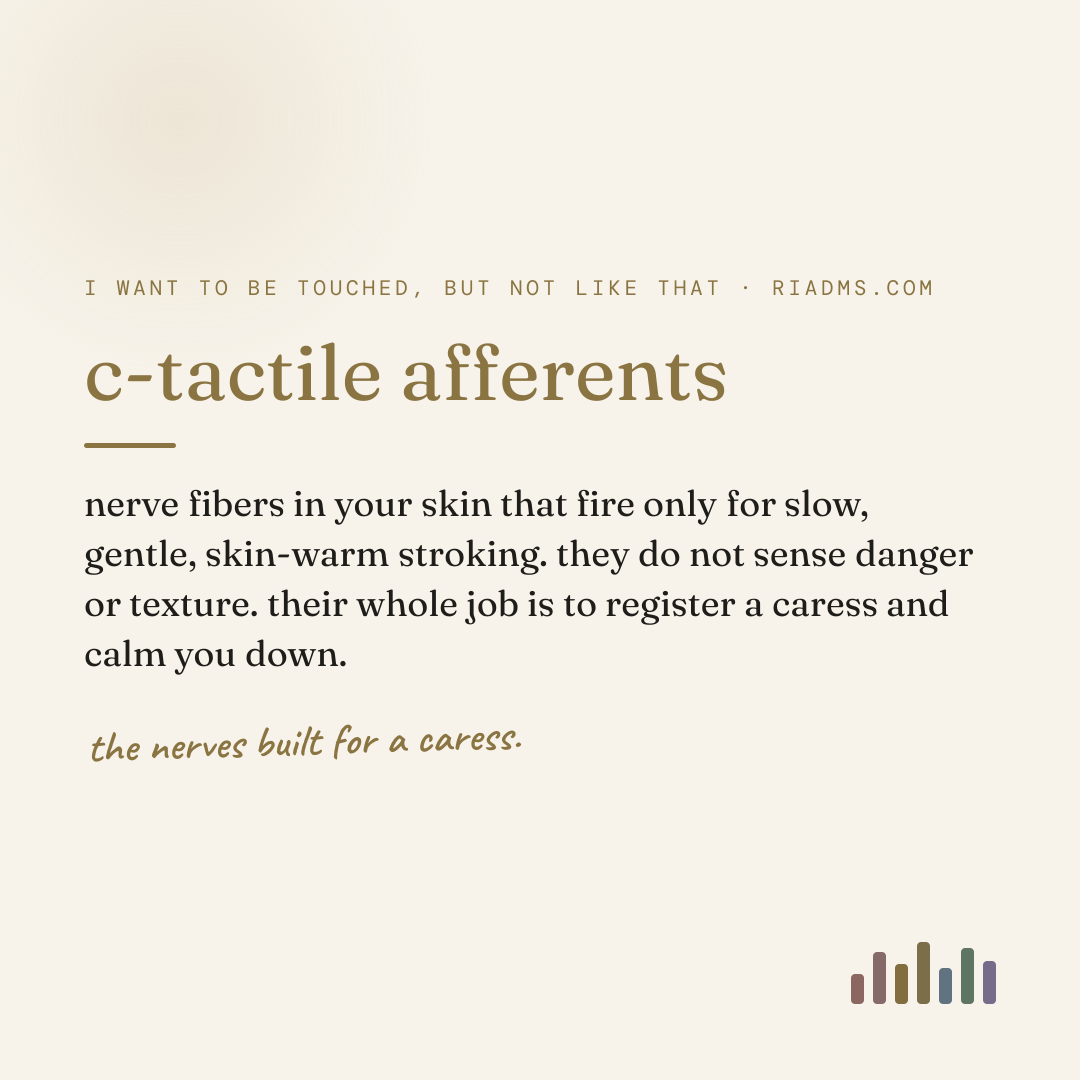
And this is where the page can go past the video, because there’s a real mechanism under that feeling. Your skin has a specific class of nerve fibre, c-tactile afferents, that doesn’t sense danger or texture or pressure. They fire almost exclusively for slow, gentle, skin-temperature stroking. A caress, basically. Their whole job seems to be registering affectionate touch and routing it to the parts of the brain that handle emotion and safety, not the parts that map the physical world. You have a dedicated wiring for being stroked, and it is separate from the wiring for everything else your hands do.
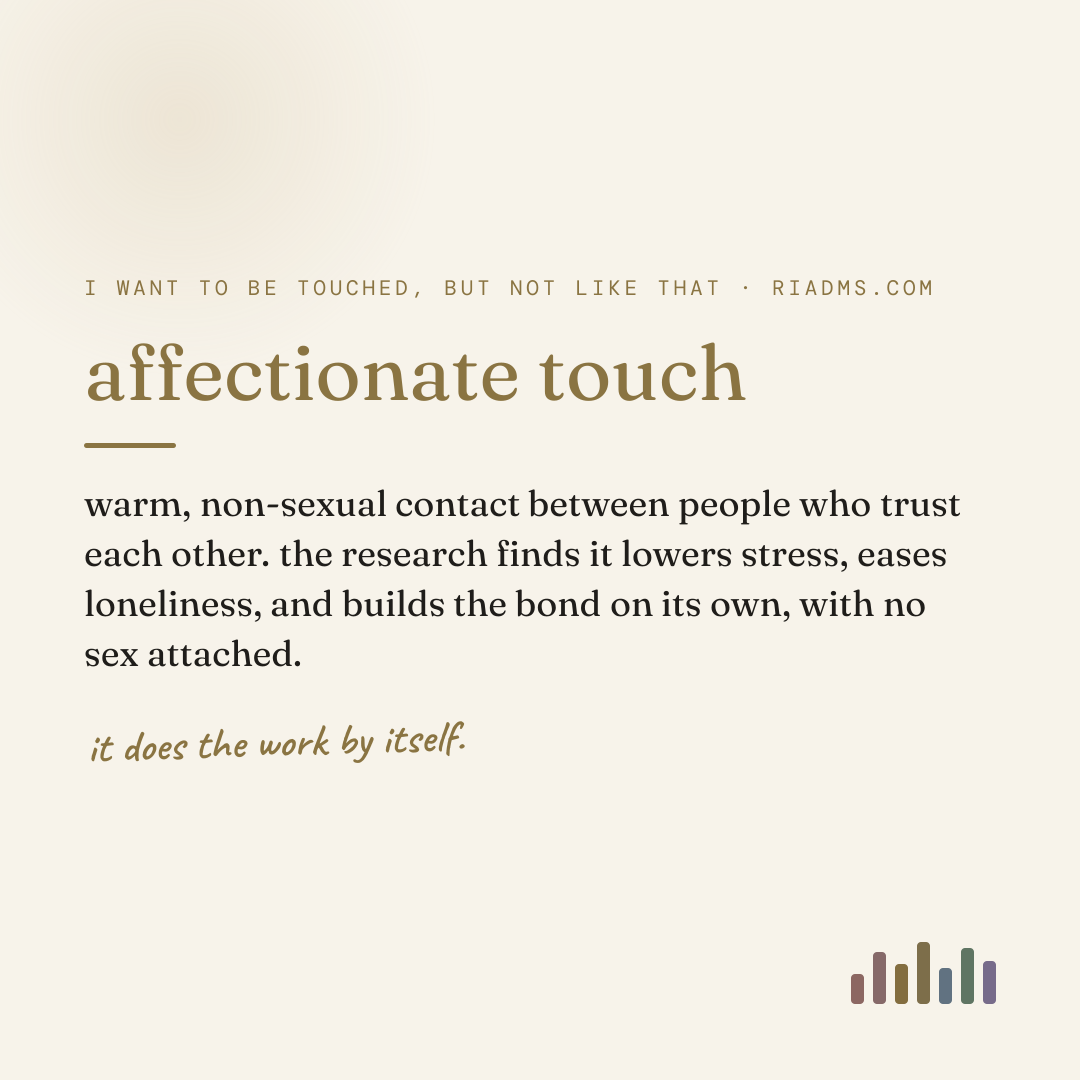
When that system gets what it’s built for, the body responds. Affectionate touch lowers heart rate, blood pressure and cortisol, and raises oxytocin, the hormone that quiets the stress response. In one study, people facing the threat of a mild electric shock had their brain’s alarm circuits go quiet the moment they held a partner’s hand. The contact was doing the regulating. None of this needs sex to happen. The calm is the touch, full stop.
Which is the whole point. This deep, physical, nervous-system-level need for contact exists completely independently of wanting sex. It’s not desire turned down low. It’s a different need, the way thirst and hunger are both real and not the same. You can be thirsty without being hungry. You can want to be held without wanting to be touched sexually.
the ache when it goes missing
If touch is a need, then going without it isn’t neutral. It has a name, and the name is skin hunger.
Going without affectionate touch tracks with more loneliness, more depression, more stress, and worse health. Not as a metaphor. As a measurable thing, in the research on affection deprivation. Your body keeps count of how long it’s been since someone held you, the same quiet way it keeps count of how long since you ate.
And here’s the part that isn’t really about ace people at all. Most adults, especially men, especially straight men, have been trained to treat the urge for non-sexual closeness as suspect. If I want to be physically close to my friend, what does that say about me. So the impulse gets suppressed, the touch never happens, and an entire population goes years without being held by anyone who isn’t sleeping with them. The Surgeon General now treats loneliness as a public-health emergency, and I don’t think it’s a coincidence that we got lonely right as we erased the one kind of touch that asks for nothing back.
touch that isn’t going anywhere
In my relationship, sensual intimacy is one of our primary love languages. We hold each other. We sit close. We fall asleep tangled. And none of it is leading to anything. It’s the main event.
I’ve come to think that’s actually healthier than how touch usually works. When touch always leads somewhere, it turns transactional. You touch someone and they start calculating. Is this going to become sex. Should I reciprocate. What does this mean. The touch becomes a question that needs answering.
But when a hug is just a hug, and both people know it, the calculation stops. There’s no agenda to read. It’s just two nervous systems saying I trust you through the skin. That is what most people are actually starved for, and it’s the thing the research on affectionate touch keeps landing on: the closeness does its work on its own, with nothing attached.
If you want the one book that goes deepest here, it’s Tiffany Field’s Touch, from the researcher who basically built this field. For the ache side of it, Kory Floyd’s The Loneliness Cure is the whole thing on skin hunger and how to actually meet it. And if you want the vantage point this page is written from, Angela Chen’s Ace is the clearest writing anywhere on what closeness looks like when sex isn’t the engine.
I want to be touched. I just don’t want it to mean what you think it means. And I think millions of people feel the same and never had it put into words. They want closeness, not sex. Comfort, not passion. To be held without being wanted.
That’s sensual attraction. It isn’t lesser and it isn’t incomplete. It’s one of the most fundamental things a body can need, and we spent a long time pretending it didn’t exist because we couldn’t tell it apart from sex. The research says they’re different systems. Your body knew that the whole time.


