You were completely unbothered by someone. Not attracted, not interested, nothing. And then they said one brilliant thing, and something in your brain just woke up. Suddenly you needed to hear what else was in there.
That’s not admiration. That’s attraction. A real, specific kind, pointed at a mind instead of a body. And for some people, maybe you, it’s the strongest pull they have, and nobody ever handed them the word for it.
I’m asexual, so this one is basically my whole map. When the sexual pull isn’t running, the pull toward how someone thinks gets very, very loud. So let me tell you what it is.
what intellectual attraction actually is
Intellectual attraction is the pull toward someone’s mind. Not their face, not their vibe in general. Their mind, specifically. The way they build a thought. The way they land somewhere you wouldn’t have. The way a sentence out of their mouth reorganizes something in your head.
And this isn’t just poetic. In 2026, the first peer-reviewed instrument to validate different types of attraction did the careful academic version of what the asexual community had been saying for years. It built and tested a measure of seven separate forms of attraction. Sexual, romantic, and then five more that usually get ignored, including intellectual. And statistically, they hold up as distinguishable things. Intellectual attraction isn’t a branch of romance. It’s its own channel.
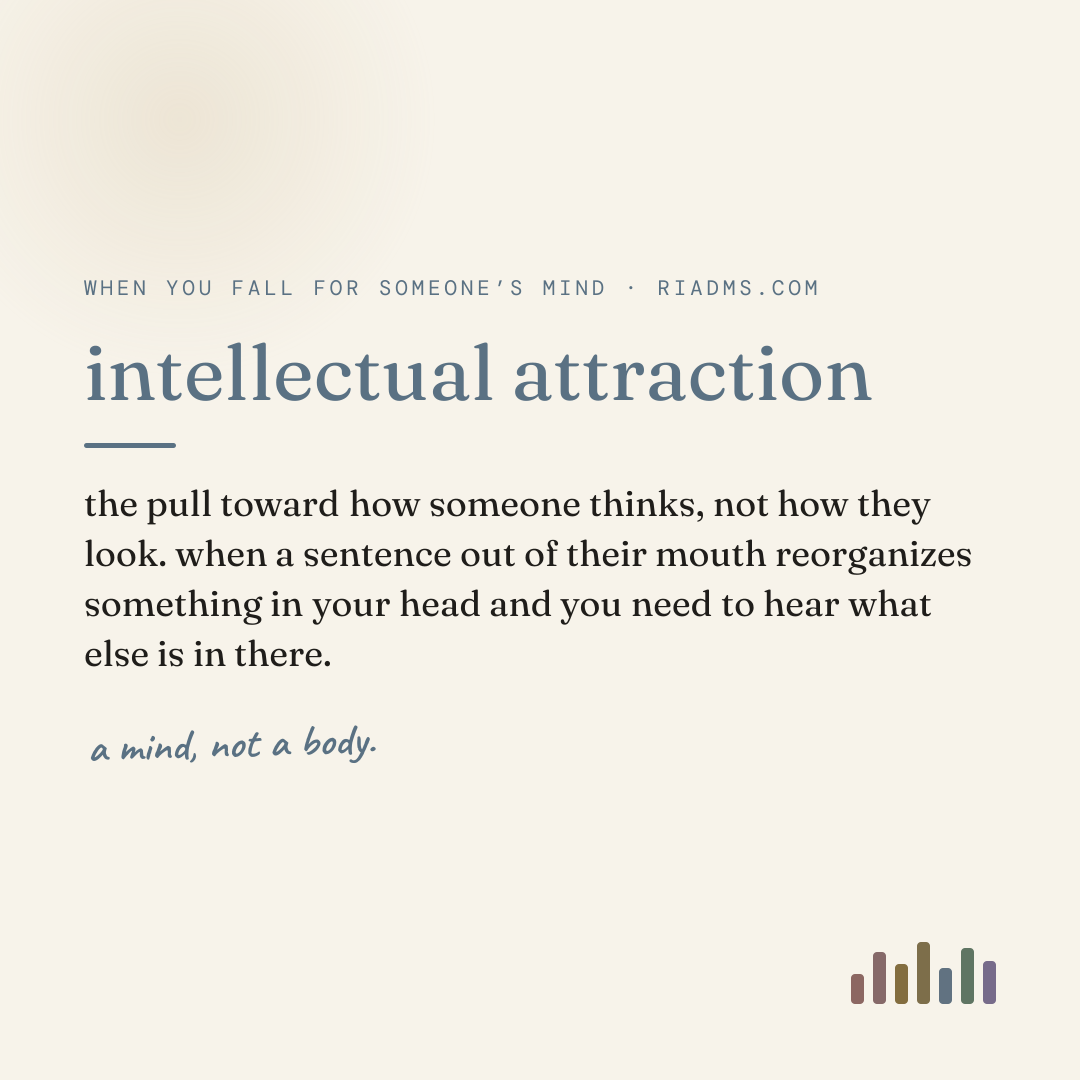
The word itself came out of the ace and aromantic community in the mid 2010s, part of a whole vocabulary people built once they realized “attraction” was doing the work of about six different feelings at once. No lab handed it down. People needed a word for the thing where a mind pulls you and a body doesn’t, so they made one.
And here’s the part that should make you feel less strange. Wanting a mind is not niche. It’s one of the most human things there is. Back in 1989, David Buss ran a massive study, over ten thousand people across 37 cultures, asking what they actually want in a partner. And across almost every single culture, two traits sat at the very top for everyone. Kindness, and intelligence. Not looks, not money. A good mind and a good heart. So if you’ve ever felt shallow for chasing brilliance, relax. You’re chasing the thing the entire species quietly ranks first.

come think with me
one letter a week.
the word for one feeling you’ve had but couldn’t name, and why it works that way. the same thing you just read, in your inbox, once a week.
- one letter a week, about a ten minute read
- all nine printable workbooks, free
- the research, with its caveats kept in
- hit reply and it reaches me. i read every one
no pressure, no spam, no gatekeeping. unsubscribe anytime · riadumitrescu.substack.com
all of this is free and it stays free. if it gave you a word you didn’t have, you can buy me a coffee.
the surprising part: smarter is not better
Here’s where it gets genuinely interesting, because there’s a study just on this, and the finding is not what you’d guess.
In 2018, a researcher named Gilles Gignac set out to measure sapiosexuality. That’s the term for people who are specifically, sexually drawn to intelligence. He built a scale, gave it to people, and asked, basically, how attractive is intelligence, and how much of it is most attractive.
You’d assume the answer is “more is better.” The smarter the person, the hotter. It’s not. Attractiveness of intelligence climbed steadily and peaked around the top ten percent. Someone smarter than about ninety percent of people. And then, going higher, toward genius level, the top one percent, it actually dropped back down.
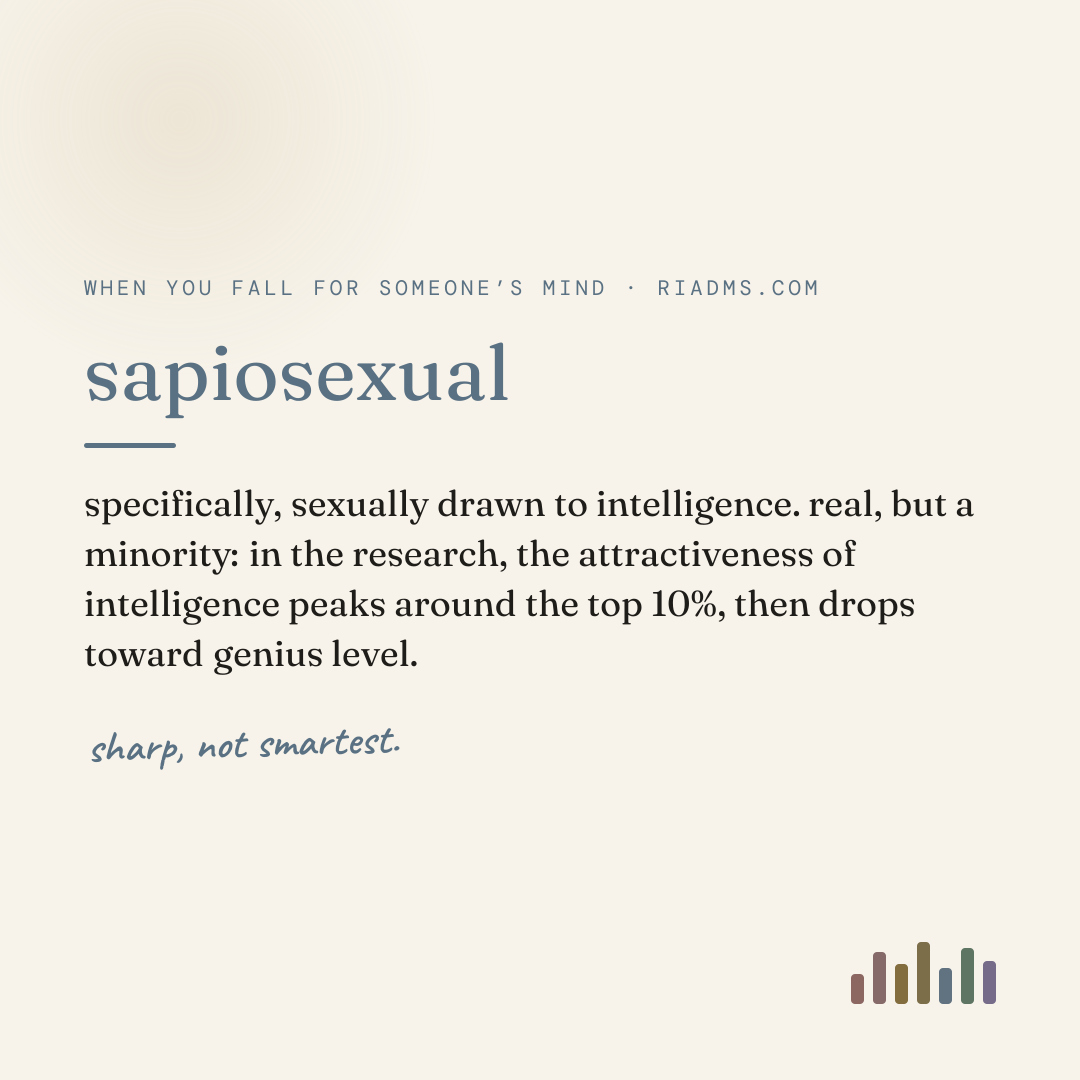
So the sexiest thing isn’t the smartest person in the room. It’s the person who’s clearly sharp, clearly gets it, but not so far out that you can’t reach them. That’s not “I want to be outsmarted.” That’s “I want to be met.” And I think that’s the real thing under intellectual attraction. It was never about ranking someone’s IQ. It’s about the feeling of your mind being kept up with. Being understood at speed.
One honest note, because I say these things carefully. That study was people reporting how they feel, not machines measuring arousal in a lab. And here’s the twist that makes me trust it more, not less: when the researchers actually tested people’s intelligence, it barely correlated with their sapiosexuality scores. Which suggests the pull isn’t toward raw IQ at all. It’s toward perceived intelligence. Wit, the way someone reasons, the confidence of a mind that clearly works. And only a small slice of people, somewhere between one in a hundred and one in ten depending on how strict you are, said intelligence was a real turn on for them specifically. For most people it’s a strong preference, not the main event. But for that slice, and I’m in it, the mind is the event.
what this means for me as an ace person
For me, intellectual attraction is probably the strongest pull I have. And I think that’s directly because I’m asexual.
When you take the sexual channel out, it doesn’t leave a blank. The other channels just get louder. And the loudest one for me is this. I’m drawn to people by their minds. It’s the thing that makes me want to be around someone, the thing that makes me think I need to talk to them again, the thing that does what a crush does to other people.
My partner’s mind is why I’m with him. Not his face, not his body. The specific way he thinks. The way he gets to conclusions I wouldn’t have reached, the way his brain runs differently from mine and the difference makes something neither of us could make alone. And I want to be really clear, because people assume this is a consolation prize. Like, well, she can’t be into his body so she settled for his brain. No. His brain is the attraction. Fully. It’s not the runner up, it’s the whole race.
There’s this thing that happens in a conversation that goes long, past midnight, where you keep handing each other pieces and the pieces keep fitting. That, for me, is more intimate than any touch. And it turns out there’s research on exactly this. Back in 1997, Arthur Aron ran the famous study where he put two strangers together and had them ask each other a set of slowly deepening questions, real ones, not small talk. And after about forty five minutes the pairs felt dramatically closer than strangers who just chatted.
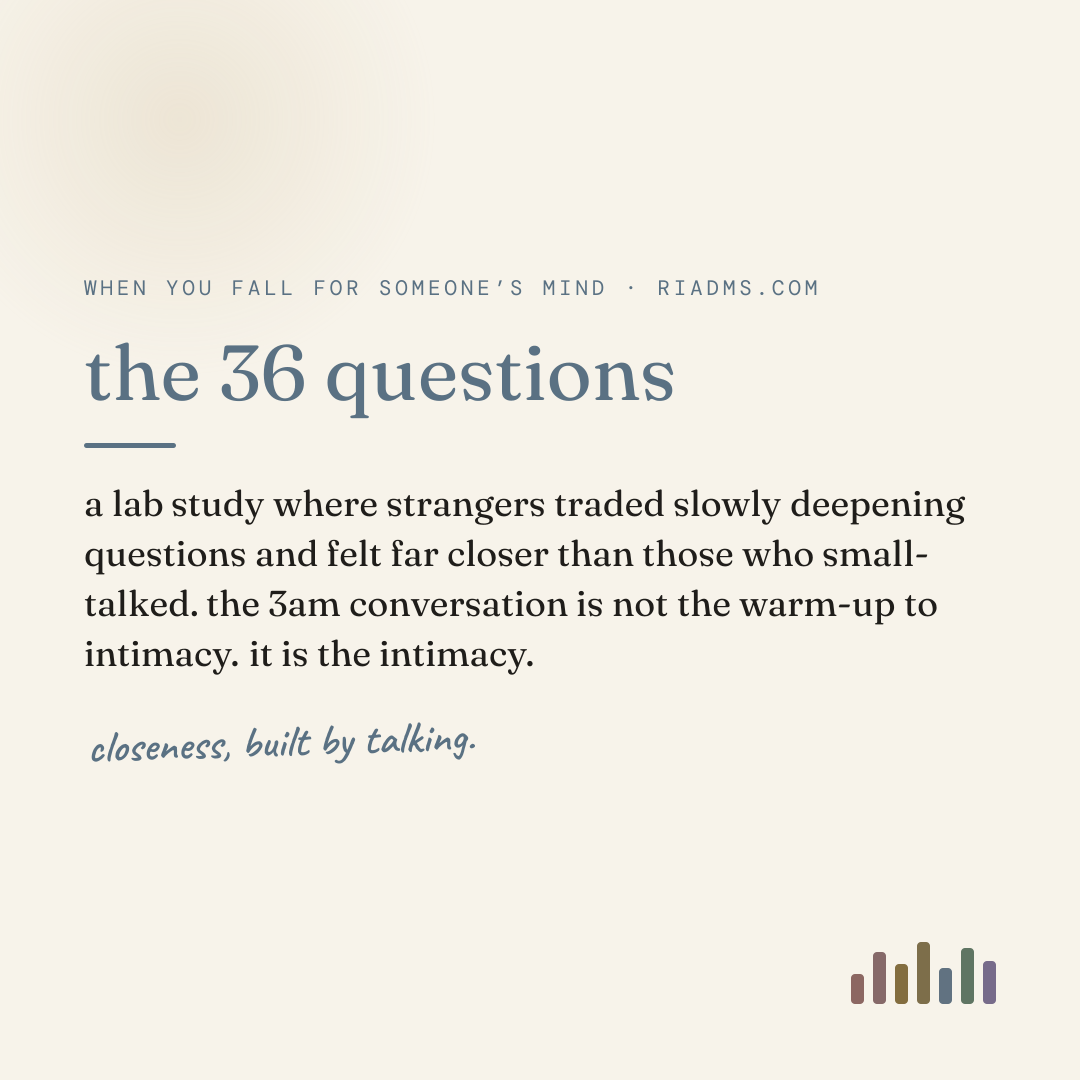
You’ve probably heard this study called “the questions that make you fall in love.” That’s a headline, not the finding. What it actually showed is quieter and, honestly, better: escalating mutual disclosure builds closeness, on its own, faster than we think it can. The 3am conversation isn’t a warm up to intimacy. It is the intimacy. That’s the whole event for me, and I don’t think I’m as unusual as the culture makes me feel.
it shows up in who we actually marry
Here’s the thing the video didn’t have room for, and it’s my favorite part.
If intellectual attraction were just a feeling people romanticize, it wouldn’t leave a mark on the real world. But it does. When researchers look at who actually pairs off, they find assortative mating: people reliably end up with partners of similar education and cognitive ability. Not identical, but close, and far closer than chance. The pull toward a mind is strong enough to show up in the census, not just the poetry.
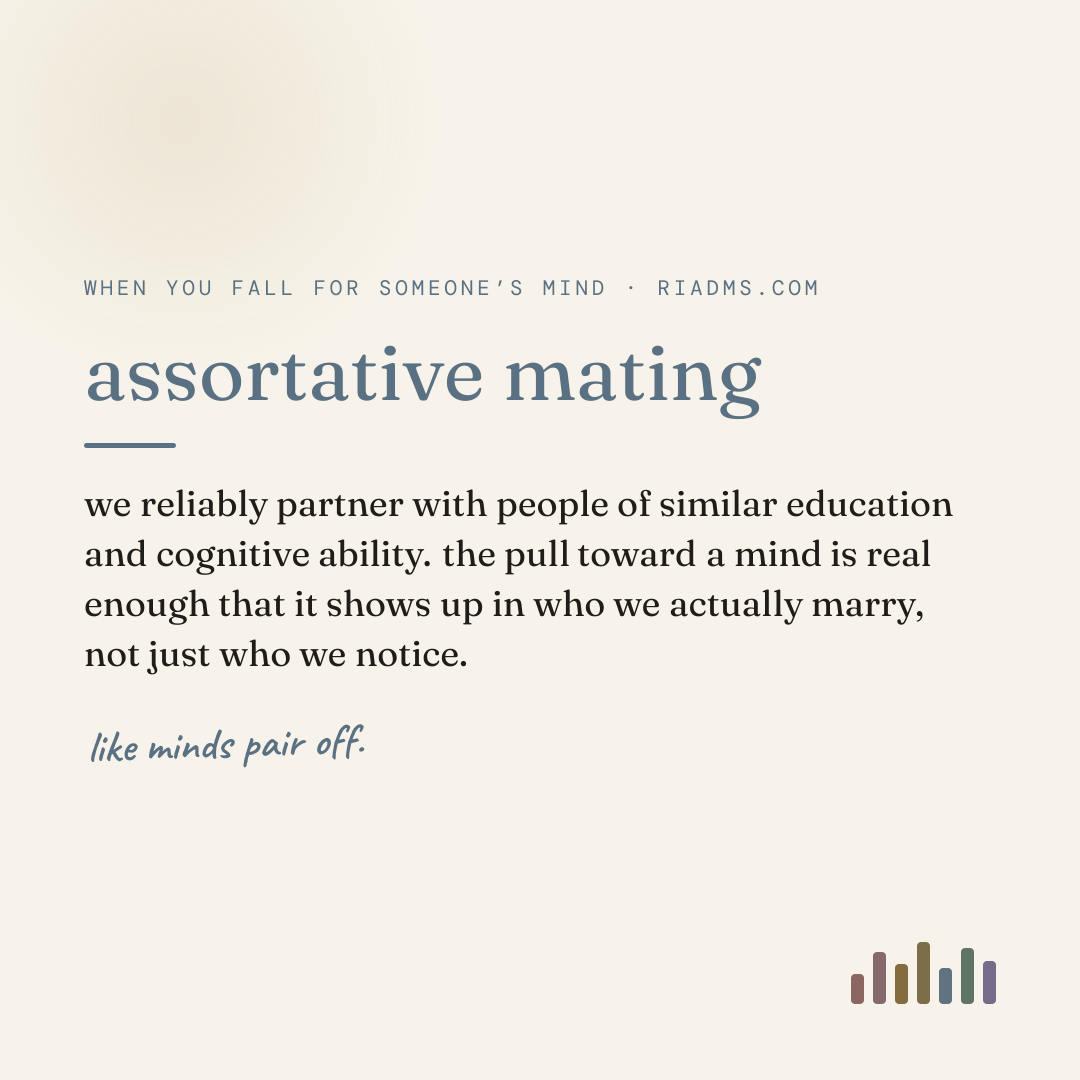
Which reframes the whole thing. We treat “we just really clicked” as a vague, unmeasurable spark. But a lot of the time, the click is two minds recognizing they run at the same speed. That’s not mystical. It’s a real, trackable form of attraction that has been steering who people build lives with the entire time, quietly, under a name nobody gave it.
the signs you feel it too
So how do you know if this is one of yours. Here’s what it looks like from the inside.
You’ve lost interest in someone the second you realized they couldn’t hold a conversation. Not because they were unkind or ugly. Just, the lights weren’t on in there, and something in you quietly deflated and the whole person got less interesting.
You’ve become fascinated by someone you did not find attractive at first, and the fascination started with something they said. A take, an argument, a joke so precisely built it showed you a whole way of thinking, and after that you couldn’t stop paying attention.
You’ve felt closer to someone after one long conversation than after any amount of physical time. Talking till the sky went grey did more than any hug.
And you’ve described someone as “attractive,” and when a friend asked why, every single reason you gave was about how they think, not how they look.
If you’re nodding, that’s intellectual attraction, and it’s been running your relationships this whole time. You just filed it under “we really clicked” because nobody gave you the sharper word.
We’re taught attraction lives in the body. The face, the chemistry, the spark. And the idea that you could be genuinely attracted to a mind sounds almost like a line, something you say to seem deep. It’s not a line. It’s real, it’s got its own channel in the research, and for some of us, ace people, sapiosexual people, and honestly a lot of people who never had the word, it’s the most powerful pull we have.
If you want to go further, the one book to read is Angela Chen’s Ace, which is the clearest writing anywhere on what attraction looks like once you take the sexual channel out and the quieter channels get loud. And if you want to sit with the science, the 36 questions study is the whole idea in one experiment: closeness is built by disclosure, not by time or by touch. The full shelf is below.
So the next time someone says something and your brain lights up, and you catch yourself thinking wait, who are you, don’t talk yourself out of it. That’s not just respect. That’s attraction. The smartest kind, the one that’s still there long after a face becomes familiar.
Go find the minds that keep yours company. That’s not settling. That’s the good stuff.


