Nobody did anything wrong. That is the part you keep getting stuck on.
You were asked. You thought about it. You said yes, and you meant it in the only sense you had a word for, which is that nobody made you say it. And then afterwards you felt like something had been taken off you, and you could not say what, because on paper nothing was.
So you file it under being difficult. You decide you are the problem, because every box got ticked and you still came out of it wrong.
I want to be clear about what this is not. This is not the one where somebody pushes and pushes and you give in. That has a name, it is worse, and it is not what I am talking about. I am talking about the yes that was freely given and still cost you something, and the reason nobody can help you with it is that there is no incident in it to point at.
there are two completely different reasons to say yes
Here is the thing I worked out much later than I should have.
There are two reasons to say yes to something you were not already wanting, and they have nothing to do with each other.
One is moving toward. I want to be close to them. I want to see their face when I say it. I like being wanted, and that is a real reason and it counts. Nobody had to want the act itself first for this to be honest. You wanted what was on the other side of it, and you went and got it.
The other is moving away. I do not want the sulking. I do not want the conversation. I do not want to spend the next four days being punished in ways nobody could describe out loud. There is no one to blame in that sentence either, and that is what makes it so hard to see. It is not a threat. It is a forecast, and you have made it enough times to trust it.
Both of those make the exact same word come out of your mouth.
From the outside they are identical. There is no tell. If you filmed both of them you would get the same footage, the same yes, the same face. And they do not leave you in the same condition at all.
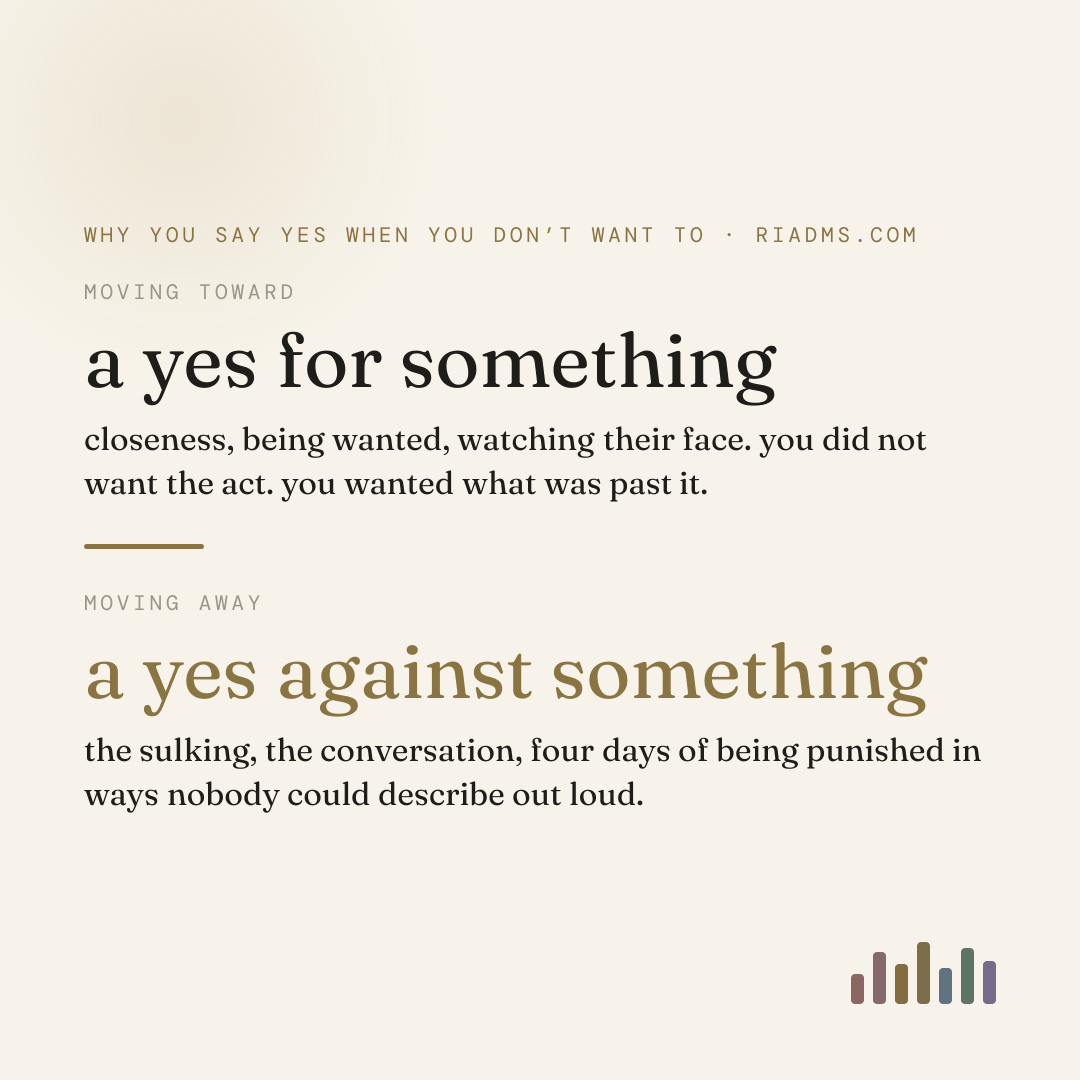
That is the whole thing. Not whether the yes was real, because it was real, both times. What it was made of.
come think with me
one letter a week.
the word for one feeling you’ve had but couldn’t name, and why it works that way. the same thing you just read, in your inbox, once a week.
- one letter a week, about a ten minute read
- all nine printable workbooks, free
- the research, with its caveats kept in
- hit reply and it reaches me. i read every one
no pressure, no spam, no gatekeeping. unsubscribe anytime · riadumitrescu.substack.com
all of this is free and it stays free. if it gave you a word you didn’t have, you can buy me a coffee.
it has a name, and it is very ordinary
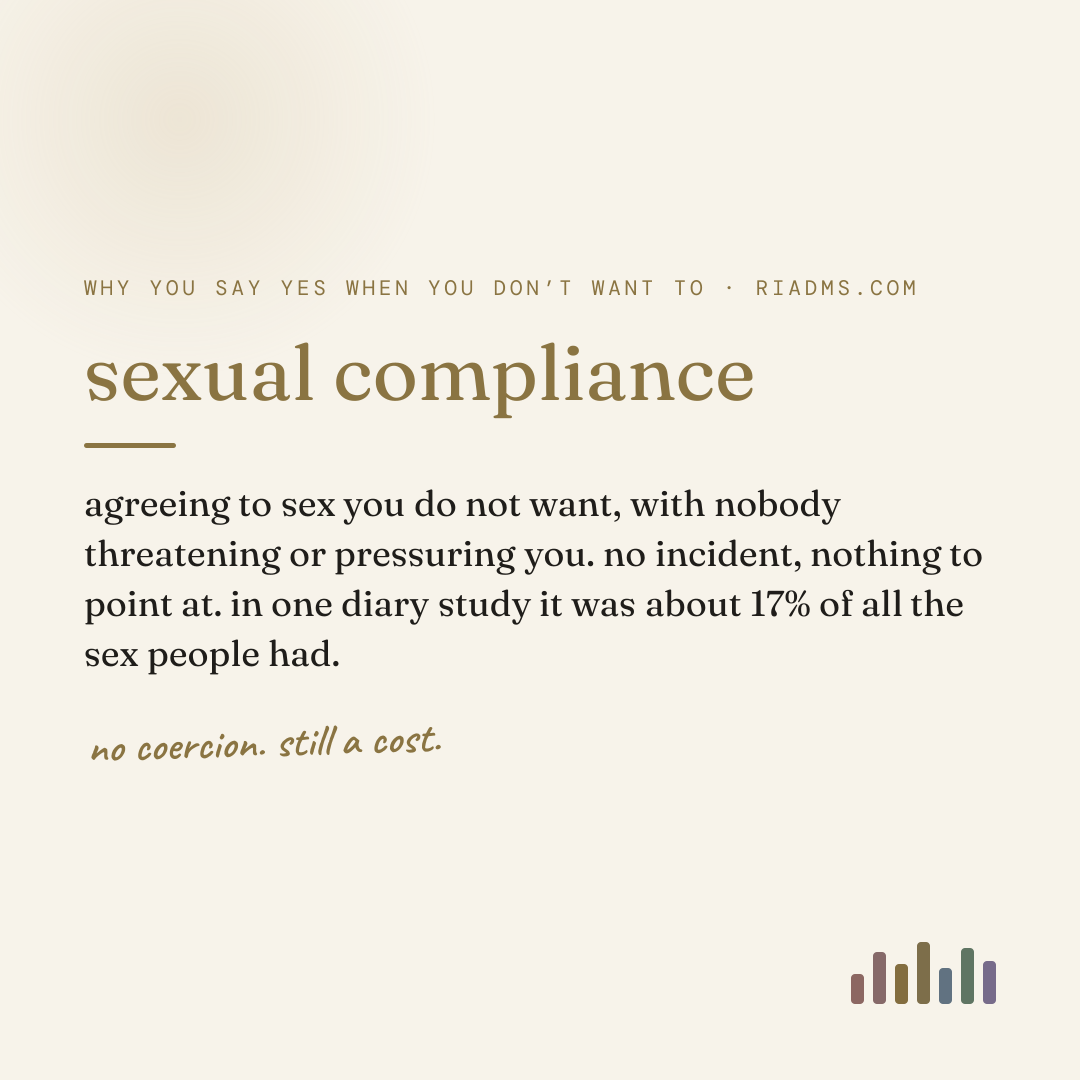
The research calls it sexual compliance: agreeing to sex you do not want, in the absence of any pressure, threat or coercion. Emily Impett and Letitia Anne Peplau established the term in a 2003 review in the Journal of Sex Research, and the thing I want you to take from it is how unremarkable it turns out to be.
Sarah Vannier and Lucia O’Sullivan followed 63 young adults in committed relationships through a diary study with interviews in 2010. Around 17% of all the sexual activity they logged was compliant, and those occasions were rated less enjoyable and more unexpected than the rest. One in six. Not a rarity, and not a crisis either. Just a normal part of the furniture of a relationship that nobody had given them a word for.
In an earlier study, Impett and Peplau asked 125 college women about it directly. Sixty-three per cent of the sexually active women who saw their partner at least weekly said they had consented to unwanted sex with him.
So the first thing to put down is the idea that this is your private defect. It is the most common thing in the world, and you were never handed language for it, which is why it has been sitting in you unfiled for years.
consenting and wanting were never the same question
Here is the structural problem, and it is not in you.
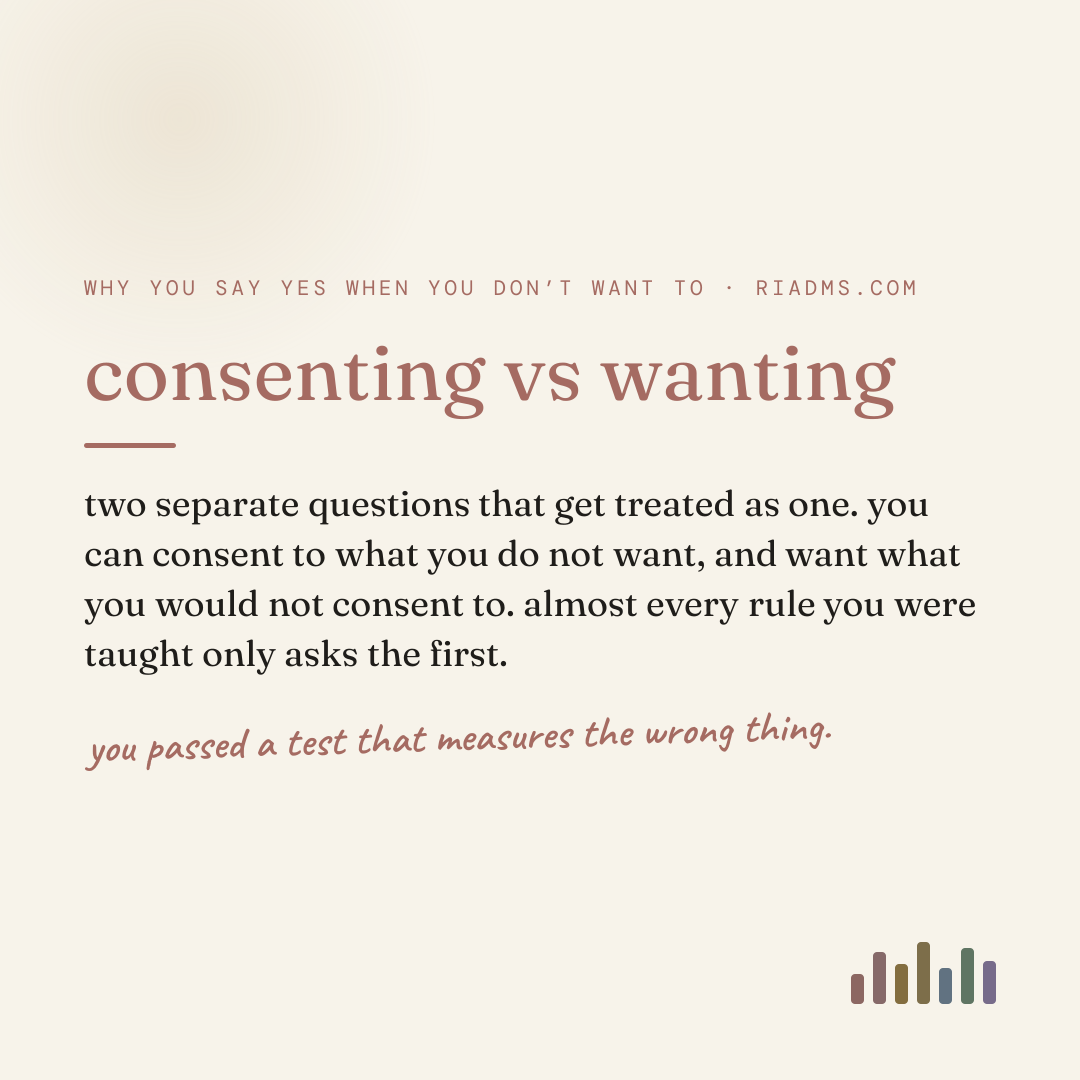
Almost everything you were taught runs on one axis: wanted and consensual on one end, unwanted and non-consensual on the other. Zoë Peterson and Charlene Muehlenhard named that assumption and took it apart in 2007. Their words for it are that the usual model of wanting is “unidimensional and dichotomous” and that it “conflates wanting and consenting.”
They are two different questions. You can consent to something you do not want. You can want something you would never consent to. Wanting is not one dial with a number on it, and it is not the same instrument as agreement.
Muehlenhard, Terry Humphreys, Kristen Jozkowski and Peterson later wrote the full review of how tangled this gets, and if you only ever read one academic thing about consent, read that one.
Katherine Angel’s Tomorrow Sex Will Be Good Again is the book that sits on top of all of it. Her argument is that consent is necessary and nowhere near sufficient, and that a demand got built into it along the way: that you know your own desire in advance and can state it clearly on request. Which a lot of people, most of the time, cannot.
they are not two ends of one dial
This is the finding, and it is the reason the whole thing works.
In 2005, Impett, Peplau and Shelly Gable ran a fourteen-day daily diary study with 121 people in dating couples, collecting 1,549 daily logs. They measured two things separately. Approach motives: to promote intimacy, to express love for my partner, to pursue my own pleasure, to feel good about myself. Avoidance motives: to avoid conflict in my relationship, to prevent my partner from becoming upset, to prevent my partner from getting angry at me, to prevent my partner from losing interest in me.
Read that second list again. That is your four days of being punished, written as a questionnaire item in 2005.
And the two lists did not move together, and they did not move against each other either. Within days the correlation was r = .06. Within persons it was r = .13. Neither is meaningfully different from zero. Somebody high on one was not therefore low on the other. They are two separate dimensions living in the same person at the same time.
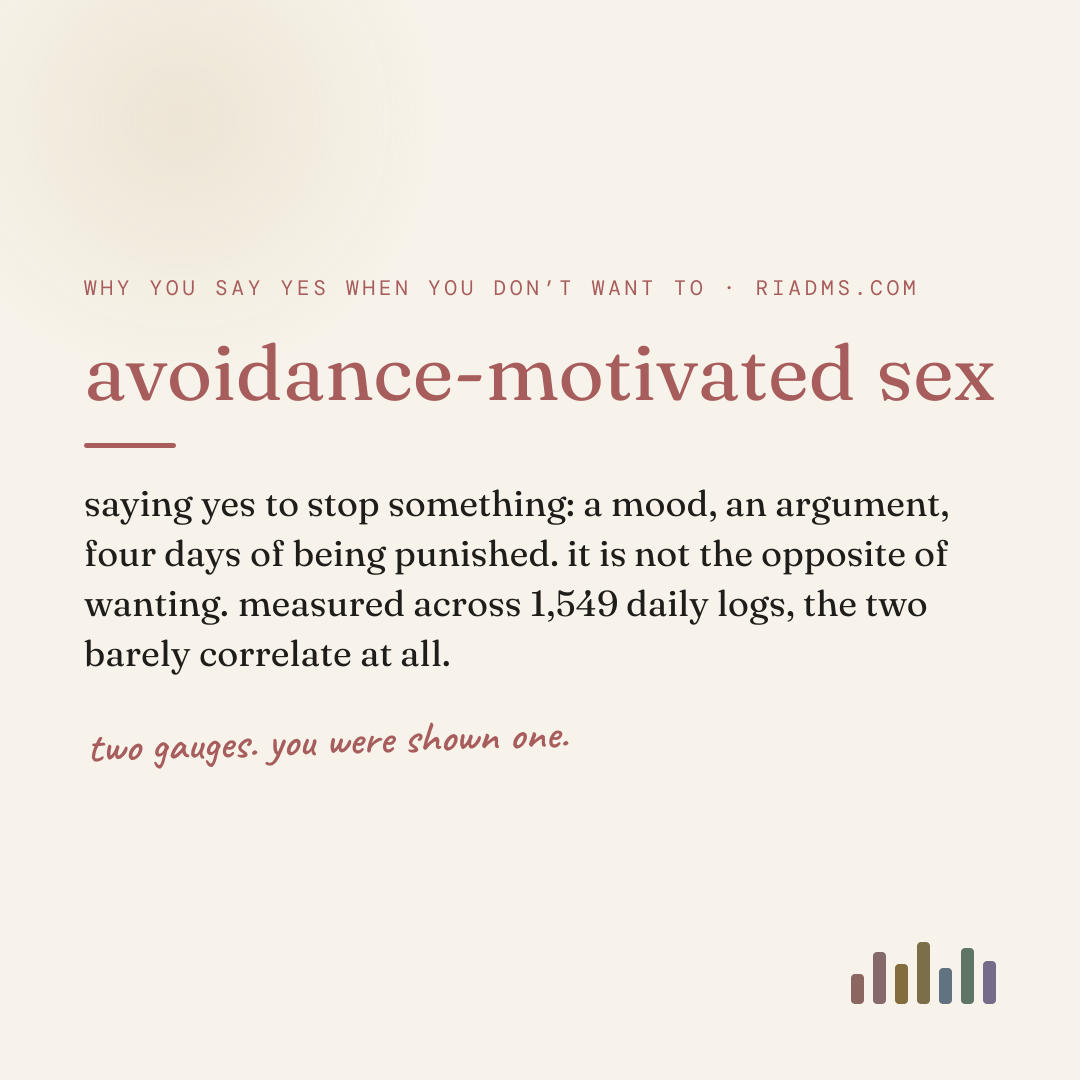
Which means the question “did I want to?” cannot get at it. They are two gauges, and you were only ever shown one.
Day to day, approach motives went with more satisfaction, more closeness and more fun, and less conflict. Avoidance motives went the other way. A month later, only the avoidance side still showed up: for each unit increase in avoidance motives, participants were more than two and a half times as likely to have broken up.
There is one more thing in that study I have to give you, because it complicates a line I said earlier. I said the two are identical from the outside. Partly they are not. When people perceived that their partner was having sex with them for avoidance reasons, their own satisfaction was substantially lower, at r = −.45. Something gets across. Not the word, and not reliably, but something.
And the pattern is not only about sex. The same team applied the identical architecture to sacrifice of any kind in relationships, in the Journal of Personality and Social Psychology, and got the same shape: approach motives tracked with well-being, avoidance motives tracked against it, and sacrificing for avoidance reasons was the thing that wore relationships down over time. The dinner you did not want. The visit. The favour.
the toward yes is not a smaller yes
I want to be careful here, because the easy misreading of all this is that a yes without prior desire is a failure, and the research says the opposite.
Lisa Day, Amy Muise, Samantha Joel and Impett ran three studies on exactly this in 2015. People high in sexual communal strength, meaning the motivation to be responsive to a partner’s sexual needs, were more willing to say yes when their own desire was low, and both partners reported better relationship and sexual satisfaction for it. Amy Muise and colleagues found the same thing sustaining desire over four months in long-term couples.
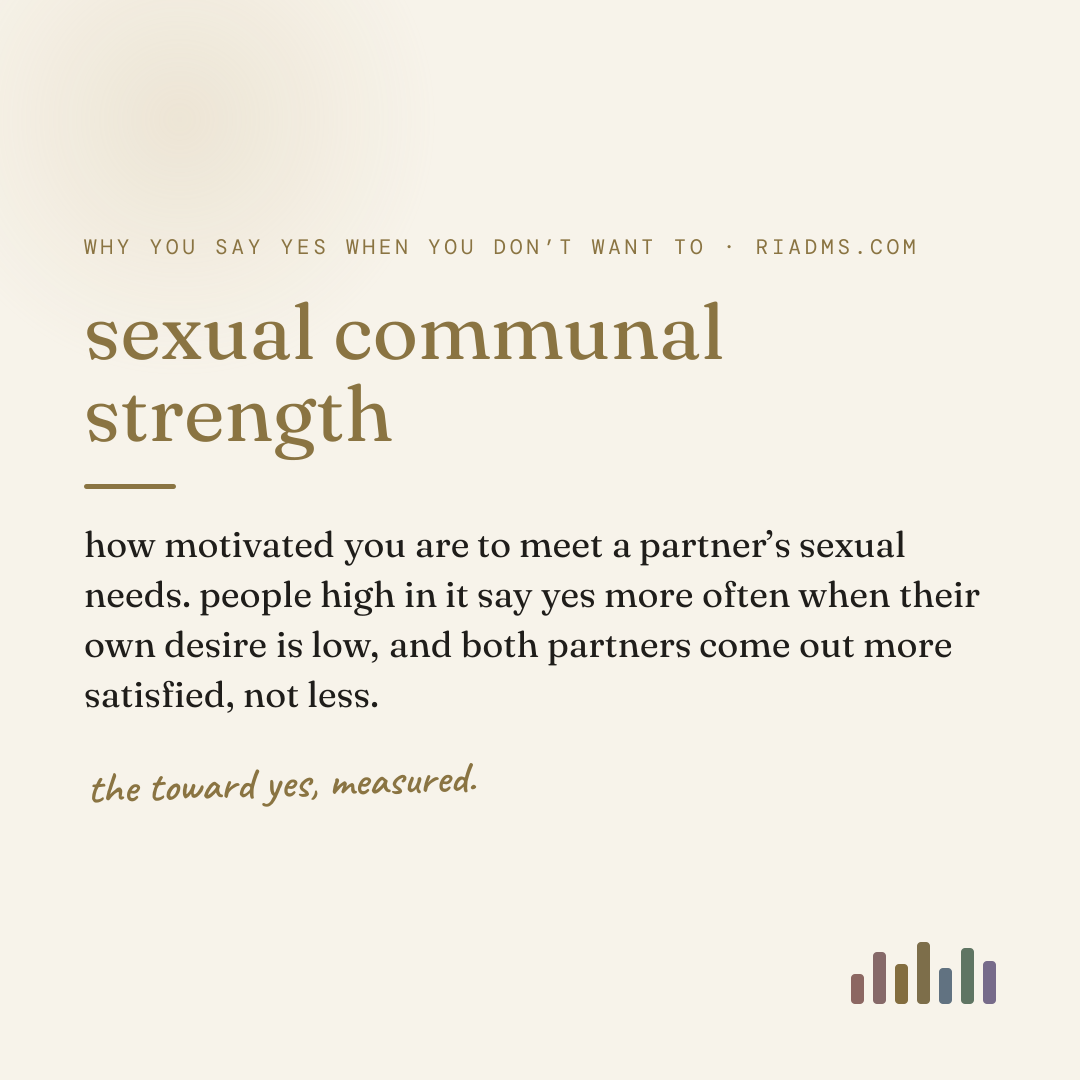
So the yes without wanting is not the problem. It is not even a compromise.
Impett, Muise and Cheryl Harasymchuk then split the good version from the bad one across 21 days with 122 couples, and named the failure mode unmitigated sexual communion: meeting your partner’s needs while neglecting your own. The mechanism they propose is about attention. Communal strength went with noticing positive things about your partner during it. Unmitigated communion went with noticing negative things about yourself.
Which is the closest thing I have found in a journal to the feeling of coming out of something having lost a small amount of something you cannot name.
the counterweight, because leaving it out would be dishonest
In 2025, Sabina Nickull and colleagues built a scale for the consequences of sexual compliance and ran it on a Finnish population sample of 1,159 people, which is not undergraduates. Their conclusion, in their words: people reported “significantly more positive than negative consequences of sexual compliance, suggesting that engaging in sex without initial sexual desire does not harm well-being for most people.”
I could have left that out. It would have made the page tidier and it would have been a lie by omission.
And read properly it does not damage any of this. It says compliance in general is not the injury. Which is the thesis. The direction is the injury, and a population that is mostly moving toward is a population that is mostly fine.
about the word fawn
You have probably met fawning by now, offered as the fourth F after fight, flight and freeze. It describes this well, and I am going to be straight with you about what it is and is not.
The term comes from Pete Walker’s Complex PTSD: From Surviving to Thriving, a self-published book by a marriage and family therapist. His definition is that fawn types “seek safety by merging with the wishes, needs and demands of others,” as if the price of admission to any relationship were the forfeiture of your own preferences. It is a good description and it has helped a lot of people.
It is also not a validated construct. There is no measure for it, no factor-analytic support and no prevalence data. And the peer-reviewed defence cascade, mapped by Kasia Kozlowska and colleagues in Harvard Review of Psychiatry, runs arousal, then fight-or-flight, then freezing, then tonic immobility, then collapsed and quiescent immobility. There is no appeasement stage in it. The most serious recent paper to engage with fawning concludes that it remains underdeveloped and understudied.
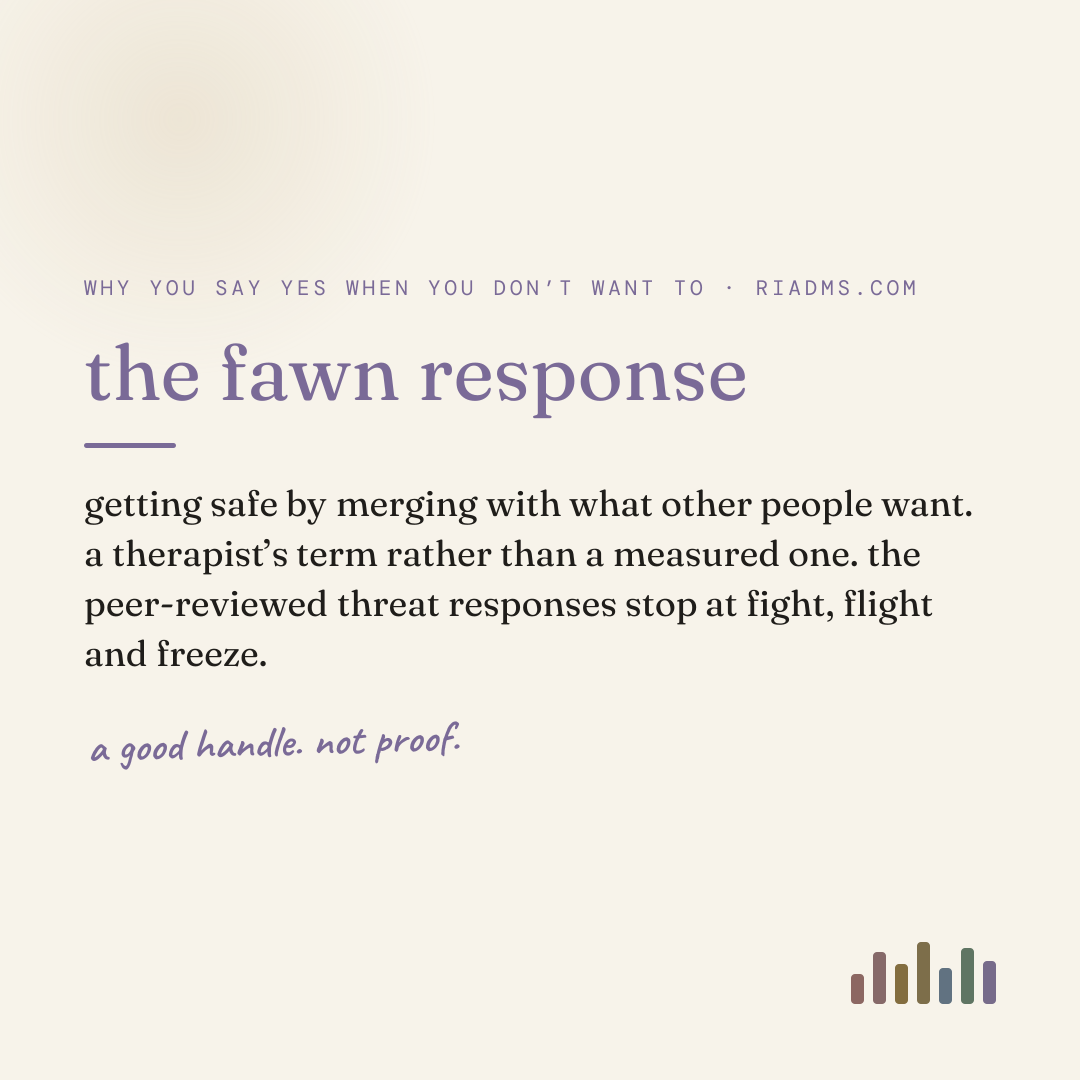
Use it as a handle if it helps you. Do not use it as proof, and be careful with the internet version that slides from “I keep agreeing to things” to a trauma diagnosis in one step.
why it is so hard to tell from the inside
The construct that does have thirty years of measurement behind it is Dana Jack’s self-silencing. Her book is Silencing the Self: Women and Depression, from Harvard University Press in 1991, and the scale followed in 1992. It measures putting your own needs last to keep a relationship going, judging yourself against an external standard, and one subscale she calls the divided self: complying outwardly while disagreeing inwardly. A 2019 review found it tracking with depression and with the gender gap in several disorders.
That is as far as the evidence goes, and I want to mark the edge clearly. There is a story people tell, and I nearly told it here, where years of self-silencing wear away your ability to know what you want at all. There is no study behind that. I looked. It is Jack’s theory, and it is not a finding. A 2025 study found most young women still describing themselves as authentic in their relationships and framed silencing as situational and strategic rather than total.
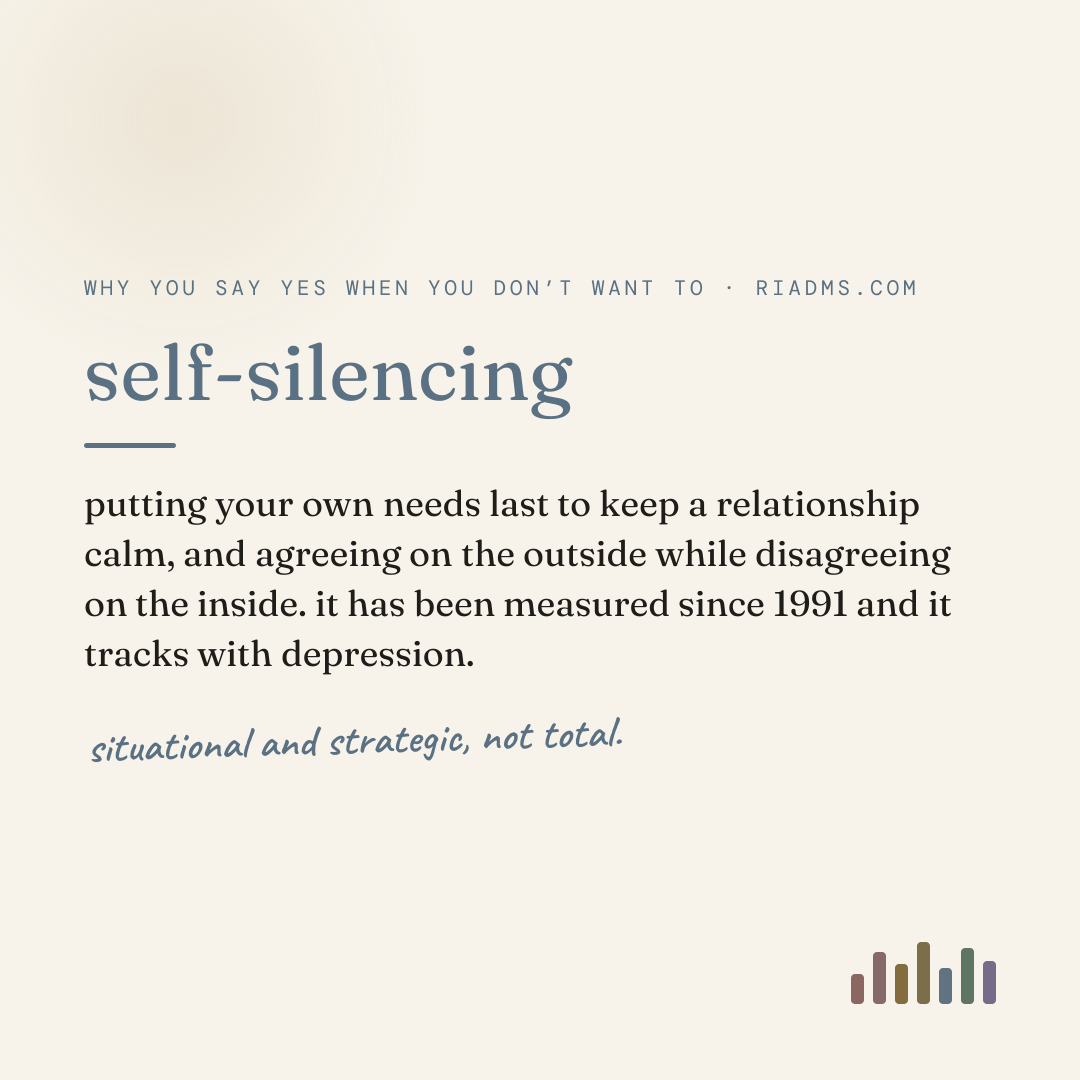
Strategic is the useful word. You are not broken and you have not lost access to yourself. You learned, accurately, that some things are expensive, and you started paying in advance.
if you want to go further
Start with Impett, Peplau and Gable’s 2005 paper. It is the spine of this whole page and the questionnaire items alone are worth the read.
Then Katherine Angel’s Tomorrow Sex Will Be Good Again, which is short, and which takes the demand that you know your desire in advance and asks who that demand actually serves. If your version of this is more “I do not seem to want things in the first place,” Emily Nagoski’s Come As You Are on conceptresponsive desireSexual desire that arrives in response to arousal or closeness rather than spontaneously. It shows up after you get close, not before. A common pattern, not a dysfunction.what is responsive desire? →Basson, 2000 ↗ is the better next book.
the question nobody handed you
Nobody ever taught me to check which one I was doing. I was taught to check whether I agreed.
And I agreed. Every time. That was never the question.
Everything I was given about this was a yes-or-no test, and I kept passing it, and I kept coming out of things feeling worse than the facts justified. Of course I did. The test was not measuring what was going wrong.
So the question is not did I agree. You know the answer to that one and it has never helped you. The question is which direction was I facing. Was I walking toward something I wanted on the other side of this, or was I walking away from something I did not want to happen next.
You can ask it afterwards, which is where most people start, because afterwards is when the strange feeling shows up and gives you a reason to look. You get better at asking it earlier. Eventually you can sometimes catch it in the two seconds before you speak, and even then you will get it wrong sometimes, because the two feel identical from the inside for a while.
And if you ask it and the answer is toward, that is not a smaller yes than one that started with wanting. That is the part I would not want you to lose. Going to get closeness is a real reason. Liking being wanted is a real reason. Neither of those needs to be dressed up as desire to count.
If the answer is away, you have not caught yourself lying. You have found out that something in your life is expensive enough to buy things with, and now you know what it is, and that is the first useful thing anybody has handed you about this in years.


