Being the understanding one is a job, and you do not remember anybody hiring you.
You are the one who gets it. Who can always see where the other person was coming from. Who says it is fine before checking whether it is fine, because the checking would take longer than the forgiving.
And people love you for it. That is the part that makes it hard to put down. You are genuinely good at this, it is genuinely a nice quality, and everybody around you benefits from it constantly. Nothing in your life is arranged to tell you to stop.
I want to go slowly through this one, because there is real research sitting under it and there is also a great deal of confident internet language sitting on top of it with almost nothing underneath. Those two are worth telling apart before you use either of them on yourself.
it is not the same thing as being kind, and psychology can tell them apart
Personality research has a word for orienting toward other people. Communion: warmth, attachment, care about the people around you. And the first surprise is that communion on its own has a thin track record. Helgeson’s 1994 review in Psychological Bulletin found that agency was fairly consistently linked to wellbeing while communion’s links were weak and inconsistent, which is not what you would predict if caring about others were straightforwardly good for you.
That puzzle is what produced the useful construct, and it has been measured separately since 1998. Unmitigated communion: the same orientation toward others, with the self taken out of it. Fritz and Helgeson defined it as a focus on and involvement with others to the exclusion of the self, and pulled out two components, overinvolvement in other people’s problems and neglect of your own needs.
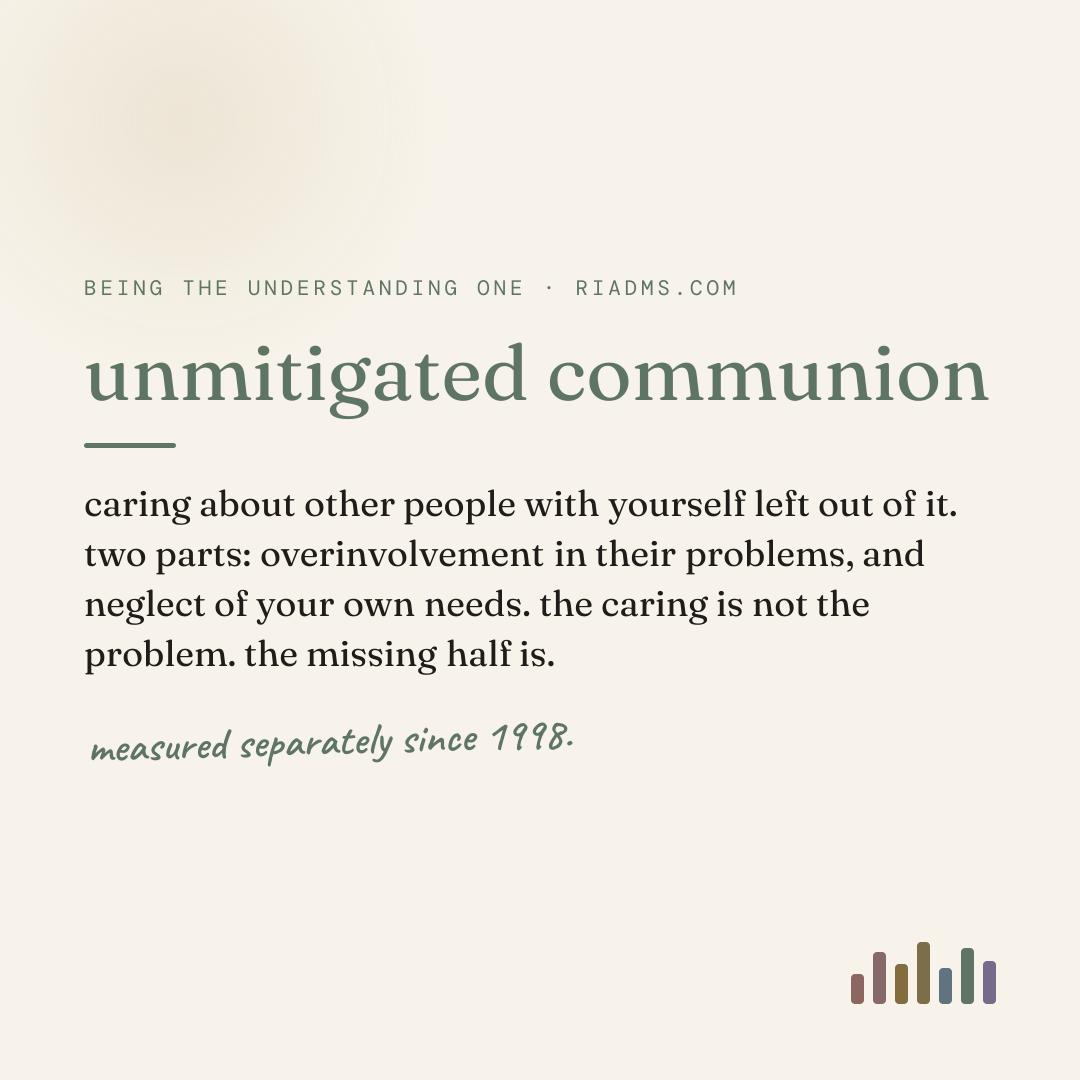
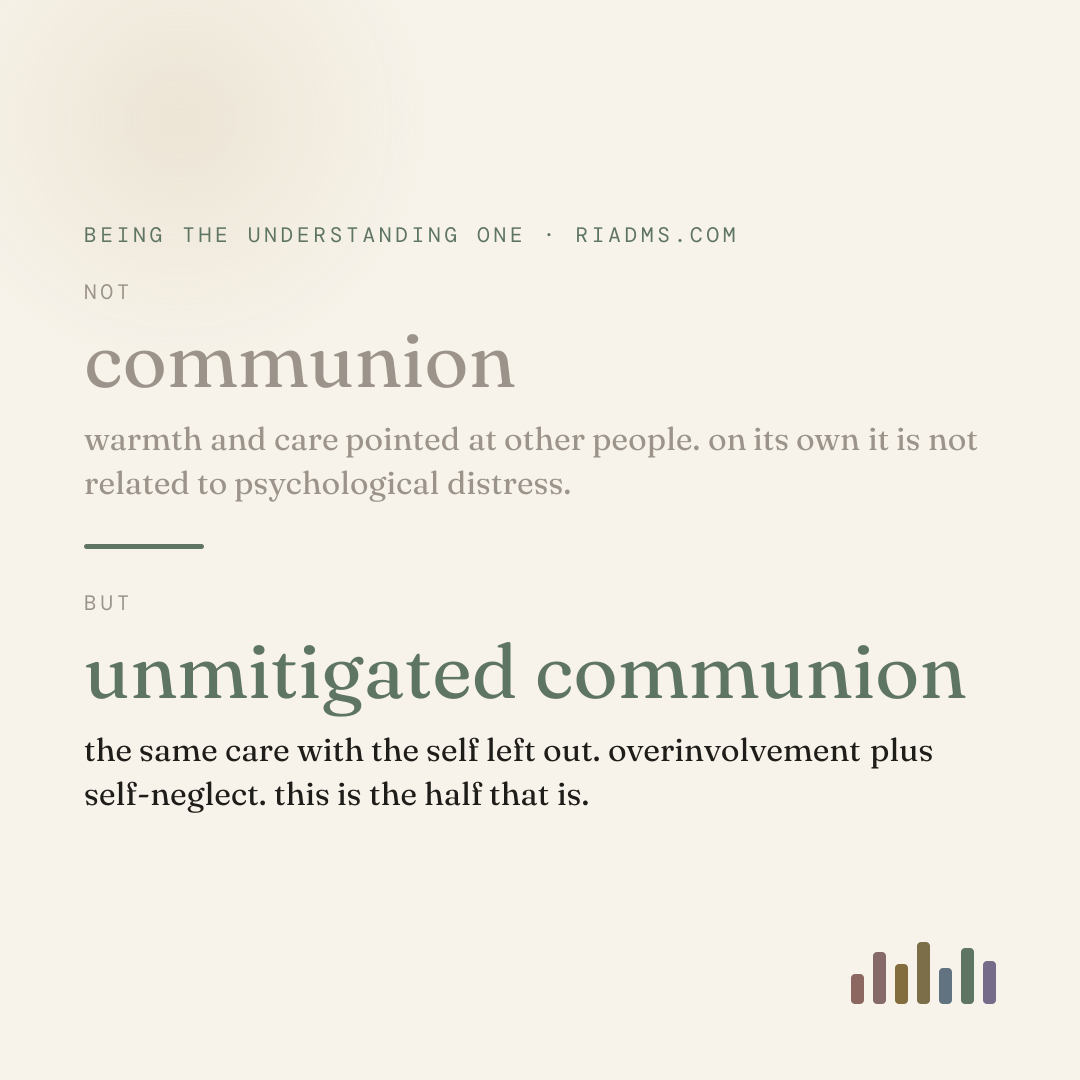
Across four studies, communion was not related to psychological distress. Unmitigated communion was. Same warmth, same attention pointed outward, and the thing separating them was whether anybody was left over on the inside.
So it was never the caring. The caring is fine. It is what is missing next to the caring.
And then there is the part of that paper almost nobody quotes, which is the engine rather than the description. What the study identified underneath unmitigated communion was a reliance on other people for self-esteem. That reliance is what produces the overinvolvement and the self-neglect, and those in turn are what account for the distress. Read that chain again with your own life next to it. It is not that you care too much. It is that your sense of whether you are alright is stored in other people, so keeping them alright is not generosity, it is maintenance.
The obvious objection is that this is all self-report, and someone who feels bad will describe themselves as overinvolved. Fair, and somebody checked. Aubé ran three studies built to get past exactly that: peer reports rather than only self-reports, a community sample followed for ten years, and a daily diary. The distinction survived the better methods, which is not something you can say about most of what gets written about this.
come think with me
one letter a week.
the word for one feeling you’ve had but couldn’t name, and why it works that way. the same thing you just read, in your inbox, once a week.
- one letter a week, about a ten minute read
- all nine printable workbooks, free
- the research, with its caveats kept in
- hit reply and it reaches me. i read every one
no pressure, no spam, no gatekeeping. unsubscribe anytime · riadumitrescu.substack.com
all of this is free and it stays free. if it gave you a word you didn’t have, you can buy me a coffee.
where it gets learned
But I think a lot of us learned it somewhere specific. Understanding people is what you do when you cannot afford for them to be angry. It starts as a safety behaviour and gets promoted to a personality.
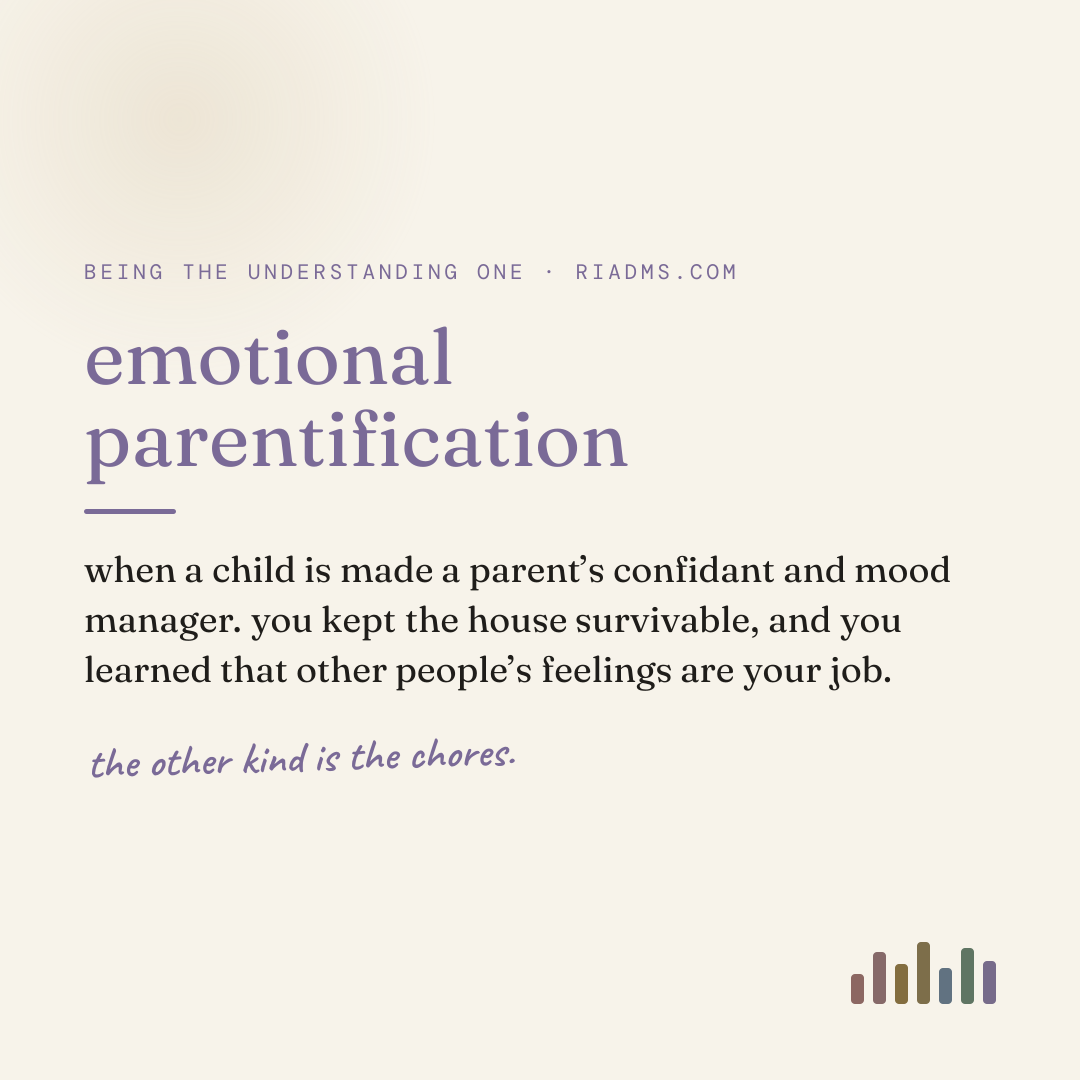
The literature’s word for the childhood version is parentification, and it has two forms worth keeping apart, separated out in the measure Hooper and colleagues validated. Instrumental parentification is the tasks: the cooking, the bills, the younger sibling got to school. Emotional parentification is being a parent’s confidant, regulator and mediator. It is the second one that produces an adult who is unusually good at this.
Now the part I want to be careful with, because this idea gets handled roughly online. The best pooled number is from a meta-analysis by Hooper, DeCoster, White and Voltz: 12 non-overlapping studies, 2,472 people, and the relation between self-reported childhood parentification and adult psychopathology came out at r = .14, with a confidence interval of .10 to .18. The authors’ own phrase is “a small significant but reliable effect.” That is roughly two percent of the variance. It is a real association and it is nowhere near a life sentence, and anyone telling you parentification determined who you became is going past what the evidence carries.
The syntheses also refuse to run one direction. The largest recent one, a mixed-methods systematic review of 95 studies by Dariotis and colleagues, is organised around vulnerability and resilience and thriving, because all three are in the data. Which matches the thing you already know about yourself. You are not damaged goods who picked up a bad habit. You learned something that worked, in a room where it was needed, and you got good at it.
two words everyone reaches for here, and one of them is not what you think
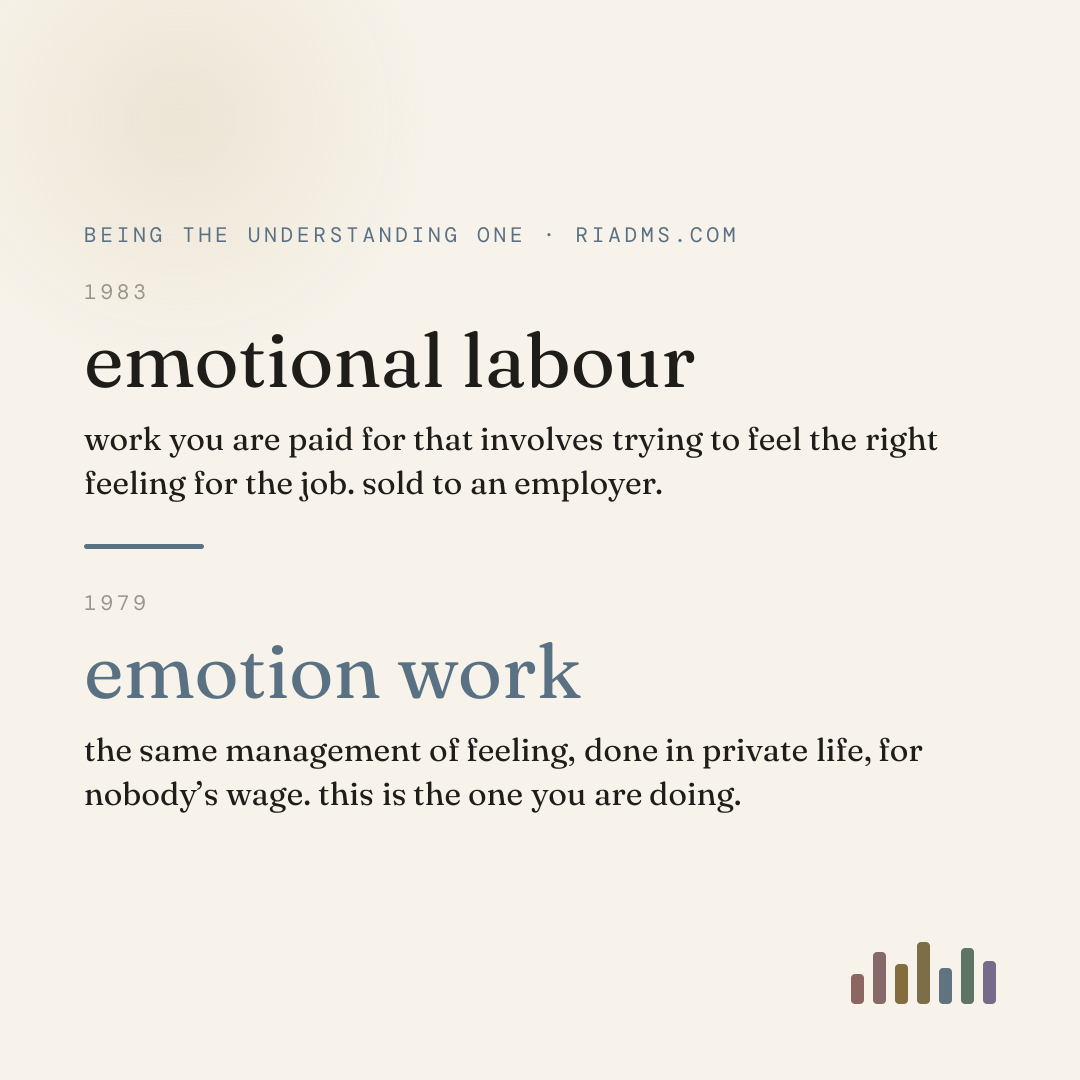
Emotional labour. This gets used for what you are doing roughly a hundred times a day online, and it is not what it means. Arlie Hochschild coined it in The Managed Heart in 1983, and her definition is about a wage. In a 2018 interview with Julie Beck she put it as plainly as anyone could want: “the work, for which you’re paid, which centrally involves trying to feel the right feeling for the job. This involves evoking and suppressing feelings.” The flight attendant required to be warm at hour eleven. The debt collector required not to be.
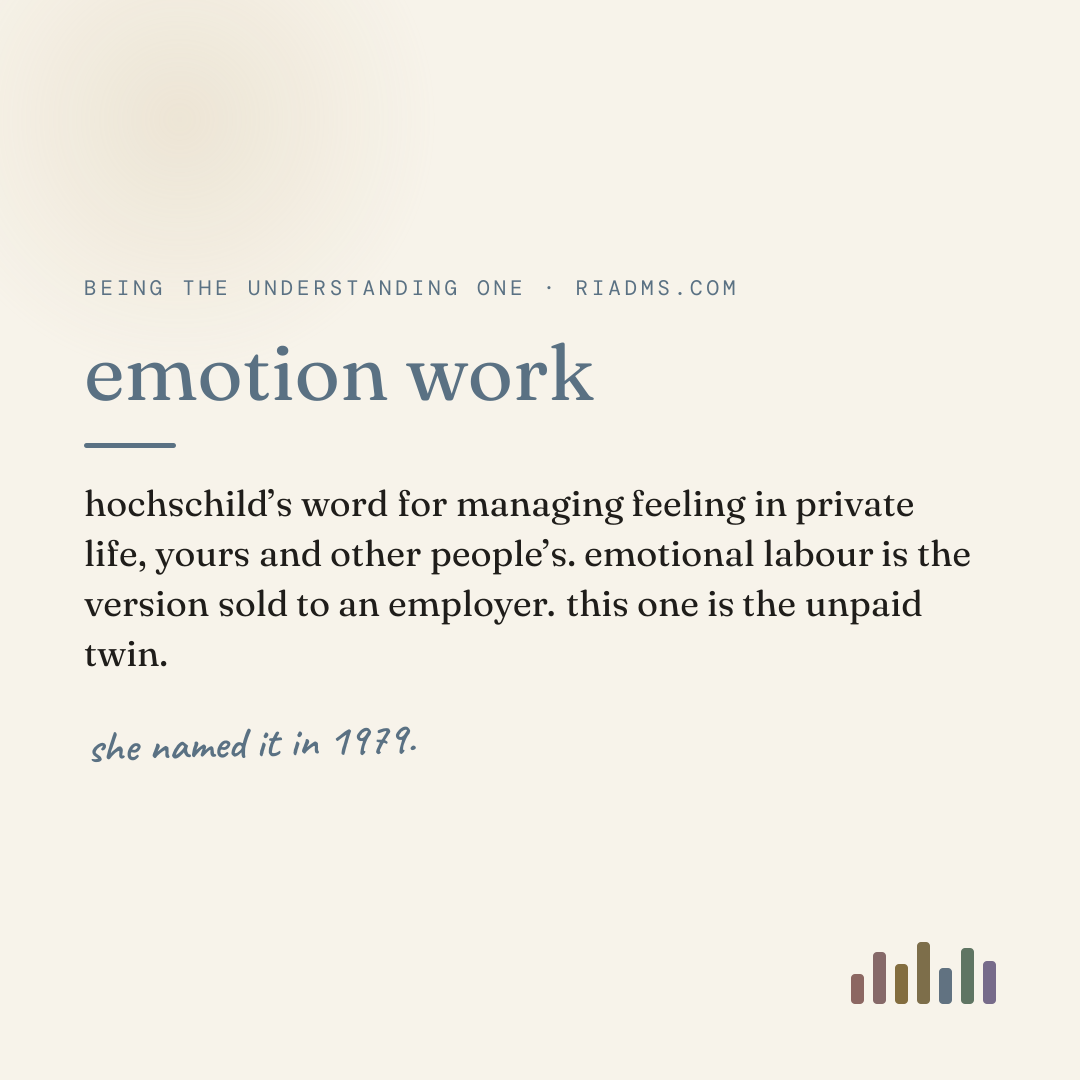
She had already named the unpaid version, four years before the book, in a 1979 paper in the American Journal of Sociology. That word is emotion work: the same management of feeling, done in private life, for no employer. Most people who invoke Hochschild have only ever read the book, which is part of why the two collapsed into one.
Asked in that interview what she made of the drift, she said the term is “being used to apply to a wider and wider range of experiences and acts” and called the result “very blurry and over-applied.” The person who invented the phrase does not think it means what it is being used to mean.
But the interview also contains the sharpest line anybody has written about what this page is about, and it is hers. Beck asks whether managing someone else’s feelings counts. Hochschild answers with a scene: going to visit your mother-in-law is not emotional labour. “But if your mother-in-law is extremely disapproving of you, and in the first five minutes you become aware of that again, and you’re having to defend your self-esteem against the perceived insult, that’s emotional labor.”
So the accommodating is not the work. The bracing is the work. That is exactly the distinction between someone who is pleasant to be around and someone who is doing a job.
The fawn response. The other word, everywhere at the moment, and you deserve its status before you build anything on it. It comes from Pete Walker, a psychotherapist, who proposed fawn as a fourth response next to fight, flight and freeze: appeasing the threat rather than fighting it or running from it. Almost everything online dates this to his 2013 book. It is older than that, from a 2003 article he wrote for The East Bay Therapist, and in that article he takes the word from a dictionary and supports it with clinical observation. He cites no studies, because there were none.
Twenty-three years on, that is still roughly where it stands. Fawning is not in the DSM. It is not among the disturbances that define complex PTSD in the ICD-11. There is no validated scale for it, and the 2013 book is self-published, which is a fact about its review process rather than a judgement about its usefulness. The most honest peer-reviewed mention I found is a 2026 paper that builds fawn into a stress-response framework for substance use and then says outright that fawning remains “underdeveloped and understudied” in that field, and that going further requires validated measures. Which is a paper using the idea and admitting in the same breath that nobody has built the instrument yet.
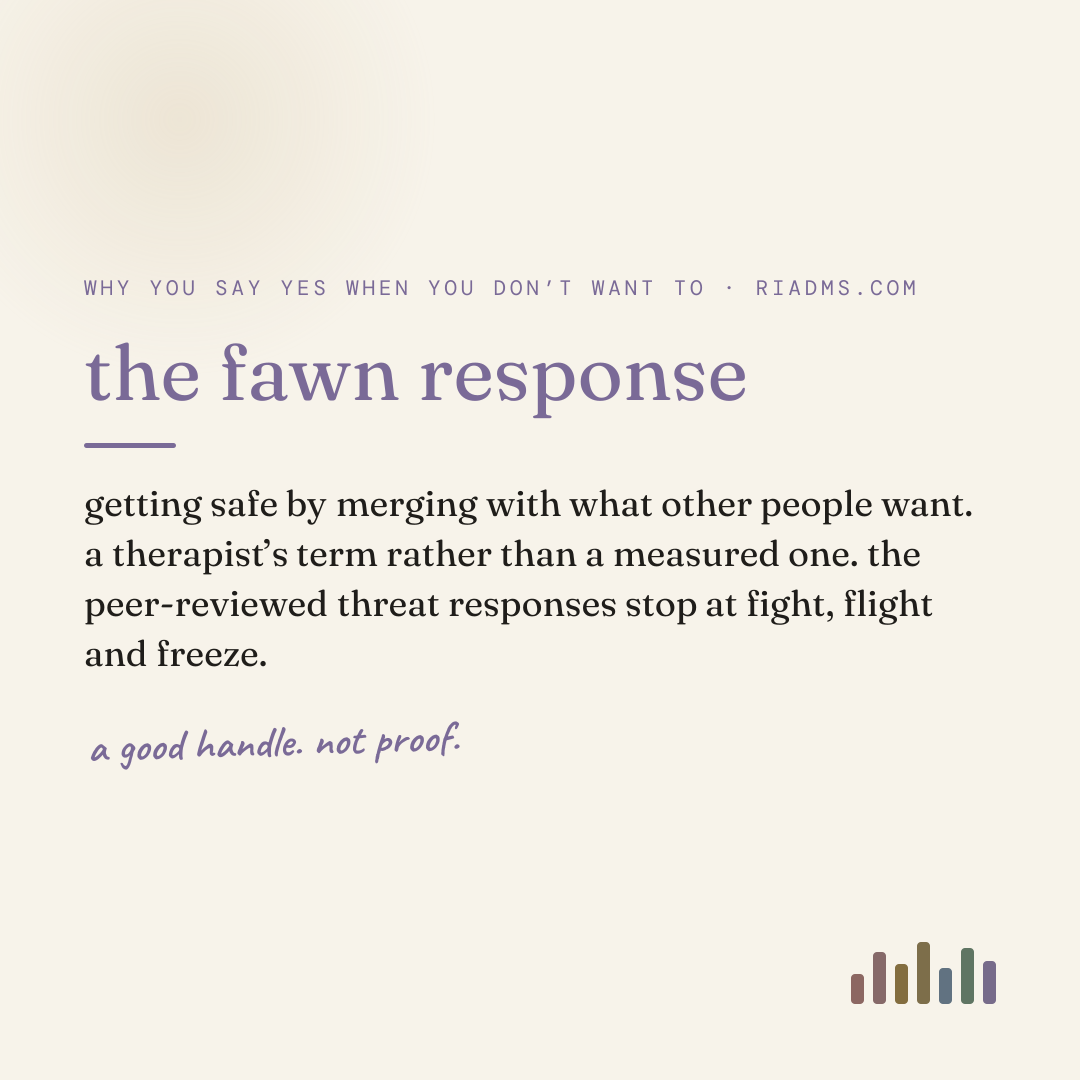
None of that makes it wrong. It makes it a description that has not been tested, which is a different animal from one that has been tested and held.
If you want the nearest peer-reviewed treatment, it is Bailey and colleagues in 2023 on appeasement, arguing it should replace Stockholm syndrome as the name for this survival strategy. Hold it loosely. It is a proposal paper rather than a finding, it notes that the concept it is replacing had scarce empirical support, and it rests on polyvagal theory, which is itself argued about. What I would not do is reach for tend-and-befriend here, the way a lot of articles do. Taylor and colleagues’ 2000 model is about affiliation and caregiving under stress, not about placating a person who might turn on you, and stretching it to cover fawning is the same move Hochschild is complaining about upstairs.
the cost is not the tiredness
Everybody writing about this lands on exhaustion. Exhaustion is real and it is the least interesting part. This is the part, and it took me a long time to see it.
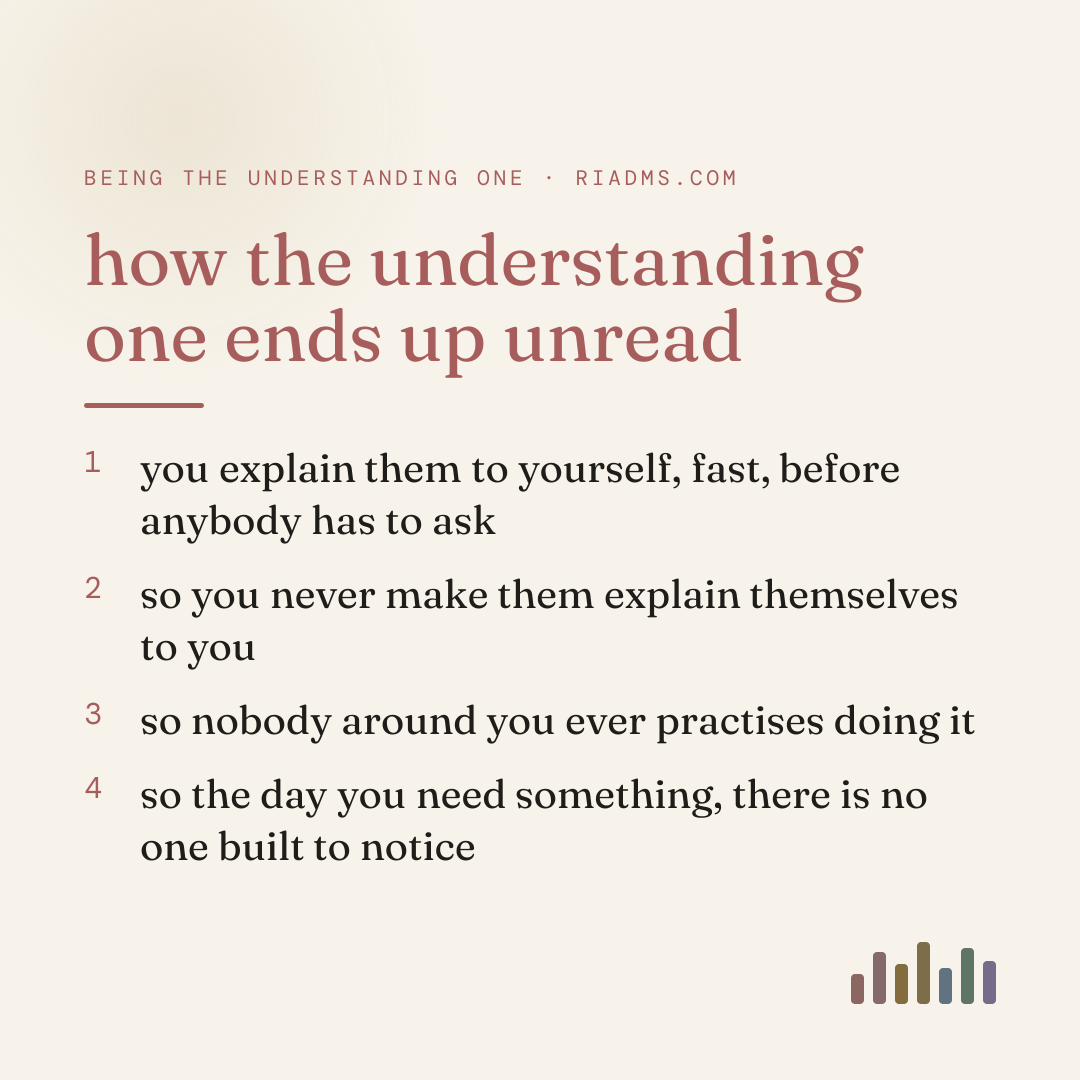
If you always explain other people to yourself, you never make them explain themselves to you. So they never have to develop the skill. You are so good at the translation that nobody in your life has ever had to learn your language.
Some of that has been measured and some of it has not, and I want to be exact about which is which.
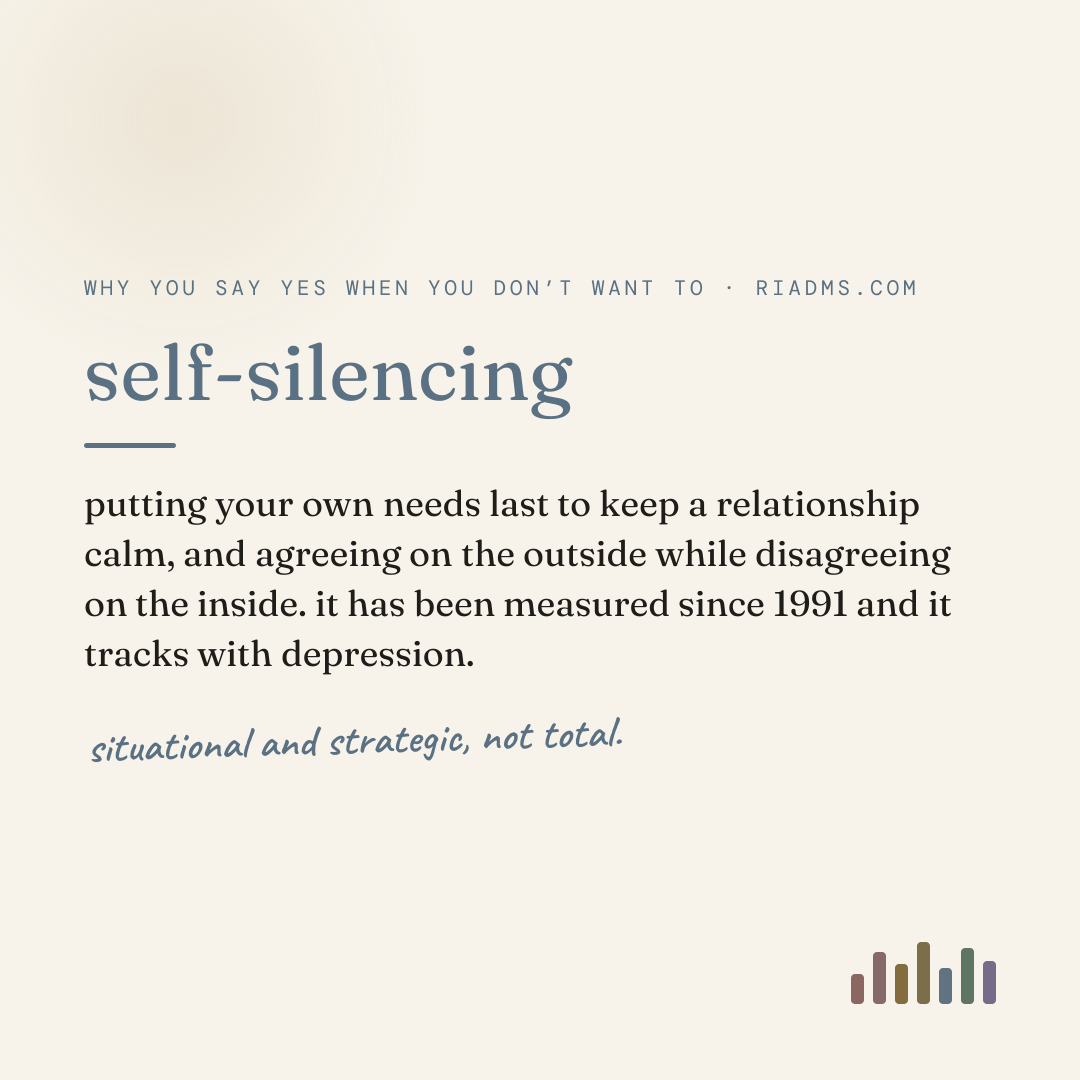
Your end of it has a scale. Dana Jack built the Silencing the Self Scale out of a longitudinal study of clinically depressed women, and its four subscales read like a job description: externalized self-perception, care as self-sacrifice, silencing the self, and the divided self. That last one is the thing you already know about, the gap between the person being agreeable in the room and the person watching her do it. Jack and her colleagues reviewed three decades of that work in 2026, and it is worth knowing it is a narrative review rather than a pooled analysis, so there is no single effect size to quote at you.
The other end of it has partial evidence. Helgeson and Fritz, reviewing their own program of studies in the Journal of Personality in 2000, report that unmitigated communion is associated with a lack of support from others and a reluctance to ask others for help, and trace it to subjugating your needs to other people’s and taking your esteem from them. Their 2015 daily diary study followed the same people across ten consecutive days and found unmitigated communion running with support given and with interpersonal difficulty.
What that establishes is that the support does not come back. What it does not establish is my explanation for why. The claim that the people around you got worse at understanding, over years, because they were never once required to try, is mine. It is a description to hold against your own life, not a finding, and the honest alternative is simpler and less flattering to all of us: maybe they would have managed it fine and were never asked.
Either way you arrive at the same morning. You need something, and you find you have not built anybody capable of noticing.
which is not an argument for giving less
There is a result that stops me writing the tidy version of this, and it belongs on the page.
Brown, Nesse, Vinokur and Smith followed older married adults for five years and found that providing support predicted lower mortality while receiving it had no effect once giving was accounted for. That paper gets quoted constantly, and read alone it says the understanding one has the better deal.
The better study is newer and it is the one to keep. Chen and colleagues took 6,325 adults from a US national sample, measured the monthly hours of support each person gave and received, and followed all-cause mortality for twenty-three years. What predicted lower mortality was balance. People who disproportionately received did worse, and so did people who gave many more hours a month than they got back. The authors are careful that this is correlational, and their own reading of it is to give in moderation while being willing to accept support.
So the problem was never how much goes out. It is that nothing was ever built to come back, and you built it that way, for reasons that were good at the time.
keep reading
If you take one book, take Silencing the Self, because Dana Jack got there by sitting with depressed women and listening to how they talked about their relationships, and the book is mostly them talking. If you want the one study, it is Fritz and Helgeson, 1998, for the finding that reorganises everything: the caring was never the part associated with distress, and the part that was is where your self-worth is kept.
Read The Managed Heart so that you own the term properly rather than the version of it going around. And read Complex PTSD: From Surviving to Thriving if fawn is the word that fit, holding it as what it is, a therapist’s map rather than a set of results. The chapters next to this one are your type is not your type, for what an early room does to the shape of an adult, and the fear of being known all the way, for the far end of the same problem.
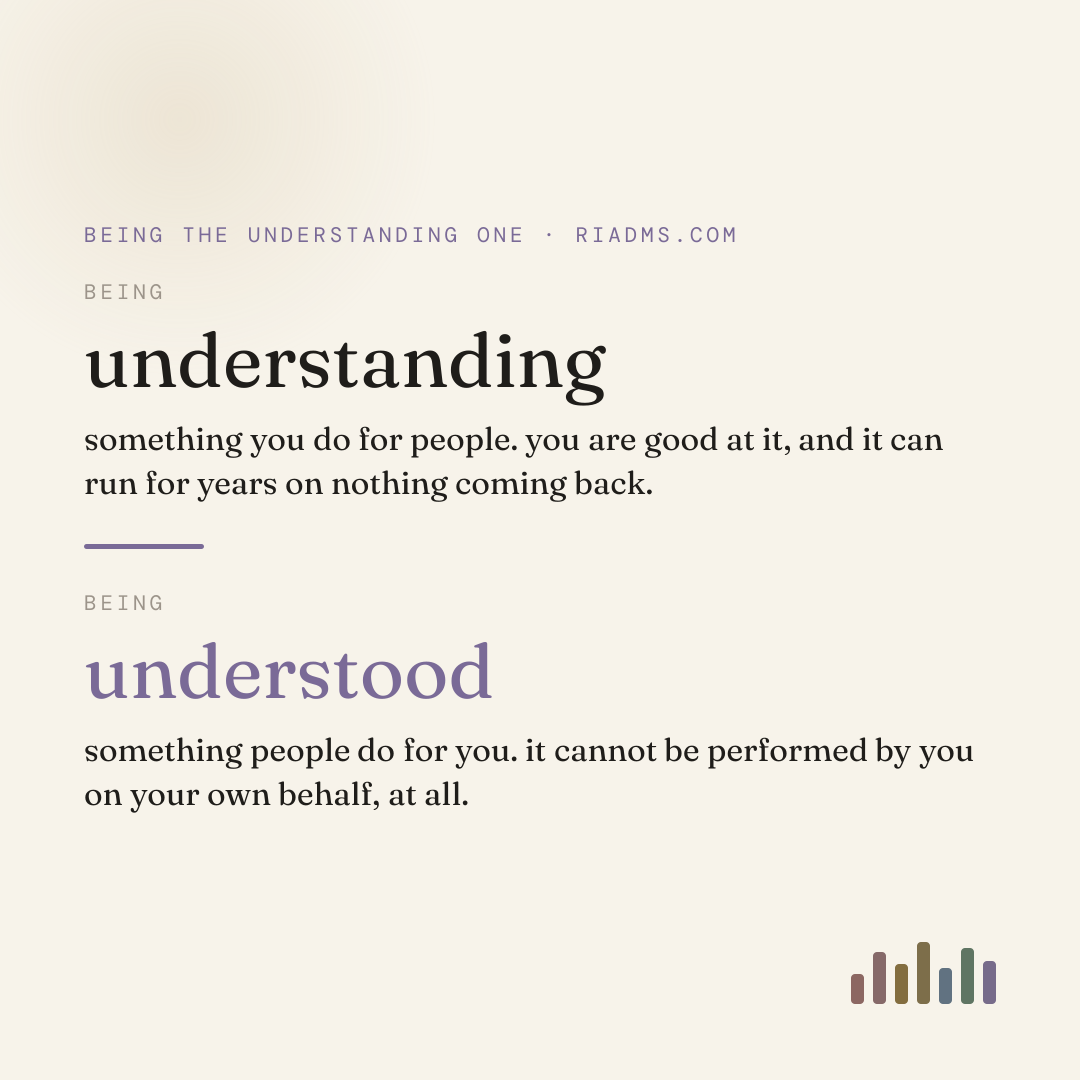
Maybe that is why being understood feels almost embarrassing when it finally happens. You have no practice at receiving it. There is no version of you that knows where to put your hands while somebody works that hard to get you right, so the reflex is to start helping them do it, which is the job again.
Being understanding is something you do for people. Being understood is something people do for you. And only one of those has ever made anybody feel less alone.


