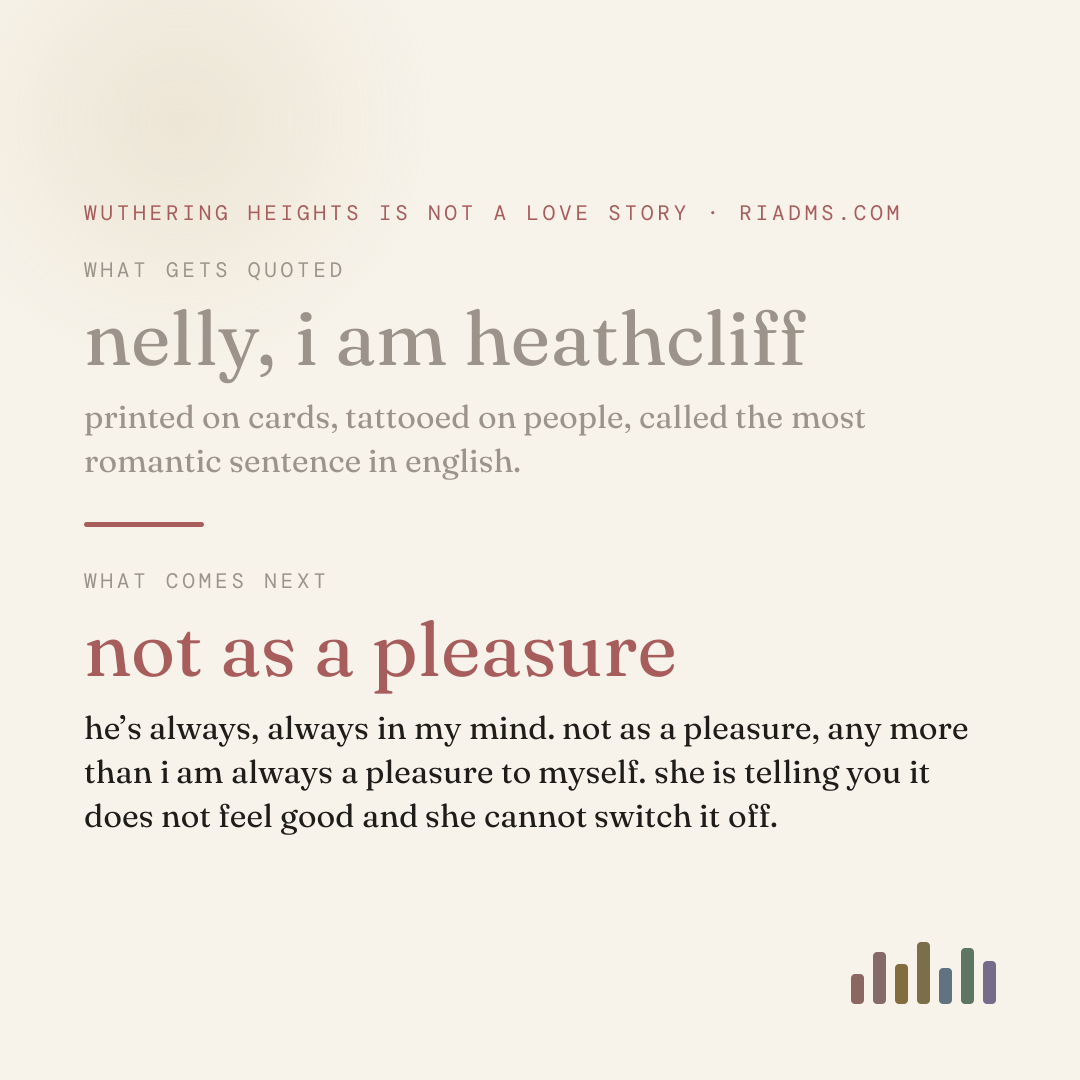
In 2007 a poll of British readers voted it the greatest love story of all time. In February 2026 Emerald Fennell put Margot Robbie and Jacob Elordi in it, billed the film as the greatest love story of all time, and made 242 million dollars. And the sentence everyone quotes as the most romantic in the language is Cathy, in chapter nine, saying: Nelly, I am Heathcliff.
That is not a declaration of love. It is half of one.
Here is the rest of it, from the book: “He’s always, always in my mind. Not as a pleasure, any more than I am always a pleasure to myself, but as my own being.”
Not as a pleasure. She is telling you it does not feel good, and that she cannot switch it off. That is a description of involuntary intrusive thinking, written in 1847, a hundred and thirty two years before anybody had a name for it. And we have spent two centuries putting the first half on greetings cards.
what is actually in the book
A lot of people know the atmosphere and not the plot, so let me be boring for a paragraph.
Cathy marries Edgar Linton because marrying Heathcliff would degrade her. Heathcliff leaves, comes back rich, and spends the rest of the novel on revenge. He marries Edgar’s sister Isabella, who he does not care about, to get at the family. He is violent to her. He takes the son of the man who tormented him as a boy and raises him deliberately illiterate, as an experiment. He imprisons a teenage girl and forces a marriage to get a house. He digs up Cathy’s grave and opens the coffin. At the end he stops eating and dies.
And Cathy dies in chapter sixteen of thirty four. She is dead for the entire second half.
The Romance Writers of America definition of a romance needs two things: a central love story, and an emotionally satisfying, optimistic ending. This has one of those. And the pair are never together in any formal way at any point in the novel. Not once. They are not a couple who fail. They are not a couple.
that’s not love, that’s limerence
So something enormous is happening, and it is the most intense something in English literature. It just has a different name.
concept limerence An involuntary, obsessive state that feels like love: intrusive thoughts, a hunger for reciprocation, and a charge that gets stronger with uncertainty and weaker with security.
Read Cathy’s line again with that in front of you. Not as a pleasure, any more than I am always a pleasure to myself. She is not describing joy. She is describing a mind she does not have control of.
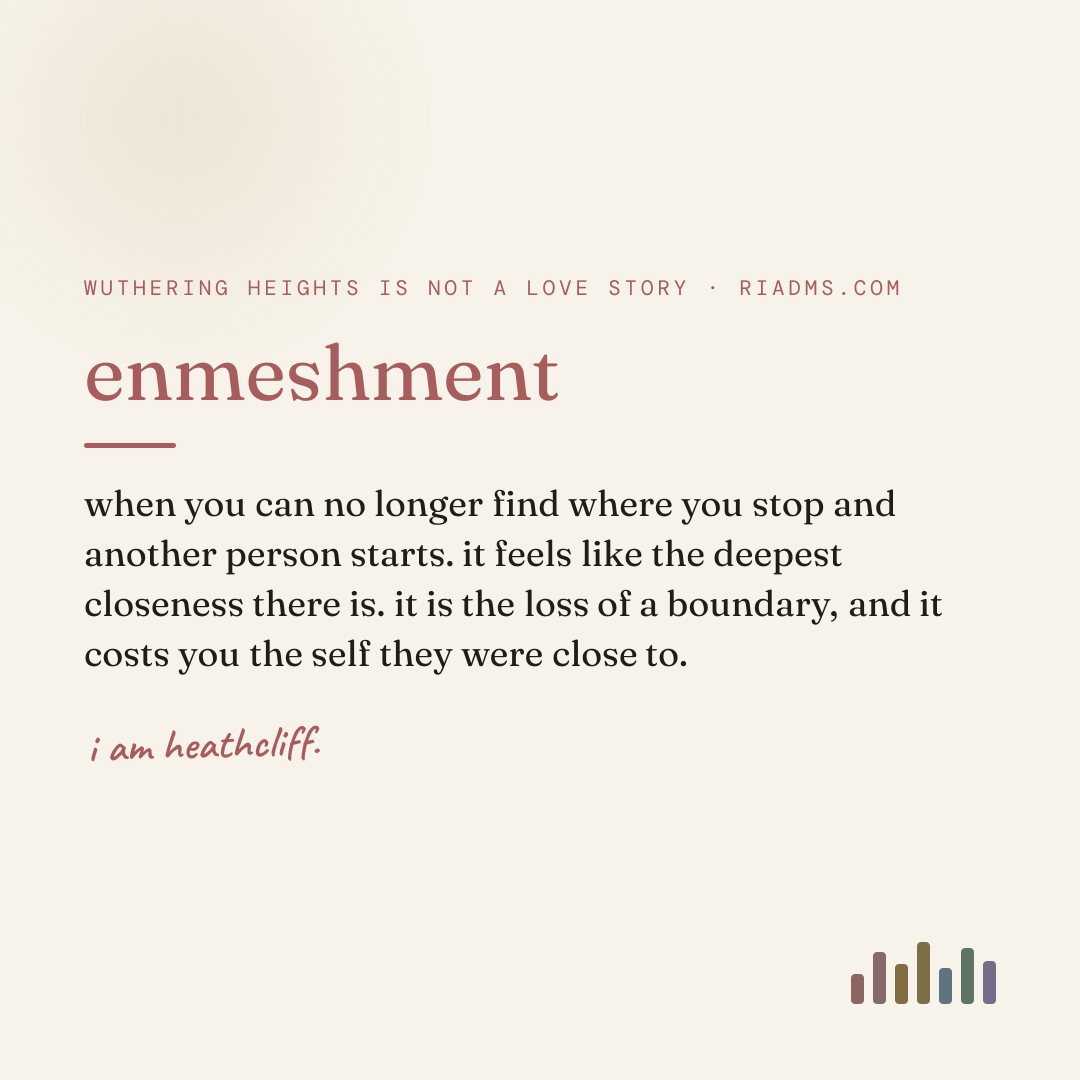
And the second half of what she says is the part nobody quotes either, because it is not romantic, it is frightening. I am Heathcliff. Not I love him. I am him. She grew up beside this person with no other self available and she can no longer locate where she stops. Family therapists have a word for that, and the word is enmeshment, and it is not a description of intimacy. It is a description of a missing boundary.
The measurements line up with the feeling, for what that is worth. In 1999 Donatella Marazziti took twenty people who had fallen in love in the previous six months, twenty people with obsessive compulsive disorder, and twenty controls, and found the first two groups were indistinguishable on the same serotonin marker, both about forty percent below the controls. And in 2005 Aron and Fisher scanned people newly and intensely in love and found the ventral tegmental area and the caudate lighting up. The dopamine wanting circuit, not the warm cherishing regions.
Both of those want handling honestly. Marazziti’s study is twenty people per group, it measures a proxy in the blood rather than a brain, and the effect normalises within about eighteen months. It does not show that love is a disorder. What it shows is that the obsessive quality is not a personal failing somebody invented, which is worth knowing if you are currently living inside it.
the tell is that it never has to survive an ordinary tuesday
This is the part that settles it for me, and it is the part you can use on your own life rather than on a novel.
The signature of limerence is that the charge goes up when the person is out of reach and down when they are available. Obstruction is fuel. Security is the solvent.
So look at the shape of the book. When they are children on the moors, genuinely available to each other, nothing is declared and nothing is at stake. The feeling becomes absolute at the exact moment she decides to marry someone else. It grows when he leaves. It grows when she is married. It reaches its maximum when she is dead, and he holds it there for eighteen years without it thinning out once.
Eighteen years, and not one ordinary Tuesday in them.
Because the boring day is the test. You are both there, the tension is gone, nothing is happening, and you look over and think oh good, it’s you. That is the moment concept companionate love Intimacy plus commitment without the fire, in Sternberg’s model. The calm, chosen, long-haul love people keep mistaking for settling. It’s not the absence of feeling, it’s a different feeling: steady instead of loud.
the bit the folk theory gets wrong
There is an obvious objection here, which is that everyone knows forbidden love burns hotter, so of course the obstruction made it bigger, and that is just what love does.
That belief has a name and a source. In 1972 Driscoll, Davis and Lipetz followed dating and married couples and reported that increases in perceived parental interference predicted increases in love. They called it the Romeo and Juliet effect, and it is the folk theory underneath every forbidden romance ever written.
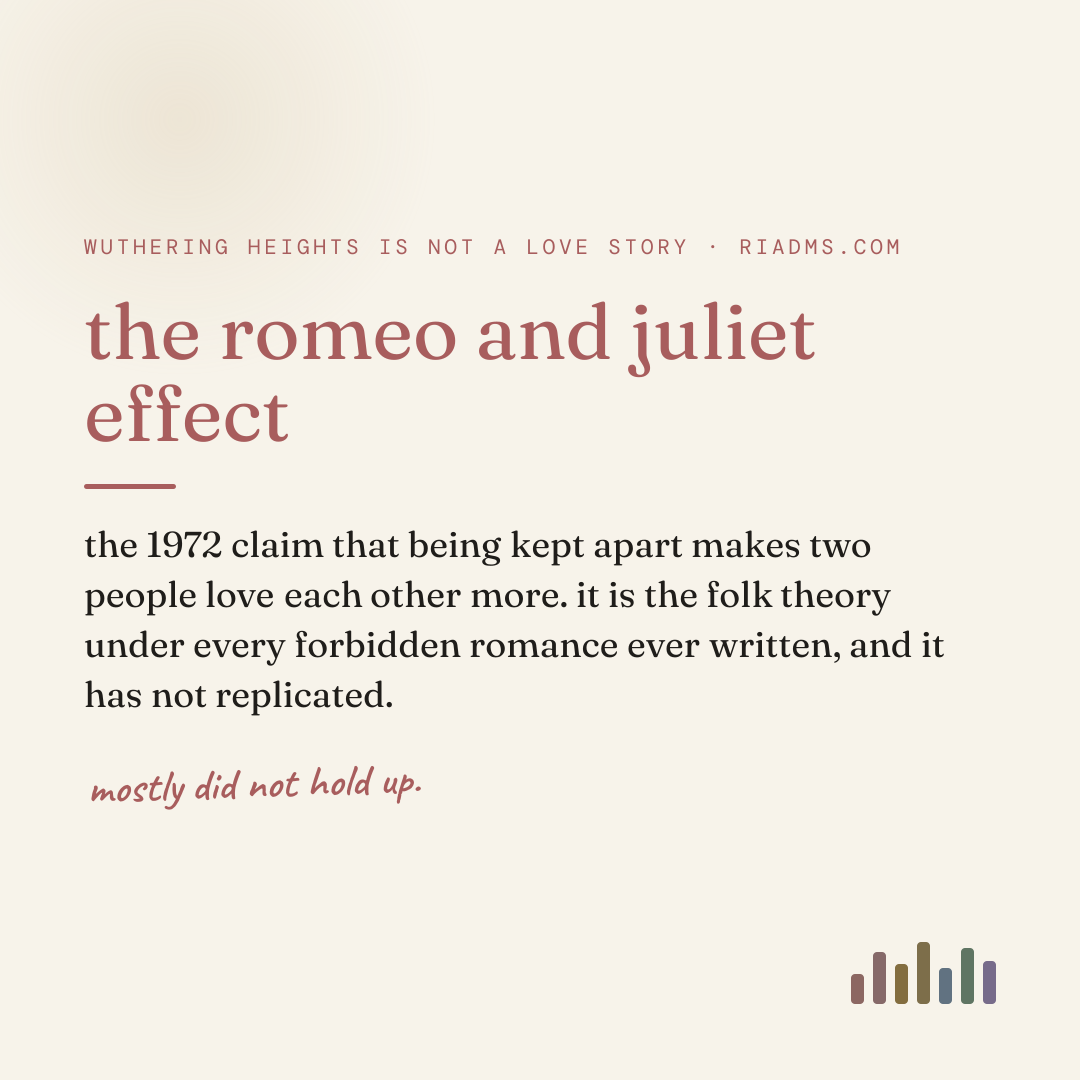
It has not held up. In 2014 Sinclair, Hood and Wright ran it again with the original measures on 396 people and could not find it. What they found instead is now called the social network effect: when the people around you disapprove, relationship quality goes down, not up. Later work has mostly agreed with them.
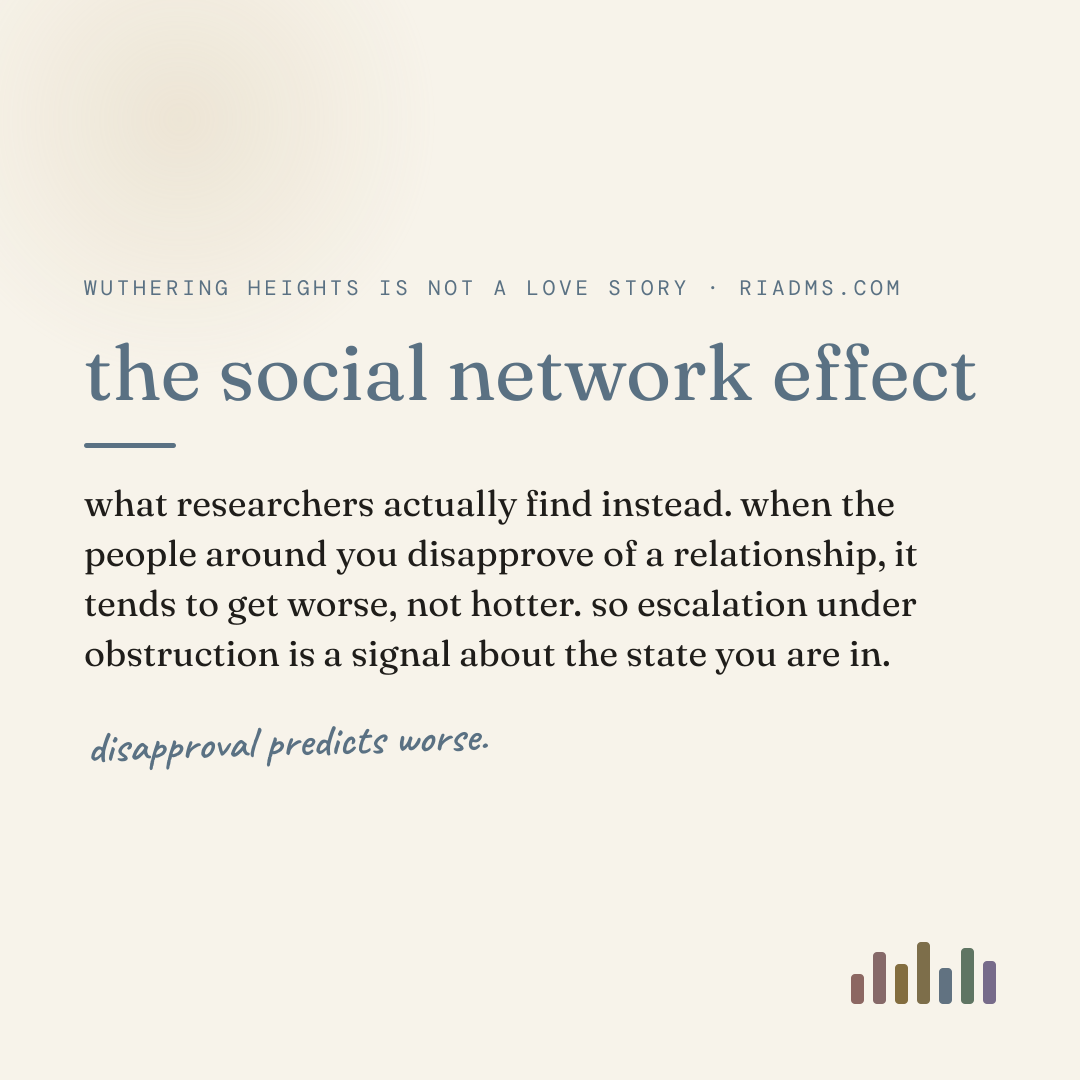
Which matters here more than it looks. If obstruction reliably grew love, Cathy and Heathcliff would be an ordinary case of an ordinary mechanism. It does not. So a feeling that gets bigger every time the person gets further away is not the normal shape of love running into an obstacle. It is a signal about which state you are in.
brontë knew, and the book came with a warning label
I want to be careful here, because there is a smug version of this essay and it is a worse one. Emily Brontë was not confused. She did not accidentally write a book about obsession while trying to write a romance.
The reviewers in 1847 understood immediately and were appalled. One wrote that they knew nothing in the whole range of fiction “which presents such shocking pictures of the worst forms of humanity”. Another said it showed “the brutalising influence of unchecked passion”. Another said it “does not soften; it harasses”. Nobody in 1847 thought they were reading a love story.
Then Emily died, and Charlotte edited the second edition and wrote a preface for it in 1850 in which she doubts whether it was right or advisable for her sister to have made Heathcliff at all, and calls him unredeemed. The author’s own sister put the warning on the front of the book.
And then there is the line I cannot get over. Isabella has run off with Heathcliff because she is in love with an idea of him, and he sneers about her to Nelly: she abandoned her family “under a delusion, picturing in me a hero of romance, and expecting unlimited indulgences from my chivalrous devotion.”
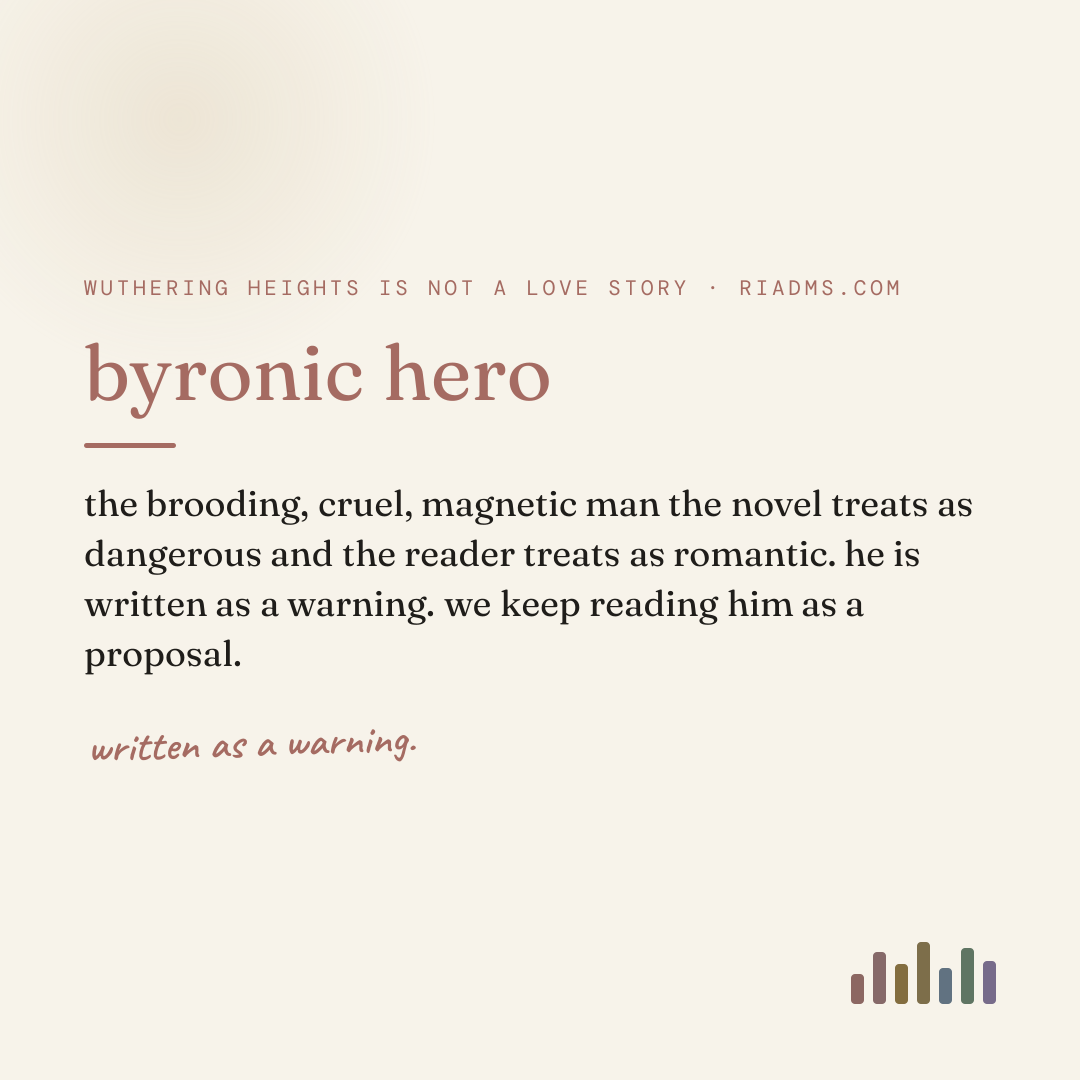
Picturing in me a hero of romance. The character says out loud, on the page, that reading him as a romantic hero is a delusion and that people get hurt doing it. Brontë wrote the warning into the villain’s own dialogue. We peeled it off and put a clinch cover on the front, which is more or less literally what the 2026 poster is, and the most common complaint in the film’s mixed reviews was that it traded the novel’s emotional depth for sensuality. The film adapted the misreading rather than the book.
why it still feels like the greatest love story
Here is my honest answer, and it is the reason I did not want to write the smug version.
I am asexual. I do not get the physical pull that most people use to tell “this is real” from “this is chaos”, so I have spent my whole life reading intensity from the outside, watching people describe it and trying to work out what they were measuring.
And what I notice is that intensity is the only instrument most people are handed. Nobody gives you a scale for whether you are known by this person. Nobody gives you a scale for whether you are easy together, or whether either of you is actually there. You get one dial, and the dial measures how much it hurts.
Wuthering Heights is the highest reading anybody has ever recorded on that dial. Of course it wins the poll. It is not competing as a love story. It is competing on the one axis we were all taught to read, and it holds the record.
keep reading
If you want the state itself rather than the novel, go to Tennov’s Love and Limerence, which is where all of this starts, and then read the limerence chapter here, which has the full symptom list and the tests.
If you want the honest version of the research, the single most useful link on this page is Sinclair, Hood and Wright (2014), because it takes away the excuse that obstruction is just what love does.
And if you want the book, read the book. None of this takes a word off it. It is the strangest and best novel in English about obsession, and it is much better read as what it is.
When somebody says they want a love like Cathy and Heathcliff’s, they are not asking for cruelty. They are asking to matter that much to someone, which is an entirely reasonable thing to want.
But the book they are pointing at is about two people who could not be separate and destroyed three generations over it. And if the only story we hand people about what enormous love looks like is that one, they will keep reading the alarm as the fire.
Keep the want. Just notice which story you got it from, and notice that the story disagrees with you.

