He never hit you. He never called you anything you could repeat to somebody and watch their face change. There was no incident.
There was just this. You check his mood before you decide what kind of day you are allowed to have. You have started drafting sentences in your head before you say them out loud, in your own house. There are two friends you see less than you used to and you cannot point at the week that changed. And the last four times you brought something up that hurt you, the conversation ended with you apologising.
None of that sounds like anything.
That is the problem. You could describe the whole relationship to a friend, in detail, for an hour, and watch her face stay completely neutral, because nothing you just said is a thing. There is nothing in it she can be angry about on your behalf. So you land where everybody lands, which is deciding that you are difficult. Sensitive. A lot to be with.
There is another possibility, it has a name, and it has been a criminal offence in England and Wales since 2015. Not the hitting. The pattern.
you were taught to look for an incident
Think about where you learned what abuse is. Television, mostly, and public information films, and in every version there is an event. A night. A door. Something with a before and an after.
So that is how you audit your own relationship. Like a bank statement, scrolled for one enormous transaction. There isn’t one, so you close the tab and decide you are fine.
But that is not the shape of what you are looking at. It is four hundred withdrawals of eleven pounds each, and not one of them, alone, would survive being said out loud.
He goes silent for a day and a half. He asks who I’m texting, but he says it like a joke. He got weird about the trip.
Say one of those in isolation and a reasonable person shrugs. Say four hundred of them across three years and you have a different life than the one you started with, and no moment where it changed.
In 2025, Kristy Kassing and Anthony Collins published interviews with fifteen women in an Australian survivor group in the Journal of Interpersonal Violence. It is small and it is qualitative, so it is testimony rather than statistics, and I want to be straight with you about that. But one of them described it like this: “slowly, over time, you completely lose yourself, your independence, and your desire to make choices.”
There is no event in that sentence either. Even the person it happened to cannot point at a night.
come think with me
one letter a week.
the word for one feeling you’ve had but couldn’t name, and why it works that way. the same thing you just read, in your inbox, once a week.
- one letter a week, about a ten minute read
- all nine printable workbooks, free
- the research, with its caveats kept in
- hit reply and it reaches me. i read every one
no pressure, no spam, no gatekeeping. unsubscribe anytime · riadumitrescu.substack.com
all of this is free and it stays free. if it gave you a word you didn’t have, you can buy me a coffee.
the word, and the man who had to invent it
In 2007 a researcher called Evan Stark published Coercive Control: How Men Entrap Women in Personal Life, and spent it arguing something that sounded absurd at the time: that domestic abuse is neither primarily domestic nor necessarily violent.
What he meant is that everything we had built, the laws, the refuges, the question the doctor asks, was designed around counting assaults. And in real cases the assaults were often not the main event. Sometimes there were barely any. What was happening was closer to hostage-taking than to fighting. Somebody’s world was being made smaller, one rule at a time, until they could not move inside their own life.
So he called it a liberty crime. Not a violence crime.
Sit with how much that changes. If it is a violence crime, the question is how badly were you hurt, and if the honest answer is “not really, physically,” you do not qualify and you go home. If it is a liberty crime, the question is how much of your life do you still control. And that is a question you can answer right now, in your head, and you probably already started.
This did not begin with Stark. Go back to 1984, to Duluth, in Minnesota, where a project did something that had not really been done. They did not theorise about what was happening to women who had been battered. They sat with them over months and asked them what was being done, then wrote it down. What came out is the Power and Control Wheel, and it has since been translated into more than forty languages.
I love that detail. The categories were not invented in an office. They came from women describing, in their own words, the exact thing you have not been able to describe.
Then in 2015, England and Wales did something about it. Section 76 of the Serious Crime Act created a new offence, controlling or coercive behaviour in an intimate or family relationship. It came into force on the 29th of December 2015. It needs the behaviour to be repeated or continuous, it needs a serious effect, and it carries up to five years. Scotland went further in 2018, folding the whole pattern into a single offence rather than bolting it on.
And here is why legislation belongs in an article about your feelings.
A government had to write an entirely new criminal offence, because every offence it already had could only see incidents. The law had the same blind spot you have. It looked directly at this for decades and could not find the crime in it, because it kept looking for a moment.
You are not slow. You inherited a broken lens, and so did everyone you tried to explain it to.
the two machines that stop you using the word
So the word exists. Why can’t you pick it up?
The first reason is gaslighting, and you have been told what it is wrong.
You have heard it as a personality thing. A manipulative individual, doing a manipulation, to somebody too trusting. In 2019 a sociologist called Paige Sweet published “The Sociology of Gaslighting” in the American Sociological Review, and argued that this is not primarily psychological at all. It is sociological, and it runs on inequality.
What she found is that it works by picking up tools that are already lying on the ground. It works when someone can reach for an idea the world has already agreed with. That women are emotional. That women overreact. That women misremember when they are upset. That anyone with a mental health history is unreliable about their own life.
The person doing it does not have to build your self-doubt from nothing. It is prefabricated. They point at it.
So that is not you being crazy. That is a stereotype handed to you as a tool and used on you. And it works so well precisely because it was never personal. It was structural before either of you arrived.
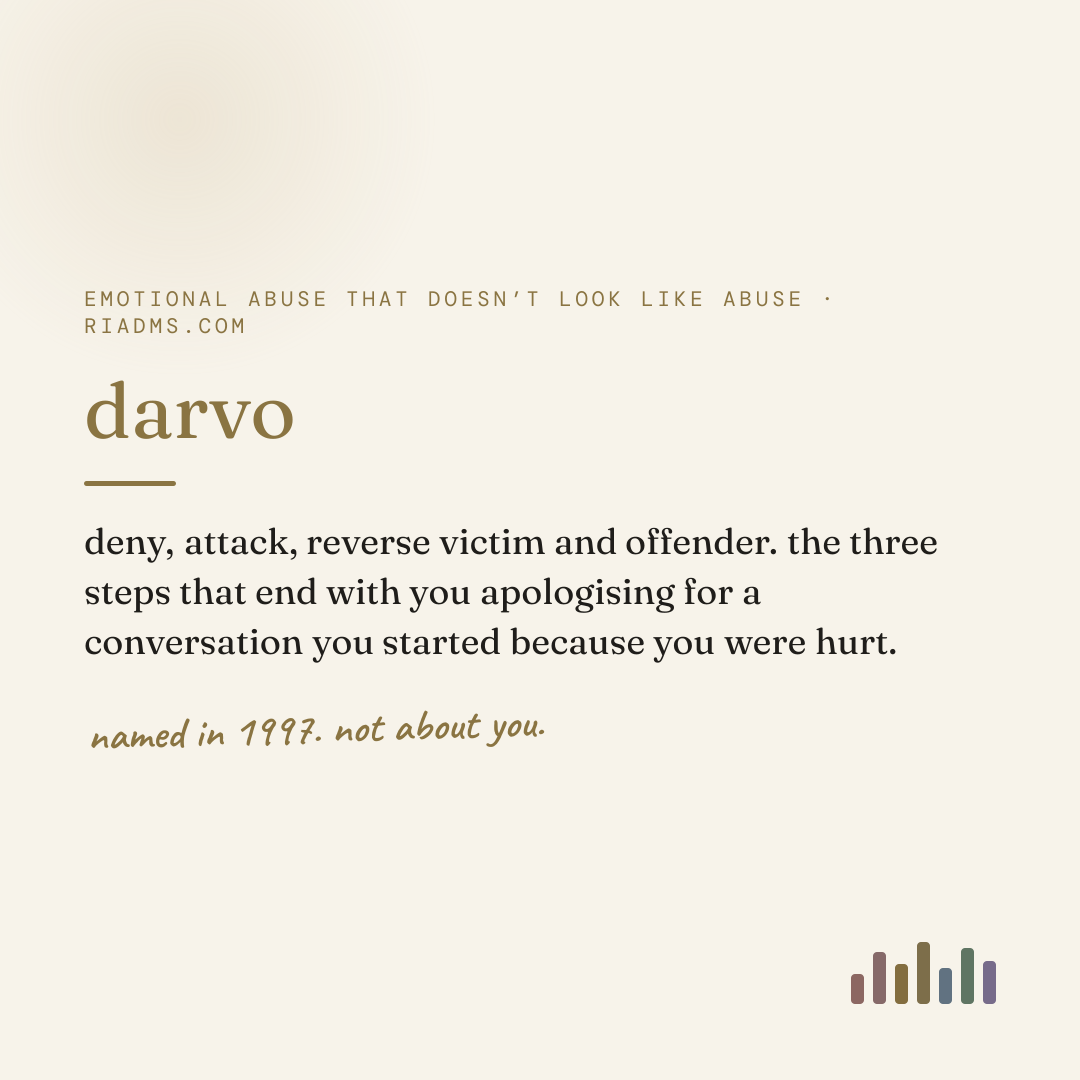
The second machine is conceptDARVO · deny, attack, reverse victim and offenderThe three-step move a person makes when confronted: deny it, attack the credibility of the person confronting them, then swap the roles so they are the wounded one. It is why you can go in with a hurt and come out apologising.Freyd, DARVO ↗, and it explains the apologising.
The psychologist Jennifer Freyd named it in 1997. Deny, Attack, Reverse Victim and Offender. Confronted about something, a person first denies it, then attacks the credibility of the person confronting them, and then swaps the roles, so that by the end they are the wounded one and you are the one who did something.
That is why you go in with a hurt and come out apologising. It is not that you were wrong. It is a three-step sequence that has been sitting in the literature for nearly thirty years.
It has also been measured. Harsey, Zurbriggen and Freyd found in 2017 that people who ran into DARVO when they confronted somebody reported more self-blame afterwards. Not more doubt. Blame, turned inward.
And then there is the finding this whole page exists for. In 2020, Harsey and Freyd showed people a confrontation where DARVO was used, and reliably, it worked: observers believed the victim less. Then they took another group, taught them what DARVO is, gave them the name and the three steps, and showed them the same thing.
The people who had been taught the name rated the perpetrator as less believable.
test the room, not the feeling
You cannot use the feeling as your test, and that is not a stupid mistake to have made. The feeling is simply not diagnostic. Love feels like love, and from the inside, early on, control feels like love too. It feels like being wanted more than you have ever been wanted. Asking yourself but does it feel real gets you nothing, because it does.
So stop testing the feeling. Test the room.
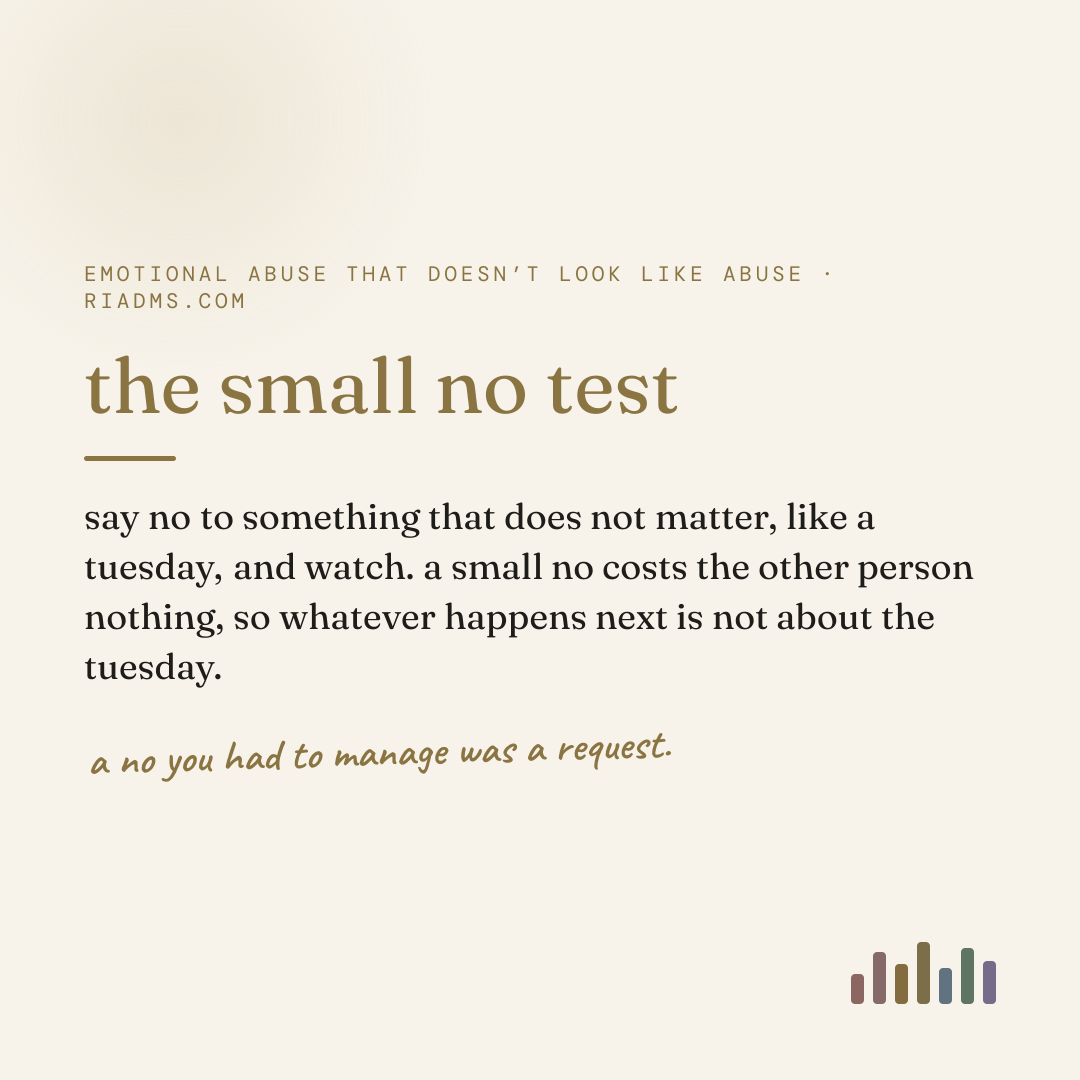
The question is: what happened the first time you said no?
And I mean a small no. Not a boundary about something enormous. A no about a Tuesday. I can’t tonight, I’m tired. I don’t want to go to that. I’d rather stay in.
Small, because a small no costs the other person nothing. There is no reasonable case for being upset about a Tuesday, which means whatever happens next is not about the Tuesday.
There are three ways it goes. It was fine and forgotten, and neither of you thought about it again, which is what a no is supposed to cost. Or it was fine, and then it came back four days later in a different conversation, as evidence. Or the temperature in the room changed and you found yourself explaining. Adding reasons. Offering a different night. Managing it.
If you had to manage a no, it was not a no. It was a request.
Once you have that one, here are five more, and these are the ones I would actually run, because each is something you can check without deciding anything yet.
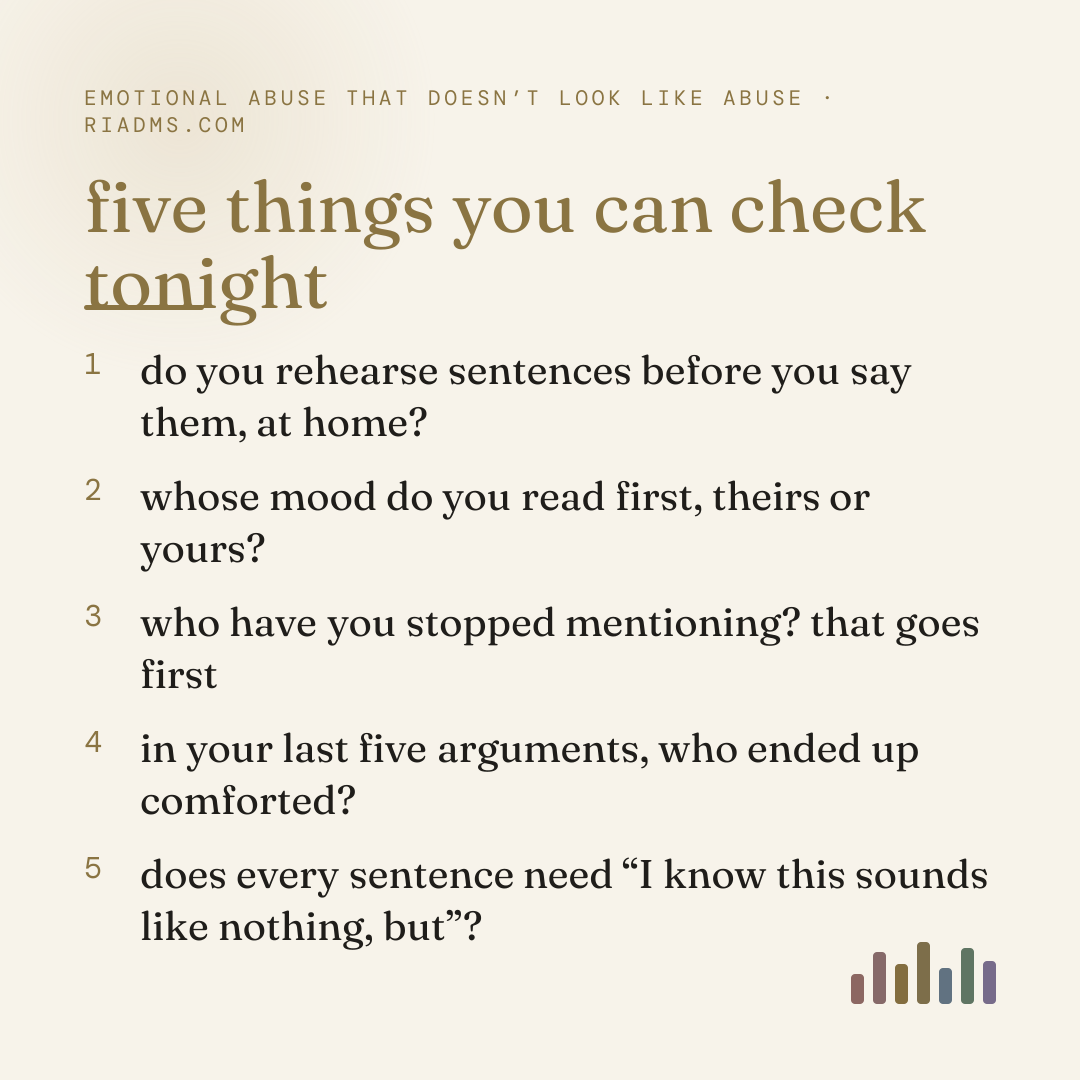
The last one does the most work, so I want to draw it out. If every sentence you say about this needs the prefix I know this sounds like nothing, but, that is not proof you are exaggerating. Given everything above, it is closer to the opposite. That prefix is the sound of harm that was deliberately built too small to report.
two honest notes
One. Stark’s book is about men entrapping women, and the data on this is heavily gendered. It is also not only that. It happens to men. It happens in queer relationships, where the same pattern arrives with the extra problem that fewer people will believe you. If that is you, all of this is yours.
Two, and please actually hear this one. This page is a lens. It is not a plan. If things are landing while you read, do not build a strategy off an article and do not make a decision tonight. The people who do this work for a living are clear that the leaving is the part that needs planning, and it needs somebody who knows how.
what the research cannot tell you yet
One thing I want to be careful about, because the internet is not careful about it.
You will see it said, constantly, that psychological abuse is worse than physical abuse, usually citing a 2022 systematic review by Dokkedahl and colleagues. It is a real and serious piece of work, 149 studies and nearly 230,000 people, and it did find that psychological violence on its own predicts PTSD in women at a large effect size.
But read what the authors say about their own work. They rated the certainty of the evidence as low. And the heterogeneity of the data stopped them running the analysis that would have controlled for other kinds of abuse happening at the same time. Which means the study cannot support the sentence everybody uses it for.
I am telling you this for two reasons. Because you deserve accurate things, and because you do not need that sentence. Nothing here rests on a ranking. You do not have to win an argument about whether what happened to you was worse than something else in order for it to have been something.
keep reading
If you read one thing after this, make it Why Does He Do That? by Lundy Bancroft. Fifteen years of running groups for abusive men, written for the people on the other side of it, and it is the least theoretical book on this list. Stark’s Coercive Control is the primary source and it is worth it, but it is an academic book and it reads like one, so take it second.
And if you only read one study, read Harsey and Freyd on DARVO, because it is the one with the good news in it.
He never hit you.
That is still true. It was true at the top of this page and it is true now. It was just never the question.
The question was how much of your own life you are still in charge of. Whether a no costs you anything. Whether you have become a person who reads somebody else’s weather before deciding what kind of day she is allowed to have.
And if you ran every one of these and none of them fit, then genuinely, that is the best outcome and I am glad. Go and have your Tuesday. Some relationships are just hard. Some people are terrible at conflict and are not doing anything to you. Not everything that hurts is a pattern, and I am not handing you a reason to be suspicious of somebody who loves you.
But if you got to the small no and your stomach did something, you already know why you are here.
You are not difficult. You have been managing something, without a word for it, on your own, for a long time.
You have a word now.
