You’re not in love with them. You’re in love with who they’d be if they just changed a little. The version in your head. The one who texts back, who’s ready, who’s over the ex, who wants the same future you do. You’ve been dating the potential for months now, quietly, and waiting for the real one to catch up to him.
This is one of the gentlest counterfeits, because it doesn’t feel like a warning at all. It feels like faith. Like loyalty. Like seeing the best in someone. And sometimes it is exactly that. But there’s a line where believing in a person turns into loving a person who isn’t there, and standing on the wrong side of that line will cost you years.
you fell for a draft
The tell is the explaining. You catch yourself narrating them to your friends in the future tense. “He’s not usually like this.” “She’ll come around once things settle.” “When he sorts the job out, he’ll finally be…” You have a whole finished version of this person assembled in your head, and you are loyal to HIM. Not to the unfinished one actually in front of you.
That’s not love. That’s a renovation project. And the quiet cruelty of it is that the real person can feel it. They can feel you being a little disappointed in who they are today, measured against a blueprint they never agreed to and can’t see. You think you’re being patient. From the inside of the relationship, it can feel like never being enough.
People are not fixer-uppers. If your love is contingent on them becoming someone, then what you love is the someone, and they’re just the raw material you’re hoping it’s made of.
come think with me
one letter a week.
the word for one feeling you’ve had but couldn’t name, and why it works that way. the same thing you just read, in your inbox, once a week.
- one letter a week, about a ten minute read
- all nine printable workbooks, free
- the research, with its caveats kept in
- hit reply and it reaches me. i read every one
no pressure, no spam, no gatekeeping. unsubscribe anytime · riadumitrescu.substack.com
all of this is free and it stays free. if it gave you a word you didn’t have, you can buy me a coffee.
this is an old trick, and it has a name
You did not invent this, which should make it easier to forgive yourself for. Back in 1822, the French writer Stendhal gave it the best name it’s ever had: crystallization.
He had a metaphor for it. If you leave a bare winter branch in the depths of a salt mine and come back a few months later, it’s covered in glittering crystals, transformed, dazzling. But the branch didn’t change. The salt did that. And Stendhal said this is exactly what the mind does to a person you’re falling for. It coats them, slowly and without your permission, in imagined perfections. You look at an ordinary person and see something radiant, and you assume the radiance is coming from them. A lot of the time it’s coming from you. You’re not seeing them. You’re seeing the crystals.
the honest nuance
Now I won’t lie to you and say idealizing someone is always the problem, because the research says the opposite, and I’d rather be accurate than tidy.
In 1996, the psychologist Sandra Murray found that partners who see each other in an idealized, generous light actually do BETTER. Their relationships were more satisfying and lasted longer, and in some cases the partner even grew into the flattering picture. She called it love that’s “not blind, but prescient.” So seeing the best in someone is not the failure mode. It can be one of the kindest things love does.
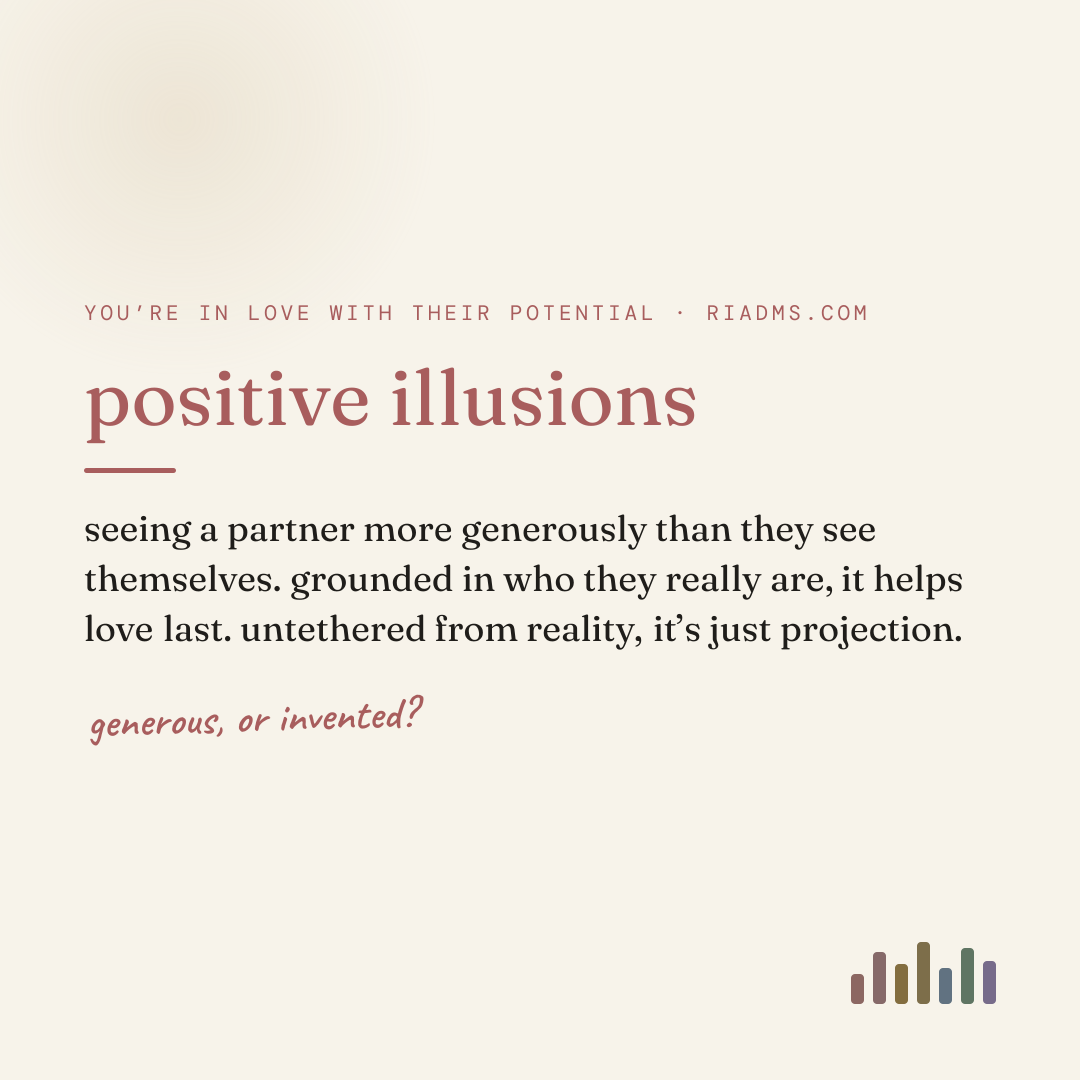
But there’s a line, and it’s the whole thing. Murray’s couples were idealizing a REAL person. They took someone’s actual qualities and read them in the most generous possible light. That’s grounded. What breaks people is the other version: inventing qualities that aren’t there at all, ignoring who the person actually is, and then getting quietly angry at the real one for failing to be the invention. One loves who they are, generously. The other loves who they’re not yet, and resents them for the gap.
If you’ve read the limerence chapter, this will sound familiar, and it should. conceptlimerenceAn involuntary, obsessive state that feels like love: intrusive thoughts, a hunger for reciprocation, and a charge that gets stronger with uncertainty and weaker with security.what is limerence? →Tennov, Love and Limerence ↗ runs on the same projection, just turned all the way up: the obsessive, involuntary, high-voltage version, where the idealized image completely eclipses the real human. Loving someone’s potential is the quieter everyday cousin of the same mistake. Same mechanism. Lower volume. Which is exactly why it’s harder to catch.
why I think I catch this faster
I think being asexual makes this one easier for me to see, because I never had the haze around it. When I find someone beautiful, it’s a lot like finding a painting beautiful. I notice it, I appreciate it, and then I keep walking. The appreciation doesn’t come bundled with a fantasy about who they are on the inside. I don’t invent a soul to match the face.
So I’ve spent years watching friends do the opposite. Watching someone build an entire imagined personality onto a jawline, fall in love with the personality, and then grieve when the actual person eventually showed up and refused to match. The projection is easiest exactly when the wanting is loudest. The pull fills in every blank with something flattering. Turn the wanting down, even a little, and you can finally see who’s actually standing there.
If you want to go deeper, Stendhal’s On Love is where the whole idea starts, two centuries before the psychology caught up. Murray’s study on positive illusions is the grown-up, honest take on when idealizing helps and when it wrecks you. And the limerence chapter is the louder version of this exact trap, worth reading right after.
So look at them again. Not the future one. The one who exists today, on a completely ordinary day, being exactly who they are right now, with no renovations. If you love THAT person, you’re in love, and you can stop waiting. If you love the draft, then you’re in love with something you wrote, and a draft can’t love you back. It was never really them you were reaching for. Let the real one either be enough, or not, but let them be real.


