Every time I talk about being asexual, the same question shows up, phrased a hundred careful ways. If you don’t feel sexual attraction, do you still, you know. Want anything. Do you still do anything.
And I understand why nobody can answer it cleanly. Because to answer it you have to separate two things almost everyone has fused into one word. Attraction, and desire. You think they’re the same feeling. They’re two completely different systems. And once you pull them apart, a lot of confusion about your own body starts to make sense. Not just mine.
the two things you’ve been calling one thing
Here’s the split, and it’s the whole chapter.
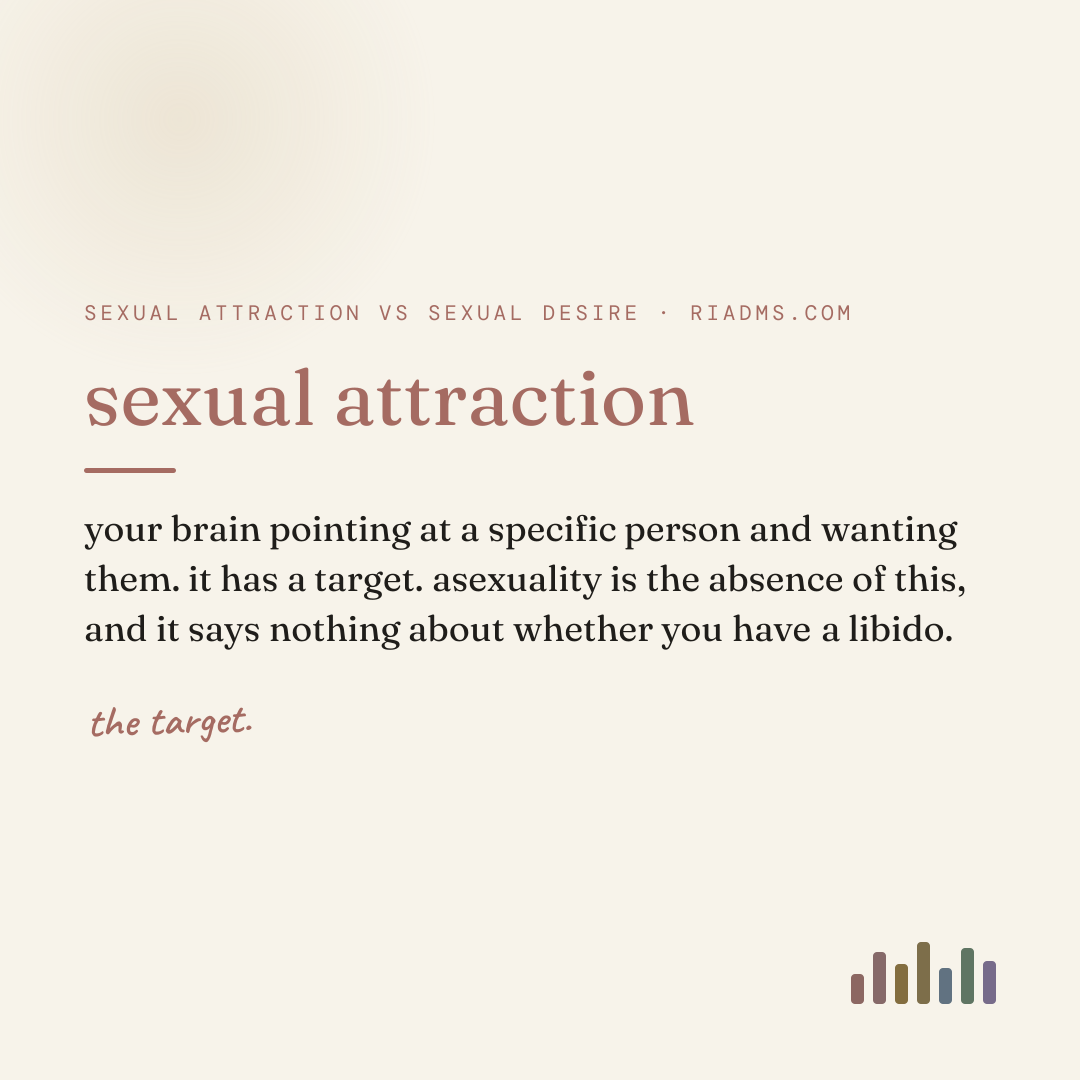
Sexual attraction is a target. It’s your brain pointing at a specific person and going, them, that one. Attraction has a direction. It’s aimed.
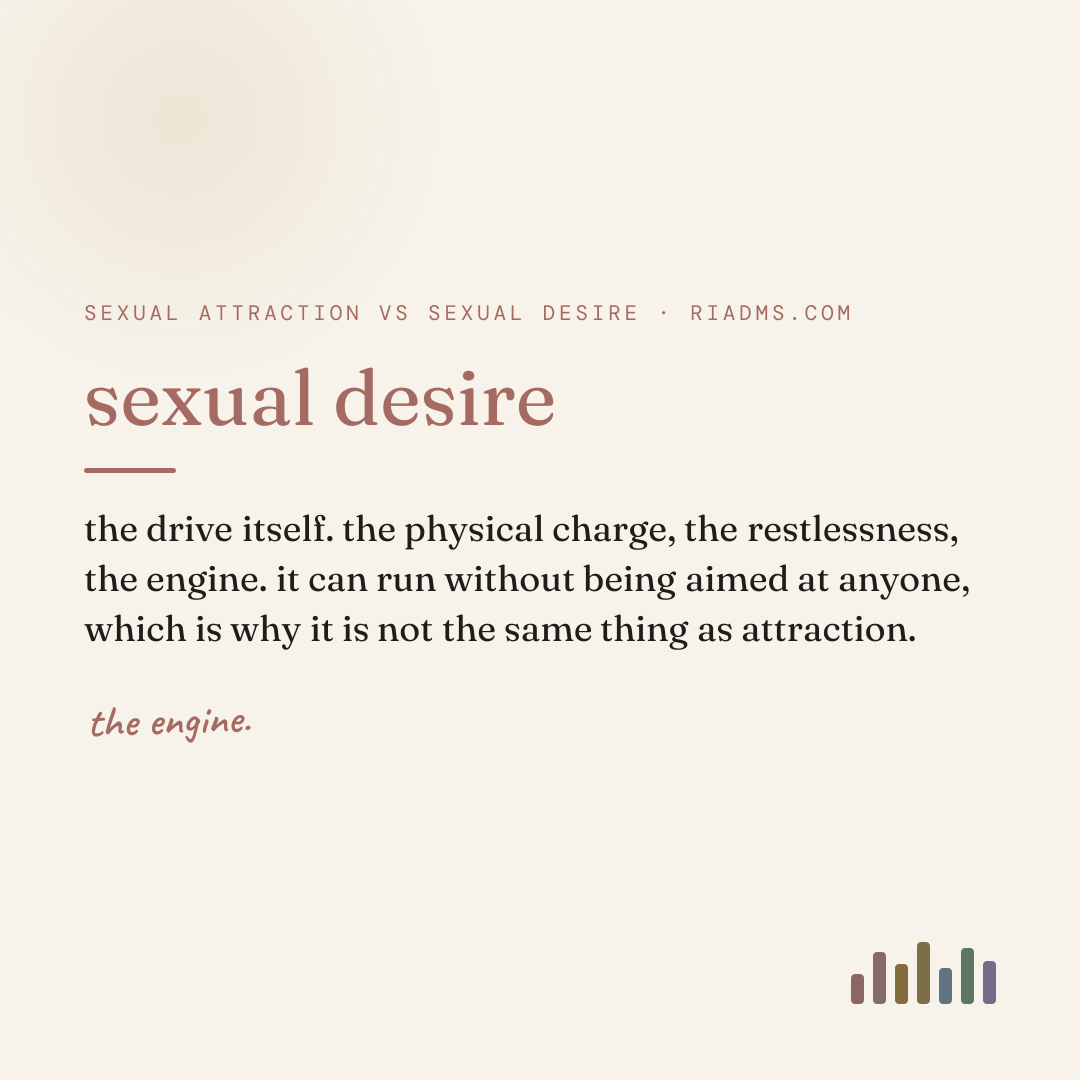
Sexual desire, libido, whatever you call it, is a drive. An engine. And an engine can run without going anywhere. Desire is the wanting itself, the physical charge, the restlessness, and it doesn’t have to be aimed at a person. It can just idle.
The asexual community has been drawing this line for over twenty years, well before the research. AVEN puts it plainly: asexuality is the absence of sexual attraction. It says nothing about whether you have a libido. Plenty of asexual people have a sex drive. It’s just not pointed at anyone.
Think about hunger. There’s being hungry, the general engine. And there’s craving one specific thing, that exact sandwich. You feel them together so often you think it’s one feeling. But you can be hungry with no specific craving, and crave something you’re not even hungry for. Attraction is the craving for a specific person. Desire is just the hunger.
come think with me
one letter a week.
the word for one feeling you’ve had but couldn’t name, and why it works that way. the same thing you just read, in your inbox, once a week.
- one letter a week, about a ten minute read
- all nine printable workbooks, free
- the research, with its caveats kept in
- hit reply and it reaches me. i read every one
no pressure, no spam, no gatekeeping. unsubscribe anytime · riadumitrescu.substack.com
all of this is free and it stays free. if it gave you a word you didn’t have, you can buy me a coffee.
so, do asexual people masturbate
Yes. A lot of us do. I’m going to answer it plainly, because the silence around it is what keeps people confused about themselves.
There’s real research here. Morag Yule and Lori Brotto studied masturbation and fantasy in asexual people, and it’s the clearest proof that attraction and desire are separate. Asexual people masturbate less on average. And when we do, the reason tends to be different: less “I want this person,” more functional. Releasing tension. Quieting a restless body. The engine is running, so you let it run down.
And the part that made it click for me: asexual people were much more likely to say their fantasies don’t involve other people at all. The libido is there. The person isn’t. There’s no one in the room, even in the imagination. Which is exactly what you’d expect if desire is an engine and attraction is the steering wheel, and you were simply born without the steering wheel.
The foundational work on this goes back to Bogaert’s national sample in 2004, where asexuality got defined precisely as never having felt sexual attraction to anyone. Attraction. Not desire, not behaviour, not arousal. Just the target.
and this is where non-asexual people go quiet
Now watch this land for people who aren’t ace at all.
The sex researcher Rosemary Basson changed how therapists think about desire. The old model said desire is spontaneous: it arrives on its own, out of nowhere. And a lot of people, especially women, kept coming into therapy convinced they were broken, because that never happened to them.
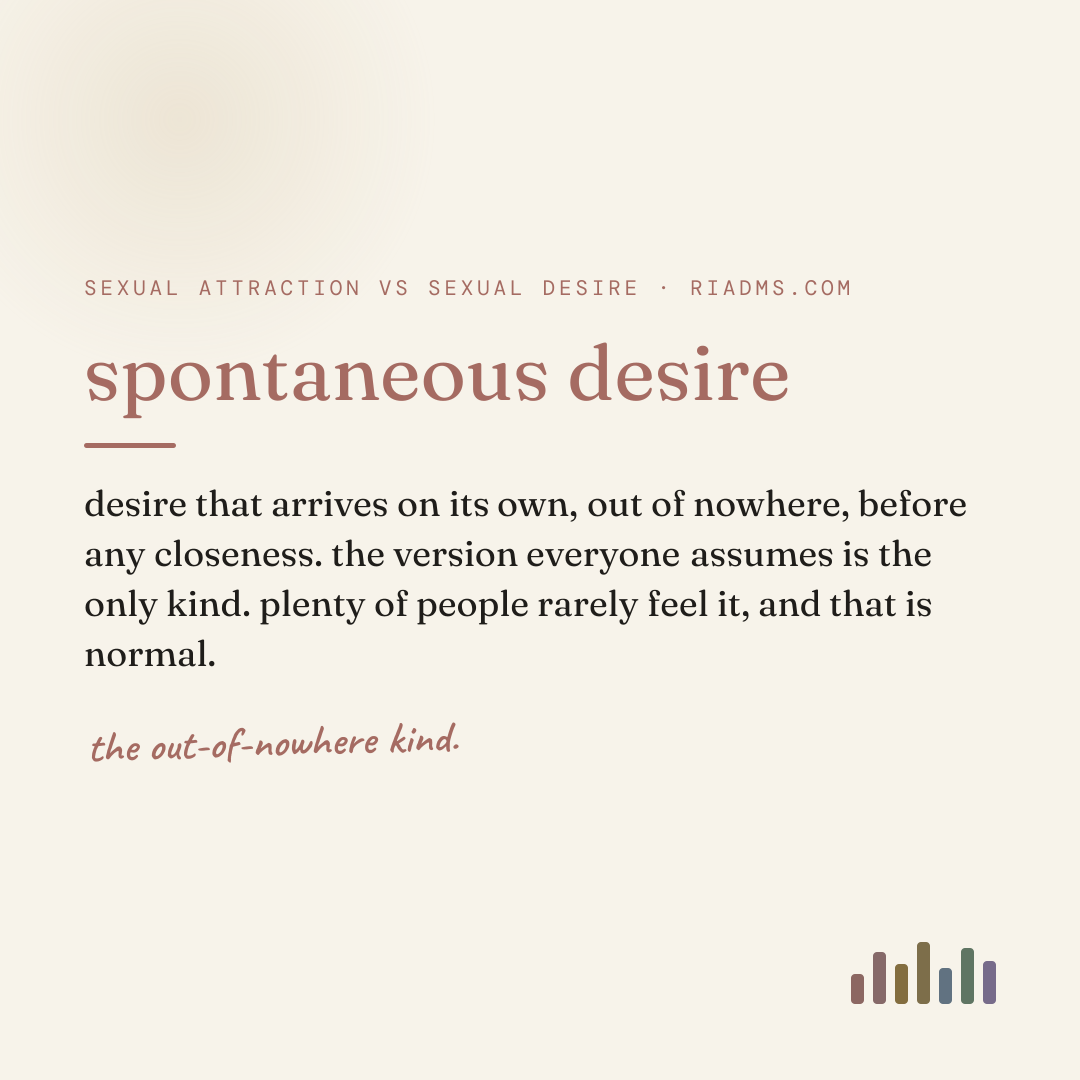
Basson said, what if that’s not the only kind. What if for many people desire is responsive. It doesn’t show up first. It shows up second, after closeness, after touch, after safety. You don’t feel the wanting and then get close. You get close, and then the wanting arrives.
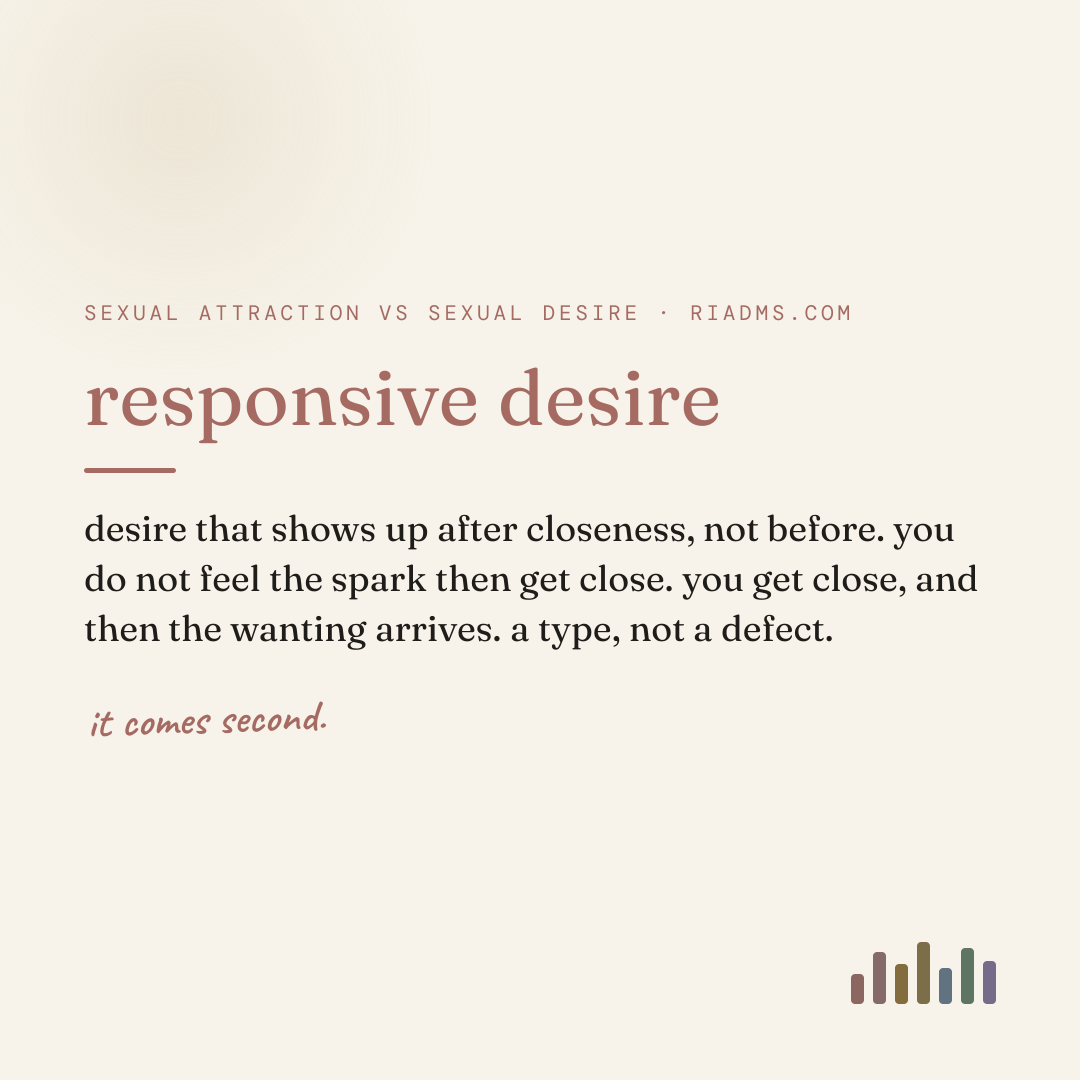
So if you’ve ever thought “I never feel that sudden hit of desire everyone describes, something’s wrong with me,” maybe nothing is wrong with you. Maybe your desire is conceptresponsive desireSexual desire that arrives in response to arousal or closeness rather than spontaneously. It shows up after you get close, not before. A common pattern, not a dysfunction.what is responsive desire? →Basson, 2000 ↗ instead of spontaneous. That’s not a defect. That’s a type. Emily Nagoski’s Come as You Are is the whole popular science of this, if you want the 300-page version.
You can see how these keep getting tangled. Spontaneous desire, responsive desire, attraction, libido. Four different things. One overloaded word. No wonder everyone’s confused about their own body. We were handed one syllable, sex, to describe a whole control panel.
what it feels like from the inside
People imagine that living without the target is emptiness. It isn’t.
For most of my life I thought everyone was performing. I thought when people said they saw a stranger and instantly wanted them, they were quoting a movie. Because I had the engine. I understood a body being restless. I just never once had it point at a person. The steering wheel was never installed, and I assumed nobody else’s was either.
Learning the words didn’t change my body at all. It changed the story. I stopped thinking I was cold, or repressed, or a late bloomer, or damaged. I had the drive. I didn’t have the direction. That’s the ace vantage on the whole thing: because I live with them separated, I can see the seam that for you is invisible, because your two systems fire together, aimed at the same person, welded into one experience.
one thing before you spiral
If you’re now wondering whether you don’t feel “enough” attraction, here’s the line that matters.
There is a real medical thing, a low-desire disorder. Brotto and Yule looked at whether asexuality is a version of it, and the answer was no. What separates a disorder from an orientation is distress. A desire disorder is low desire that genuinely distresses you, that you want treated. Asexuality is not that. The distress ace people feel isn’t “I wish I wanted this.” It’s “I wish the world would stop insisting I’m broken for not wanting it.” One is internal. The other is just pressure from outside.
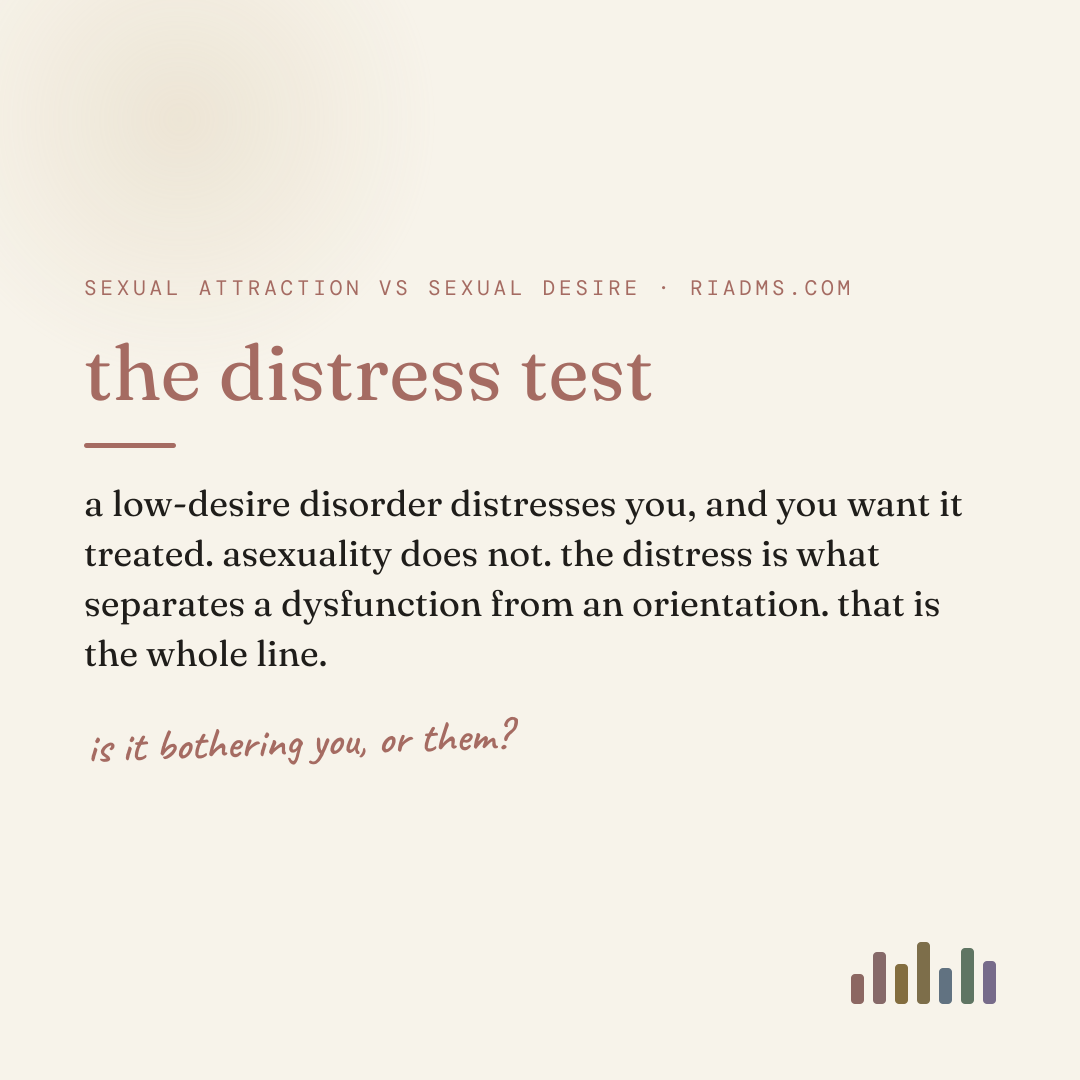
The DSM actually agrees. It specifically says that if you identify as asexual, you don’t get diagnosed. Even the manual knows the difference between a disorder and a person.
keep pulling the thread
If this reframed something, the next chapter, which orientation combination are you, splits the other pair nobody separates, romantic from sexual attraction. And Come as You Are by Emily Nagoski is the best single book on desire being more varied and less broken than anyone told you.
Sexual attraction is the target. Sexual desire is the engine. They usually run together, which is exactly why nobody notices they’re two things until they come apart. And they come apart for a lot more people than just asexual ones.
If you’ve felt the engine with no target, or the target with no engine, or a desire that only ever shows up second, none of that means you’re broken. It means you had one word for four feelings, and the word was too small. Here are better words. Take the ones that fit. You don’t owe your body a diagnosis.