There’s a sentence underneath almost every piece of advice anyone has ever given you about being lonely, and it’s so obvious that nobody says it out loud. Find someone. Get into a relationship, and this goes away.
That’s not just folk wisdom. It’s close to a founding assumption of relationship science, and there’s a mountain of evidence behind it. People in good relationships really are less lonely. It’s one of the most replicated findings there is, which is exactly why nobody went looking for an exception.
In 2026 a team went looking, and found one.
the finding
Giulia Zoppolat, Manuela Barreto, Pamela Qualter, Jasmine Crosbie and David Doyle published Does Romantic Involvement Benefit Everyone? in Social Psychological and Personality Science. The title isn’t rhetorical. The paper treats “romantic involvement is good for you” as a foundational tenet of the field and then tests it against a group nobody had checked.
The data is the BBC Loneliness Experiment, which ran in 2018 and is one of the largest loneliness datasets ever collected. 55,060 people accessed it, mostly in the UK, aged 16 to 99. The analysis used 36,464 heterosexual participants, 3,684 other sexual minority participants, and 1,443 asexual participants.
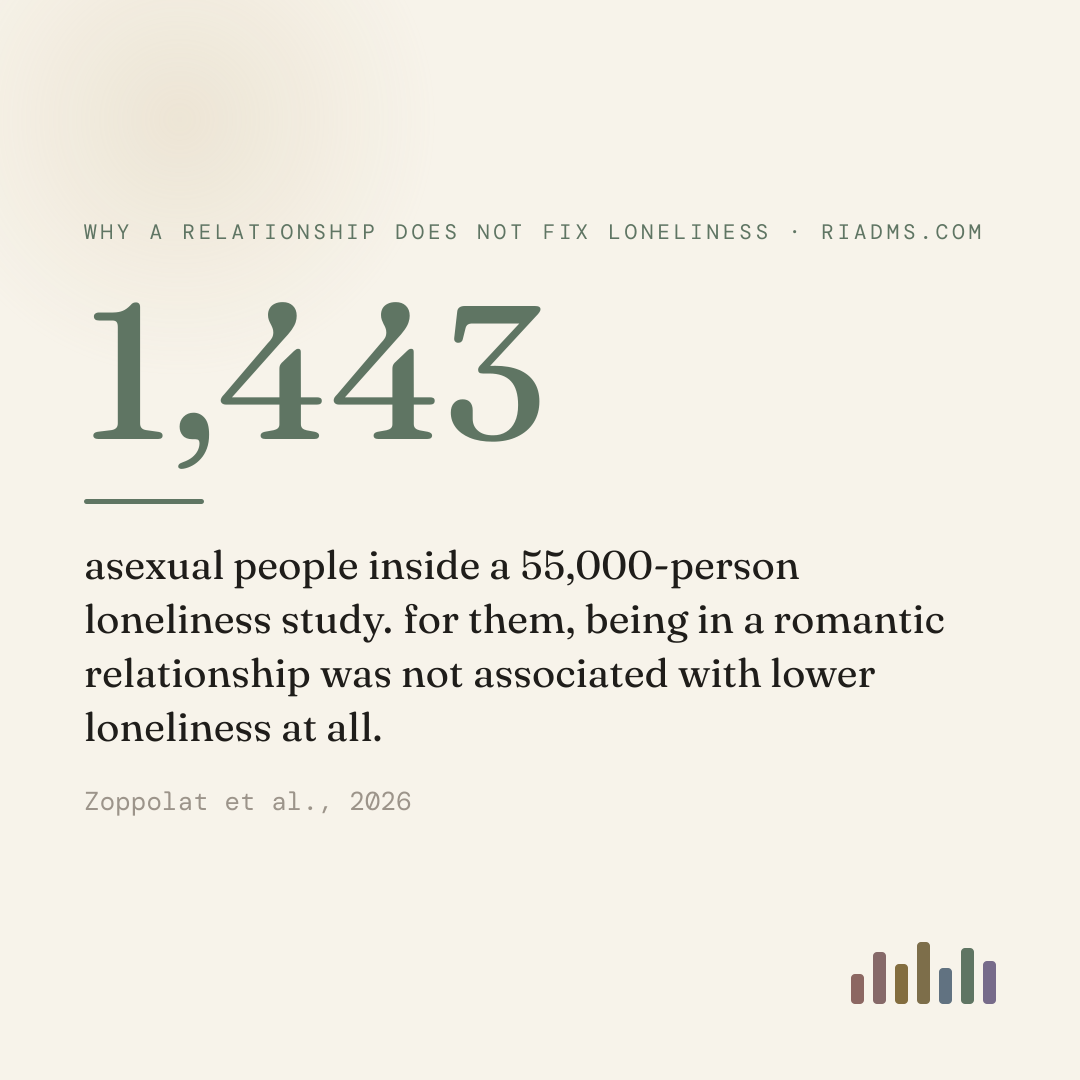
For the heterosexual participants and the other sexual minority participants, the expected pattern was there. Being in a satisfying relationship went with being less lonely. For the asexual participants, that association wasn’t.
That 1,443 is worth pausing on. Asexual samples in psychology are usually a couple of hundred people recruited off a forum. Fourteen hundred, sitting inside a general survey that wasn’t about asexuality and therefore not selecting for people who had already thought hard about it, is a genuinely good sample for this field.
Now the limits. They go here rather than at the end, because putting them last is how a finding gets oversold.
It’s cross-sectional. One snapshot rather than people followed over time, so it can’t tell you which direction the arrow points. It’s self-report, on both loneliness and relationship satisfaction. And the authors flag the largest problem themselves: “asexual” was one box, and the people inside it aren’t one thing. Demisexual people are in there. wordgray-asexual · gray-aSitting in the grey area of the asexual spectrum: sexual attraction that’s rare, faint, or only under specific conditions.what does gray-asexual mean? → people are in there. wordaromantic · aroLittle or no romantic attraction. An aromantic person may still feel sexual attraction. Being aromantic and being asexual are two separate things that can come apart.what does aromantic mean? → people are in there, and so are romantic asexual people like me, who are about three quarters of us. The authors say directly that their measure couldn’t examine those groups separately, which means we don’t know how much of the effect is being carried by the aromantic participants inside the asexual category.
That’s a real hole. What survives it’s still the interesting part.
come think with me
one letter a week.
the word for one feeling you’ve had but couldn’t name, and why it works that way. the same thing you just read, in your inbox, once a week.
- one letter a week, about a ten minute read
- all nine printable workbooks, free
- the research, with its caveats kept in
- hit reply and it reaches me. i read every one
no pressure, no spam, no gatekeeping. unsubscribe anytime · riadumitrescu.substack.com
all of this is free and it stays free. if it gave you a word you didn’t have, you can buy me a coffee.
two doors to close first
This doesn’t say asexual people can’t be happy in relationships. The measured variable is loneliness. Not satisfaction, not happiness, not whether the relationship is good. Mine is the best thing in my life and this finding doesn’t touch that claim.
And it doesn’t say relationships are pointless. For 36,464 heterosexual people in the same dataset the effect was exactly where the field said it would be. Relationships do this for most people, reliably.
What it says is smaller and more useful than either. For one group, the standard machine didn’t run. And when a machine works for everyone except one group, the interesting question isn’t what’s wrong with that group. It’s what the machine was actually doing all along that this group wasn’t getting.
what a relationship is actually doing
This next part is my reading rather than the paper’s, and I want that labelled.
When somebody gets into a serious relationship, several completely different things happen at once and arrive in one box. They get a person who knows the whole story. They get somebody in the house. They get a default plan on a Friday. They stop being asked why they’re single. And they get sorted, by everyone around them, into the category of person whose life is going correctly.
Only the first of those is being known. The rest are logistics and status. For most people they all show up on the same day, so nobody ever finds out which one was doing the work.
There’s a piece of research about this I find genuinely uncomfortable. In 2006 Naomi Gerstel and Natalia Sarkisian published Marriage: The Good, the Bad, and the Greedy. Using national survey data, they found that married people are less connected to friends, parents and neighbours than single people. Less likely to stay in touch, less likely to give or receive practical and emotional help. Their 1998 to 2008 follow-up work found the same pattern in ties to parents.
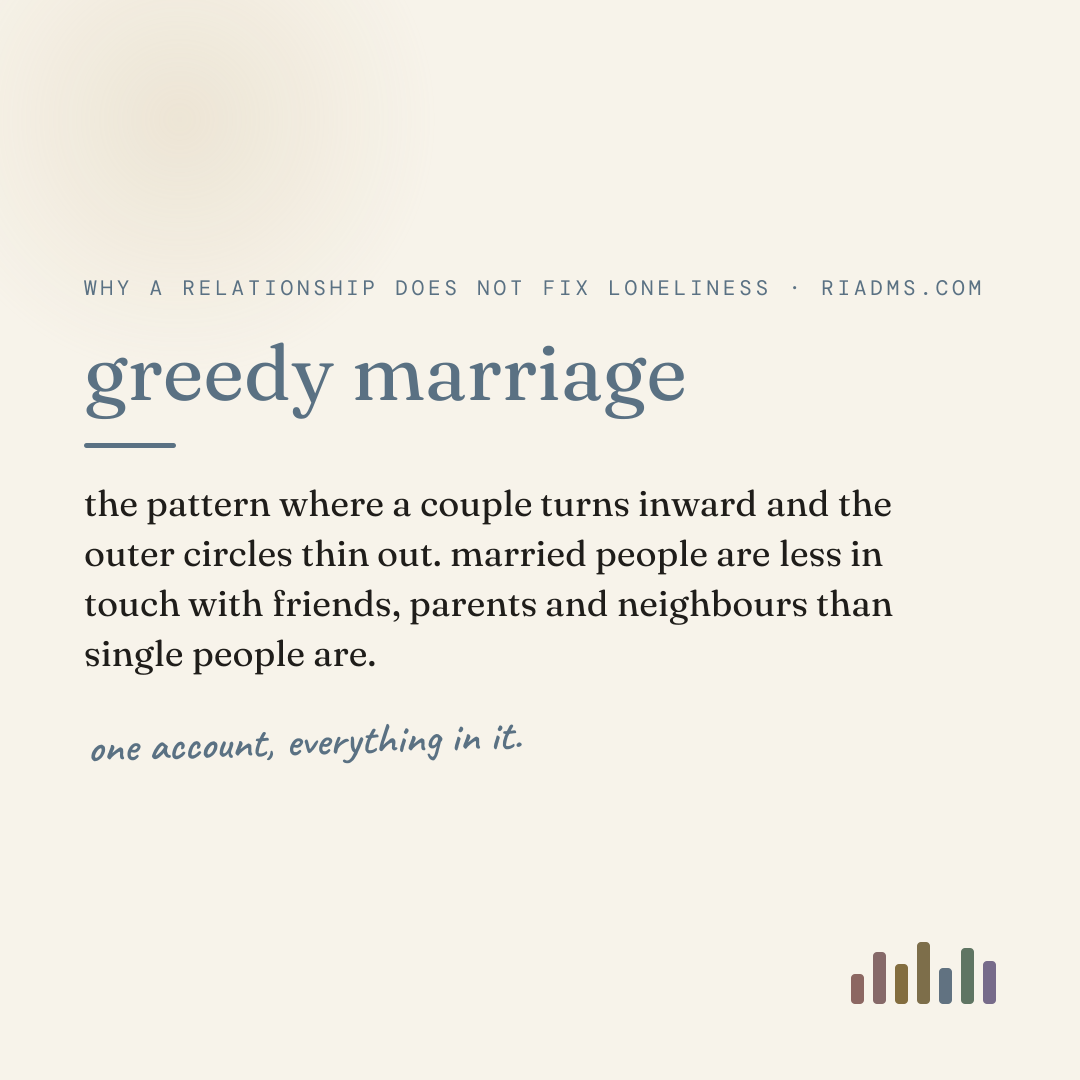
They called it greedy marriage, and the mechanism isn’t a failure of the couple. It’s what the norm instructs them to do. You’re supposed to be each other’s everything, so the outer circles thin out on schedule and nobody experiences it as a decision.
Look at what that’s, financially. It’s closing every account you’ve and moving the whole balance into one. Which is a completely reasonable move if that account pays out. It’s a very exposed position if for any reason it doesn’t.
And if you’re asexual, or aromantic, or in any relationship the standard sequence has no slot for, you’re running that bet with worse odds, because a large share of what the box was going to hand you was the social sorting, and the sorting is precisely the part you don’t get.
the detail everybody skips
The best evidence on what actually predicts this is Julianne Holt-Lunstad’s 2010 meta-analysis in PLOS Medicine: 148 studies, 308,849 people. People with stronger social relationships had a 50% higher likelihood of survival. That figure is why you’ve heard loneliness compared to smoking.
That much gets quoted constantly. The part that almost never does is the breakdown, and it’s the reason this page exists.
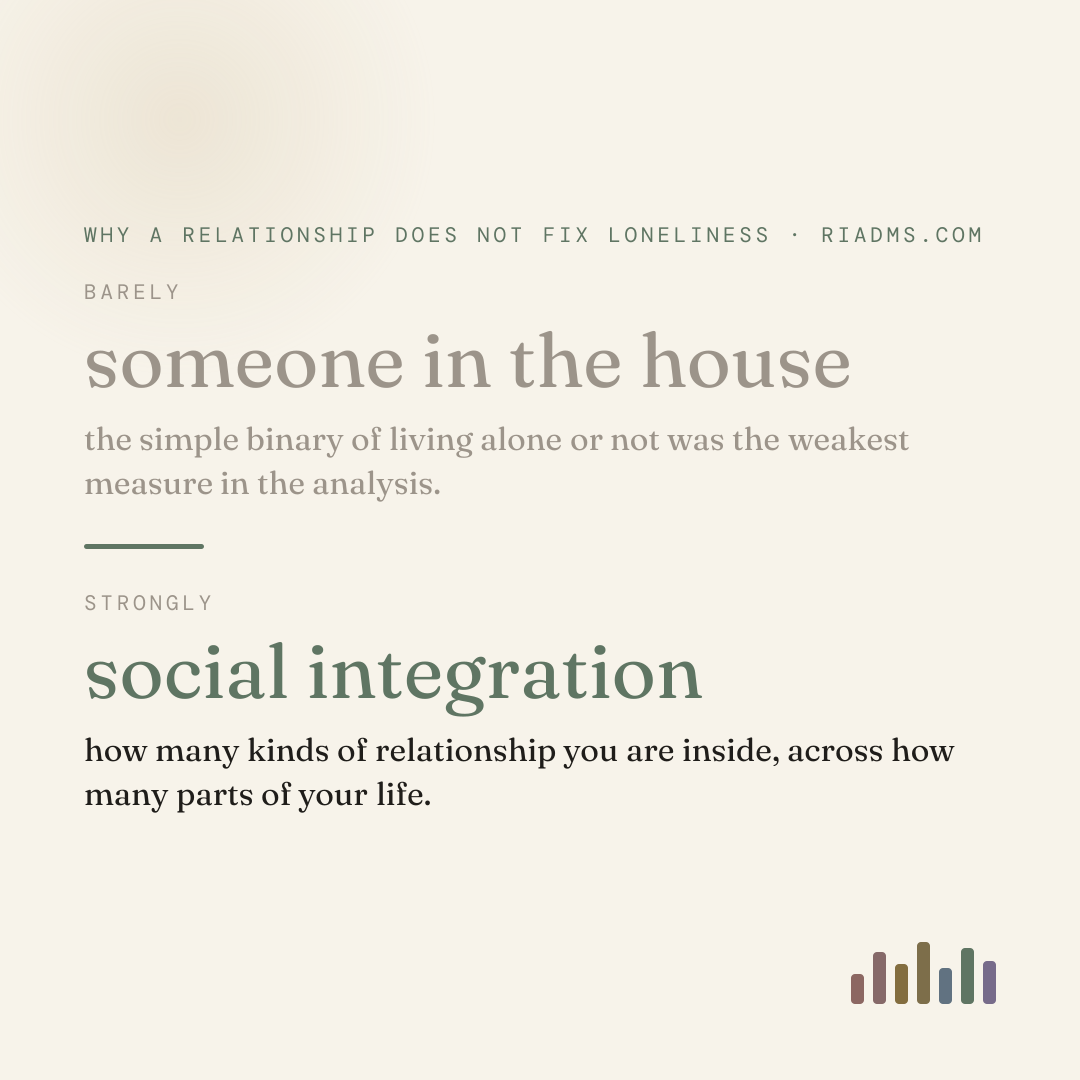
They separated the result by what kind of measure each study used. The association was strongest for complex measures of social integration, an odds ratio around 1.91. That means how many different kinds of relationship you’re actually inside, across how many parts of your life. It was weakest for the simple binary of whether you live alone or with someone, around 1.19. Barely present by comparison.
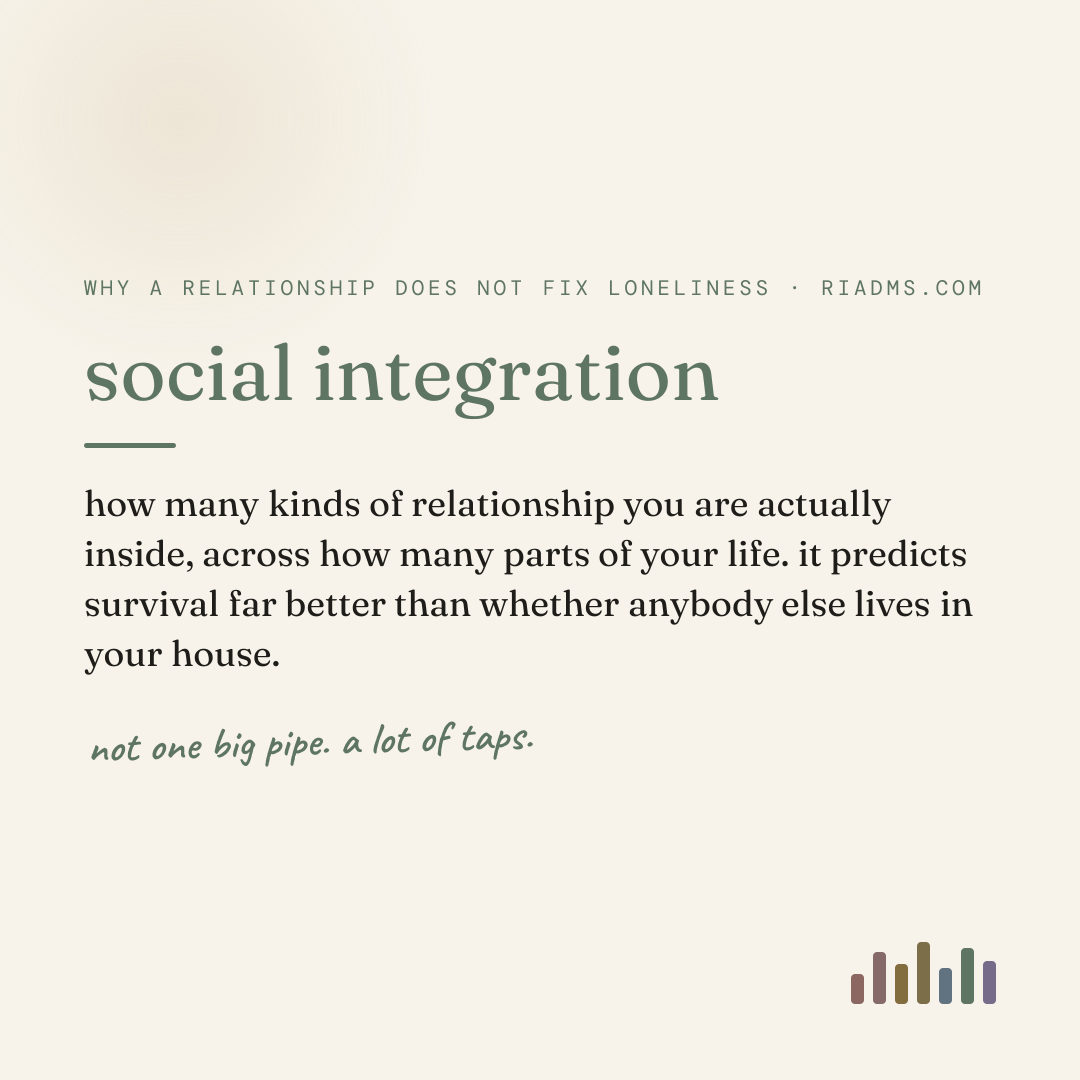
So the largest study on this says the thing predicting survival is the richness of the whole network, and that whether there’s another human being in your house sits near the bottom of the list. It isn’t one big pipe. It’s a lot of taps. And “find someone” is advice to install one very large pipe and stop worrying about the taps.
There’s a mechanism underneath this too, which explains why the feeling doesn’t switch off the moment your relationship status changes. Cacioppo and Hawkley showed that loneliness changes cognition, biasing you toward reading other people more negatively and scanning for threat. It’s an alarm for connection in general, not a request for one particular person, which is exactly why pointing one particular person at it doesn’t reliably switch it off.
from where I’m standing
I said this finding caught me, so let me be specific rather than gracious about it.
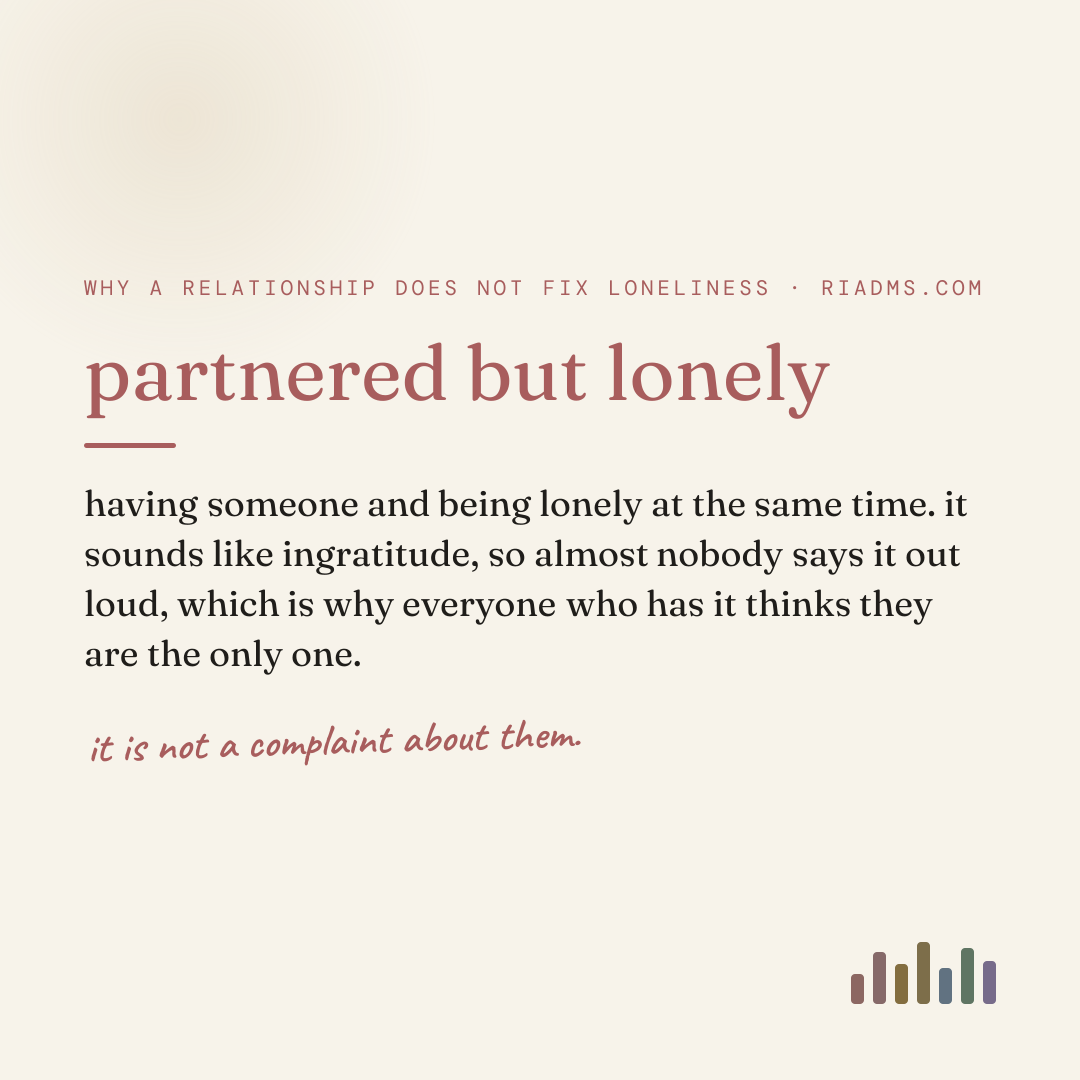
For a long time I had the good relationship and the loneliness at the same time, and I couldn’t report it to anybody, because “I’ve a partner and I’m lonely” reads as ingratitude. It sounds like a complaint about him. It wasn’t. He was doing everything a person can do.
What was actually happening is the thing two sections up. I had made the standard move. I had let the outer circles thin out on the understanding that this is what you do, and I had put the whole balance in one account. A partner can’t be your entire social integration, because that’s not a thing one person is capable of being, for anyone, ace or not.
The ace version has one extra turn in it. When the relationship you’re in doesn’t look like the standard one, you get less of the external confirmation that you’ve arrived somewhere. There’s no moment where everybody agrees your life is now correct. So you keep checking, and checking whether you’ve arrived is itself a lonely activity.
The fix, and I’m one person and this isn’t a finding, had nothing to do with the relationship. It was rebuilding the taps. The friend who gets the unflattering version. The person who knows what happened in 2022. The standing thing on a Thursday that nobody has to organise. None of that’s romantic and all of it’s load bearing, and the research on integration says it was never a consolation prize.
keep reading
The single best thing to read next is the Zoppolat paper itself, which is unusually honest about what it can’t separate. If you want the book, John Cacioppo and William Patrick’s Loneliness is the one that reframes the whole feeling as a biological alarm for connection in general, which is the idea this entire page is built on. And Holt-Lunstad 2010 is worth opening yourself, specifically to read the breakdown table that nobody quotes.
So: the sentence underneath all the advice. Find someone, and the loneliness goes.
For most people it works, there’s a mountain of evidence for it, and I’m not taking it off anybody. But it works because of what usually arrives inside the box, not because of the box. And in 1,443 asexual people, the box arrived and the effect didn’t.
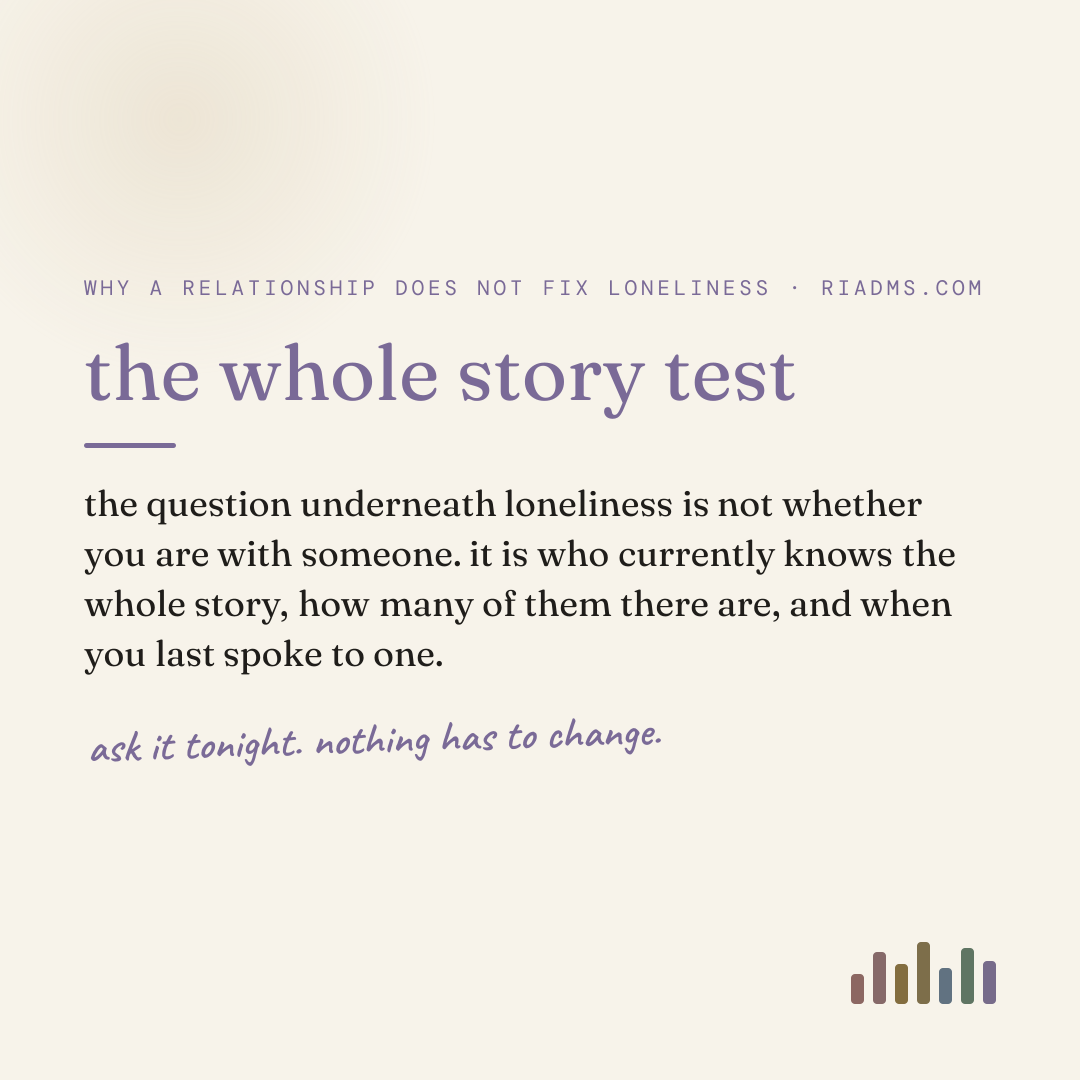
The useful version of that, for anybody, is a question you can ask tonight without changing a single thing about your life. Not: am I with someone. Who currently knows the whole story? How many of them are there, and when did you last actually speak to one.
If the answer is a number you don’t like, that’s not a relationship problem, and getting into a relationship won’t touch it.


