You see her once a month now, and when you see her, he’s there.
And you can’t say anything about it, because you’re supposed to be happy for her. The moment you open your mouth you’re the jealous friend. The clingy one. The one who couldn’t be happy for her. So you say nothing, and you stop suggesting things, because you already know what the answer is going to be.
Three things about this. It has a name and researchers found it in 1982, so you didn’t invent it by being needy. The best recent study on it found something I wasn’t expecting, and it changes what you should actually be upset about. And nobody in your life is going to let you call this a loss, which turns out not to be about your friend at all.
it has a name, and it’s older than you
In 1982 two researchers, Michael P. Johnson and Leigh Leslie, formalised something called the dyadic withdrawal hypothesis. The prediction is simple. As a romantic relationship gets more committed, the couple pulls back from their friendship networks. The network gets smaller. The friends who stay become friends the couple shares, rather than friends one person has on their own.
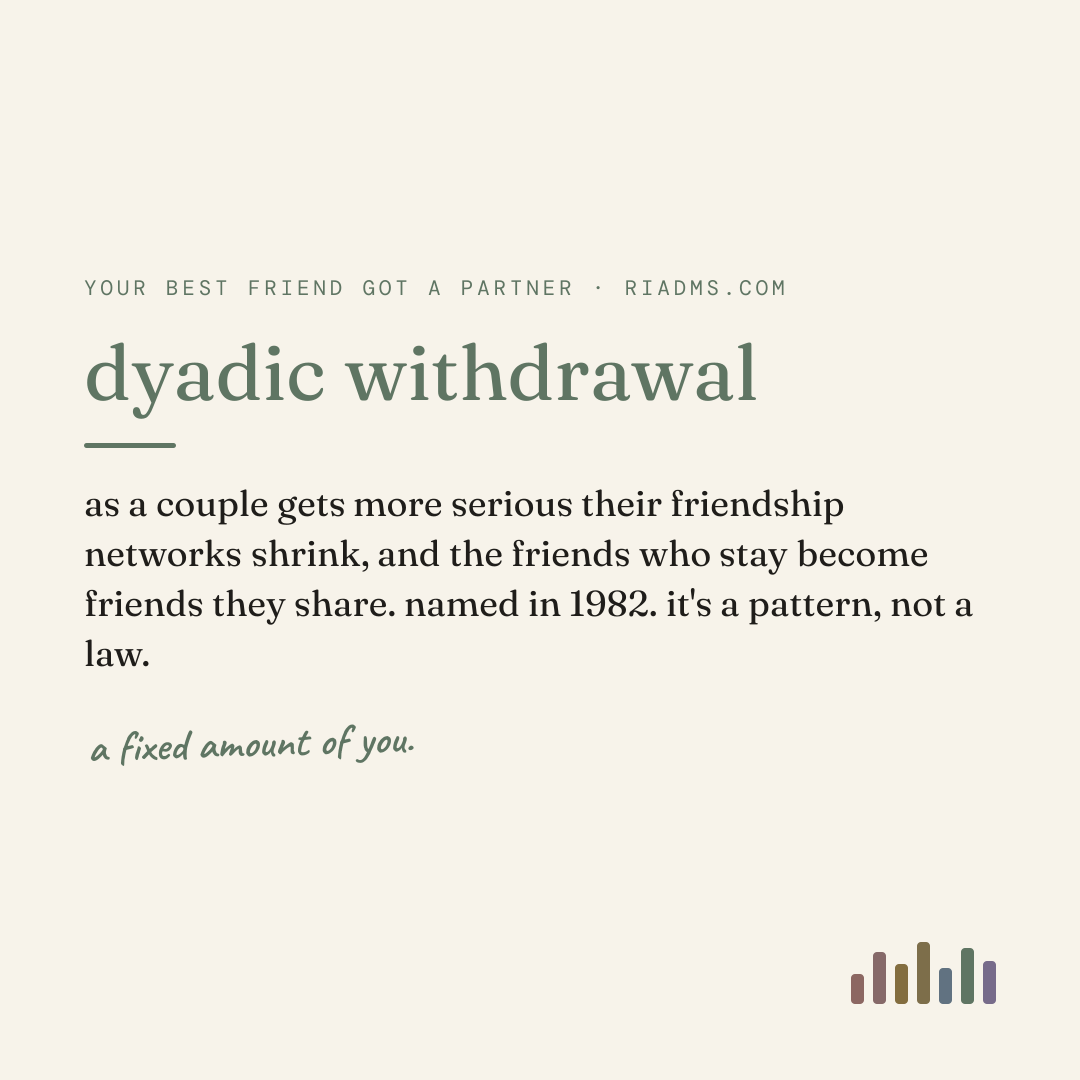
The reasoning is practical and a bit brutal. It assumes there’s a fixed amount of you. Time, attention, the energy to care about somebody’s day. A new large relationship can’t be built out of nothing, so it gets built out of something, and the something was where you used to be.
The evidence is mixed, and the internet version of this never says so, so here it is. Matthijs Kalmijn tested it across the life course in 2003 and found it in pieces: real, but showing up in one partner and not the other, at some life stages and not others. It’s a pattern, not a law. Which is worth knowing before you build a whole theory of your friendship on it.
come think with me
one letter a week.
the word for one feeling you’ve had but couldn’t name, and why it works that way. the same thing you just read, in your inbox, once a week.
- one letter a week, about a ten minute read
- all nine printable workbooks, free
- the research, with its caveats kept in
- hit reply and it reaches me. i read every one
no pressure, no spam, no gatekeeping. unsubscribe anytime · riadumitrescu.substack.com
all of this is free and it stays free. if it gave you a word you didn’t have, you can buy me a coffee.
the finding that changes what to be upset about
In 2024, Haoyang Zhang and Diane Felmlee published a study in the Journal of Social and Personal Relationships that followed a network of adolescents from 14 to 15 and modelled how their friendships actually formed and ended over time.
The people who were dating were not more likely to end their existing friendships.
What they were significantly less likely to do was make new ones.
Sit with that for a second. Does that sound like what happened to you? She didn’t drop you. She stopped adding. And she stopped at exactly the point in both of your lives where a friendship gets built into the kind that survives into your thirties.
Which means two true things at once, and they don’t cancel out.
It’s less of a betrayal than it feels like. Nobody made a decision about you.
And it’s more of a loss than anyone is naming, because what you lost isn’t one afternoon a week. It’s a rate of growth. A friendship that was still being built and now is being maintained, if that. That compounds, over years, across two people, because she lost the same thing and hasn’t noticed yet either.
the three things that actually went
It isn’t the hours. That’s the thing people get wrong when they try to comfort you, because the hours are the only part that’s countable.
One. You lost your position, and nobody announced it. You used to be the first call. Something happened at work and you heard it while it was happening, and you gave the advice. Now you hear about it on Thursday, possibly from someone else. You haven’t been removed. You’ve been moved down one, with no announcement, and there’s no version of that you can raise without sounding like you’re keeping score.
Two. You lost the unplanned part, and the unplanned part was most of it. What’s left is a dinner in three weeks that’s in both calendars and turns out to be a group. It has an end time. The substance of a close friendship was never the dinner. It was the walk, the two hours about one stupid thing, the sitting in the same room doing separate things. You can have someone’s calendar and not have them.
Three. She’s happy in a way you can’t get to. There’s a version of you that finds that unbearable and a version that’s glad for her, and they’re running at the same time, and you’ve decided the first one makes you a bad person. It doesn’t. It makes you someone who lost something. People don’t have one feeling at a time.
nobody will let you call it a loss
Here’s the part I actually made the video for.
If her relationship had ended in a fight, you’d be allowed to be devastated. If a partner had done this to you, gone from daily to monthly, stopped calling first, left you on read for a week and then said oh my god I didn’t see this, you’d have a whole vocabulary for it. You’d say he ghosted you. You’d tell everyone.
A friend does the identical thing and there’s no word, because it wasn’t romantic. You get to be weird about it. That’s the allowance.
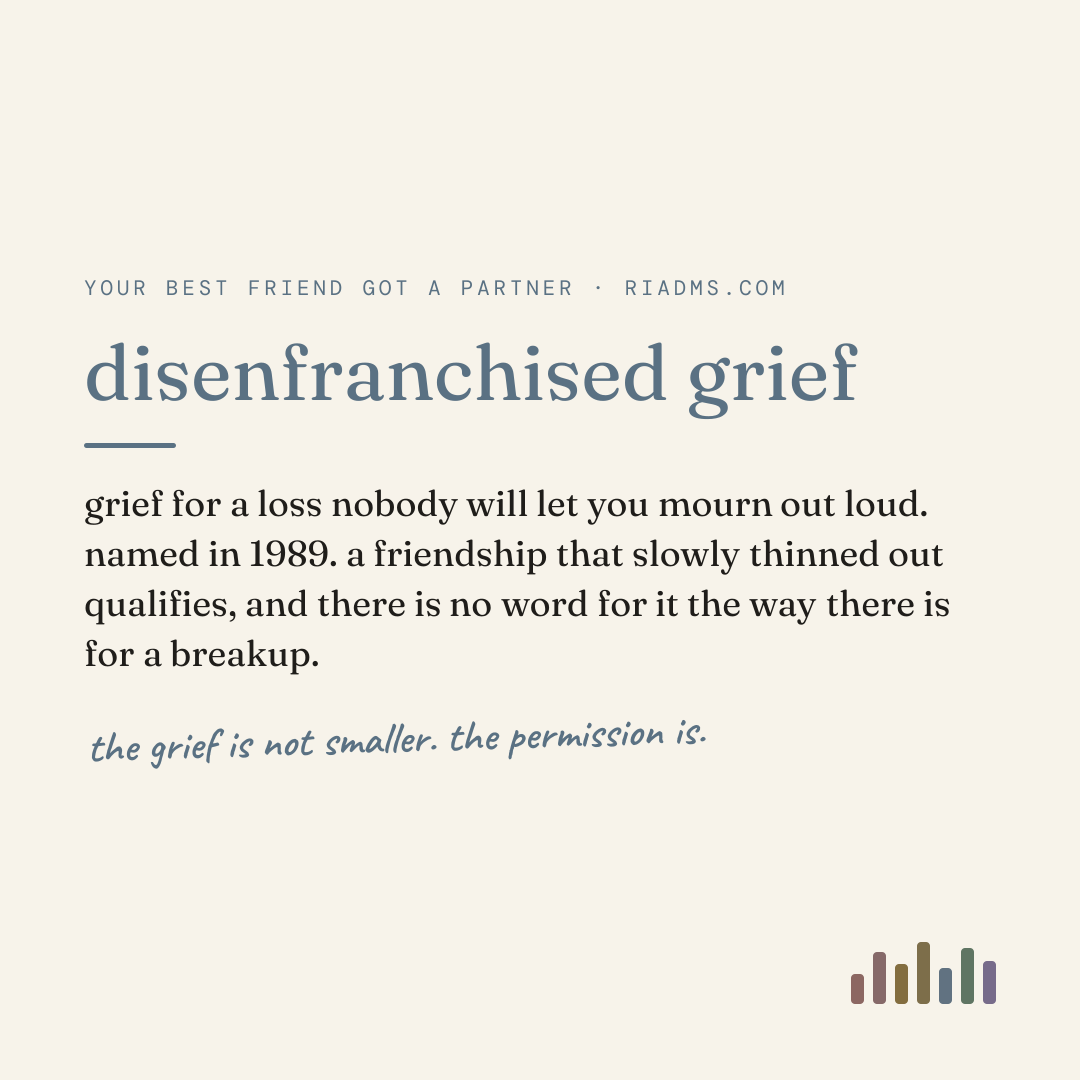
There’s a name for this too, and it isn’t from friendship research, it’s from grief research. Kenneth Doka called it disenfranchised grief in 1989: grief for a loss that can’t be openly acknowledged, publicly mourned or socially supported. He was writing about the people who mourn a colleague, an ex, a patient, a relationship nobody registered as real. The grief isn’t smaller. The permission is.
the rule underneath it
This isn’t about your friend, and it isn’t really about her boyfriend either. It’s a rule with a name: amatonormativity, from the philosopher Elizabeth Brake in 2012. The assumption that a central, exclusive romantic pair is the highest form of relationship, that everyone’s better off in one, and that it should get first claim on your time.
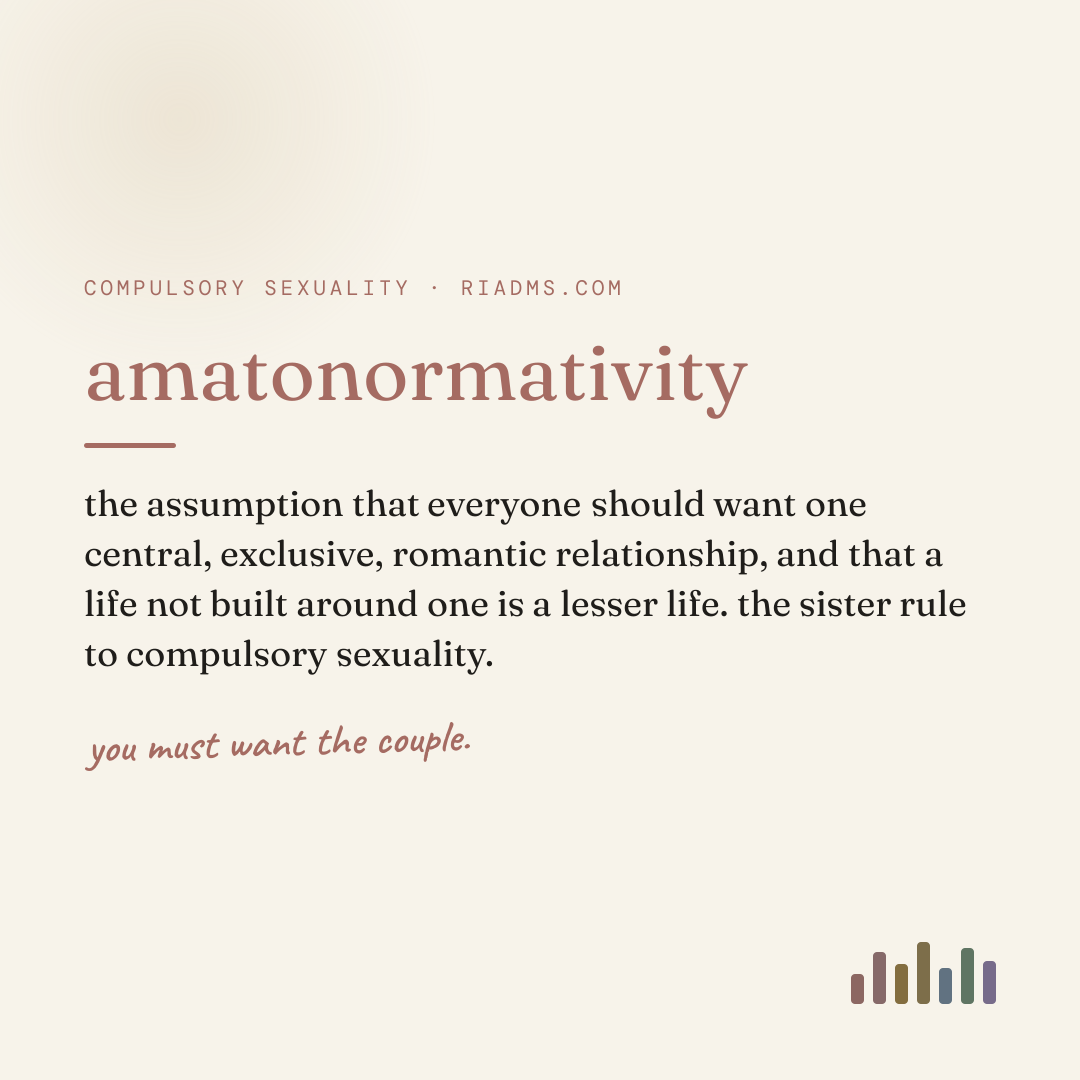
So she didn’t neglect you. She upgraded. Your loss doesn’t count as a loss because the thing that replaced you outranks you in how everyone has agreed to see it. Nobody says that sentence out loud and everybody acts on it. That’s why you can’t bring it up. There’s no way to complain that isn’t asking her to choose the lesser thing.
It was never the lesser thing. It was a different thing.
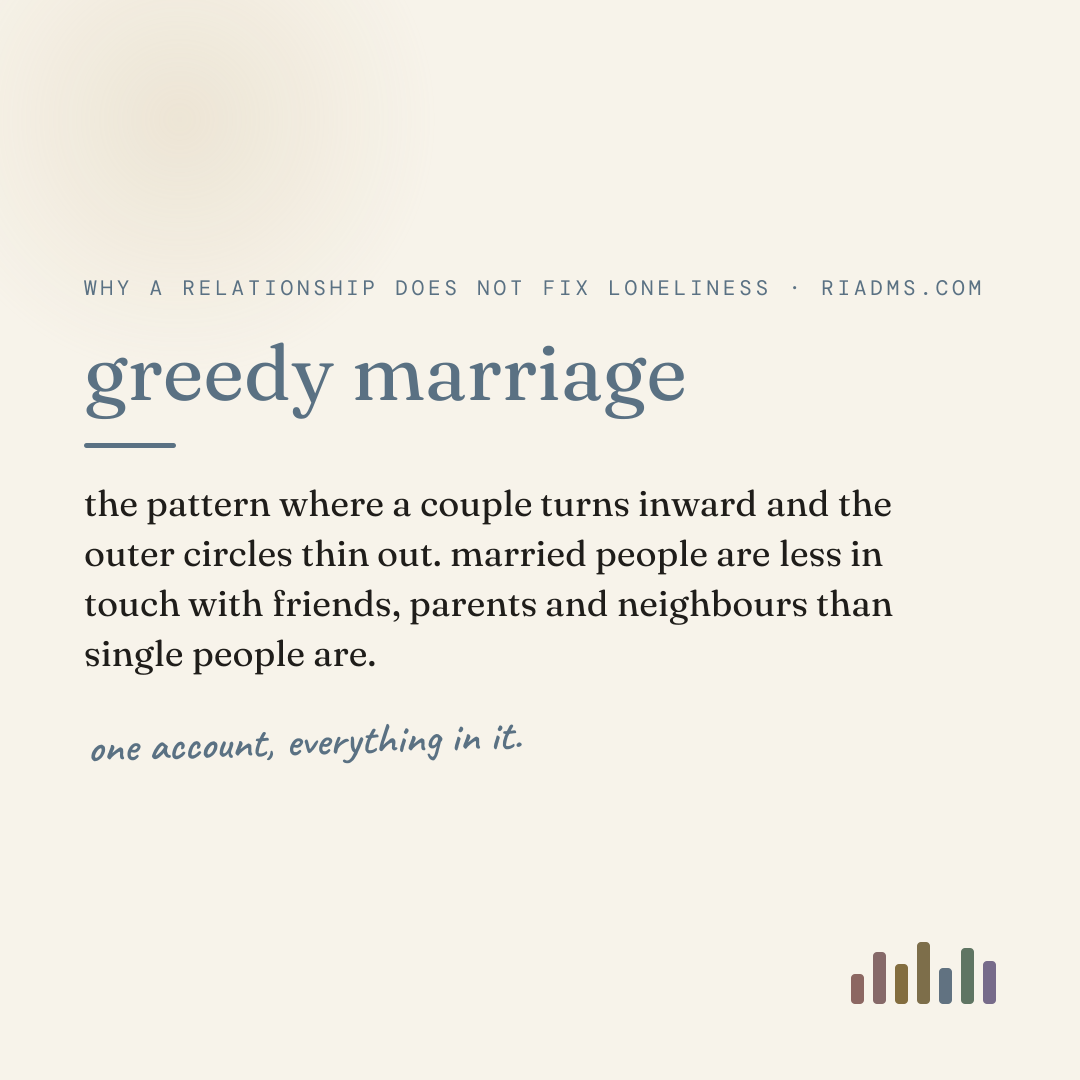
And the couple turning inward is measurable, not a feeling. Naomi Gerstel and Natalia Sarkisian call it greedy marriage: across two nationally representative surveys and forty separate comparisons, single people did more than anyone else to keep up with friends, neighbours, parents and siblings. Married people did the least, every time. The previously married sat in between, which tells you it’s the arrangement doing it and not the person.
from outside the bubble
I’m asexual, and I’ve spent most of my life outside the romantic default looking in, so I’ll say the thing plainly.
The ranking isn’t wrong. It’s arbitrary. There’s no reason a person who has known you for fifteen years, who was there for the actual struggles, who watched you become whoever you are, should automatically move to second place because someone new arrived with hormones attached. Is romantic love enormous? Obviously. I’m in one, I feel it. I’m saying we demote every friend by default at the moment it arrives, nobody decided that, and nobody has shown it’s right.
There’s some evidence pointing the other way. In a 2023 analysis across age groups, the share of happiness accounted for by friendship went up with age, from about 7% in people under thirty to about 11% past sixty, while the contribution of family relationships stayed flat. Friends matter more later, not less. We’re building our lives as if the opposite were true.
And the practical cost of building a life around one person is obvious once you say it. You hand that person every job a human being could do for you, the other ties thin out, and then, statistically often, the relationship ends and there’s nothing standing around you.
what you can actually do with this
Your friend isn’t doing the wrong thing. She’s doing the default thing. Defaults are allowed to be argued with, especially once they’ve stopped serving the people inside them.
The Zhang and Felmlee finding is the useful part here, because it says the failure is in adding rather than keeping. Which means the repair is also adding, and it doesn’t need her to notice anything or agree to a conversation about hierarchy. It needs an unscheduled thing that isn’t a dinner in three weeks with four people. A walk. A phone call with no reason. The boring shared hours are the whole substance, and they’re the part that disappeared first because they’re the part nobody puts in a calendar.
And you’re allowed to be sad about this. Not instead of being happy for her. At the same time as it.
keep reading
If you read one thing next, make it Rhaina Cohen’s The Other Significant Others. It’s full of people who built their lives around a friendship and had to invent the shape as they went. If you’d rather read the research, start with Zhang and Felmlee, because it’s short and the finding is the one that changes what you do.
And the friendship arithmetic is on this site too: about 200 hours to a close friend, and why adulthood stops handing them to you. Both of those are the same problem from the other end.