You can be with someone who loves you, and who you love back, and still go a whole week feeling like nobody has actually met you.
When that happens, there are two explanations on offer, and both are bad. Either you’re ungrateful and should appreciate what you have. Or the relationship is wrong, and you’re going to have to blow up your life.
It’s usually neither. Closeness isn’t one thing. You can be getting seven kinds of it and still miss one, and the one you’re missing is the only one you can feel.
I think there are at least eight ways to be close to a person. Most people have a favourite, and they often assume theirs is the definition. Almost nobody gets all eight from the same person.
closeness is a process, not a feeling you have
Before the list, the model underneath it. It’s good, and almost nobody has heard of it.
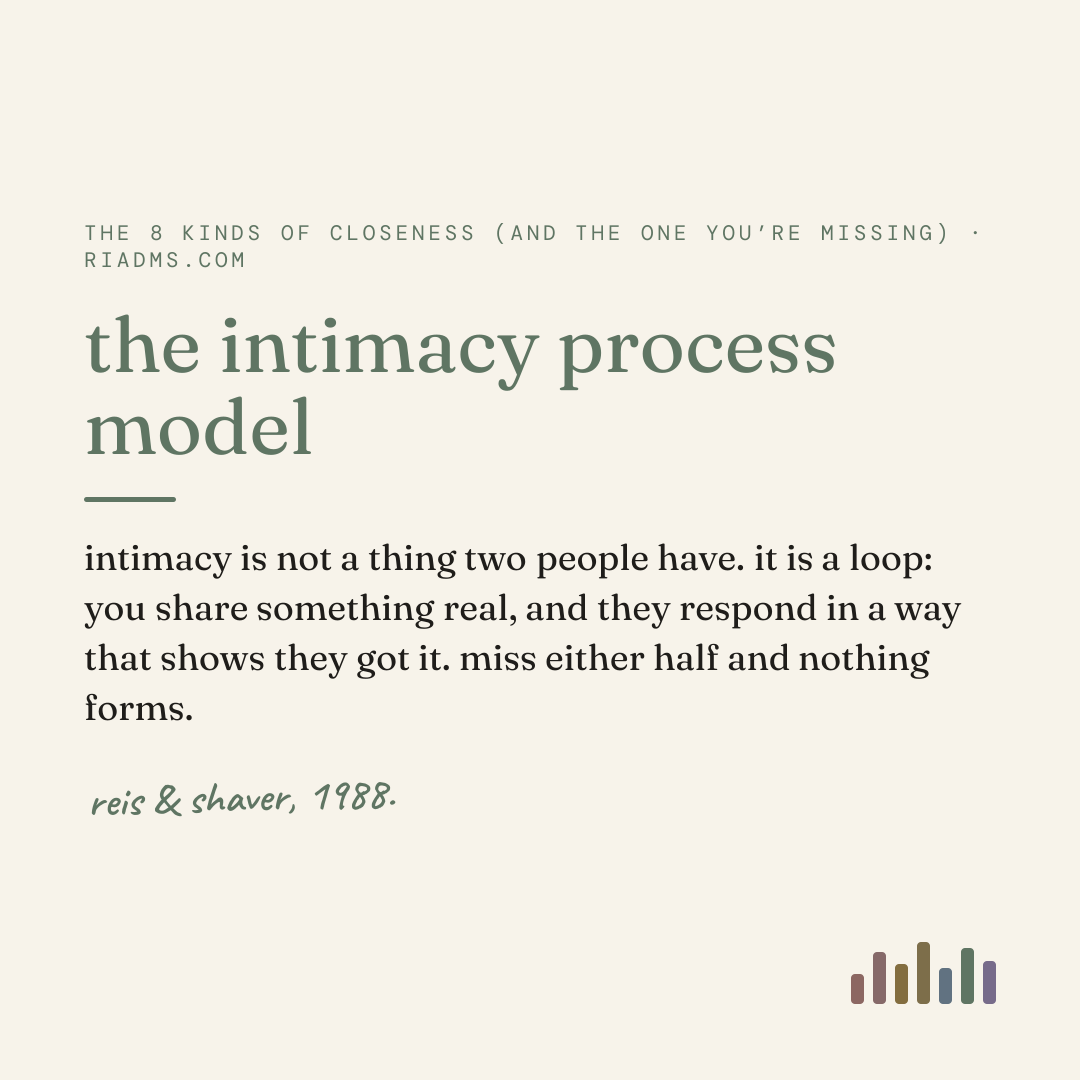
In 1988, Harry Reis and Phillip Shaver argued that intimacy isn’t a substance people have more or less of. It’s a process with two moving parts. You disclose something, and then you notice whether the other person responded in a way that shows they understood you, valued you and cared about you. Both halves are required. Disclosure with no response is just talking at someone, and a response with nothing disclosed has nothing to respond to.
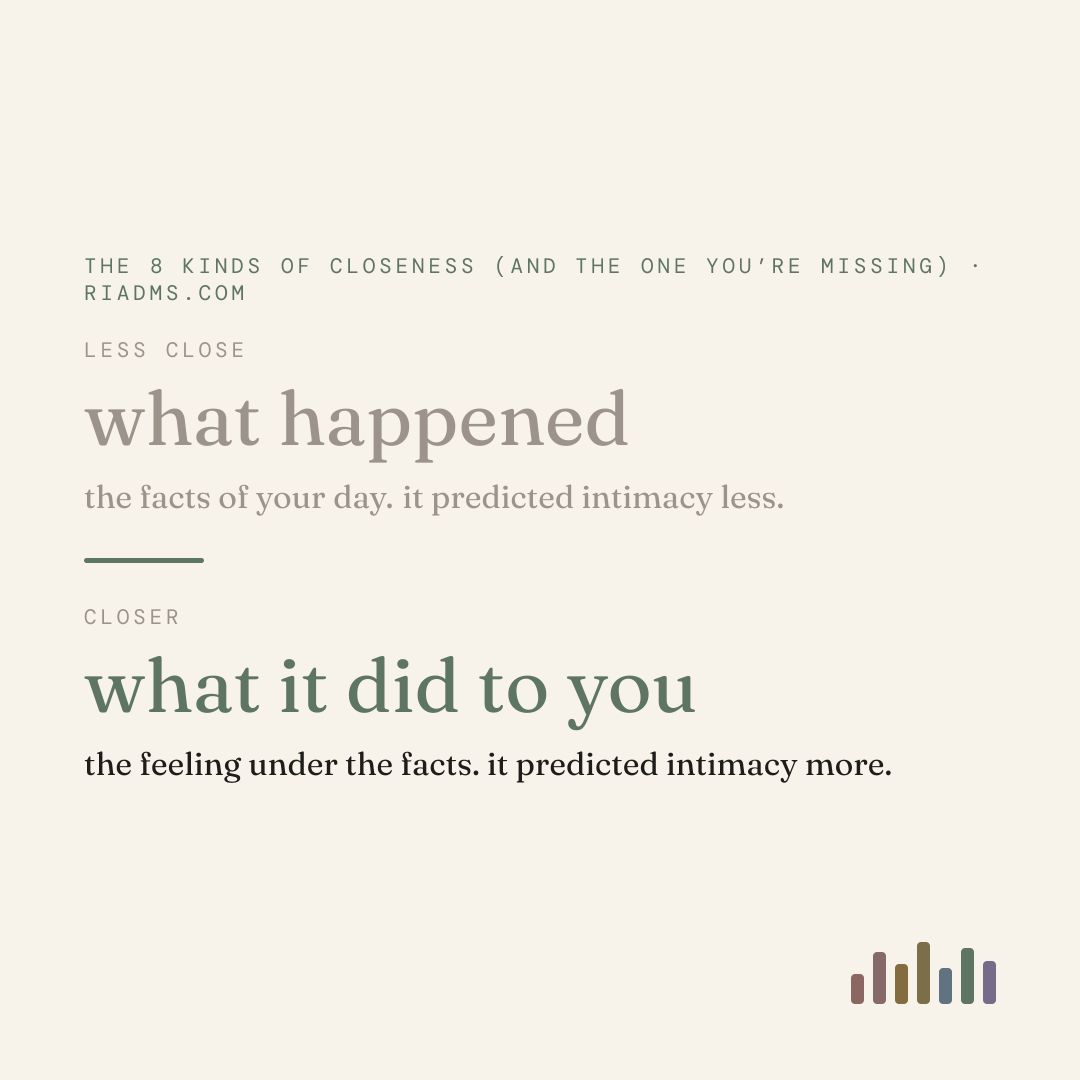
Ten years later, Jean-Philippe Laurenceau, Lisa Feldman Barrett and Paula Pietromonaco tested the model with real people, who kept diaries of their everyday interactions. Disclosure predicted how intimate an interaction felt, and part of that effect came from whether the person felt the other one had responded to them. Then, in the second study, they found the detail I’ve thought about ever since. Sharing feelings predicted intimacy more strongly than sharing facts did.
Telling someone what happened is not the same move as telling them what it did to you. Only one of them makes you closer.
So closeness is made of channels. Each one is a different thing you disclose and a different way someone can respond.
come think with me
one letter a week.
the word for one feeling you’ve had but couldn’t name, and why it works that way. the same thing you just read, in your inbox, once a week.
- one letter a week, about a ten minute read
- all nine printable workbooks, free
- the research, with its caveats kept in
- hit reply and it reaches me. i read every one
no pressure, no spam, no gatekeeping. unsubscribe anytime · riadumitrescu.substack.com
all of this is free and it stays free. if it gave you a word you didn’t have, you can buy me a coffee.
why one kind can’t stand in for another
In 1973, the sociologist Robert Weiss divided loneliness in two. Emotional loneliness is the lack of one close attachment. Social loneliness is the lack of a wider group you belong to. His point was that they don’t substitute for each other. Twelve friends can’t fix a missing attachment, and one perfect partner can’t fix a missing network.
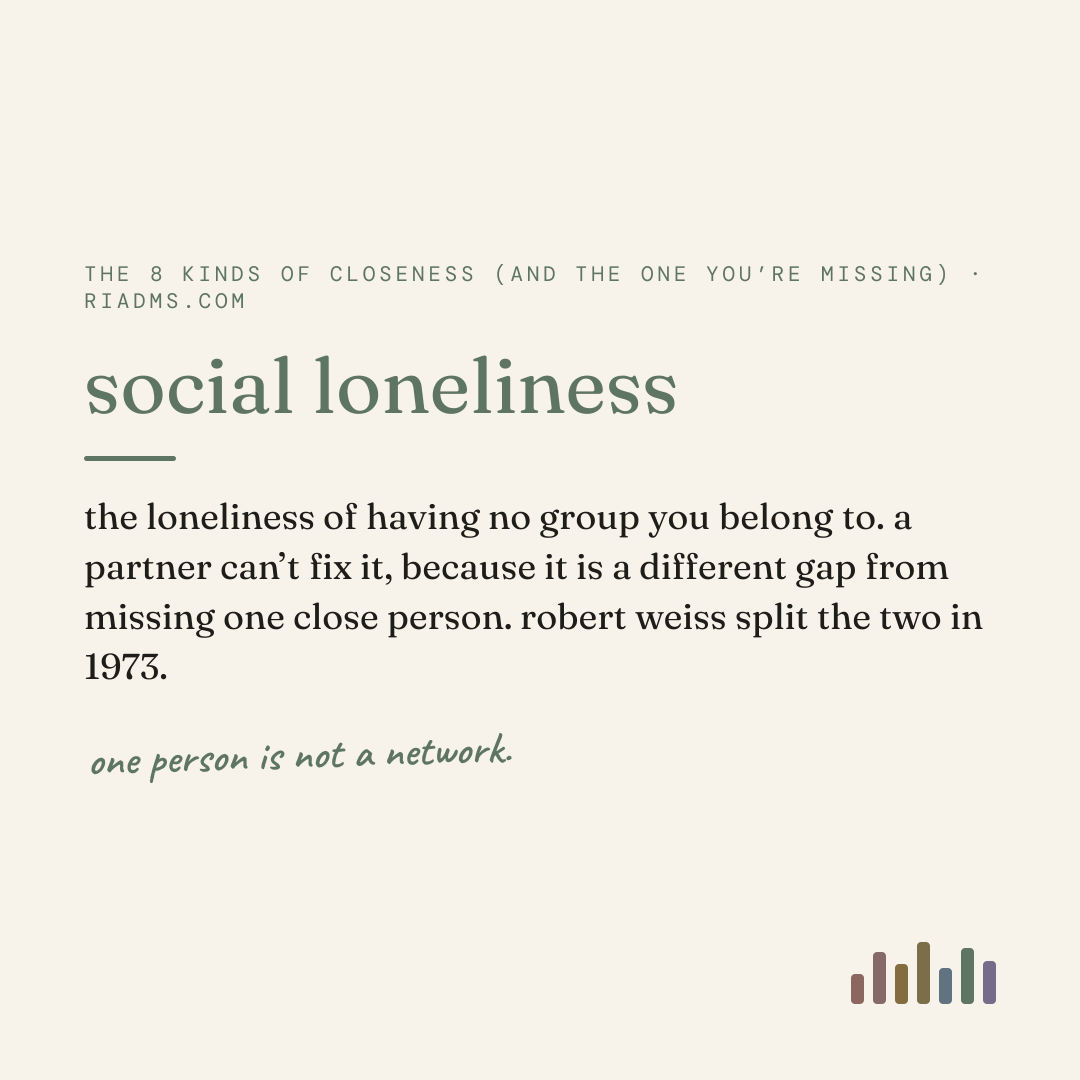
Weiss wrote about two kinds, and nobody has measured eight. The eight below are mine, built out of my own life and a stack of studies. I think his logic still applies. When one channel is empty, the full ones can’t fill it.
That’s not a bad relationship. That’s a missing channel. Those are different problems that need different repairs, and mixing them up ends things that didn’t need to end.
one: being known
The channel where somebody has the accurate version of you. Not the flattering one. They know what you’re like when you haven’t eaten, which of your opinions you’d drop under pressure, and the specific reason you’re weird about phone calls.
This is the Laurenceau one, and the currency is feelings rather than facts. You can tell somebody every event of your day for six years and they still won’t know you, because events are not the disclosure that counts.
Missing it feels like performing. You’re not lying to anyone. You’re just running a slightly edited version of yourself, and the edit is so old you’ve stopped noticing it.
The test is uncomfortable. Think of the worst thing you believe about yourself. Not the acceptable flaw you give people in interviews, the real one. Who has heard it? If the answer is nobody, that isn’t a character problem, and it doesn’t mean you’re closed off. It means this channel is empty, and it stays empty until somebody hears the real one and stays anyway.
two: being understood
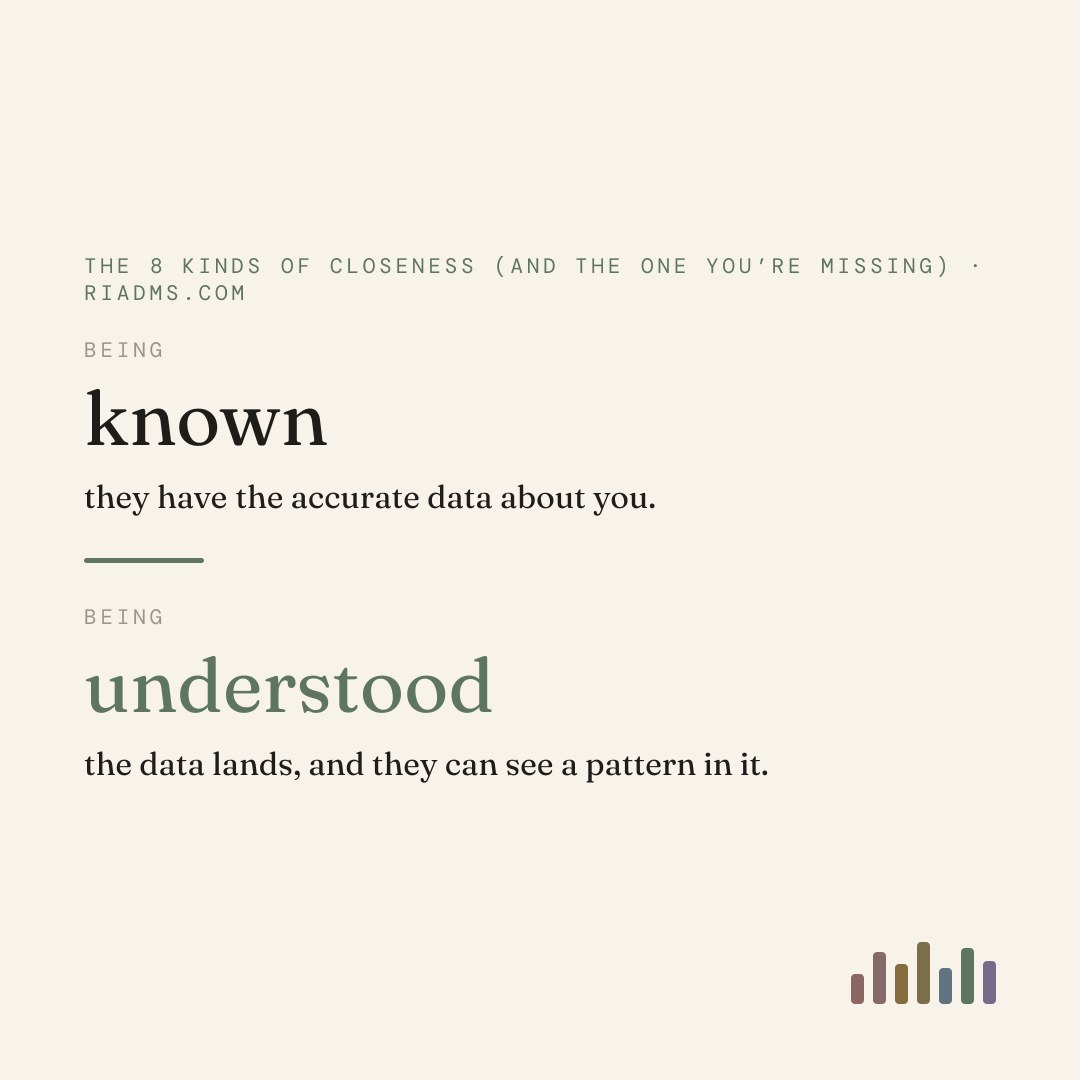
This is different from being known, and you can be known by someone who doesn’t understand you. Being known means they have the data. Being understood means the data lands, and they can point out a pattern in it you couldn’t see.
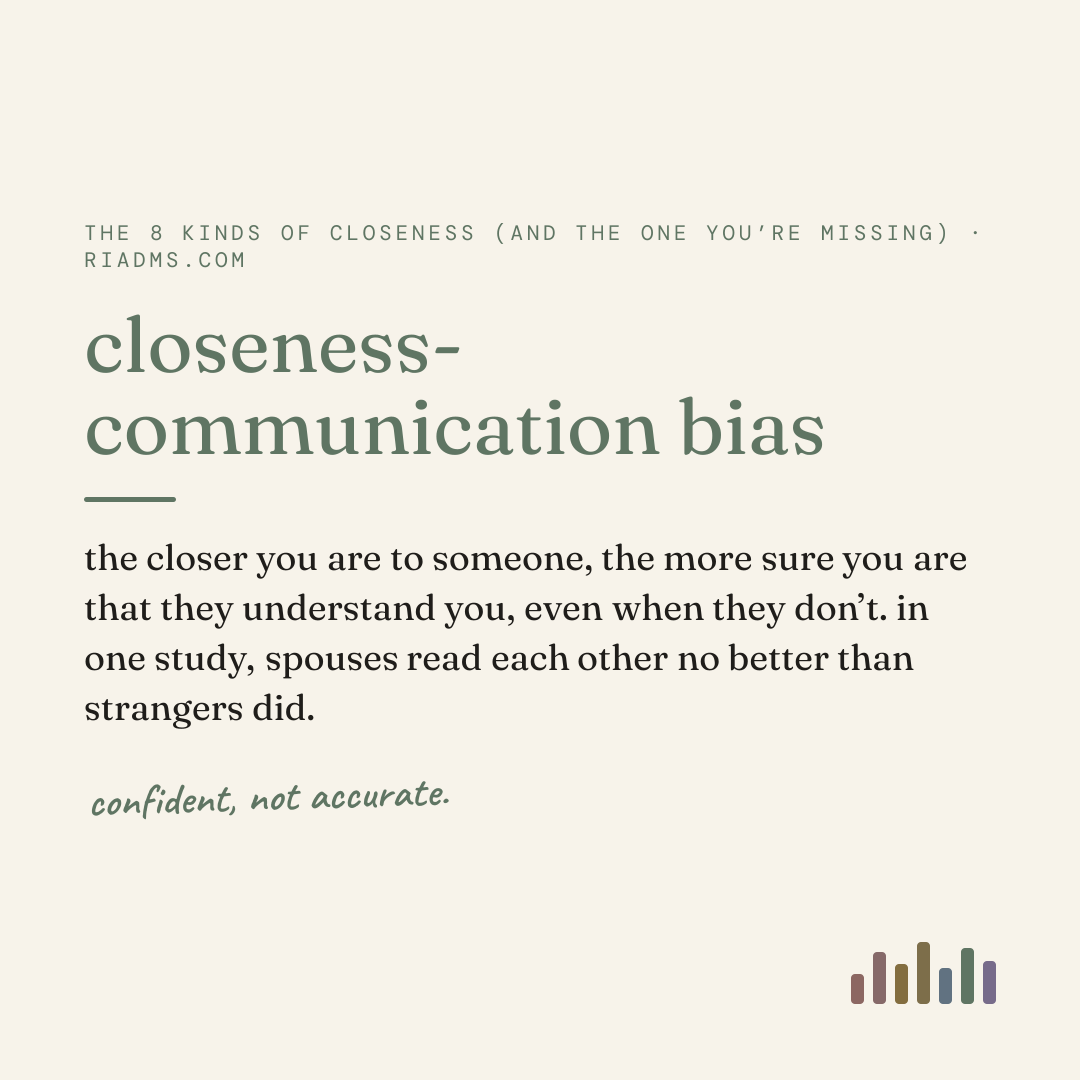
There’s a study that ruins the obvious assumption here. In 2011, Kenneth Savitsky and his colleagues had 24 married couples sit facing away from each other and say ambiguous phrases, the kind whose meaning depends on context. Then they measured how often the partner got the meaning right, and compared it with strangers.
The spouses were no better than the strangers. What was different was confidence. The spouses were much more sure they’d been understood. The researchers called it the closeness-communication bias. Being close to someone makes you assume you’re being received. It doesn’t make you received.
Missing this one has its own kind of sadness. A lot of people feel it with their parents first. It’s the moment you realise that somebody who has been in your life for twenty years has a version of you in their head that is slightly wrong.
three: touch
Your skin doesn’t have one touch system. It has at least two, and the second one has nothing to do with sex.
In 2009, a team led by Line Löken published work in Nature Neuroscience where they recorded from single nerve fibres in people’s arms while stroking the skin at different speeds. A set of slow fibres called C-tactile afferents fired most at gentle stroking between one and ten centimetres a second, and that was also the range people rated as most pleasant. A 2017 study by Pawling and colleagues found that touch at that speed also produced more activity in the muscle you smile with.
So there’s dedicated hardware for affectionate touch. You can be in a relationship with plenty of sex and none of this, and most people are surprised when I say that. The longer version, and the biology, is in sensual attraction.
four: being witnessed
The person who was there the first time. You say “it’s happening again” and they know what “it” is, because they watched the first one. No context, no preamble, no explaining who your aunt is.
This one is made of hours, and it can’t be made any other way. In 2019, Jeffrey Hall estimated that it takes 40 to 60 hours together to go from acquaintance to casual friend, 80 to 100 to become a friend, and more than 200 to become a close friend. You can’t buy those hours and you can’t speed them up.
That’s why moving city is harder than people expect. I’ve moved every four months for five years, so I feel this one more than any other. You can make new friends in three months. You can’t make a witness in three months. The new people are lovely, and every story still needs a preamble. (The hours, and how to spend them on purpose, are in the friend crush & the 200 hours.)
Missing it feels like being new all the time, even in a full life.
five: being thought with
Somebody who wants to know what you think, and says something back that changes it.
The Multidimensional Attraction Measure, built and tested on 691 people and published in 2026, includes intellectual attraction as one of its seven dimensions. That doesn’t prove anything about closeness on its own. It does mean wanting someone’s mind is a thing researchers can measure, not a preference I invented.
There’s also a way to build this one on purpose. That’s rare on this list. In 1997, Arthur Aron and his colleagues put pairs of strangers through sets of questions that got more personal as they went. The people who did the questions felt much closer afterwards than the people who made small talk for the same amount of time.
Everyone half-remembers it as the study that makes strangers fall in love. It didn’t do that, and it didn’t set out to. It built closeness. That’s more useful anyway, because it means this channel responds to effort.
Missing it is the flat feeling of a relationship where you get on perfectly and haven’t had an interesting conversation since March.
six: being in it together
The unglamorous one. Money, logistics, whose turn it is, who’s calling the plumber.
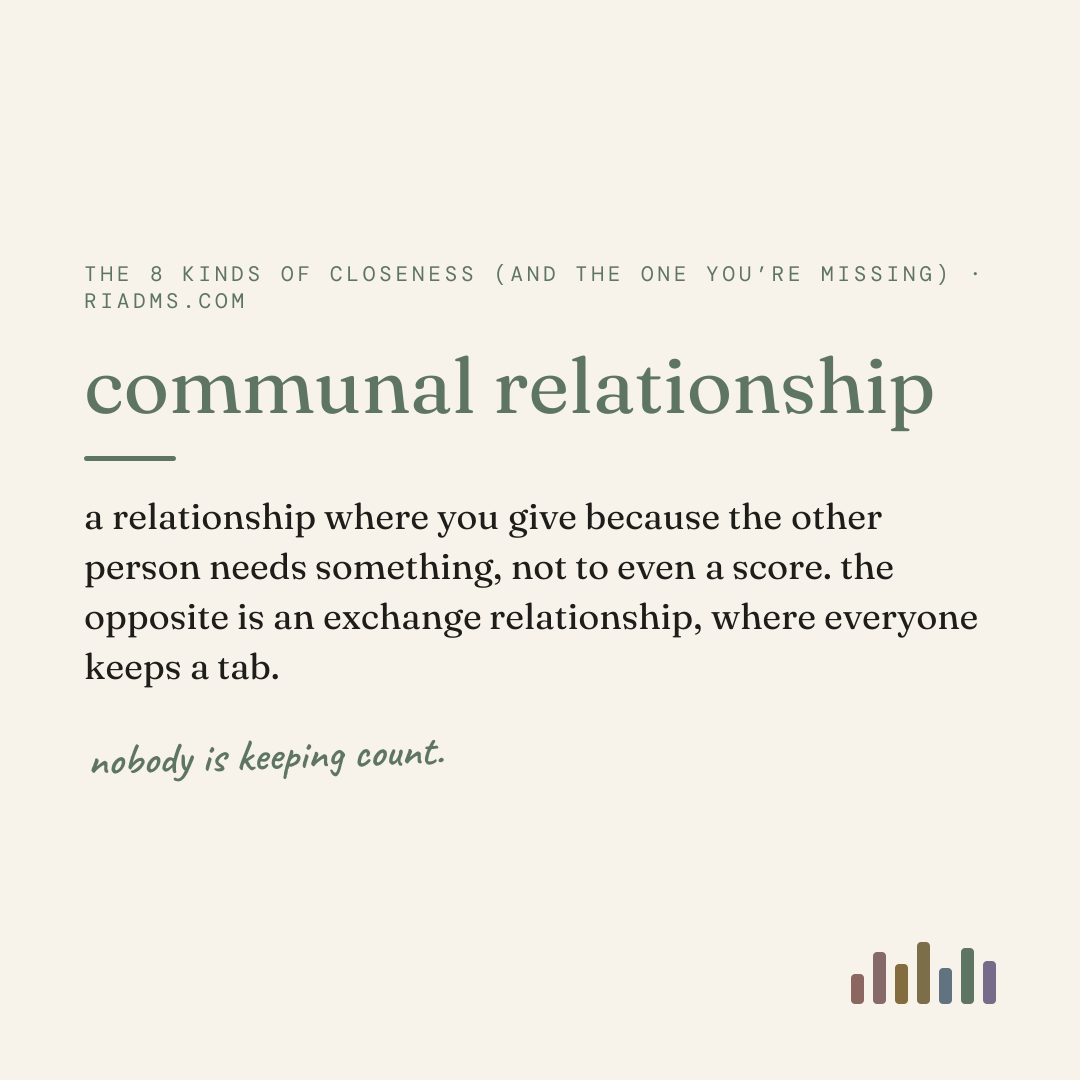
In 1979, Margaret Clark and Judson Mills described two ways of running a relationship. In a communal relationship, you give because the other person needs something, without keeping score. In an exchange relationship, you give expecting something similar back, and you track whether it’s even. A 2018 review of 100 studies by Bonnie Le, Emily Impett and their colleagues found that caring about a partner’s needs went with better relationships for both people, as long as you didn’t stop caring about your own.
This is where “we” actually lives. Not in the feelings. In the fact that your problems are held together.
When you’re young, this one comes free, because your problems overlap by default. You have the person you take the bus with, the one you do homework with, the one who hates the same teacher. Then you grow up. Different jobs, different friends, different worries. One day you notice you’re two people reporting on separate days rather than two people having one, and nothing went wrong to cause it.
Missing it feels like being flatmates who are fond of each other.
seven: being wanted
Somebody choosing you, on purpose, out loud, and still.
This needs its own slot because it can be missing from a relationship that is good in every other way, and nobody notices, because nothing is wrong.
In 2005, Emily Impett, Shelly Gable and Letitia Anne Peplau looked at why people make sacrifices for a partner. People who gave to make their partner happy did better. People who gave to prevent a fight or to avoid being left did worse, both in their own wellbeing and in the relationship over time. The same act, with a different motive, went the opposite way.
So this channel isn’t about how much they do. It’s about whether what they do comes toward you, or away from something.
Missing it feels like being the default. Not rejected. Just not picked, on purpose, since the first year.
eight: belonging with them
The last one isn’t between two people at all, and it’s the one modern relationships struggle with most. It’s having a “we” that other people can see. A group you’re part of together. A house where you’re both expected.
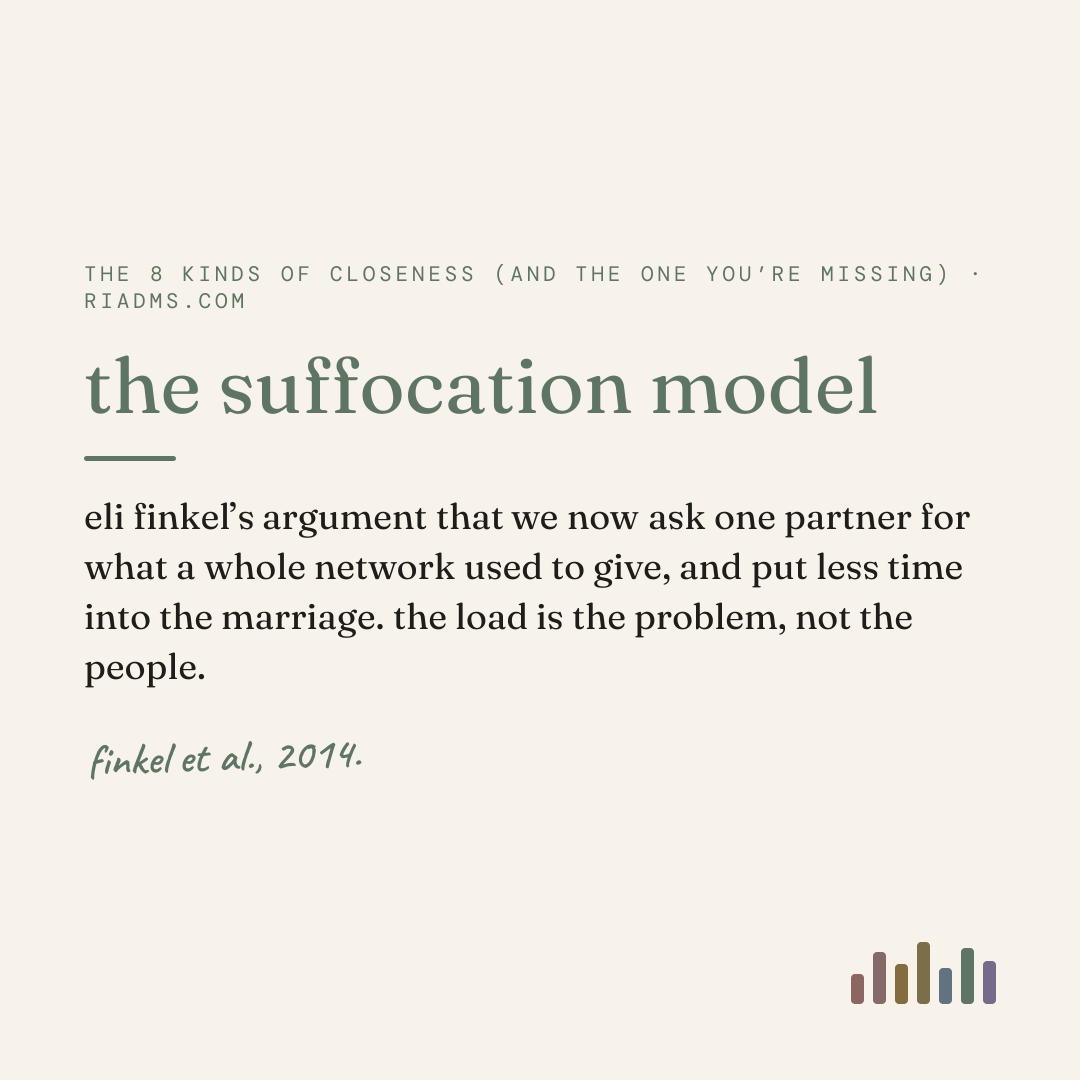
Weiss called the lack of this social loneliness, and it’s the half of his split that a partner can’t fix. In 2014, Eli Finkel and his colleagues published a model they called the suffocation of marriage. It argues that we now ask one partner for things that used to come from a whole network of people, while giving the marriage less time and energy than it would need to deliver them. One way out they name is asking less of the marriage, and elsewhere in the paper they point to people who spread those needs across a wider network.
Missing this one is the couple who have each other and nothing else, and can’t work out why it feels thin when the relationship itself is good. There’s a whole page on why a partner doesn’t switch loneliness off: why a relationship does not fix loneliness.
why I ended up with eight
When you’re asexual, the default answer to closeness isn’t available. For a lot of people, there’s one thing that means closeness and stands in for it when they’re tired and there isn’t time for the rest. I don’t have that. So there was never one channel doing the work of eight.
That meant I had to notice each one separately, ask for each one separately, and find out which ones a given person could actually give me. It turns out that when you can’t fall back on the default, you get fast at telling which specific thing is missing on a Thursday.
it doesn’t all have to come from one person
Every one of the eight can come from someone who isn’t your partner. Being witnessed usually comes from an old friend. Being thought with often comes from one person who doesn’t live with you and sees your life from outside it. There’s no rule that says all eight have to come from one address, except that we behave as if there is.
I think that rule causes a lot of ordinary misery. People decide their relationship is failing when it’s struggling in one channel and doing fine in the other seven.
keep reading
If you read one study, make it Laurenceau, Barrett and Pietromonaco. The finding about facts and feelings changes how you talk to people the same day. If you read one book, make it Eli Finkel’s The All-or-Nothing Marriage, which is the long version of channel eight and how it went missing. And if you want the older five-part map this one grew out of, it’s the five types of intimacy.
So the point isn’t to go home and audit your partner. It’s the opposite. The next time somebody loves you and you feel unmet anyway, you have somewhere to put it that isn’t “I’m ungrateful” or “this is over.”
Name the channel. Then ask where it could come from. Sometimes it’s your partner, and it’s a conversation. Sometimes it’s an old friend, and it’s a phone call. Sometimes you moved city eighteen months ago and you’re at hour sixty of two hundred, and nothing is wrong with you at all.
And if none of my eight fit what’s missing for you, make a ninth. I made these up out of my own life. You’re allowed to do the same.