You see someone across a room and your brain goes “oh.” They’re beautiful. Something about the face, the way they move, the way the light sits on them. And your whole life you’ve had one word for that feeling: attraction.
But here’s the question nobody ever asks you. Attraction to what. Because that “oh” might not be the thing you think it is, and once you can tell the two apart, you stop making a very specific mistake that quietly ruins a very specific kind of relationship. I’m asexual, so I feel this “oh” completely on its own, with nothing stacked on top of it, which means I can describe it to you cleanly. Let me hand you the word.
what aesthetic attraction actually is
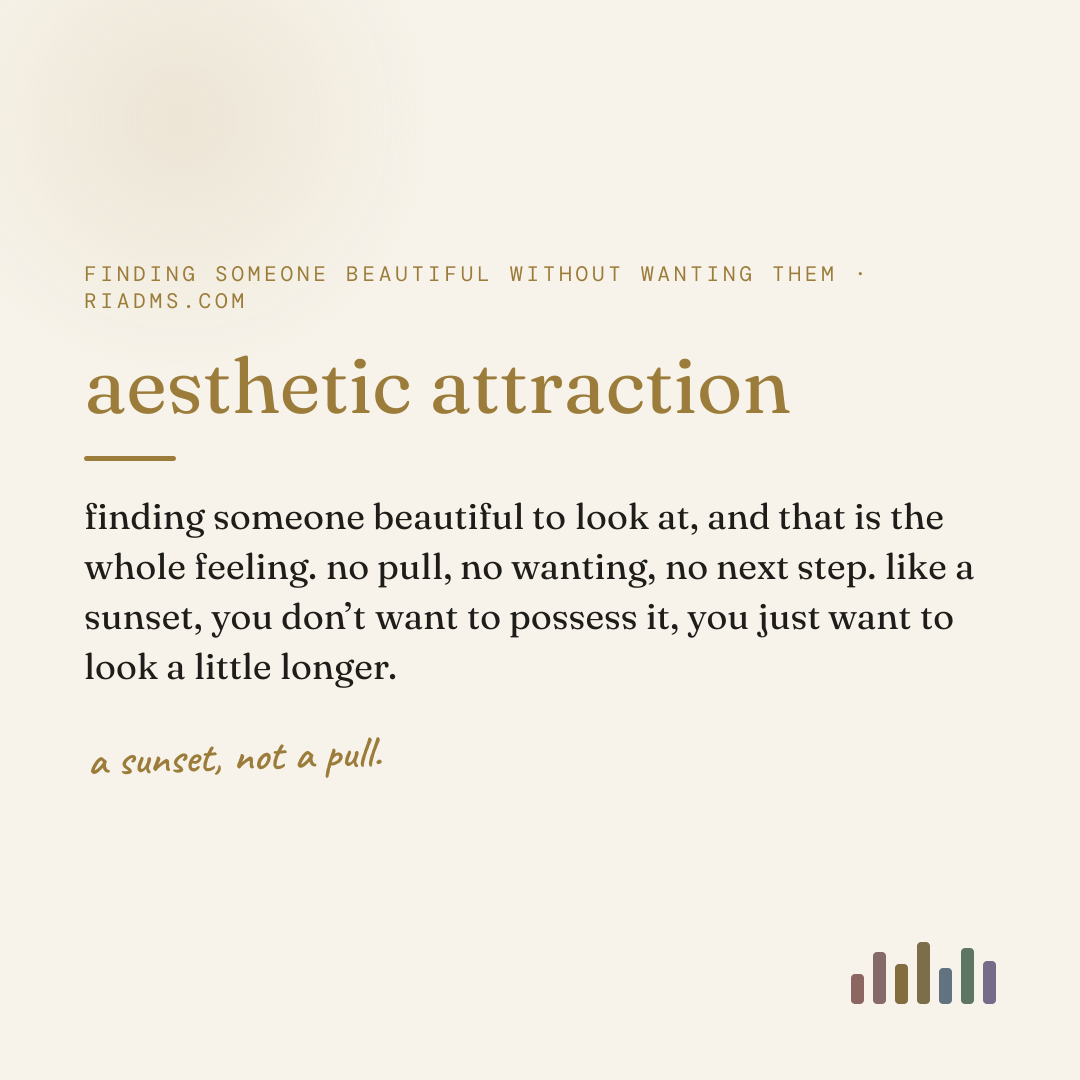
Aesthetic attraction is finding someone beautiful to look at, and that’s the whole thing. No pull, no wanting, no next step. You just want to look a little longer. Think about how you see a sunset. You stop, your breath catches, you might take a photo you’ll never look at again. But you don’t want to do anything with the sunset. You don’t want to possess it or get closer to it or take it home. The appreciation is complete on its own, not building toward anything. That’s aesthetic attraction, pointed at a person instead of a sky.
The word itself comes from the asexual community, sometime around the mid-2000s. Nobody in a lab handed it down. People who felt the “oh” without the wanting needed a word for the “oh” by itself, so they made one. It sits inside the wider conceptsplit-attraction model · SAMThe idea that romantic and sexual attraction are distinct and can point in different directions, the backbone of the whole field guide.what is the split attraction model? →, the idea that the single word “attraction” was always doing several separate jobs at once, and a 2026 study built and validated a measure of seven of those forms, aesthetic among them. Careful with how you say that last part though: it validated a measure of seven forms of attraction. It did not prove seven biological drives exist. The honest claim is that these feelings hold up as distinguishable, which is exactly what the community said for years.
come think with me
one letter a week.
the word for one feeling you’ve had but couldn’t name, and why it works that way. the same thing you just read, in your inbox, once a week.
- one letter a week, about a ten minute read
- all nine printable workbooks, free
- the research, with its caveats kept in
- hit reply and it reaches me. i read every one
no pressure, no spam, no gatekeeping. unsubscribe anytime · riadumitrescu.substack.com
all of this is free and it stays free. if it gave you a word you didn’t have, you can buy me a coffee.
beauty and wanting are two different systems
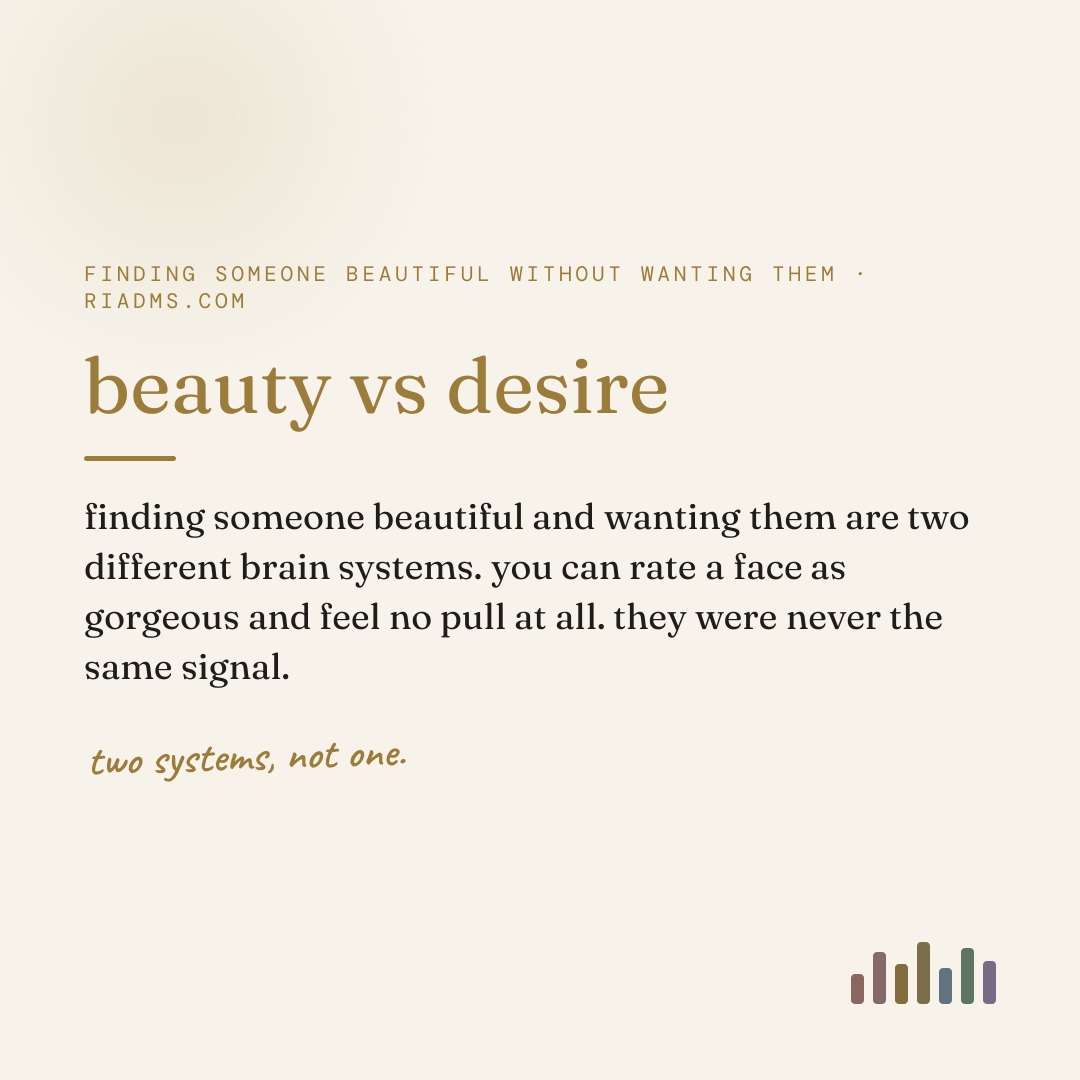
Here’s where it stops being a nice metaphor and starts being neuroscience. In 2001 a group of researchers led by Itzhak Aharon put people in an fMRI scanner and showed them faces. People rated lots of faces as beautiful. But a completely separate part of the brain, the reward circuitry, the wanting part, only switched on for some of them. And when the researchers measured how hard people would actually work, pressing a key, to keep a face on screen longer, they only worked to keep looking at the ones they desired. Rating a face as gorgeous and wanting it were two different systems that could fire separately.
So the science is doing the thing your language never did. It’s splitting “beautiful” apart from “I want you.” They were never the same signal. You just felt them at the same time, aimed at the same person, so often that you assumed they were one thing. And it goes wider than faces: judging anything beautiful, a painting, a color, a building, lights up its own dedicated spot in the brain, the orbitofrontal cortex. Beauty appreciation is its own event. The wanting is a separate event that sometimes rides along on top.
why most people never notice it’s separate
If you’re allosexual, aesthetic attraction and sexual attraction usually fire at the same moment, aimed at the same person. You see someone beautiful and you want them, in the same half second, so the two feelings arrive fused. You’ve never had a reason to pull them apart. And so you inherit a language with one word doing two jobs, and that one overworked word quietly runs your decisions.
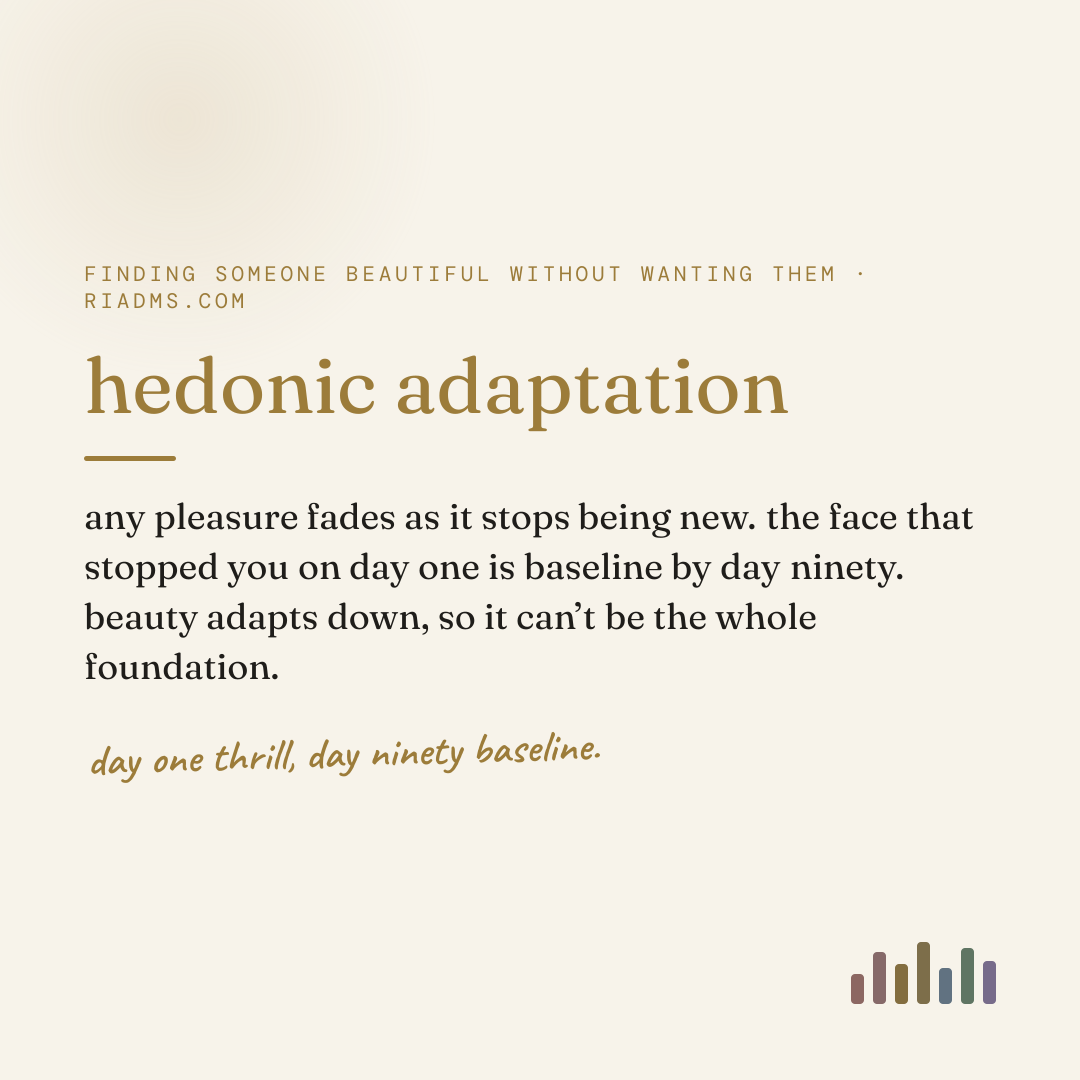
Watch what it does. You meet someone stunning, you feel the “oh,” and because the culture taught you that “attracted to” means “want to be with,” you read the “oh” as a reason to start something. So you date the beautiful person. And then a few months in, the “oh” gets quieter. Not because they got less beautiful, but because you’ve looked at that face enough that it stopped being new. This is just how pleasure works: we adapt to everything. Psychologists call it the hedonic treadmill, the way a thing that thrilled you on day one is baseline by day ninety. The beauty adapts down. And if beauty was the whole foundation, you look up one day and there’s nothing underneath it.
what I notice, as an ace person
Being asexual means I only ever get the “oh.” The full “oh,” on its own, with nothing underneath it. And I promise you it is not a dimmer version of the feeling. It’s the whole feeling, just clean. I look at someone beautiful the way I look at good architecture. I can be genuinely stopped by a person’s face, the proportions, the way their features go together, the way they hold themselves. And because my brain isn’t also running the “can I get closer to this person” program in the background, I notice things the wanting usually hides.
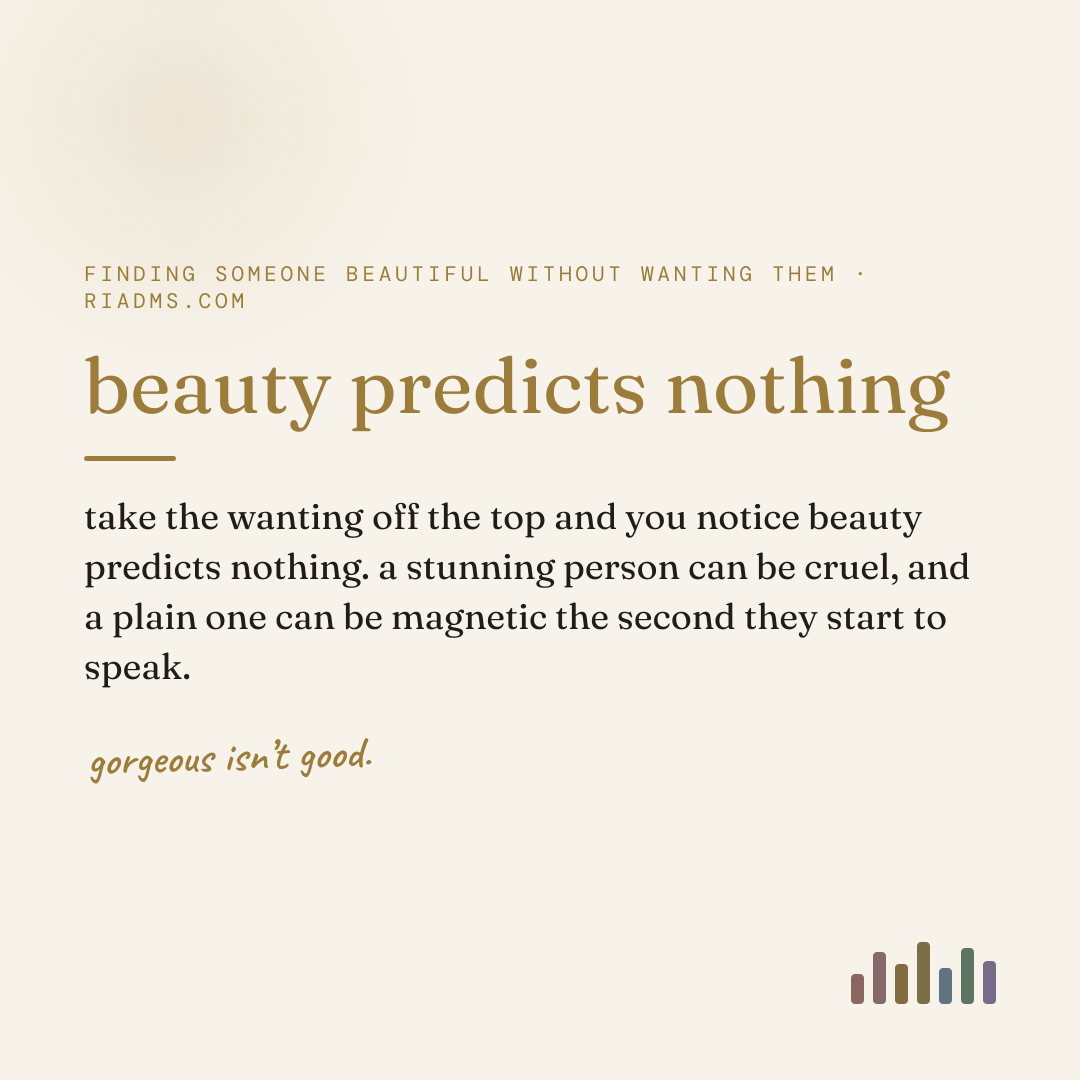
The main thing I notice is that beauty predicts nothing. A stunning person can be cruel. A completely average-looking person can be the most magnetic human in the room the second they start talking. When you take the wanting off the top, beauty stops secretly standing in for a person’s worth, and you can see it for what it is, which is just: nice to look at. I think most people have this exact same wide-open channel. They just never hear it, because when the beautiful thing is a hot person, the wanting turns the volume up so loud it drowns everything else out. I hear it because for me the loud part was never installed.
how to actually use this
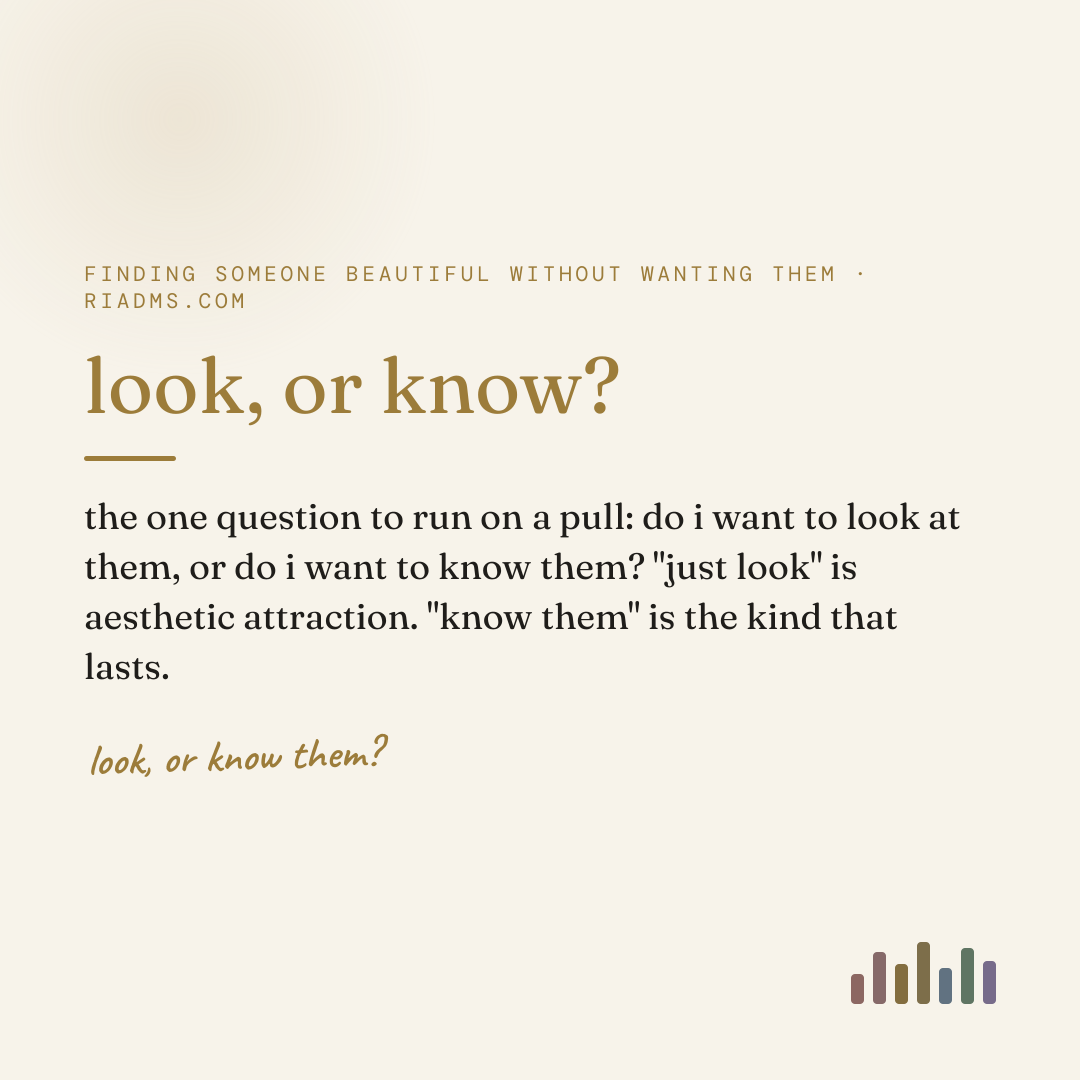
Here’s the part you can take with you. The next time you feel that pull toward someone, before you do anything about it, run one question: do I want to look at them, or do I want to know them?
If the honest answer is just “look,” that’s aesthetic attraction. It’s real, and it’s lovely, and it is not a reason to start a relationship. It’s a reason to appreciate a beautiful human the exact way you’d appreciate a painting, from a comfortable distance, without asking it to become your whole life. If the answer is “I want to know them, I want their mind, I want to be around them when they’re sick and boring and having the worst day,” now you’re talking about something that lasts, because that’s a different attraction entirely, and it doesn’t adapt away.
Most people never separate the two, so they keep starting relationships off the signal that fades and wondering why the floor drops out at month three. You don’t have to. You just needed the two words the culture folded into one.
keep reading
If you want the science of beauty in full, the best book is Nancy Etcoff’s Survival of the Prettiest, written by one of the authors of that 2001 faces study, and for the ace vantage this whole page is written from, Angela Chen’s Ace. The two chapters next to this one are sensual attraction, the want to be held with no interest in where it leads, and intellectual attraction, the pull toward a mind.
You feel this every single day. The stranger on the train, the actor who isn’t even your type, the friend you’d never date who you still think is gorgeous. That was aesthetic attraction the whole time. Your brain has always known beauty and wanting were separate systems. You just finally got the language to catch up to your own brain. Now go find where it’s been hiding in your life.


