Someone asked me how I know it’s love. The answer I’m supposed to give is chemistry, because that’s the answer everyone accepts and nobody questions. But that’s not what I mean. What I mean is that he knows what my voice does when I’m about to cry. He knows which shops I won’t go into. He knows the order I do things in the morning, and he’s never questioned it.
I didn’t know it was love because I wanted him. I knew because he’d been paying attention for a long time.
This page argues one thing, so here it is plainly. Love and desire are two different things. Almost everything we’re taught puts them together, and most people never get a reason to check whether they come apart. I did. I’m asexual, so I had to work this out on purpose. It’s hard to know what you want when the thing you want usually comes attached to something you don’t. That’s annoying in most ways. In this one it’s useful.
two systems, not one
Here’s what happens when you treat them as one thing. You meet someone and you feel something physical. Because the two are glued together, you read that feeling as evidence about the relationship. It isn’t. It’s evidence about your body.
Attraction tells you about you. It doesn’t tell you anything about them. It can tell you that you might be interested in someone. It can’t tell you whether they’ll be good for you long term.
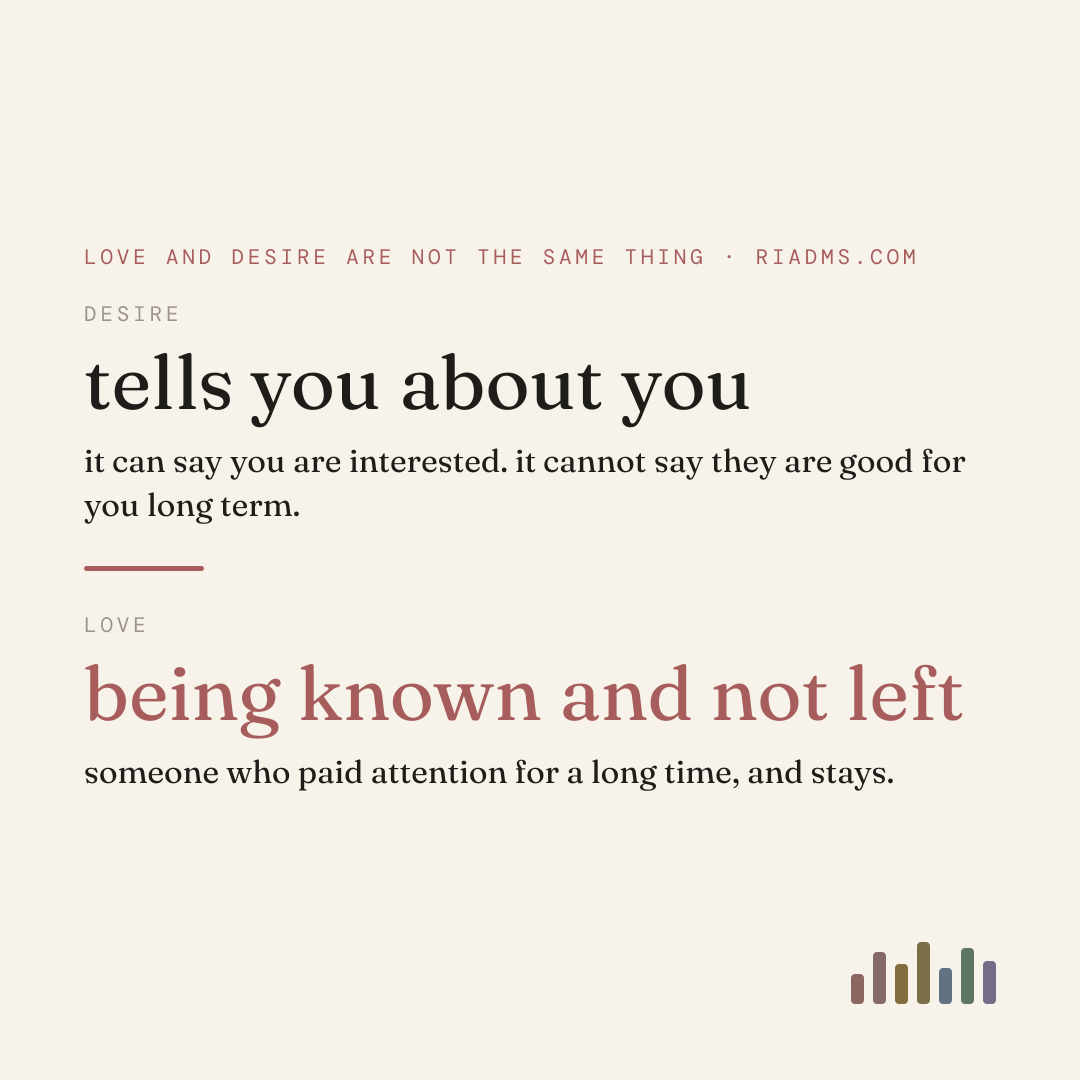
This isn’t only an ace idea. In 2003 the psychologist Lisa Diamond wrote a whole model arguing that the processes behind sexual desire and the processes behind romantic bonding are functionally independent. Helen Fisher, in 1998, split it into three: sex drive, attraction and attachment, each with its own chemistry, and she argued they became more independent of each other as humans evolved.
come think with me
one letter a week.
the word for one feeling you’ve had but couldn’t name, and why it works that way. the same thing you just read, in your inbox, once a week.
- one letter a week, about a ten minute read
- all nine printable workbooks, free
- the research, with its caveats kept in
- hit reply and it reaches me. i read every one
no pressure, no spam, no gatekeeping. unsubscribe anytime · riadumitrescu.substack.com
all of this is free and it stays free. if it gave you a word you didn’t have, you can buy me a coffee.
when the wanting fades
The reverse is worse. The wanting fades. It does that in long relationships, and most people know it does. But because love and desire were handed to us as one package, people read the drop in desire as the love going too. As if the love was tied to it and couldn’t exist without it.
So they leave a relationship that was fine, because they expected it to feel the way it did at the start. Or they stay and feel like frauds, like they’re lying about loving someone. Or they go looking for the feeling somewhere else and blow up their lives over something that was completely normal.
People don’t usually leave because the love went. They leave because the desire went, and nobody told them those two things can come apart.
There’s research on the drop. Dieter Klusmann studied 1,865 German students in steady relationships in 2002 and found that sexual activity and satisfaction fell the longer people had been together. Desire itself only fell for the women, and a 2012 study of young couples found the same. So it doesn’t look the same for everyone. Klusmann concluded that a steady bond doesn’t need high desire once the early infatuation is over.
And the love part holds up better than people expect. Bianca Acevedo and Arthur Aron went through 25 studies in 2009. They found that romantic love without the obsession of the early stage does exist in long marriages, and it goes with being satisfied. The obsession was the part that went with being less satisfied.
what’s left when you take the desire out
I get asked this constantly, and usually in a slightly worried way. Like whatever’s left must be a friendship, or something very sad.
What’s left is somebody who chooses you. Somebody who has collected information about you slowly, by paying attention. Somebody consistent enough that your body stops being anxious and braced all the time. Somebody you’re not performing for.
The Gottman Institute calls one half of this a love map. It means knowing your partner’s inner world: what they remember, what they hope for, what they’re scared of. The research word for the other half is responsiveness, the sense that your partner understands you and cares. Harry Reis and his colleagues argue it sits at the center of intimacy.
And I think most people already know this. Ask anyone to describe the happiest they’ve been with another person. They won’t describe the peak of desire. They’ll describe a normal day when nothing special happened. A kitchen, a sofa. A completely ordinary scene where they felt safe. And then they go back to organising their whole romantic life around the one thing they never mention when they talk about being happy.
love with one address
This is the part that actually costs people something, and we almost never talk about it.
If love and desire are one thing, then love only points in one direction. Every relationship in your life that isn’t romantic becomes a lesser version. Your friendships are the practice. Then you’re thirty or forty and there’s one person in your life who really knows you, and that one person carries every function. If they leave, you don’t only lose a partner. You lose your whole infrastructure.
You were told love has one address, so you sent all of it to one house.
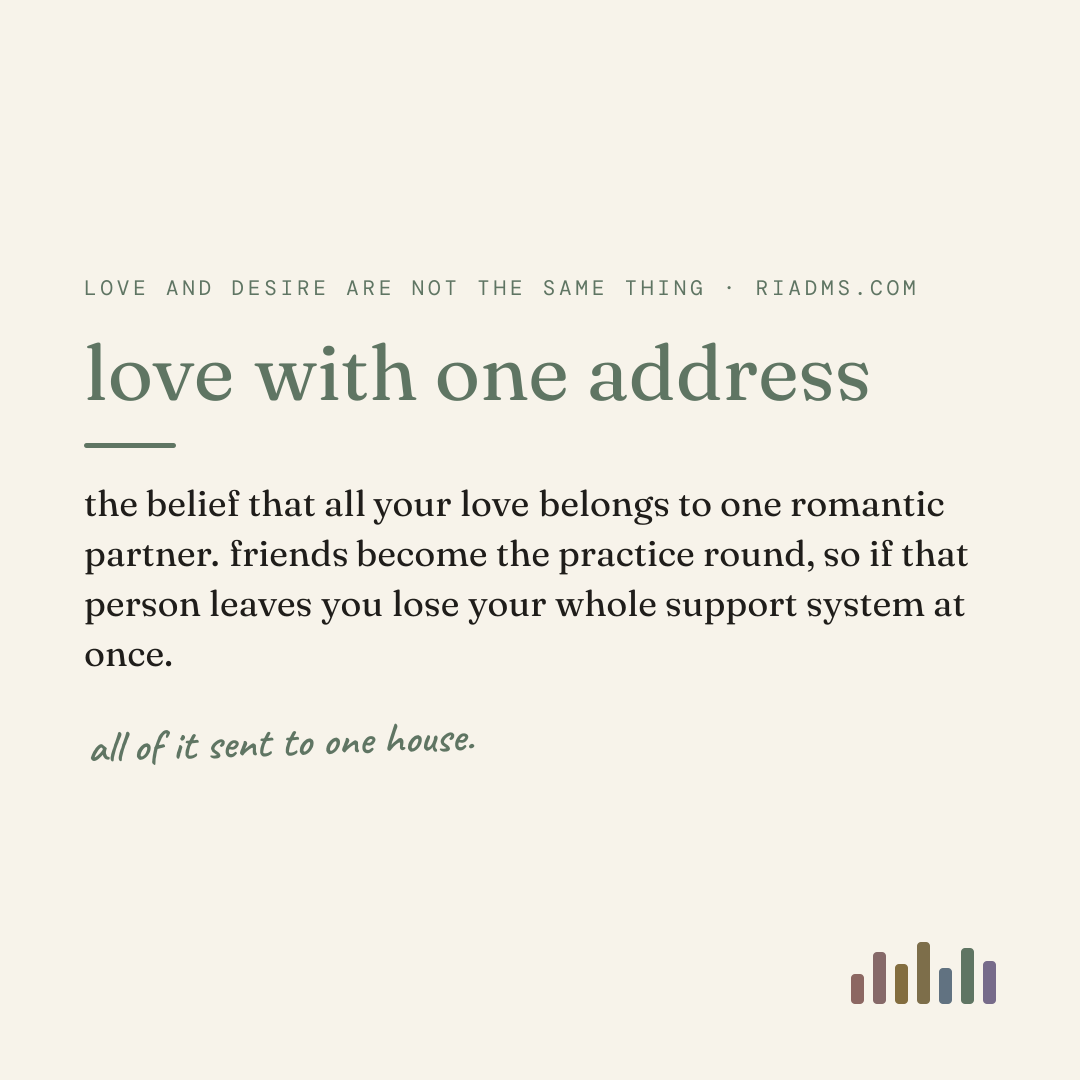
It doesn’t even take a breakup. It can be one week when your partner isn’t emotionally available. You have nobody else, so you feel lonely and empty, and you want to find support somewhere else. But you built your life so there’s nowhere else to turn. That’s when people make bad decisions.
Most people don’t build friendships that can handle that much. It would feel strange to care that much about someone you don’t want a romantic relationship with. So you end up putting everything on one person.
You’re not lonely because nobody loves you. You’re lonely because you were taught only one kind of love counts.
The research backs this up. Eli Finkel and his colleagues argued in 2014 that people now ask marriage for much more than they used to. Less for survival and safety, and much more for esteem and growing as a person. That’s a lot to put on one person. A 2015 study by Elaine Cheung and her colleagues found that people who spread their emotional needs across several people had higher well-being than people with the same number of close relationships who relied on fewer people.
Friendship matters on its own terms too. William Chopik looked at more than 271,000 adults in 2017 and found that valuing friendships was linked to better health and well-being, most of all in older adults. I wrote more about that in we stopped being allowed to love our friends.
the questions I get asked
Aren’t you just roommates? No. And I want to answer that properly instead of being offended by it. We’ve built a life together on purpose. We’ve made decisions about our lives together. There might be nobody else who knows our whole relationship. We’ve built a culture around it. If you think the difference between a partner and a friend is sex, then what you’re telling me is you’ve never had a friendship that deep. And I’d suggest that’s the thing to be worried about, not my relationship.
If the only thing separating your partner from your friends is sex, that isn’t a fact about love. It’s a fact about your friendships.
So attraction doesn’t matter? It matters. It matters to so many people, and there are so many kinds of it. I feel most of them, except sexual attraction. I feel intellectual attraction, wanting to connect with someone else’s mind, and it’s a beautiful, strong feeling that pulls you toward a person. What I’m saying is that attraction maybe shouldn’t be the foundation of a long relationship. It can be. It doesn’t need to be. Attraction on its own can’t hold up something that lasts years.
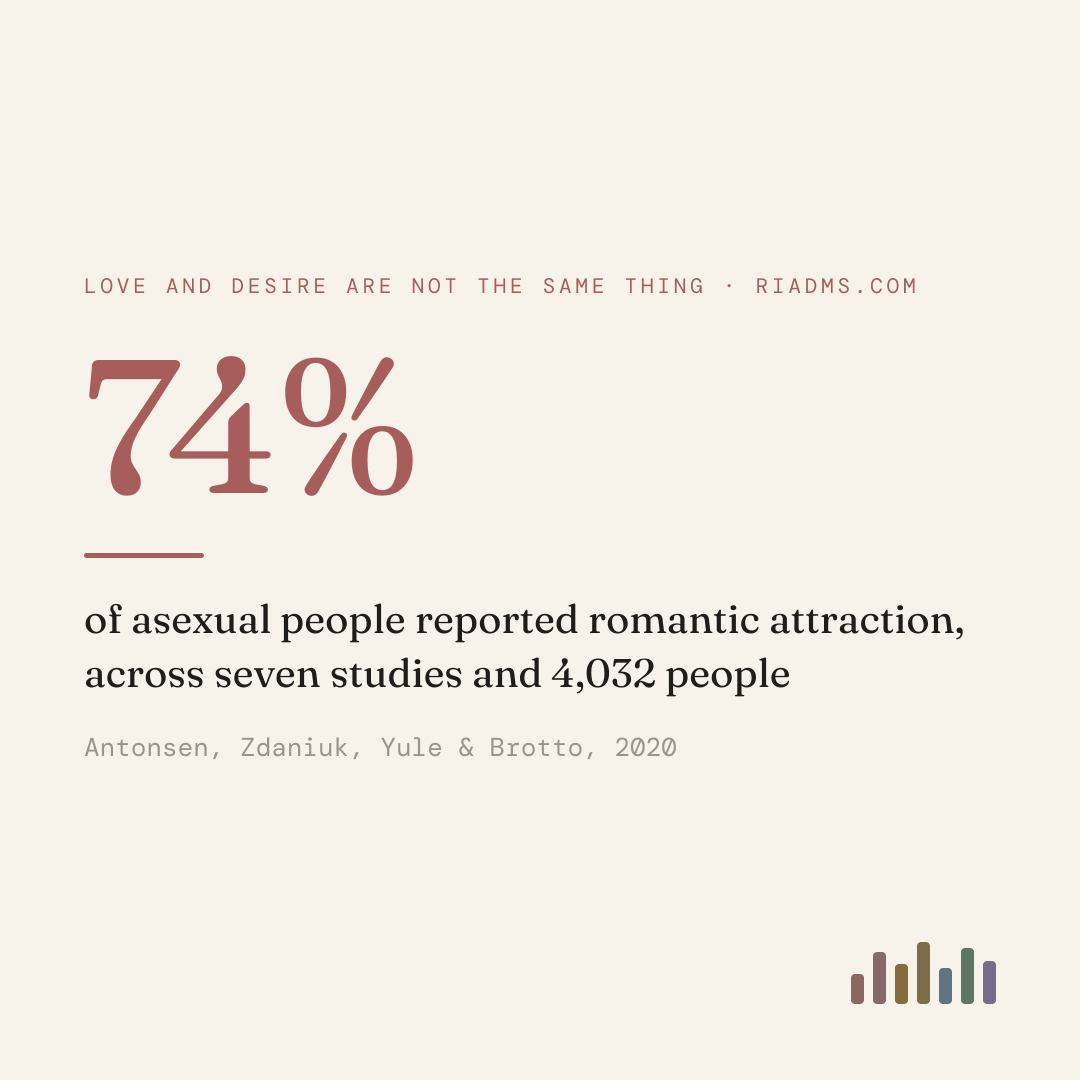
Being ace doesn’t mean there’s no romance either. A 2020 paper that pooled seven studies of more than 4,000 asexual people found that 74% reported romantic attraction.
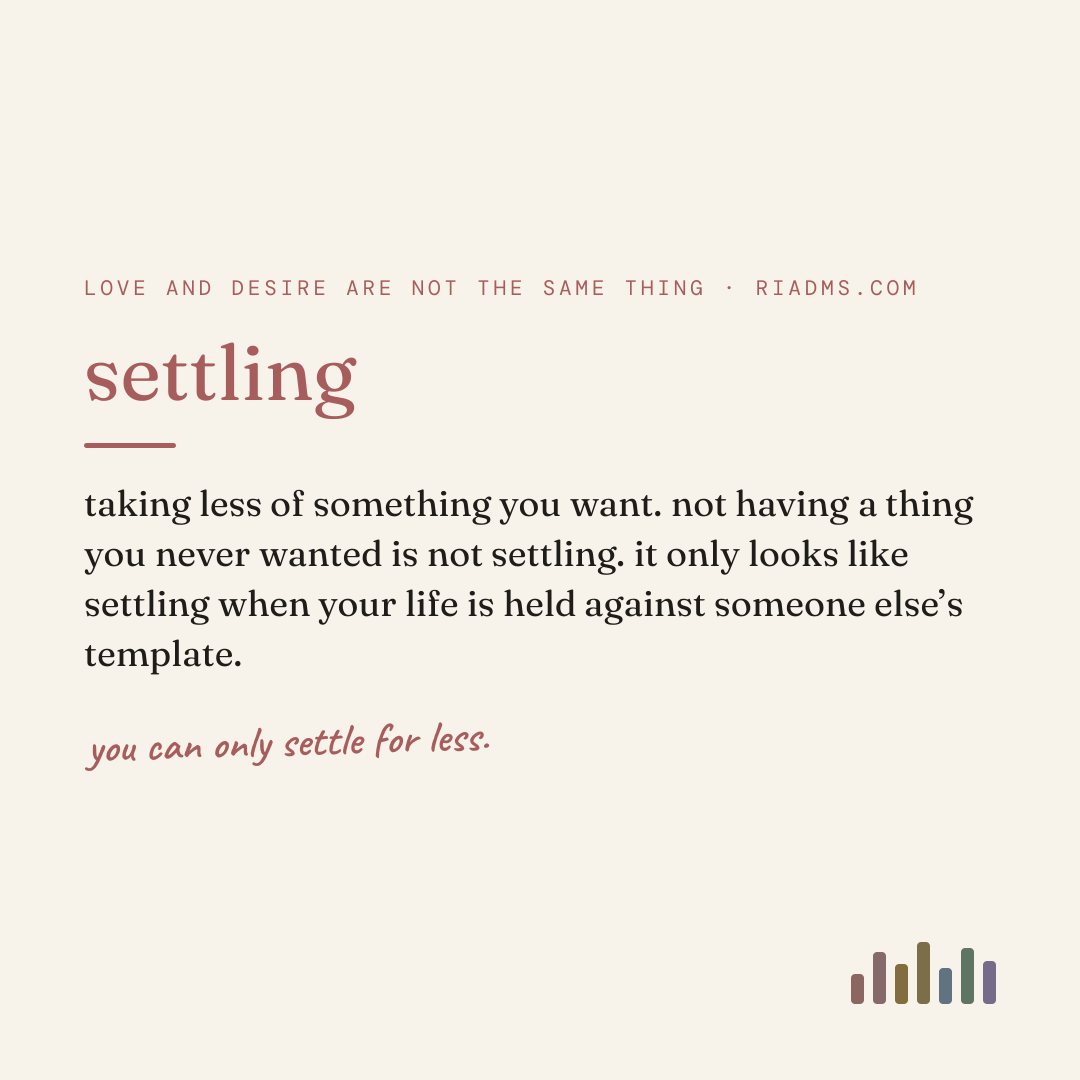
How do you know you’re not settling? Settling is when you take less than you want. I’m not taking less than I want. I have the thing I want, which is somebody who stays and knows me. What you’re calling settling is me not having something I never wanted. You can’t settle for a thing you never wanted.
desire doesn’t have to leave your life
Here’s the part people don’t expect from me. You can still have desire in your life even if it’s faded in your relationship, and you can still feel full.
Even in a long relationship you’ll still get crushes. You can enjoy how they feel without doing anything about them, if you’re monogamous. I get crushes all the time. They aren’t physical or sexual. They’re mental, or aesthetic, or emotional. I meet someone I connect with and I have a lot of feelings about them. We’re told that’s being unfaithful to your one person. I don’t think it’s cheating. I think it’s you letting yourself feel the full range of human emotion, and as long as you don’t act on it, you can still have desire in your life.
I feel so much desire when I read, especially rom-coms. You can have huge crushes on book characters, and it makes you feel warm. Then I tell my partner about it and he laughs at me. He doesn’t get jealous, of course, it’s a fictional character. He has crushes too. He’s allowed to form connections with those people. He’s just not allowed to choose to build a life with them. They’re still part of our life, and we can talk about them because we know each other and we feel safe with each other.
heat without information
A lot of people who want each other don’t know each other. That’s extremely normal. It’s most of the relationships I’ve seen from the outside. Two people with a huge amount of heat between them and no information. They couldn’t tell you what the other one is frightened of.
And somehow that looks more normal to us as a long-term relationship than two people who know each other without the heat.
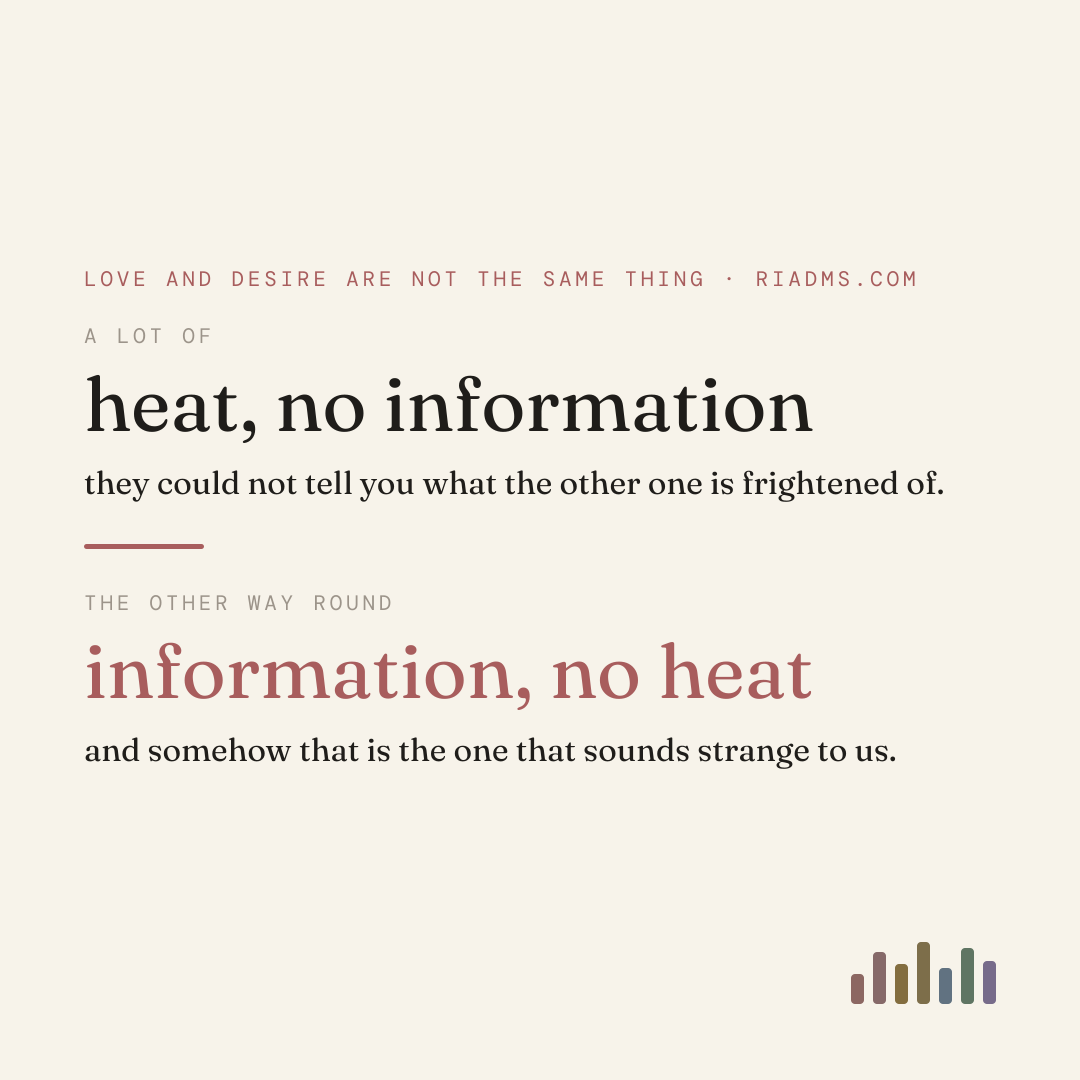
For me, information matters more than passion when I’m building a life with someone, because passion comes and goes. I’m passionate about the projects I’m working on. I’m passionate about my YouTube channel. Those passions grow and then they fade. Information stays. You can make good decisions with information. You can’t make good decisions with passion.
where to read more
If you want to go further, Angela Chen’s Ace is the book to start with, because it’s about what asexuality shows everyone about desire. Esther Perel’s Mating in Captivity is about the tension between feeling safe with someone and wanting them. Gottman’s Seven Principles has the love maps in it. And Marisa Franco’s Platonic is for the friendship half. For the science, Diamond’s 2003 paper is the clearest case that love and desire are separate, and Acevedo and Aron’s review is the best answer to whether love lasts once desire drops.
So I don’t think I’m missing love. The big one, the one that fills you up. I feel it. I just didn’t put all of it into one person. I chose not to pressure my partner to be everything for me.
This isn’t the final word. It’s a place to start the conversation, and different views are better than just mine. I’d like to hear yours.


