You met them once. Maybe twice. Possibly you have never spoken to them properly at all, and you have spent four months feeling something enormous about a person you could not describe to a stranger in more than two sentences.
You are not being stupid, and this is not a small or embarrassing version of the real thing. It is a specific process, it has been described very precisely, and the description is two hundred years old.
the branch in the salt mine
In 1822 Stendhal published a book called On Love, and in it he wrote about something he had seen on a trip to the salt mines at Hallein, near Salzburg.
The miners take a bare winter branch, no leaves on it, and throw it into an abandoned working. Two or three months later they bring it back up. The salt water has soaked into it and dried on it over and over until every twig, down to ones no bigger than a bird’s claw, is encrusted with crystals. It is dazzling. And the branch underneath is completely unrecognisable.
That, he said, is what a mind does to a person it is falling for. He called it crystallization: the operation by which you go over somebody again and again, and every pass lays down another perfection they did not necessarily have.

Which gives you the only question that matters here, and it is a question about quantity rather than feeling. How much branch have you actually got?
Not how strongly do you feel it. How many hours of real information do you have about this person, and how many of those hours were spent looking at them rather than finding things out.
the person is almost incidental
Tennov, who named concept limerence An involuntary, obsessive state that feels like love: intrusive thoughts, a hunger for reciprocation, and a charge that gets stronger with uncertainty and weaker with security.

Because in this state the person is functioning as a surface. Your mind is doing the running. That is why the feeling can survive years of no contact, and why it so often does not survive an afternoon of ordinary conversation.
It is also why the state loves an absence. The Aron and Fisher scans found early intense love running through the ventral tegmental area and the caudate, which is the wanting circuit, not the cherishing one. Wanting needs a gap. Fill the gap in and the machinery has nothing to do.
fictional attraction, which somebody named in my comments
Somebody left this under one of my videos about the seven kinds of attraction, and I have not stopped thinking about it since. They said there should be a category for being attracted to the idea of someone or something, but only in your mind and not in reality. Celebrities. Characters in books and games. People you have met once.

That is a better name than anything in the literature, and the nearest academic relative is older than you would think. In 1956 Horton and Wohl described what they called para-social interaction: a one-sided bond with somebody who does not know you exist, built entirely out of repeated one-way contact. They were writing about television hosts. The machinery is identical for a stranger from a bar, because in both cases you are getting a signal and returning nothing, and the mind fills in the other side.

the cure is boring, and it is the good news
Here is the part I actually want you to leave with, because the rest of this could read as a warning and it is not one.
What resolves this is not finding the person. It is proximity, and repetition, and time, and those are much easier to get.
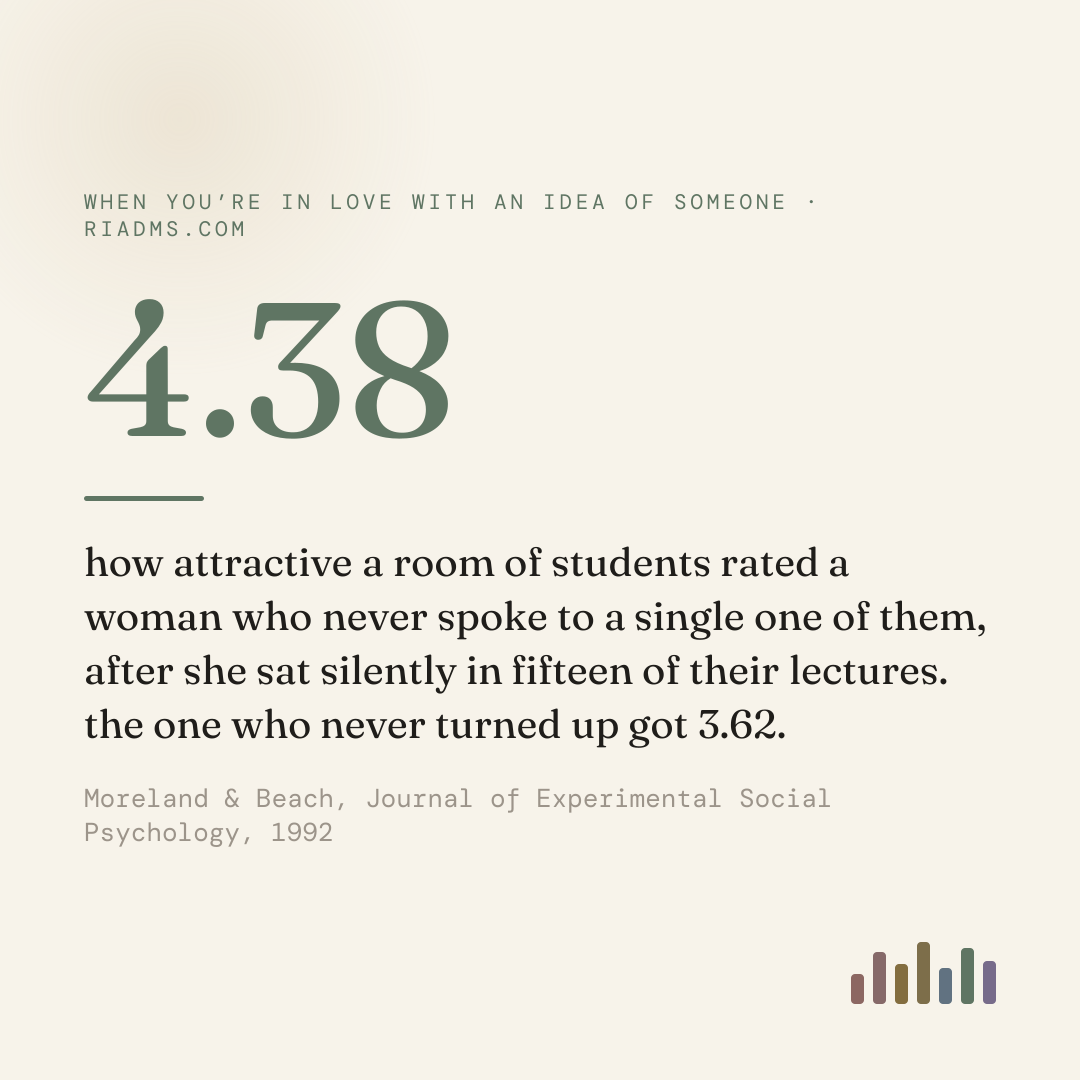
Robert Zajonc named the mere exposure effect in 1968: you like things more the more often you have simply encountered them. The version of it I love is a study by Moreland and Beach in 1992. They took four women of similar appearance and sent them to sit in on a large university lecture course. One attended zero times, one five, one ten, one fifteen. None of them spoke to anybody. They walked in, sat where they could be seen, took notes, and left.
At the end of term the class rated them. Attractiveness ratings rose with attendance, from 3.62 for the one who never came to 4.38 for the one who came fifteen times. They had done nothing at all except be in the room.

So the thing you are desperate for is not rare and it is not out there. It is being somewhere repeatedly, with someone, doing something ordinary. Getting a bus. Failing at a project. Being a bit bored together.
and the honest counterweight
None of this means that seeing somebody generously is a mistake, and I do not want to leave you thinking that the goal is to strip a person back to a spreadsheet.
Murray, Holmes and Griffin followed dating and married couples in 1996 and found that people who idealised their partners, who saw them more generously than the partners saw themselves, reported more satisfaction, more love, more trust and less conflict. In the longitudinal follow-up, the relationships with stronger initial illusions were the ones more likely to last.
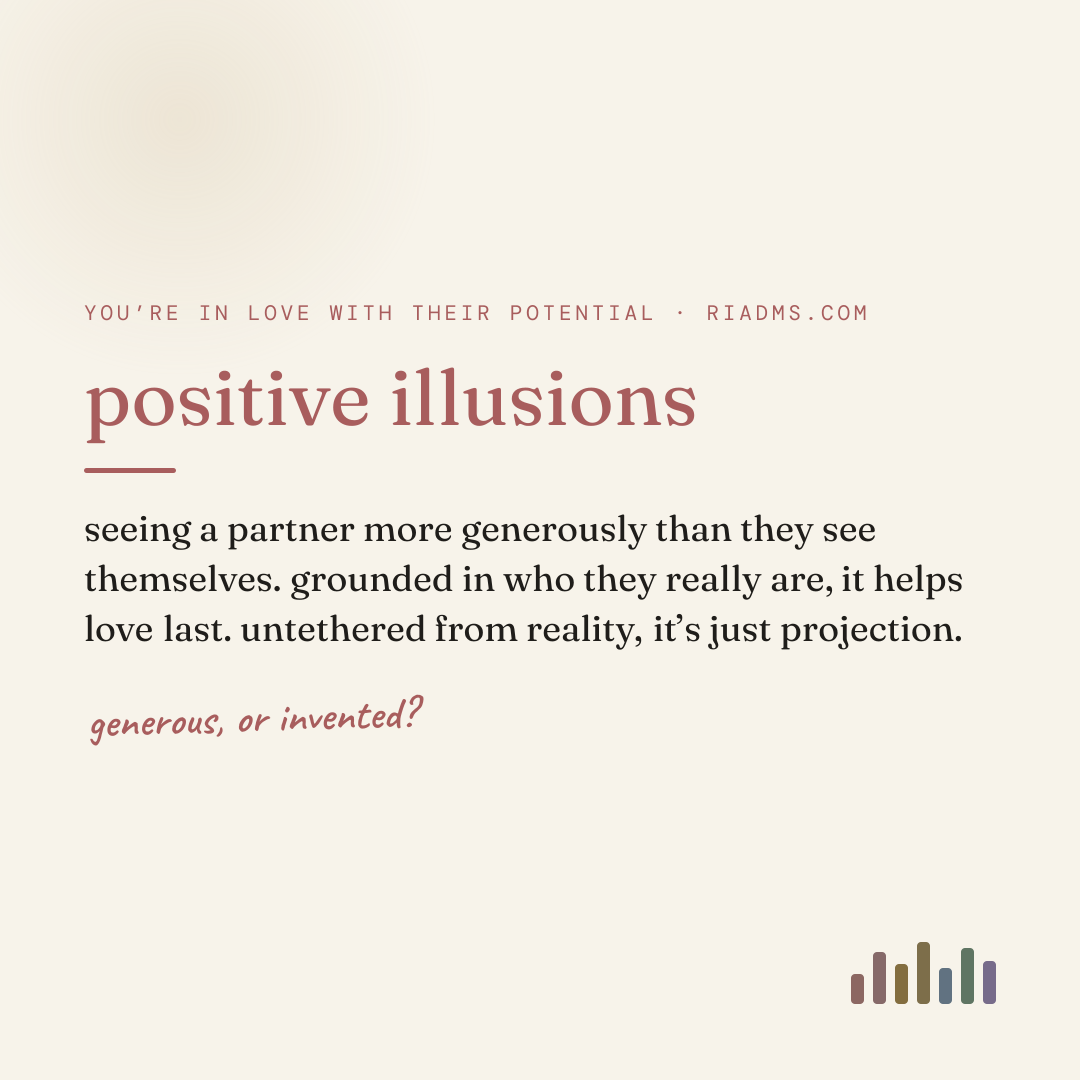
So the crystals are not the problem. Idealising somebody you actually know is one of the things that makes love work. Idealising somebody you do not know is the problem, because there is no branch under it to correct against.
That is the whole distinction, and it is a distinction about information rather than about feeling.
keep reading
The next thing to read is Stendhal, and it is short and free. The crystallization chapters of On Love will take you fifteen minutes and they are better than anything written since.
For the state itself, Tennov’s Love and Limerence and the limerence chapter here. For the version of this that happens to somebody you genuinely do know, loving their potential, which is the same mechanism with a real branch under it.
If you are currently in love with somebody you have barely spoken to, count the branch. Ask how many hours of information you have, and how many of those you spent finding something out.
If the answer is bad, you do not have a love problem. You have a data problem, and the fix is not to feel it harder. Get in a room. See what survives.
And if it does survive, that is the good news, because that was always the thing worth having: being annoyed with somebody on a bus for four months, and still wanting to get on the bus.

