There’s a book of photographs I can’t stop thinking about.
It’s called Picturing Men, by a historian named John Ibson, and it’s 142 ordinary American photographs taken between 1850 and 1950. In the early ones men are sitting in each other’s laps. Holding hands, on purpose, looking at the camera, in pictures they paid for and posted to their parents. Then you turn pages and watch the years drain the physicality out. The arms come down. The bodies separate. By the end they’re standing a foot apart with their hands in their pockets, and that’s the pose we still use.
Nobody passed a law. Something happened in the middle of that century that made an ordinary thing impossible, and I want to walk through what it was, and then I want to argue with my own explanation, because the clean version of this story is too clean.
what was normal before
This part sounds like nostalgia and it isn’t. It’s documented.
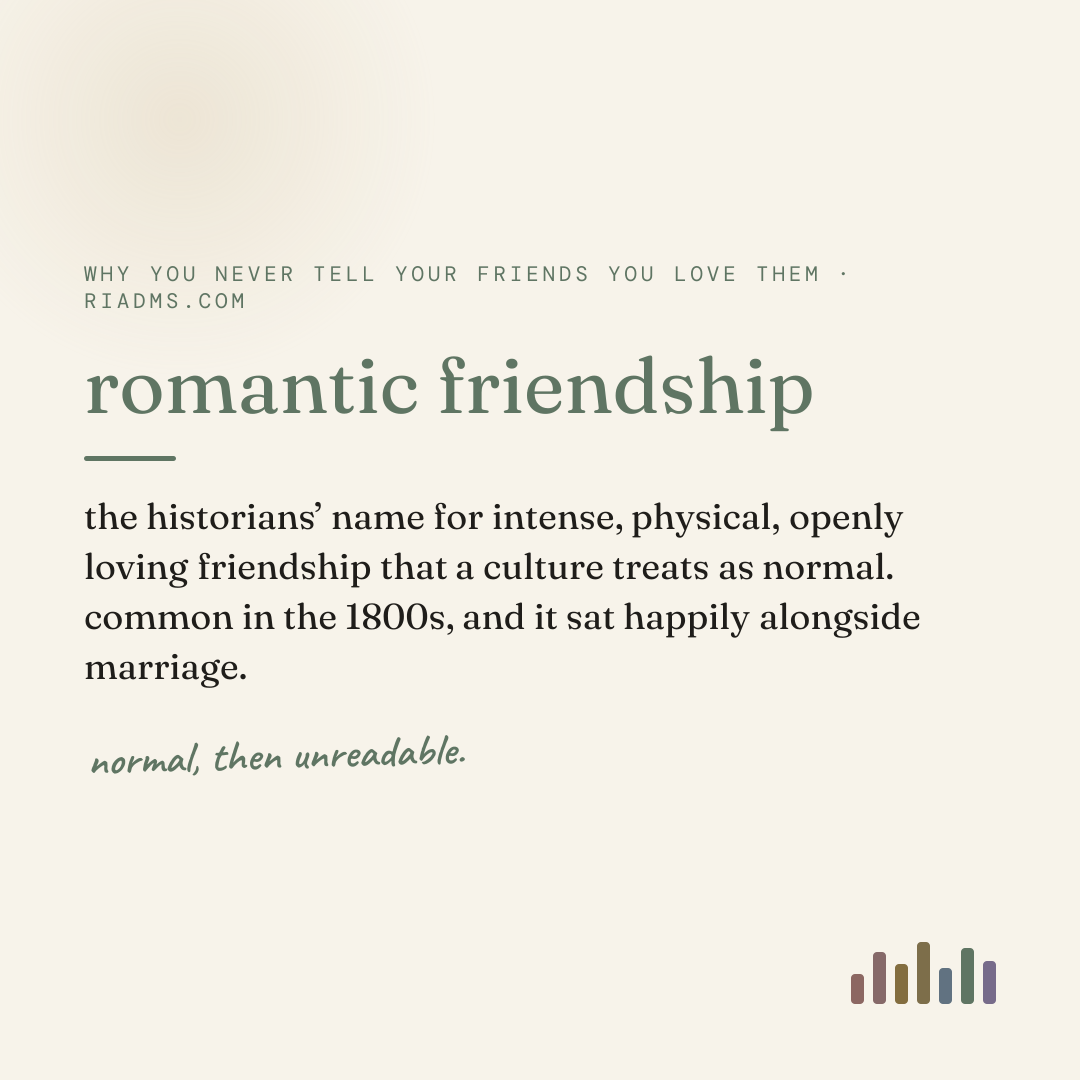
Start in the 1580s, with Montaigne writing about Étienne de La Boétie, who had died in 1563 after about four years of friendship. When Montaigne tries to explain why he loved him, he gives up and lands on one sentence: if you press me to say why I loved him, I can say no more than because it was he, because it was I. That’s about a friend. Not a wife. And Montaigne wasn’t being scandalous; he was writing into a context where it was a serious thing to say.
Aristotle gave two of the ten books of the Nicomachean Ethics to philia, and said flatly that nobody would choose to live without friends even if they had every other good in the world.
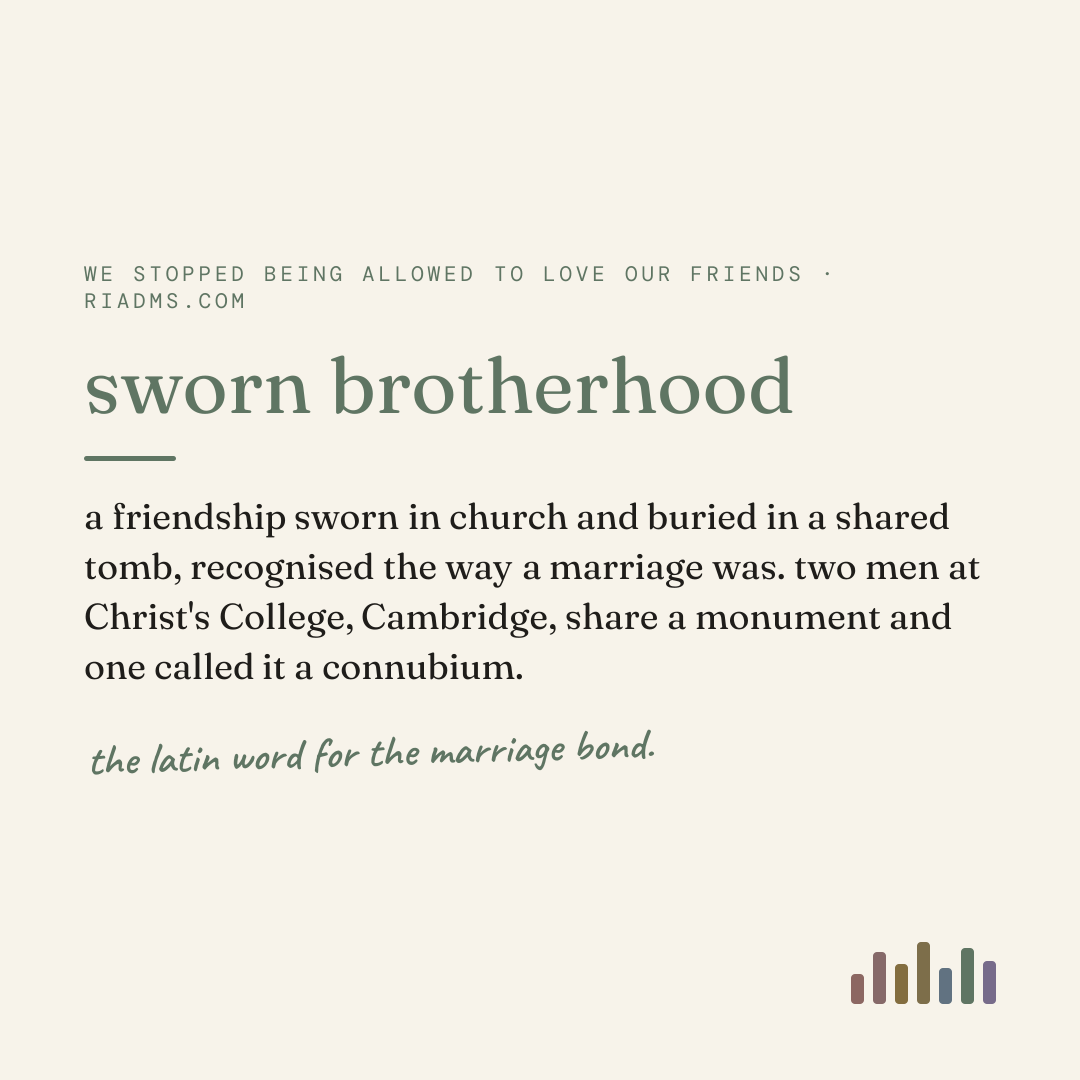
Then there’s the part that stopped me. Alan Bray’s The Friend, from 2003, is a history of friendships that were sworn, ritually, in church, and then buried together. Not family. Not spouses. In the chapel at Christ’s College, Cambridge, there’s a monument to John Finch and Thomas Baines, their portraits linked by a knotted cloth, and Finch described what they had using the Latin word connubium. The word for the marriage bond.
And in 1975, in the first issue of Signs, the historian Carroll Smith-Rosenberg published an analysis of the letters of 35 American middle-class families covering the 1760s to the 1880s. Women wrote to each other in language we’d now read as unmistakably romantic. They kissed. They shared beds. They told each other they couldn’t live apart. This went on inside their marriages, in letters their husbands could have read, and nobody treated it as a crisis.
come think with me
one letter a week.
the word for one feeling you’ve had but couldn’t name, and why it works that way. the same thing you just read, in your inbox, once a week.
- one letter a week, about a ten minute read
- all nine printable workbooks, free
- the research, with its caveats kept in
- hit reply and it reaches me. i read every one
no pressure, no spam, no gatekeeping. unsubscribe anytime · riadumitrescu.substack.com
all of this is free and it stays free. if it gave you a word you didn’t have, you can buy me a coffee.
how the line got drawn
In May 1868, a Hungarian writer called Karl Maria Kertbeny used a new word in a private letter: homosexual. He put it in print the next year, in an anonymous pamphlet arguing against Paragraph 143 of the Prussian penal code. He was on our side. He was trying to get a law repealed.
In 1886 the psychiatrist Richard von Krafft-Ebing published Psychopathia Sexualis, written as forensic material for lawyers, doctors and judges. It started with 45 case histories. By its final edition in 1903 it had swollen to 238.
In 1897 Havelock Ellis and John Addington Symonds published Sexual Inversion, the first English textbook on the subject, and it went about as badly as a book can go. Symonds’s literary executor, acting on his family’s instructions, bought and destroyed nearly every copy and asked Ellis to take Symonds’s name off the title page. It was reissued without him that November. The next year a man was arrested for selling one, and the court ruled it obscene.
And this is where Foucault comes in, with the sentence everybody quotes, from page 43 of the Hurley translation:
the sodomite had been a temporary aberration; the homosexual was now a species.
Something you might be, all the way through, whether you had done anything or not. And when there’s a kind of person, there’s a diagnosis. And when there’s a diagnosis, there’s evidence.
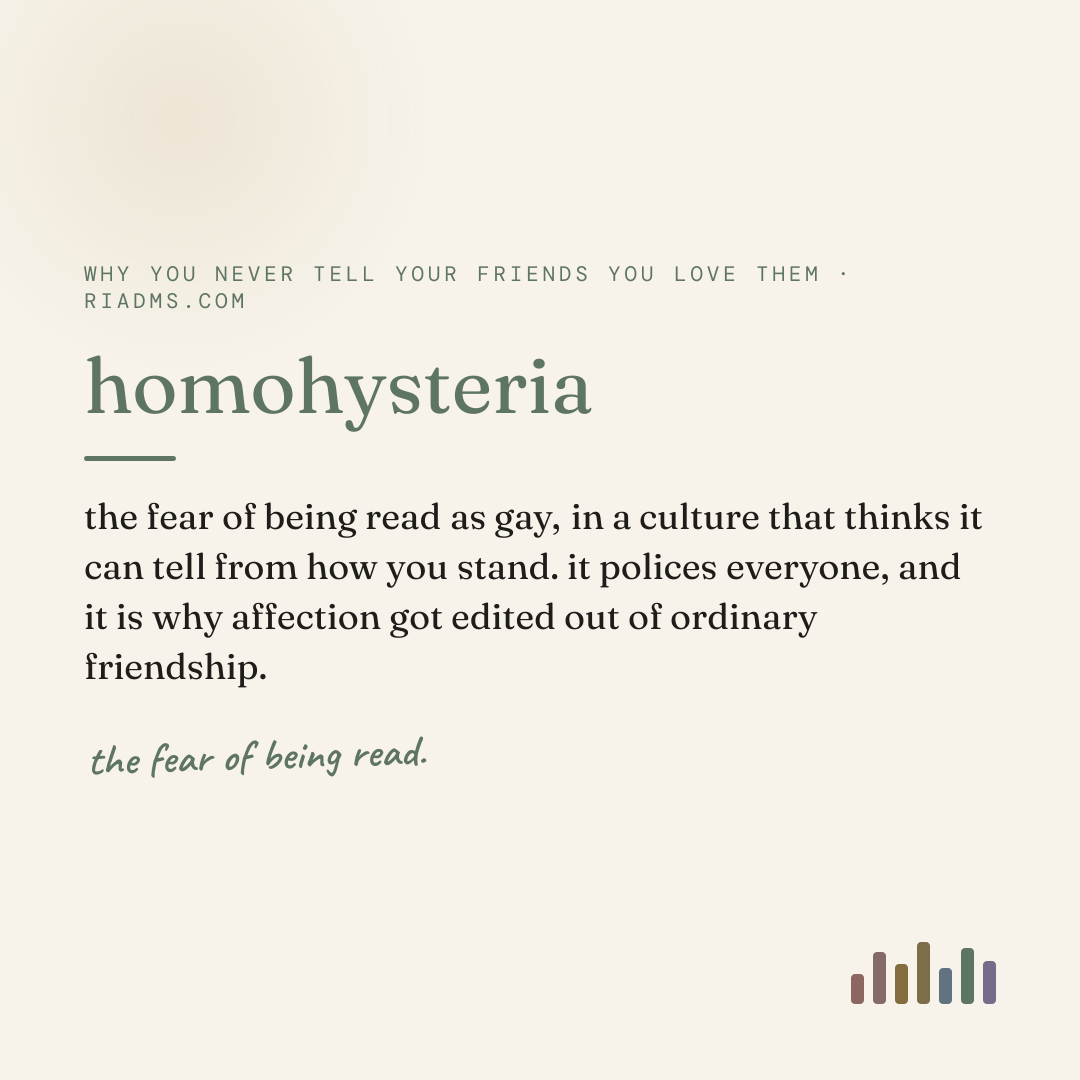
That’s the mechanism, and it’s worth being precise about what it did, because nobody banned friendship. Your arm around your friend didn’t become illegal. It became evidence. And once a gesture can be read as a symptom, everyone starts editing their gestures.
Lillian Faderman made the full version of this argument in 1981 in Surpassing the Love of Men: romantic friendship between women was expected and accepted, and then sexologists folded it into a category of sickness, and it became unavailable.
three problems with that story
I could stop there. It’s tidy, it has villains, and it would make a good video. It’s also too clean, and the problems with it are more interesting than the story.
The chronology is off by a century and a half. Randolph Trumbach dates a recognised, distinct sodomite social role in London to around 1700, in the molly houses, where men met in clubs and taverns from about 1709. And Rictor Norton found Dutch records from 1734 describing sodomites as hermaphrodites in their minds, which is almost word for word Foucault’s own “hermaphrodism of the soul”, the thing he dates to the nineteenth century. So the category the sexologists supposedly invented was already in use, in two countries, long before they wrote it down.
Faderman gets attacked on exactly the thing that makes her argument clean. Her case depends on romantic friendships between women not being sexual. Then there are Anne Lister’s diaries, an Englishwoman writing in code in the early 1800s, recording sex with other women explicitly. Which doesn’t demolish the argument, but it does mean the tidy version, where nothing was happening and then sexologists made everyone suspicious, isn’t quite what happened either.
And too much changed at once. Cities. The collapse of a world where men and women lived almost entirely separate social lives. And marriage turning into the relationship that’s supposed to supply every kind of intimacy a person needs, which I’ve written about separately because it’s a whole argument on its own.
So the honest version isn’t that sexologists killed friendship. It’s that they handed everyone a lens. And once you have a lens that reads closeness as a symptom, you get careful about what you display, because other people will do the policing for free.
what it costs now, measured
Niobe Way is a psychologist at NYU, and Deep Secrets, from 2011, is the most devastating research I’ve read on this. She followed 150 boys through adolescence, mostly Black, Latino, white and Asian American boys from working-class urban communities, and interviewed them again and again across the years.
In early and middle adolescence they described their friendships in language that startles you. Deep secrets. They said they’d go crazy without their best friend. Way’s own line is that it reads more like something out of Love Story than Lord of the Flies.
Then the same boys, interviewed by the same researcher, a few years older. Distrust. Isolation. Not needing anyone. One of them: I’m mature now, I don’t need to share my feelings.
The part I can’t get past is that they know. They name what happened to them, and the word they use is girly. Way puts it as: these boys live in a culture where ordinary human needs and capacities have been given a sex, female, and a sexuality, gay, so anyone who’s neither gets discouraged out of having them.
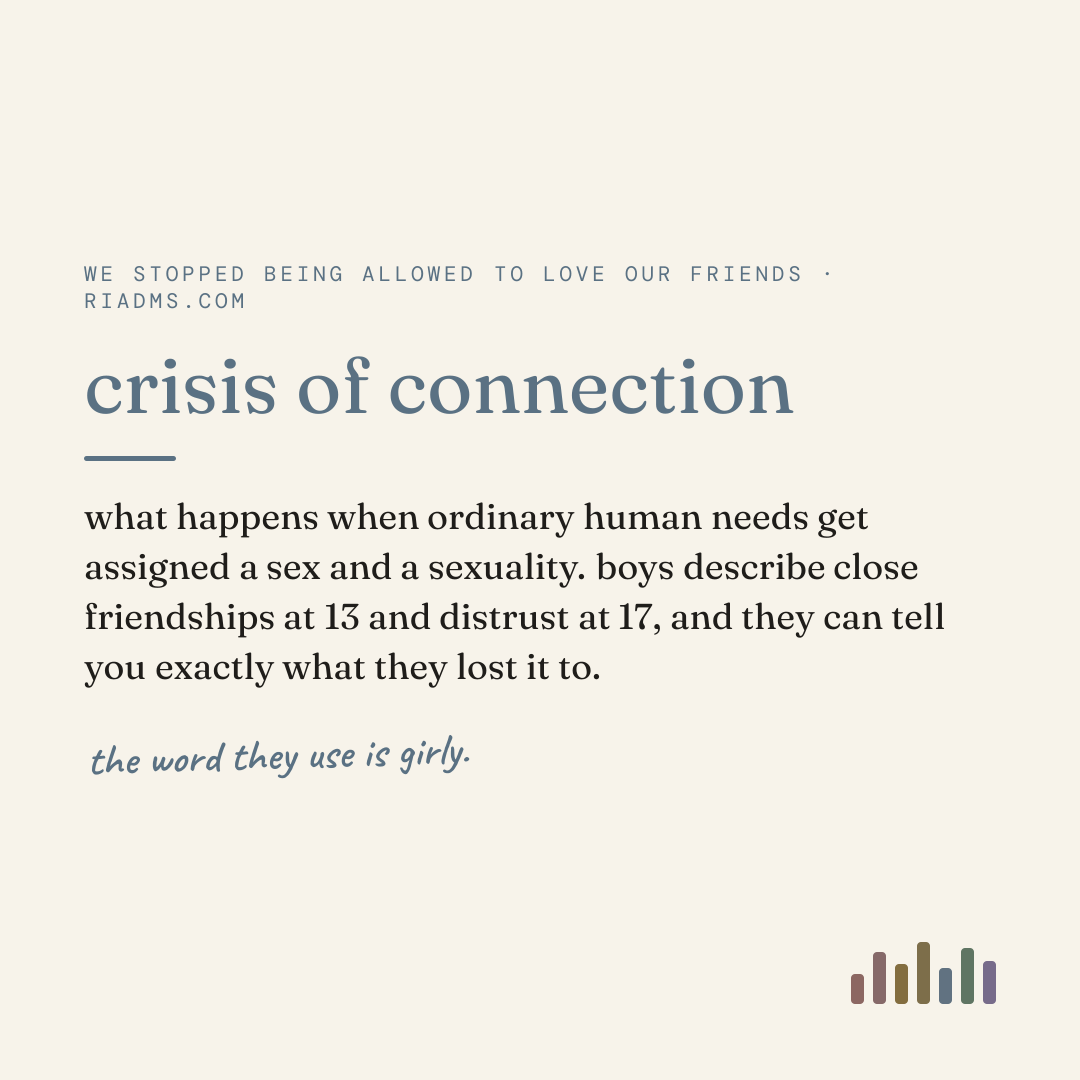
One boy said it might be nice to be a girl, because then you wouldn’t have to be emotionless.
And it shows up in the population numbers. The Survey Center on American Life polled 2,019 US adults in May 2021:
| 1990 | 2021 | |
|---|---|---|
| no close friends at all | 3% | 12% |
| ten or more close friends | 33% | 13% |
And the gendered half, all in the past week: 48% of women had a private conversation with a friend where they shared personal feelings, against 30% of men. 49% of women had told a friend they loved them. 25% of men had.
back to the photographs
The men with their arms around each other in 1880 weren’t braver than us. They weren’t more emotionally evolved. They just hadn’t been handed a lens that read their arms as a symptom. Nothing about the gesture had to be decided, because there was nothing to decide.
I’m not saying the lens should never have existed. Naming things gave people lives they couldn’t otherwise have had. The astonishing part is that we’re still homophobic enough for the lens to cost anything at all. If we weren’t, would any of this be a problem? Who cares what your arm around your friend implies.
The other half of it is that we don’t say anything out loud early. We don’t tell people what we feel about them when we notice it. If we did, the whole question of what a gesture implies would be answered before it came up.
the fix is one sentence, and somebody has to say it first
You get rid of this a sentence at a time, and the first one is genuinely frightening.
Tell them. Say the embarrassing thing. Say I love you to your friend even if you don’t love them romantically, and then say what kind of love it is. Let the silence be weird for four seconds. Then talk about it like two people who can name their own feelings, which is a thing you’re allowed to be.
That’s most of the male loneliness problem too, and I’d rather say that plainly than let it keep being framed as something women did. It isn’t. It’s what happens when you teach people that the only rule of being a man is not being a girl.
It isn’t complicated. Somebody just has to go first.
If you want the sentences written down, with space to write your own version and the part about the four seconds, the one-page workbook is free at riadms.com/sentences.
keep reading
Two books, and they do different jobs. Alan Bray’s The Friend is the one that shows you it was real, with tombs and monuments as evidence. Niobe Way’s Deep Secrets is the one that shows you the cost, in boys’ own words, and it’s the harder read.
If you’d rather have the numbers, the Survey Center report is short and free. And if the thing underneath this for you is that one relationship is supposed to carry everything, that’s its own chapter.