Listen to how you talk about people.
He’s not bringing any value to the table. She’s out of my league. I’ve invested three years in this. I’m keeping my options open. I don’t want to settle. He’s a high value guy.
Market value. Return on investment. Sunk costs. Inventory. Competition. That’s the vocabulary of a financial decision, and you are using it about somebody who might be in the room with you for the next fifty years. It comes out of my mouth too, naturally, and I could not have told you where I picked it up.
I went and found where. It is much older than you think, and the interesting part is not who did it to us.
it is not the apps. it is 1937
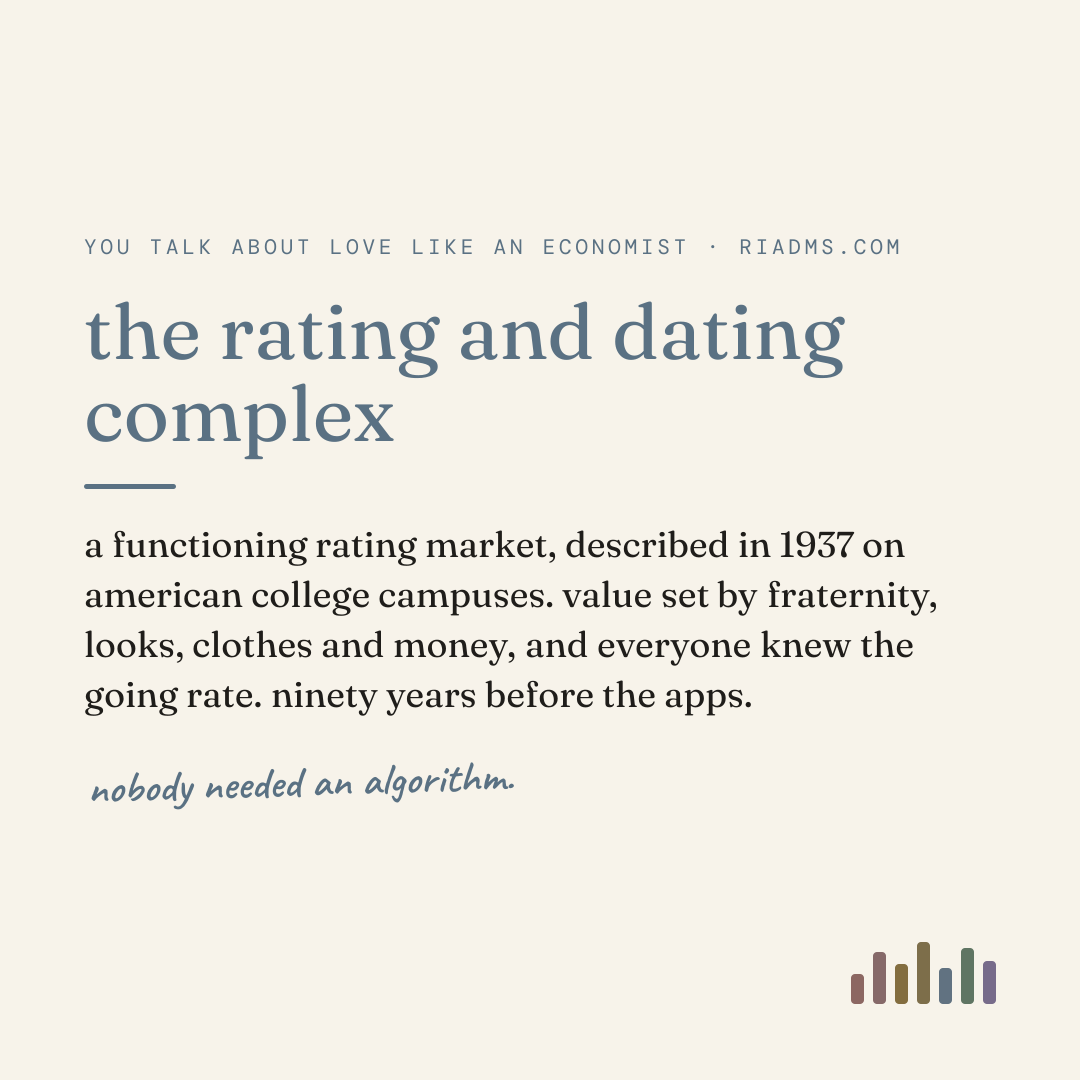
In 1937 a sociologist called Willard Waller published The Rating and Dating Complex in the American Sociological Review. He had been watching American college students, and what he described is not a metaphor for a market. It is a market, functioning, that the students themselves understood and took part in.
Your value was set by your fraternity, your looks, your clothes and how much you could spend. Everybody roughly knew where everybody sat. People dated at their own level or strategically one above it, and anyone involved could tell you the going rate and who was dating above theirs.
- No apps, no internet, no algorithm. Students running a rating market on each other with nothing but a campus.
I started this thinking I would be making a video about how technology made us superficial. It didn’t. Tinder did not arrive and ruin our dating lives. It found an algorithm that had been running for ninety years and built an infrastructure that profits from it.
So the question is not who did this. It’s why this way of talking keeps winning, and what it costs to keep it.
come think with me
one letter a week.
the word for one feeling you’ve had but couldn’t name, and why it works that way. the same thing you just read, in your inbox, once a week.
- one letter a week, about a ten minute read
- all nine printable workbooks, free
- the research, with its caveats kept in
- hit reply and it reaches me. i read every one
no pressure, no spam, no gatekeeping. unsubscribe anytime · riadumitrescu.substack.com
all of this is free and it stays free. if it gave you a word you didn’t have, you can buy me a coffee.
and the model is a serious one
In 1973 the Chicago economist Gary Becker published A Theory of Marriage in the Journal of Political Economy, and put the assumption in plain text:
since many men and women compete as they seek mates, a market in marriages can be presumed to exist. Each person tries to find the best mate, subject to the restrictions imposed by market conditions.
Presumed to exist is the phrase that stopped me. He isn’t being provocative. He is stating a modelling assumption and then doing the mathematics on it, and it worked well enough that he took the Nobel in 1992, partly for pushing economics into marriage, family, crime and discrimination, none of which anybody had thought of as economic.
I want to be fair to it, because the usual version of this argument treats economists as villains and they are not. Becker was doing what a model does.
the model fails the most basic question it has
Here is the part almost nobody says.
Becker’s framework makes a headline prediction. As women earn more, you should get complementary sorting: high-earning women pairing with lower-earning men who are better at the domestic side. That is comparative advantage, the same logic that governs trade.
It did not happen. People pair with people like themselves. Earnings sort positively, not complementarily, and the economist Pierre-André Chiappori is among those who have written about exactly this failure.
That doesn’t make the model useless. Models are allowed to be wrong in specific ways and still be worth having. It does mean that the model in your head, the one telling you what your options are and what you are worth, is a model rather than a description of reality. It is wrong in known places.
so what actually changed
If the market is from 1937 and the economics are from 1973, what is new?
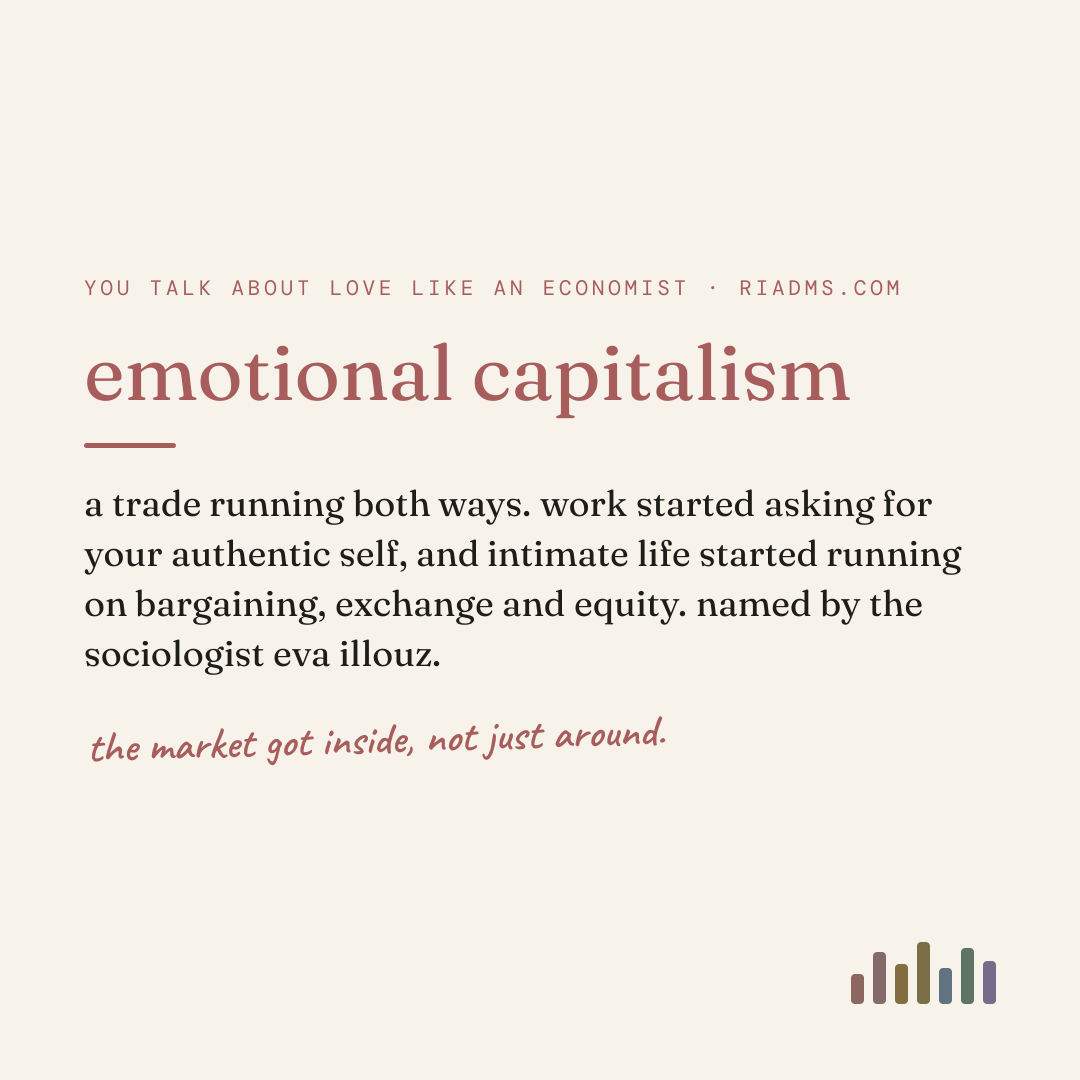
The person who has argued this hardest is the sociologist Eva Illouz, across three books: Cold Intimacies in 2007, Why Love Hurts in 2012, and The End of Love in 2019. Her term is emotional capitalism, and she defines it as a trade running both ways. Economic life became more emotional, all the workplace language about authenticity and bringing your whole self. And at the same time intimate life became more defined by bargaining, exchange and equity.
The first chapter of Why Love Hurts is called The Great Transformation of Love, or the Emergence of Marriage Markets, which tells you where she is going.
Her distinction is the useful one, and it is between two things people usually run together:
- the ecology of choice is the environment. How many people you can reach, how they are presented to you, what the norms are.
- the architecture of choice is the machinery inside you. How you evaluate, what you think you are entitled to, what counts as a good reason to leave.
The ecology obviously changed. Her argument is that the architecture changed, which is a much bigger claim. The market did not only surround you. It got into how you assess your own worth.
and something did not change at all
Marriage was always economic. Always.
Stephanie Coontz’s Marriage, a History lays it out: for most of human history marriage was about property, alliances, labour and lineage, and what the two individuals wanted came a distant second. The love match is recent.
So economics did not enter marriage. It was there from the beginning.
What changed is where it sits. It used to be external: an arrangement everybody could see and name, and your great-grandmother could have told you exactly what her marriage was for. She would not have said her husband wasn’t bringing value to the table, because that feeling was not hers to have. It was out there, in the arrangement.
Now it is a private vocabulary inside your own chest, and you cannot see it, because it feels like your own judgement.
then the apps arrived and built on it
They did not invent any of this. They accentuated it, and the research on that part is not soft.
Eli Finkel and colleagues published a major review in 2012 in Psychological Science in the Public Interest, and their language is blunt: browsing profiles can cause users to objectify their future partners, commoditising them as options available in a marketplace of people.
There is also a 2010 study with the best title in the field. Relationshopping, by Heino, Ellison and Gibbs, in the Journal of Social and Personal Relationships. Thirty-four in-depth interviews with people using a large dating site, and the finding is that the marketplace metaphor was not imposed on them by the researchers. It was already how the participants thought.
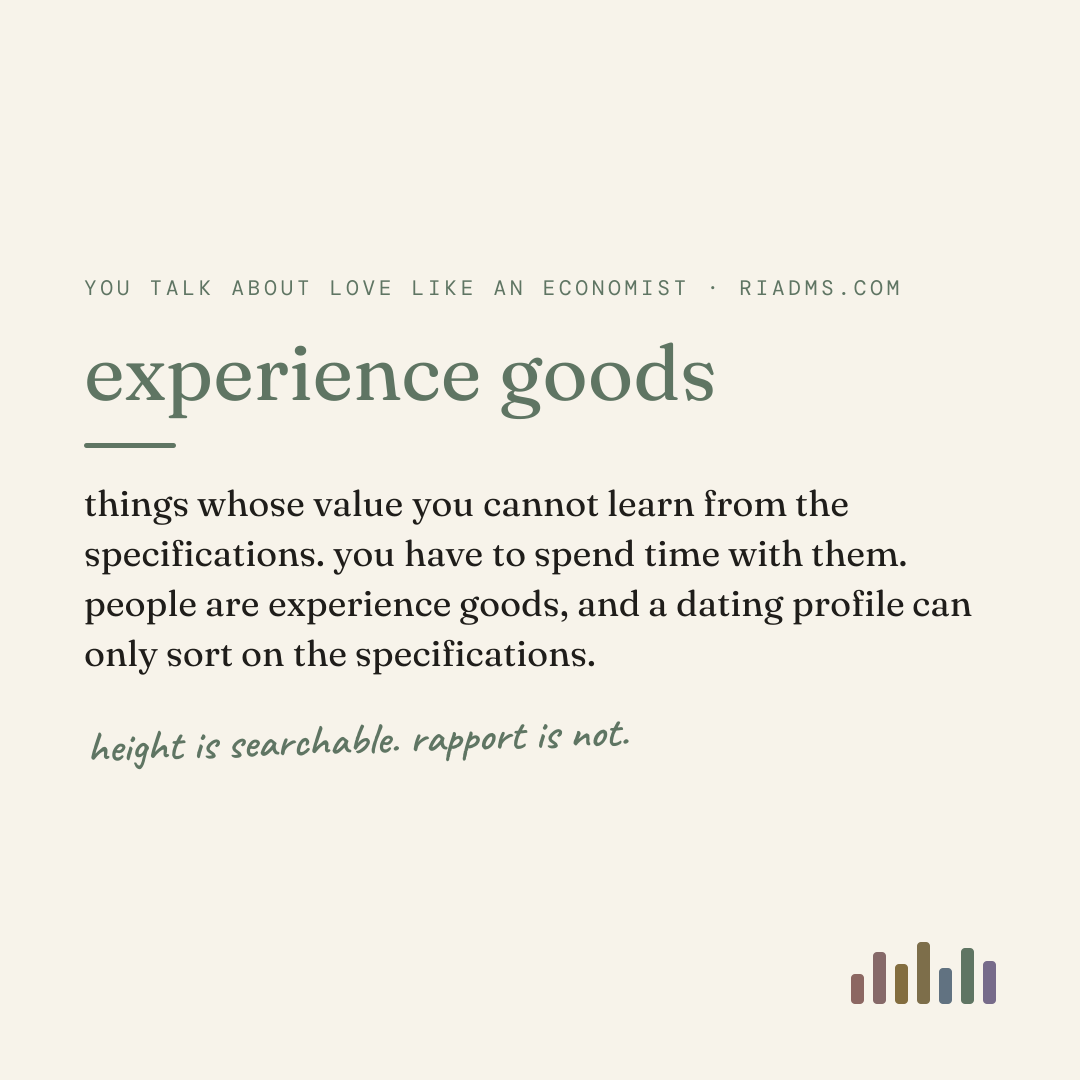
And then the one I have not been able to stop thinking about. Frost, Chance, Norton and Ariely, People Are Experience Goods, 2008. An experience good is something whose value you cannot learn from the specifications. You have to spend time with it. People are experience goods. Dating sites can only sort on searchable attributes: height, job, age, interests. So the tool is structurally incapable of sorting on the thing that tells you anything.
And there is a cost to browsing itself. In 2020 Pronk and Denissen published A Rejection Mind-Set in Social Psychological and Personality Science. Across three studies, the chance that somebody would accept a partner fell as they worked through the options, by an average of 27 per cent from the first to the last. Not because the later ones were worse. And for women it also reduced the likelihood of getting a match at all.
Bigger sets do not make you happier with the process. They make your choice drift away from what you said you wanted.
does the vocabulary actually do anything
Here I want to be straight with you, because the claim I would like to make is that the words change how you can feel, and the evidence for that is not all equally good.
There was a whole literature called money priming, where showing people images of money made them more selfish and more independent. It failed to replicate. So I am not going to use it, and I am telling you it exists rather than leaving it out.
What I can stand on is framing. Tversky and Kahneman showed that describing the same outcomes as lives saved rather than lives lost flips people’s choices, and that one holds. So it is established that changing the words changes the decision.
Psychology also separates a communal orientation from an exchange orientation. Communal means you respond to the other person’s needs because they are your person. Exchange means you are tracking benefits and costs, continuously. People in communal relationships are more satisfied.
none of this means the economics are wrong
I am not telling you that thinking about love in economic terms is bad. Some of it is very good. Caryl Rusbult’s investment model predicts commitment out of three things, satisfaction, the quality of your alternatives, and how much you have put in, and it works.
The problem is not the model. It is the person reading it.
A model is written in the third person, about populations, in aggregate. Something is lost when you take it into the first person and run it on the human being next to you. Something is lost when you are lying in bed beside somebody and thinking about your alternatives.
You are allowed to know the market exists. You do not have to be the one holding the spreadsheet.
keep reading
If you want one thing, make it Illouz’s Why Love Hurts. The distinction between the ecology and the architecture is the whole argument, and it belongs to her.
If you want one paper, the rejection mindset is short, and of all of these it is the one most likely to change what you do this week.
And if this was about one specific person rather than about the system, are you in love or just comfortable is the same question asked from the inside.