You can’t stop looking at them.
You notice how they stand. What they’re wearing. How their hair sits. How they take up space in a room. It has nothing to do with sex, and calling it a crush feels slightly off, and you don’t have another word.
There are two completely different things it might be, and from the inside they feel identical. That’s the problem. One is aesthetic attraction. The other is gender envy. And when you’re fifteen in a school corridor feeling something about somebody, nothing in your body tells them apart.
I’ve mixed them up. This page is the separation I wish I’d had.
the two feelings, defined apart
Aesthetic attraction is a pull towards how somebody looks with nothing attached to it. You find them beautiful the way a building is beautiful. You don’t want to possess it. You want to look. The looking is the desire. It doesn’t lead anywhere, and it isn’t supposed to.
Almost nobody has this word, because it isn’t common sense that you can want to look at a person without wanting a relationship with them. It sits in the split attraction model alongside the other six, and it’s the one people most often find out they’ve been misfiling for a decade.
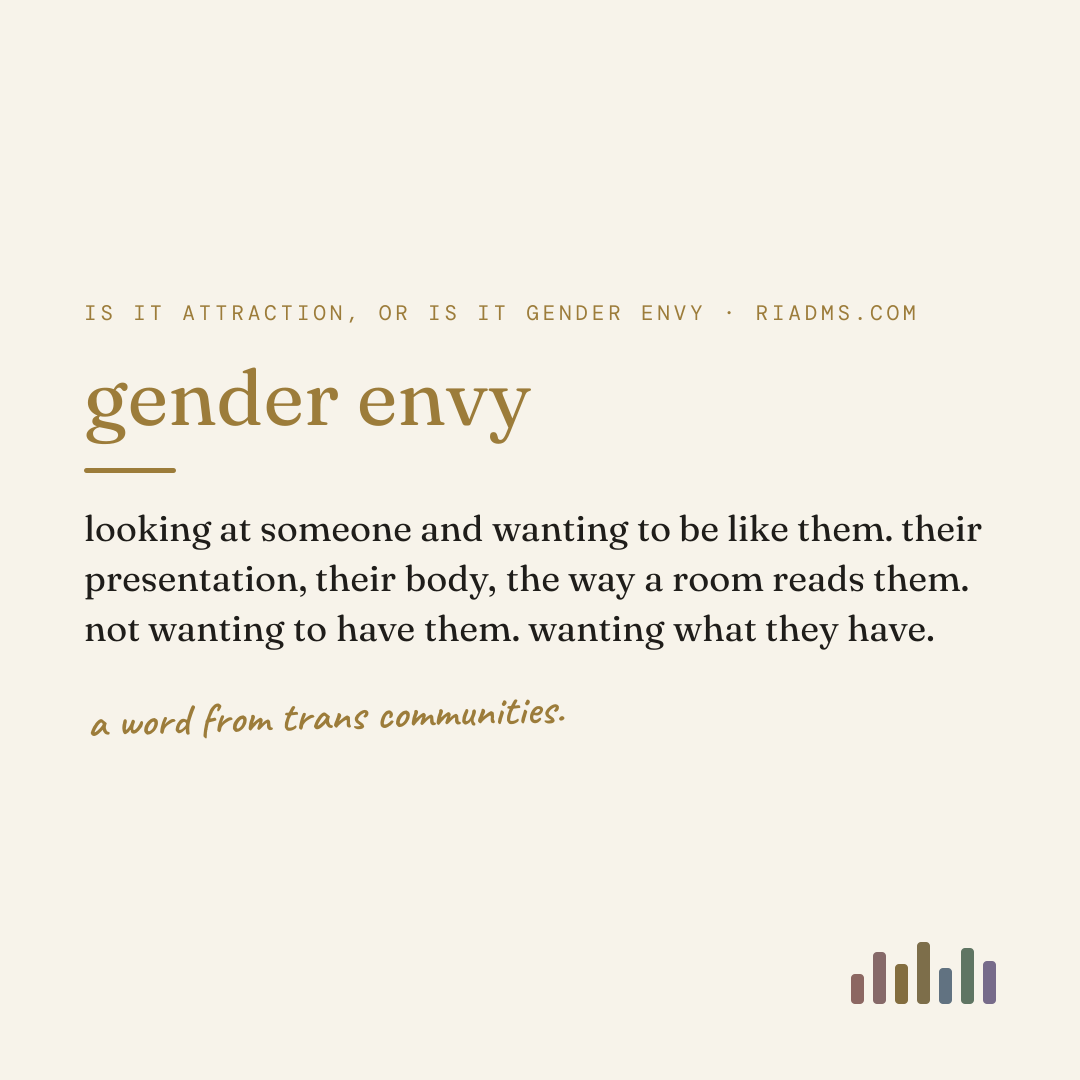
Gender envy is a term that comes out of trans and non-binary communities, not out of a lab. It’s looking at somebody and wanting to be like them. Their presentation. Their body. The way they move through a room and the way the room reads them. Not wanting to have them. Wanting what they have.
Read those two definitions next to each other and you can see exactly where the confusion lives. The symptom is the same. You want to keep looking. The cause is not the same at all.
come think with me
one letter a week.
the word for one feeling you’ve had but couldn’t name, and why it works that way. the same thing you just read, in your inbox, once a week.
- one letter a week, about a ten minute read
- all nine printable workbooks, free
- the research, with its caveats kept in
- hit reply and it reaches me. i read every one
no pressure, no spam, no gatekeeping. unsubscribe anytime · riadumitrescu.substack.com
all of this is free and it stays free. if it gave you a word you didn’t have, you can buy me a coffee.
why these two specifically, and not the others
Every other kind of attraction arrives with a built-in tell.
Sexual attraction has a physical signature. Romantic attraction shows up as wanting a future, wanting to be picked. Intellectual attraction points at how somebody is thinking and wants your minds connected. Each of those hands you a next step, and the next step is how you know which one you’re in.
Aesthetic attraction and gender envy are the two that are purely visual. Neither one has an obvious next move. Both of them just want to sit there and look at how a person is put together.
So if you don’t have the words, you land on one of two wrong conclusions. Either I must have a crush on them, and I’m confused about why I don’t want to kiss them. Or I’m jealous of this person, so I’m a horrible person.
Both of those are worse than the real answer.
the test: do I want to have, or do I want to be
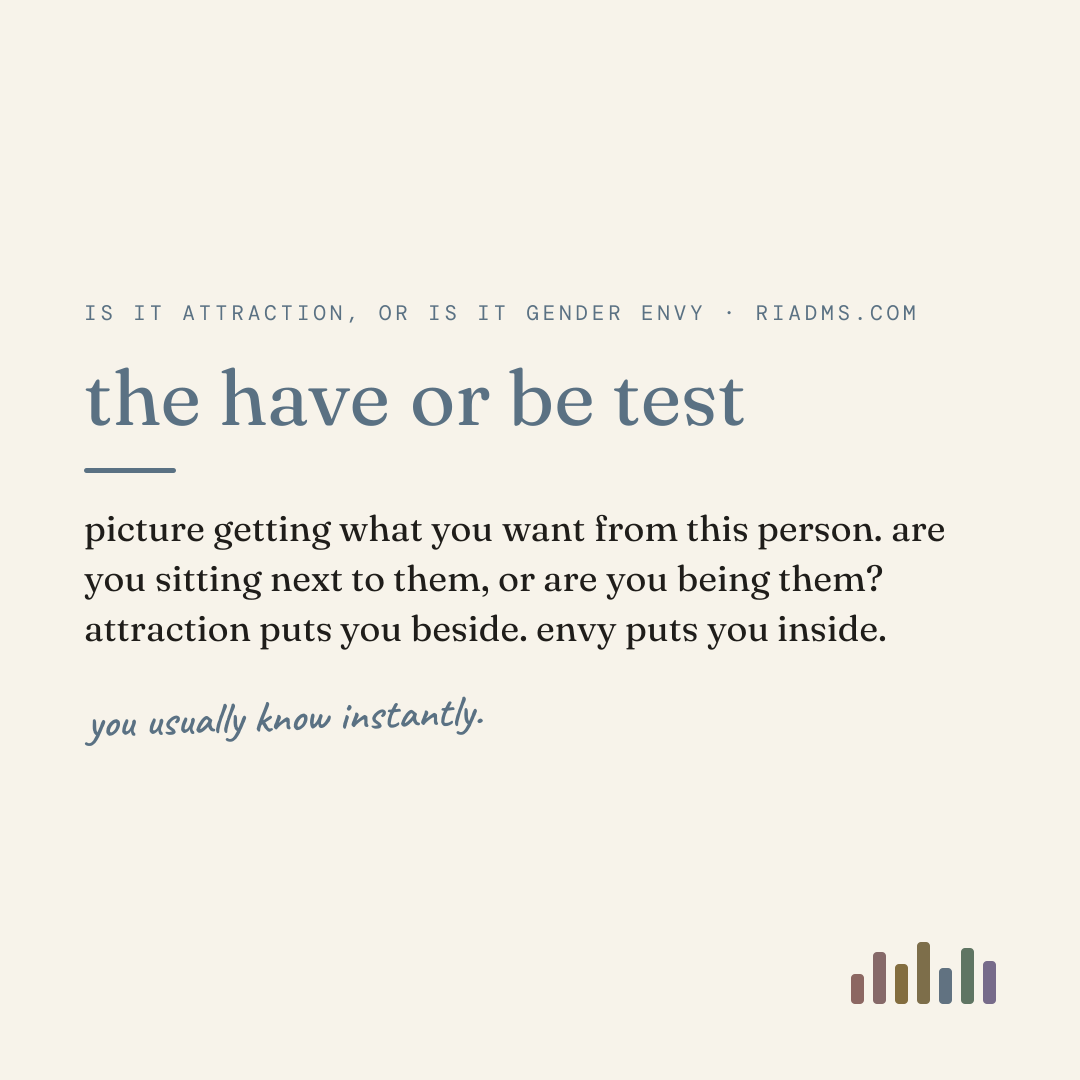
Ask it as a scene first, and make the scene ordinary rather than idealised. Picture actually getting what you want from this person. Not the fantasy version. The real daydream.
Are you sitting next to them in that picture, or are you being them?
Aesthetic attraction puts you beside the person. Envy puts you inside.
If the scene is blurry, ask it as a swap instead, which is faster and harder to talk yourself out of. You can have one of two things. An evening with this person. Or you wake up tomorrow and for one day you are them.
Which one do you take?
Most people know instantly. That instant is the answer, and it’s the single best tell I’ve found.
and then there’s the aftertaste
There’s a second test and it runs on how you feel about ten minutes later.
Aesthetic attraction feels pleasant. You looked at somebody beautiful and it was good. Envy has a sting in it. Something in there hurts a bit, and usually there’s a layer on top of the hurt where you feel you shouldn’t be having the feeling.
That sting is worth understanding rather than just tolerating, because it isn’t one thing. Psychologists separate envy into two kinds, and they behave completely differently. Niels van de Ven, Marcel Zeelenberg and Rik Pieters showed this in Leveling up and down, published in Emotion in 2009. They ran it in Dutch, which is useful, because Dutch has two separate words where English has one.
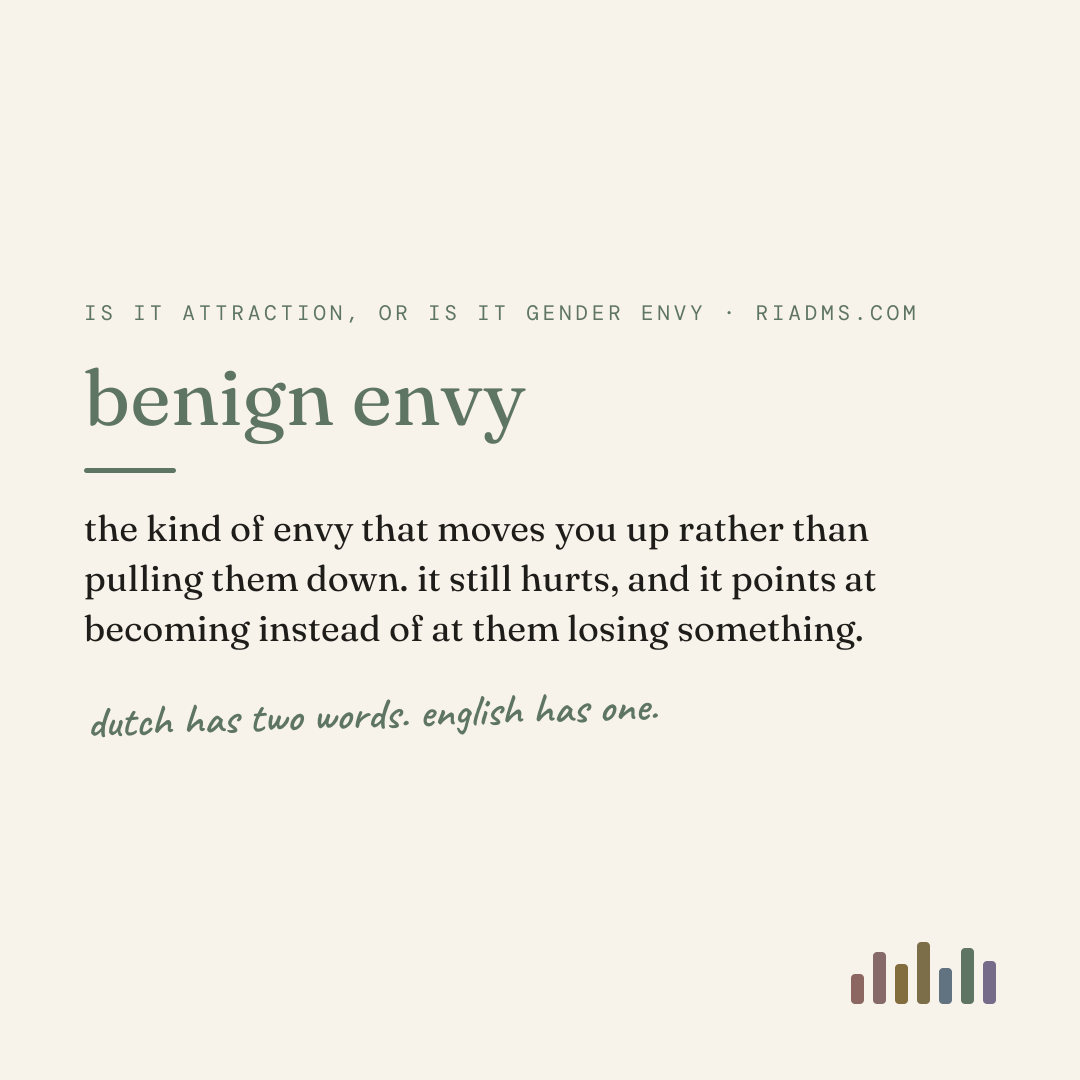
Benign envy moves you up. It’s painful and it points at becoming. Malicious envy pulls the other person down. It’s painful and it points at their losing something.
They went further in Why Envy Outperforms Admiration in 2011: benign envy actually improved people’s performance, and admiration, the clean feeling you’re supposed to want instead, did not.
Gender envy is almost always the benign one. It hurts and it points at becoming. Which means the guilt most people carry about it is attached to the wrong emotion.
where the underlying science is, honestly
I want to be straight about what is and isn’t measured here, because this is a place where confident writing would be easy and wrong.
Gender envy as a term is community vocabulary. It came from trans and non-binary people describing their own experience, the same way the split attraction model did, and the same way most of the useful words on this site did. That’s a good origin, not a weak one. It just means you won’t find a 1974 paper defining it.
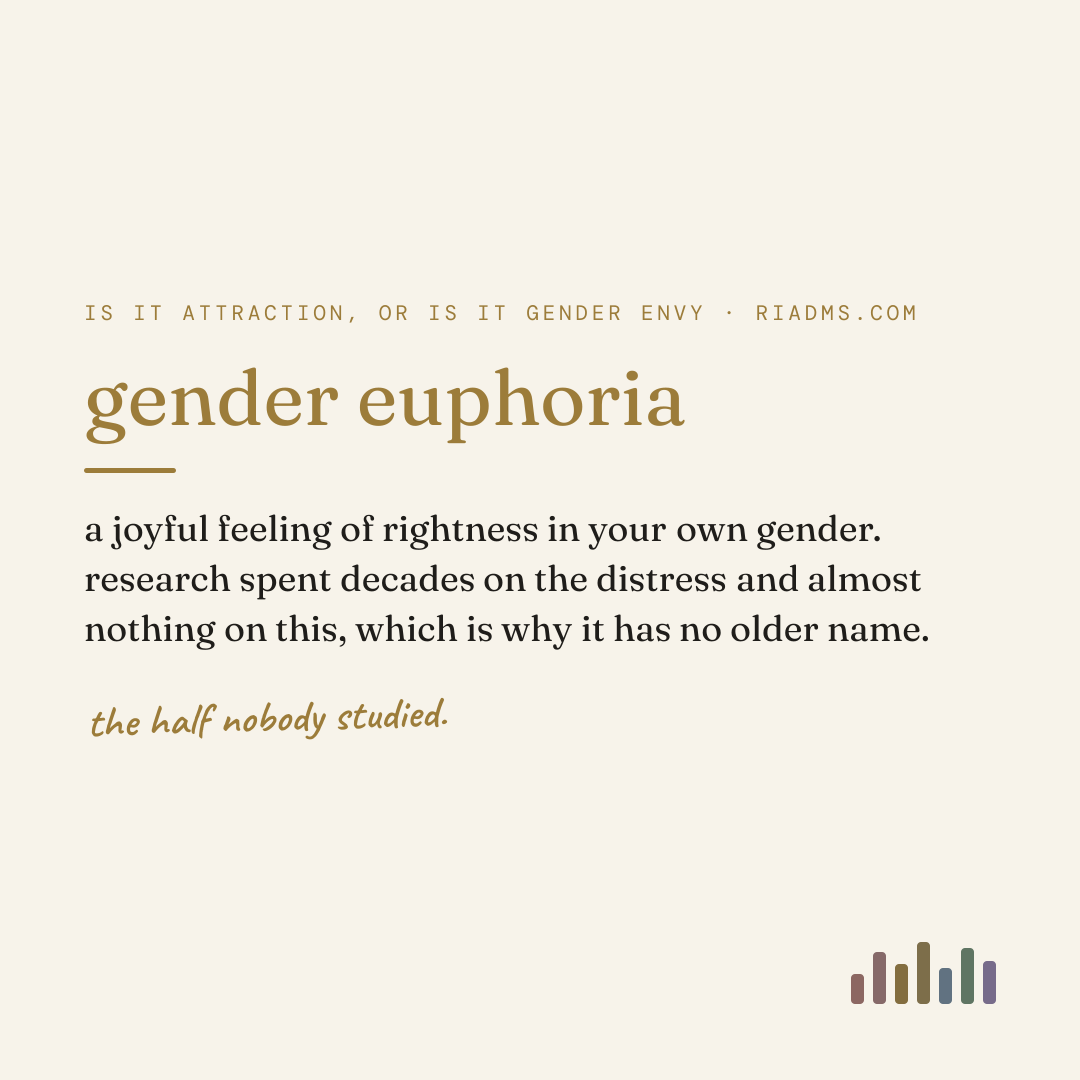
What research does exist is next door, on gender euphoria, and it’s recent. Beischel, Gauvin and van Anders published “A little shiny gender breakthrough” in the International Journal of Transgender Health in 2022, and their definition is a joyful feeling of rightness in one’s gender. The psychology and clinical literature had spent decades on dysphoria, the distress, and close to nothing on the positive side, which is a real gap and they say so.
The reason that’s relevant to this page: gender envy is often euphoria pointed at somebody else. You’re seeing the rightness on another person and recognising it.
And the older piece underneath both is comparison itself. Leon Festinger’s A Theory of Social Comparison Processes, from 1954, established that people work out who they are by measuring against other people, particularly when there’s no objective measure available. There is no objective measure of whether your gender fits you. So of course the reading happens against a person.
it can be both, and it can change
Neither answer is a verdict.
You can find somebody beautiful and want to be like them at the same time, and that’s not you failing the test. It’s the ordinary case. Feelings towards people are hardly ever clean, and the ones about your own body are the least clean of all.
It also moves. You can name it one thing at nineteen and understand it as the other at twenty-nine, and the twenty-nine answer isn’t a correction of a mistake. It’s what you have now, with the information you have now.
And the one I most want you to hear: finding gender envy in yourself does not mean you’re trans. Cis people have gender envy. You are allowed to notice a feeling, accept it, put a name on it, and then carry on with your life exactly as it was, changing nothing at all.
Feelings don’t have to mean much. When we attach an enormous meaning to a feeling, that’s usually the brain protecting us from something else.
keep reading
If you read one thing, make it the gender euphoria paper. It’s the positive half of a literature that spent forty years on the painful half, and it’s built out of what people said about themselves.
If the sting is the part you keep getting stuck on, Leveling up and down is the one that tells you which kind of envy you’re holding, and the answer is probably kinder than you think.
And if the swap question put you firmly beside the person rather than inside them, what you’ve got is aesthetic attraction, which has its own page and a long history of being mistaken for a crush.


