It’s probably not your face. It’s almost certainly not your worth. I know that’s the story the quiet hours tell you, that there’s some flaw everyone else can see and you can’t, but the actual reasons you’re single are far less personal and far more fixable than that. Most of them aren’t even about you. They’re about the shape of modern dating, and a few tricks your brain plays inside it.
So let me hand you the real reasons, the ones with research under them, instead of the one your anxiety made up.
you never stop browsing
Here’s the first one, and it’s the one nobody wants to hear. The apps didn’t just give you more options. They changed what your brain does with a person in front of it.
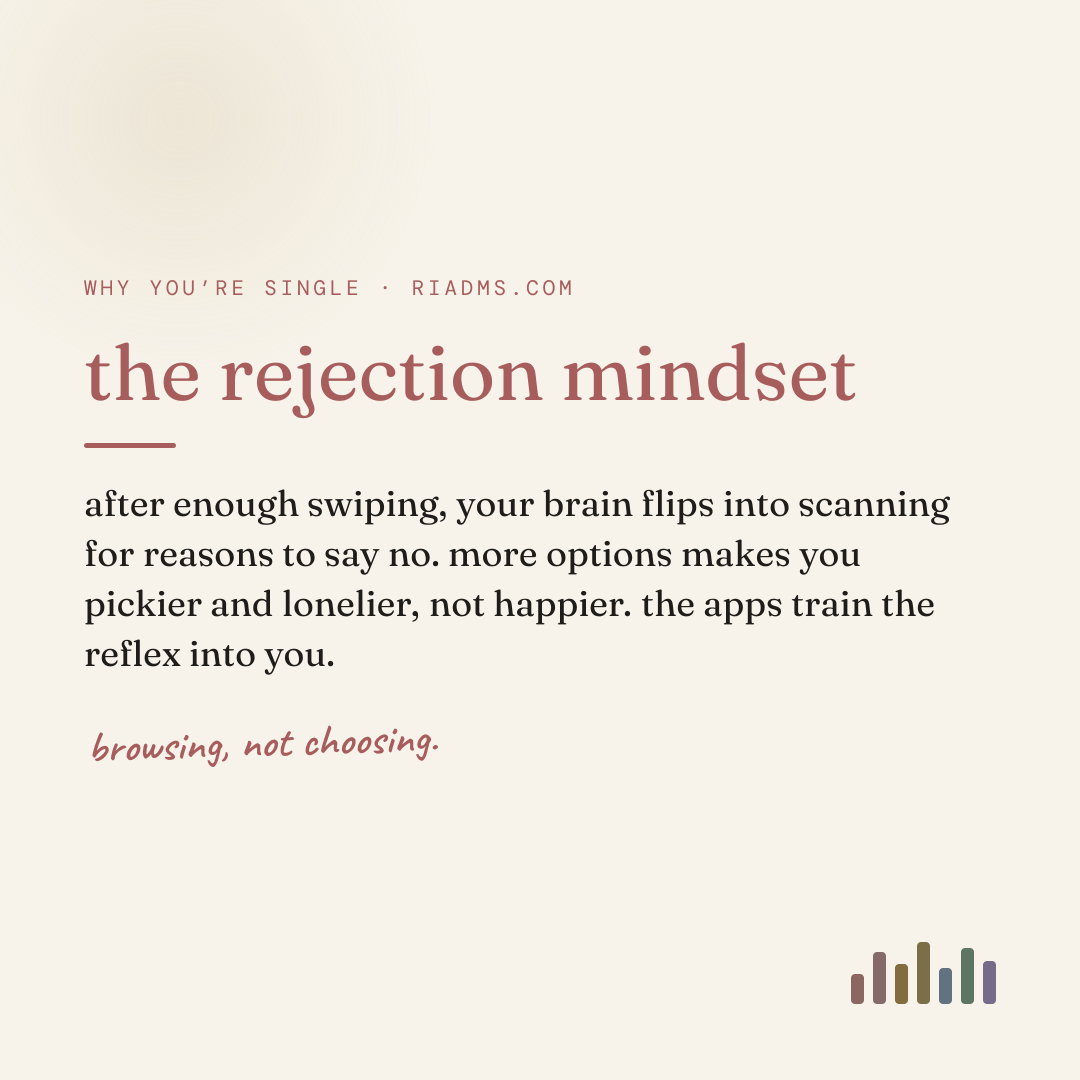
There’s a study on this, and it’s brutal. Researchers watched people swipe through online daters and found that the longer they browsed, the more they rejected. Not because the profiles got worse. Because the browsing itself trains a reflex. Your acceptance rate dropped about a quarter from the first person you saw to the last, purely from the act of scrolling. You get into a rejecting frame of mind and you can’t get out of it, and every new face pays for the abundance of the ones before.
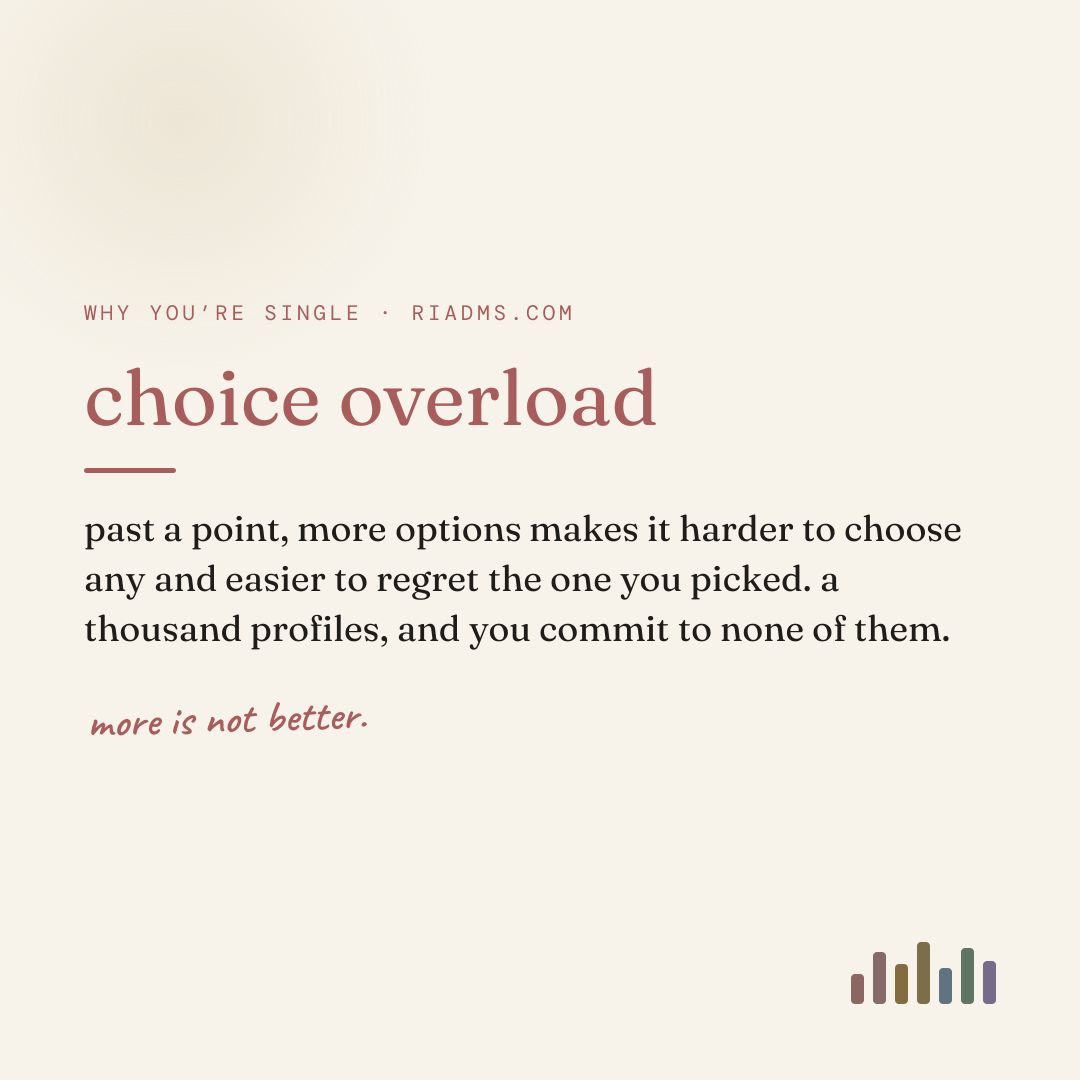
This is the older, deeper problem underneath the apps, and its most famous demonstration involved jam. When shoppers were shown six jams, many bought one. Shown twenty-four, almost nobody did. More options made people less able to choose and less happy with whatever they picked. That specific study has replicated unevenly over the years, so hold it loosely, but the pattern holds up across dating research. When you have infinite people, you invest in none of them, and you start reading everyone off tiny surface cues, height, one bad photo, a single line in a bio, because that’s all your brain has bandwidth for when the queue never ends. The person who would have been right for you got swiped past in a fraction of a second, over a detail that had nothing to do with whether you’d have loved them.
You’re not too picky. You’re stuck in the browsing phase, treating people like a feed instead of a choice.
come think with me
one letter a week.
the word for one feeling you’ve had but couldn’t name, and why it works that way. the same thing you just read, in your inbox, once a week.
- one letter a week, about a ten minute read
- all nine printable workbooks, free
- the research, with its caveats kept in
- hit reply and it reaches me. i read every one
no pressure, no spam, no gatekeeping. unsubscribe anytime · riadumitrescu.substack.com
all of this is free and it stays free. if it gave you a word you didn’t have, you can buy me a coffee.
you’re chasing the ache, not the person
The second reason is more private, and you probably already suspect it about yourself.
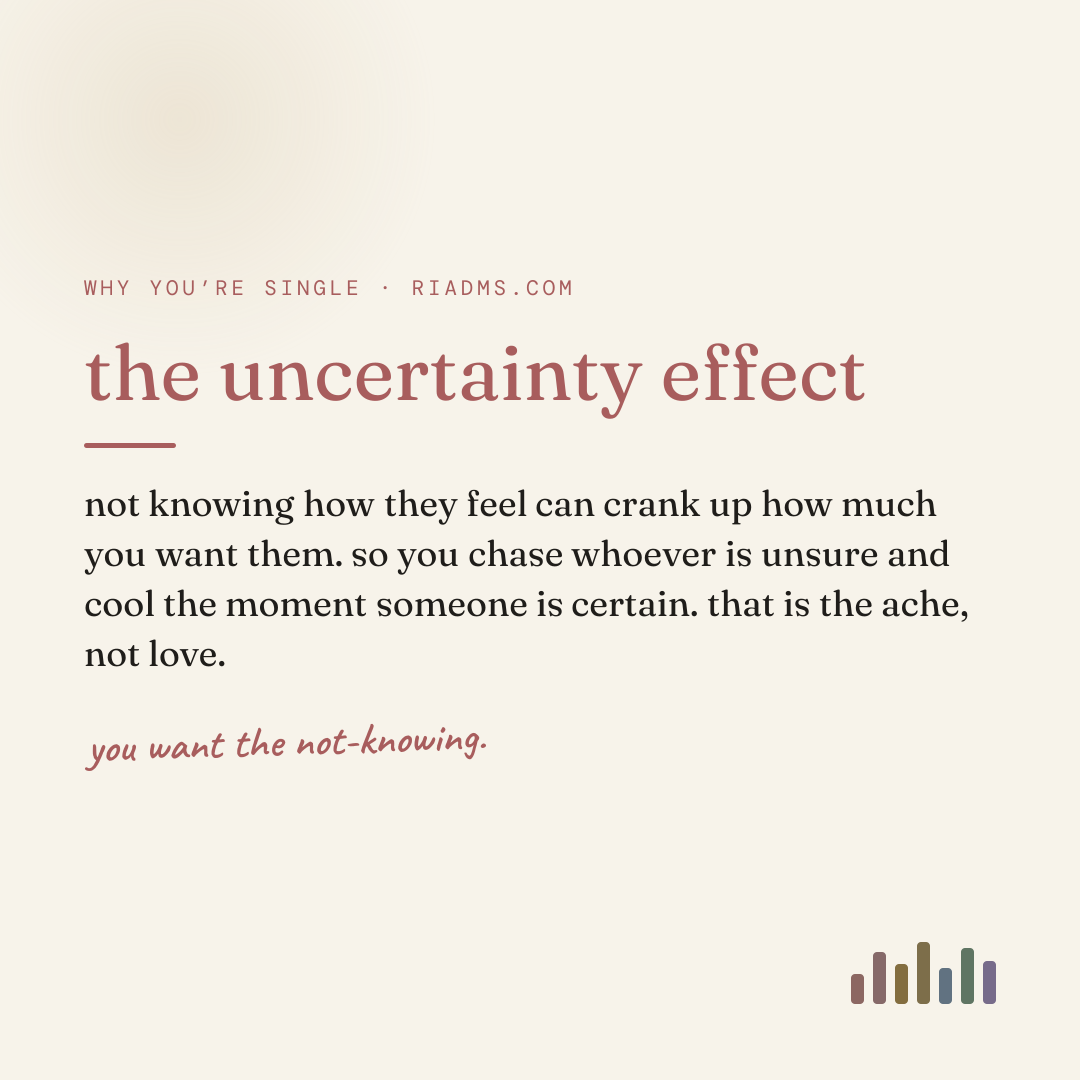
You get most interested in people right at the edge of maybe. The ones who take a while to text back. The ones you can’t quite read. And the moment someone is sure about you, fully, no chase left, something goes quietly flat. If that’s familiar, it isn’t a coincidence and it isn’t your taste. In one study, people were most attracted to those whose feelings were uncertain, more even than to people who clearly liked them a lot. The not-knowing was the pull. (That one was tested on women rating men, so don’t stretch it too far, but the shape of it shows up everywhere.)
The problem is that this feeling has a name, and it isn’t love. When the wanting needs uncertainty to survive, it’s conceptlimerenceAn involuntary, obsessive state that feels like love: intrusive thoughts, a hunger for reciprocation, and a charge that gets stronger with uncertainty and weaker with security.what is limerence? →Tennov, Love and Limerence ↗, and you can spend years chasing the ache and calling it your great love story, when what you were actually in love with was the suspense. It burns out the second there’s nothing left to win. If you keep ending up single after a string of intense almosts that never became anything, this is worth sitting with. There’s a whole chapter on the tell: is it love, or limerence? The available people didn’t bore you. Your wiring did.
you’re asking one person to be everything
The third reason isn’t about who you’re rejecting. It’s about the size of the job you’re hiring for.
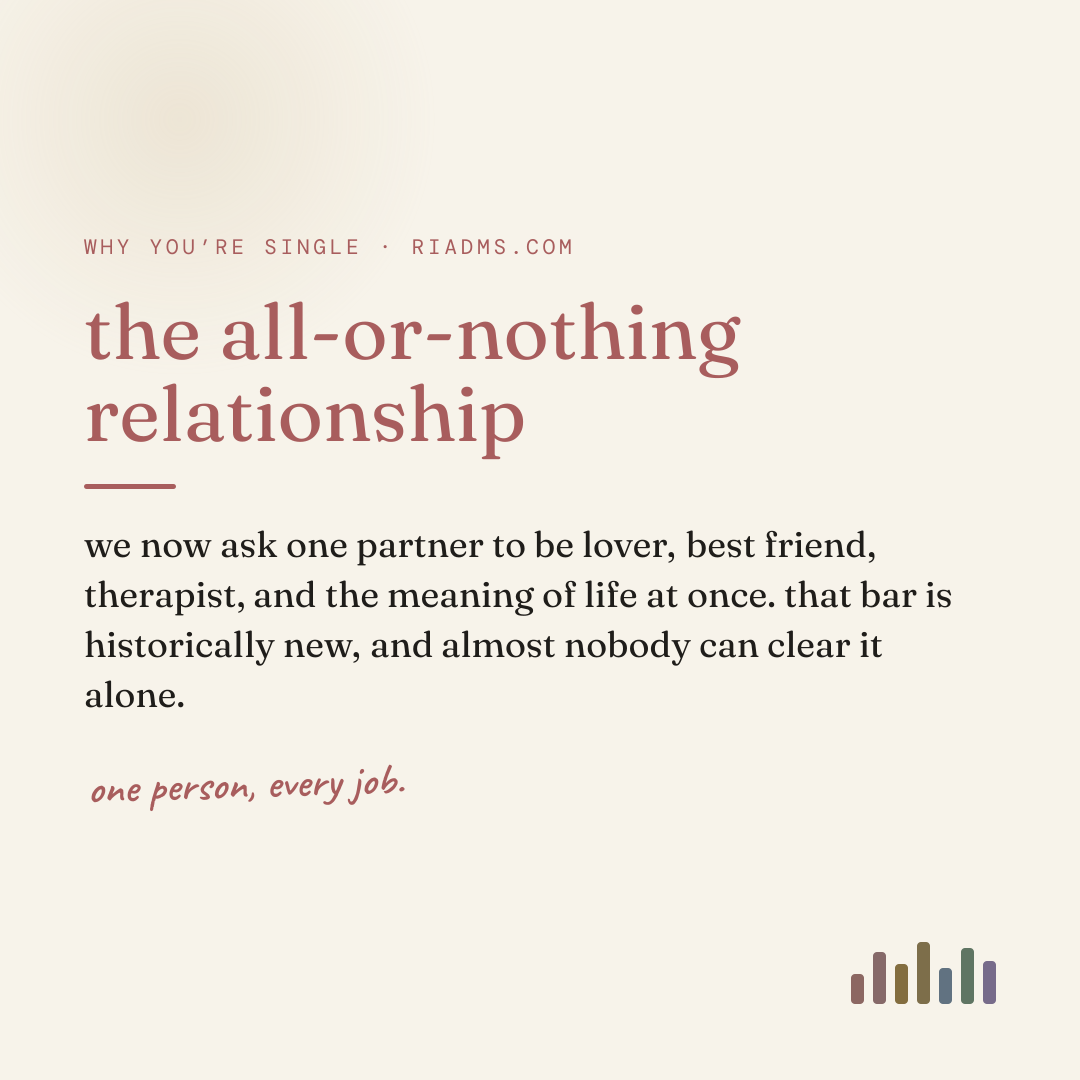
Two hundred years ago, you married for land and labour and survival, and you got your emotional needs met by a whole village. Now you’re supposed to find one person who is your best friend, your therapist, your co-parent, your intellectual match, your source of passion, your safe home, and the meaning of your life. Psychologists literally call this the suffocation model: the bar for a single partner has climbed to the top of the pyramid of human needs, at the exact moment we invest less time in our relationships than couples used to. We’re asking for more from one person than almost anyone can give, and then reading the shortfall as this one’s not it, and swiping back into the queue.
Some of what you’re missing from a hypothetical partner is stuff a good friend, a sibling, a community was always supposed to carry. When one person has to be your everything, everyone real fails the audition, because the role is impossible. This is the whole case for spreading your needs back out across more than one relationship, and it’s in the friendship chapters if you want it.
you can’t scroll your way to it
And here’s the structural one, the reason that isn’t about your psychology at all.
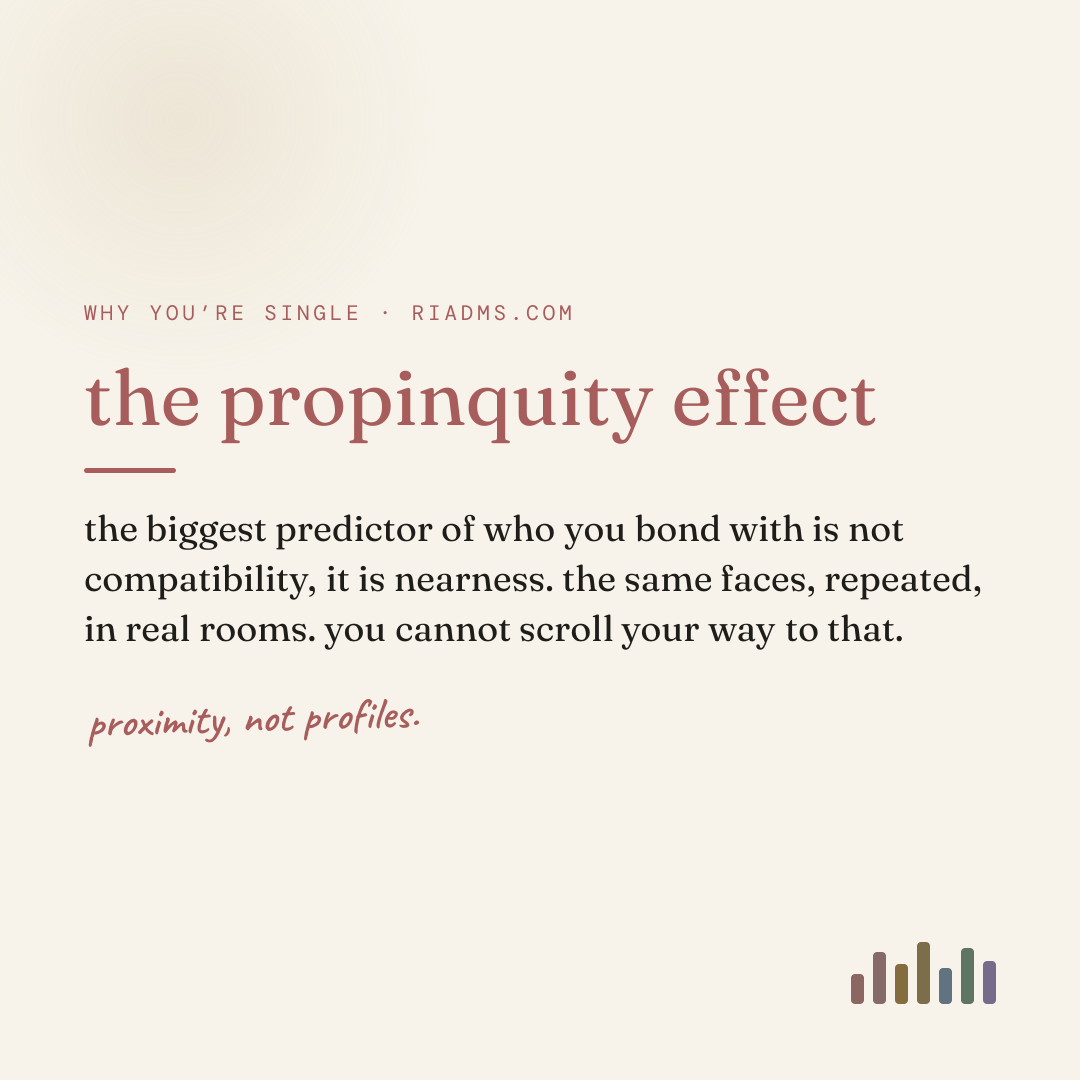
The single biggest predictor of who you end up bonding with is not compatibility. It’s proximity. When researchers mapped the friendships in a housing complex in 1950, the thing that predicted who became close wasn’t shared values or personality. It was how near their front doors were. One door apart, and you were far likelier to bond than four doors apart. Your brain builds warmth out of cognitive biasmere-exposure effectWe come to prefer things simply because we’re exposed to them repeatedly. A lot of “chemistry” is really just proximity and familiarity.what is the mere-exposure effect? →Zajonc, 1968 ↗, the same faces, over and over, in real rooms. And closeness itself gets built through slow, escalating, back-and-forth self-disclosure, the kind that needs time and presence and a hundred small unremarkable moments.
Scrolling gives you none of that. It gives you a thousand strangers you’ll never be near twice. You cannot swipe your way into proximity, and proximity is most of the machine. If your whole dating life happens on a screen, you’ve cut out the exact ingredient that actually makes people fall for each other. The fix isn’t a better opening line. It’s being repeatedly, physically around the same people. A class. A team. A bar you go back to. The same five faces, on purpose.
and maybe it isn’t a problem
I want to say this plainly, because the whole culture is screaming the opposite at you. Single is not a diagnosis. The research on this is clear and it keeps getting buried: single people are, on average, just as happy, healthy, and connected as married ones. Choosing to be single, or just being fine while you are, is not a failure state you’re waiting to exit. It’s a real answer.
Which matters here, because the browsing and the chasing and the impossible bar all get worse when you’re single at a relationship instead of just living your life. The people who date well tend to be the ones who don’t need it to happen. Desperation reads. Ease reads too.
what I notice, as an ace person
I date from a slightly odd angle, because I don’t feel sexual attraction, so I was never able to run on the spark most people use to start things. I couldn’t scroll and wait for a face to hit me a certain way, because no face does that for me. Which meant I had to do it the slow, structural way from the beginning. Get near people. See the same ones repeatedly. Build the thing out of hours and disclosure instead of a lightning bolt. My relationship started as a friendship, over a lot of ordinary proximity, and honestly I think that’s not a workaround. I think that’s just how it actually works for everyone, and the spark was always the least reliable part.
keep reading
If you take one book from this, make it The Paradox of Choice, which explains the browsing trap better than anything, or Eli Finkel’s The All-or-Nothing Marriage for the one-person-as-everything problem. And the two chapters closest to this one are limerence, for the ache you keep chasing, and why you like who you like, for the patterns underneath your type.
So, gently: you are not single because something is wrong with you. You’re single because you’re browsing a feed that trains you to reject, chasing an uncertainty you’ve mislabeled as love, holding out for one person to be an entire village, and doing all of it on a screen that can’t give you the proximity the whole thing runs on. Every one of those is a habit, not a verdict. And the day you stop treating people like a queue to reject and start treating them like someone to actually be near, the math changes. It was never your face.

