At some point you set a deadline for your own life, and you do not remember agreeing to it.
By twenty five. By thirty. By the age your mother was when she had you. There is a number in there somewhere, you did not sit down and choose it, and you have been measuring yourself against it for years like it is a real appointment somebody booked.
I want to take it apart properly, because there is a whole research literature sitting underneath this feeling, and the interesting part is that most of what it found is not what people say it found.
ask what it is for and the answer goes vague
Try the question on yourself. What exactly is supposed to have happened by the number? Hold it for a second before you answer.
Sorted. Settled. Not still figuring it out.
None of those are events. You cannot put “sorted” in a calendar. Which makes this a strange kind of deadline: it has a date and no deliverable, and nowhere else in your life would you accept that from anybody.
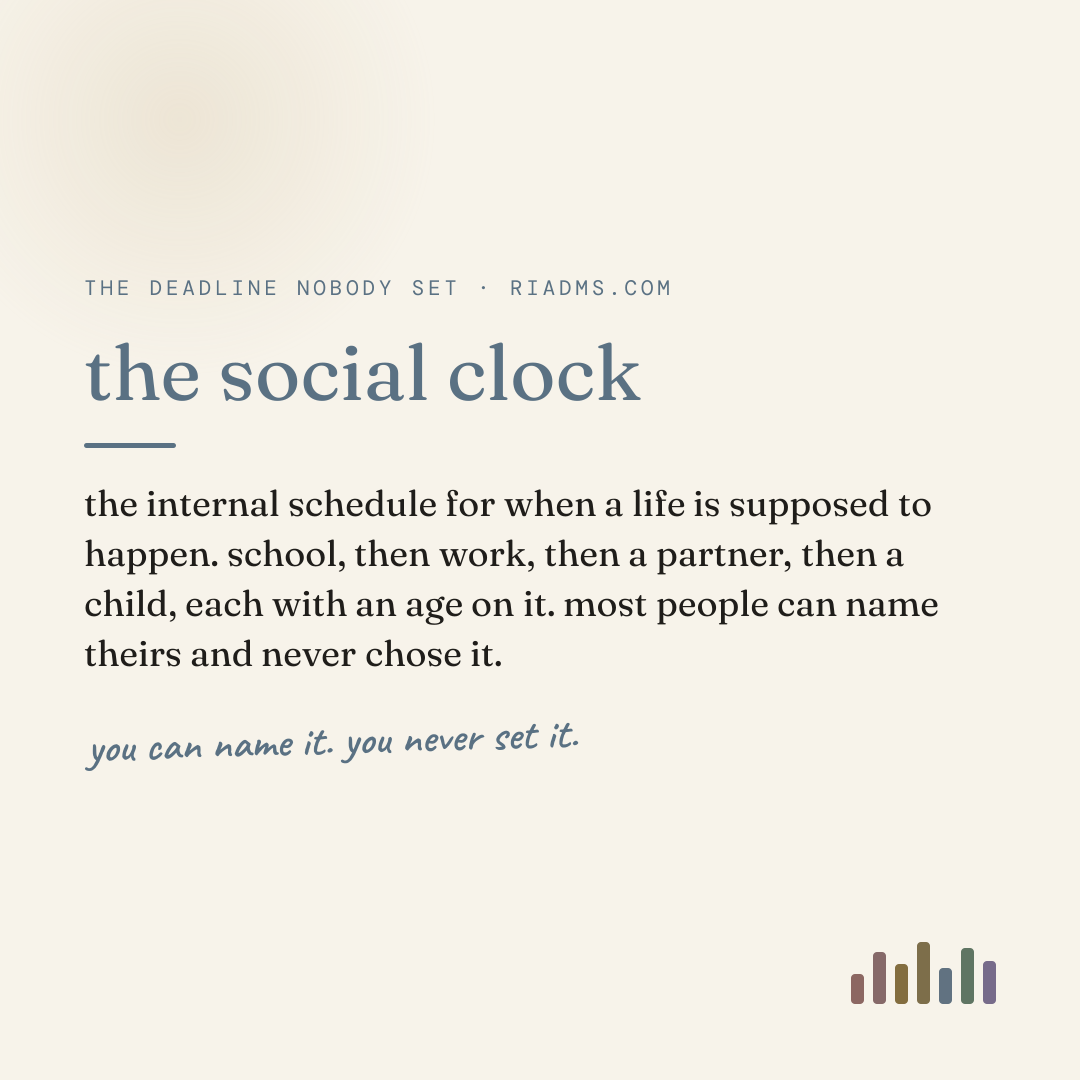
The schedule the number came off does have a name. In 1965, Bernice Neugarten, Joan Moore and John Lowe asked people about the right age for things, and got near-total agreement, delivered fast. Everyone knew the right age to marry, and the right age to be settled into a career. Nobody had been taught it. Everybody had it.
That is the study people cite, and where the citing usually stops. So it is worth knowing what Neugarten herself said fourteen years later. In 1979 she argued that a stage theory of adult life “seems oversimplified”, that the timing of life events was becoming less regular, and that age was losing its customary social meanings. The person who found the clock spent the back half of her career arguing it was coming loose.
come think with me
one letter a week.
the word for one feeling you’ve had but couldn’t name, and why it works that way. the same thing you just read, in your inbox, once a week.
- one letter a week, about a ten minute read
- all nine printable workbooks, free
- the research, with its caveats kept in
- hit reply and it reaches me. i read every one
no pressure, no spam, no gatekeeping. unsubscribe anytime · riadumitrescu.substack.com
all of this is free and it stays free. if it gave you a word you didn’t have, you can buy me a coffee.
name the specifics and half of them are not yours
The vagueness is doing work. As long as the deadline stays a mood, you cannot audit it. So name the specifics. Write down the actual things, the job, the flat, the person, the child, whatever is on your particular list, with the age attached to each one.
Then look at where each age came from, because a lot of them will turn out to be borrowed.
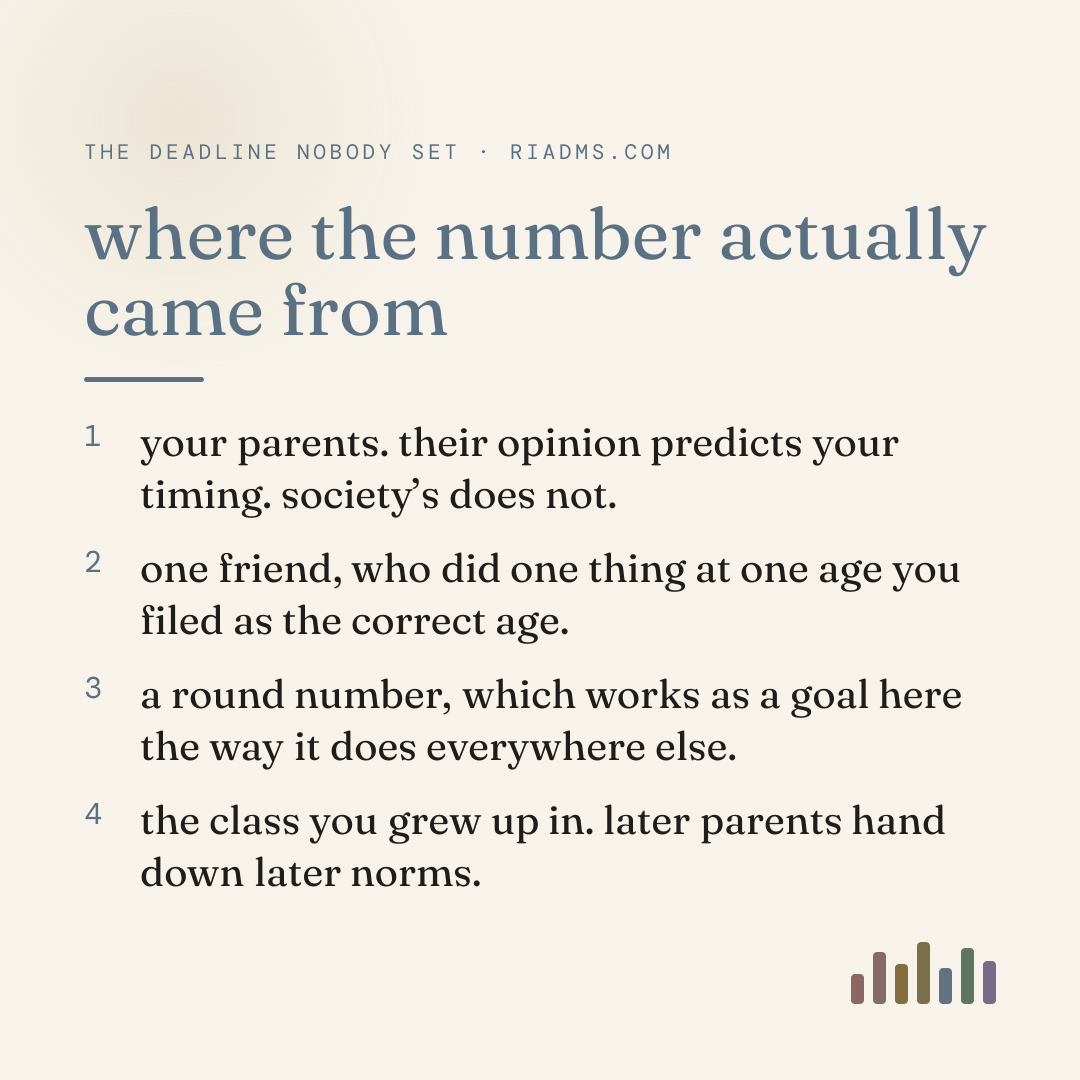
Some are your parents’ timeline, adjusted slightly for inflation. That is not a figure of speech, it is close to the hardest result this field has. When Billari and Liefbroer looked at what predicted the age young adults left home, the answer was what those young adults believed their parents thought. Societal norms did not predict it. Friends’ norms did not predict it. The generic “everyone expects you to have it together by thirty” turns out to be far weaker than one specific opinion you think two specific people hold. And it runs back further than that, because parents’ socioeconomic background predicts later age norms and later childbearing even once you control for the person’s own. There is no single clock. There are inherited ones.
Others came off a friend. One person did one thing at one age and you filed it as the correct age for that thing, which is social comparison doing exactly what it does. The sixty-year meta-analysis on this found two things worth sitting with. We reliably compare upward, toward people doing better, even when we are already feeling bad. And the dominant response to comparing upward is contrast rather than inspiration, so it reliably makes us feel worse. The authors close by asking, more or less openly, why anybody keeps choosing a comparison whose most likely result is feeling deflated. We also do not compare ourselves against people in general. We compare against people our own age, which is the one filter that can turn an ordinary life into a late one.
And some of it is only the pull of a round number. Thirty and forty carry weight the ages either side of them do not, because round numbers behave here the way they behave everywhere, as reference points people work to land above rather than below. You may have read that it is the year before that does it, that twenty nine and thirty nine send people hunting for meaning. That claim comes from a 2014 paper and it has not held up. Two independent reanalyses failed to find it, one of them in the same journal, on German panel data covering tens of thousands of people across seven separate outcomes. I mention it because in this field the catchy result travels and the correction does not, and you are entitled to the corrected version of anything you are using to judge your own life.
the trick it plays is that it moves
This is the part I want you to keep.
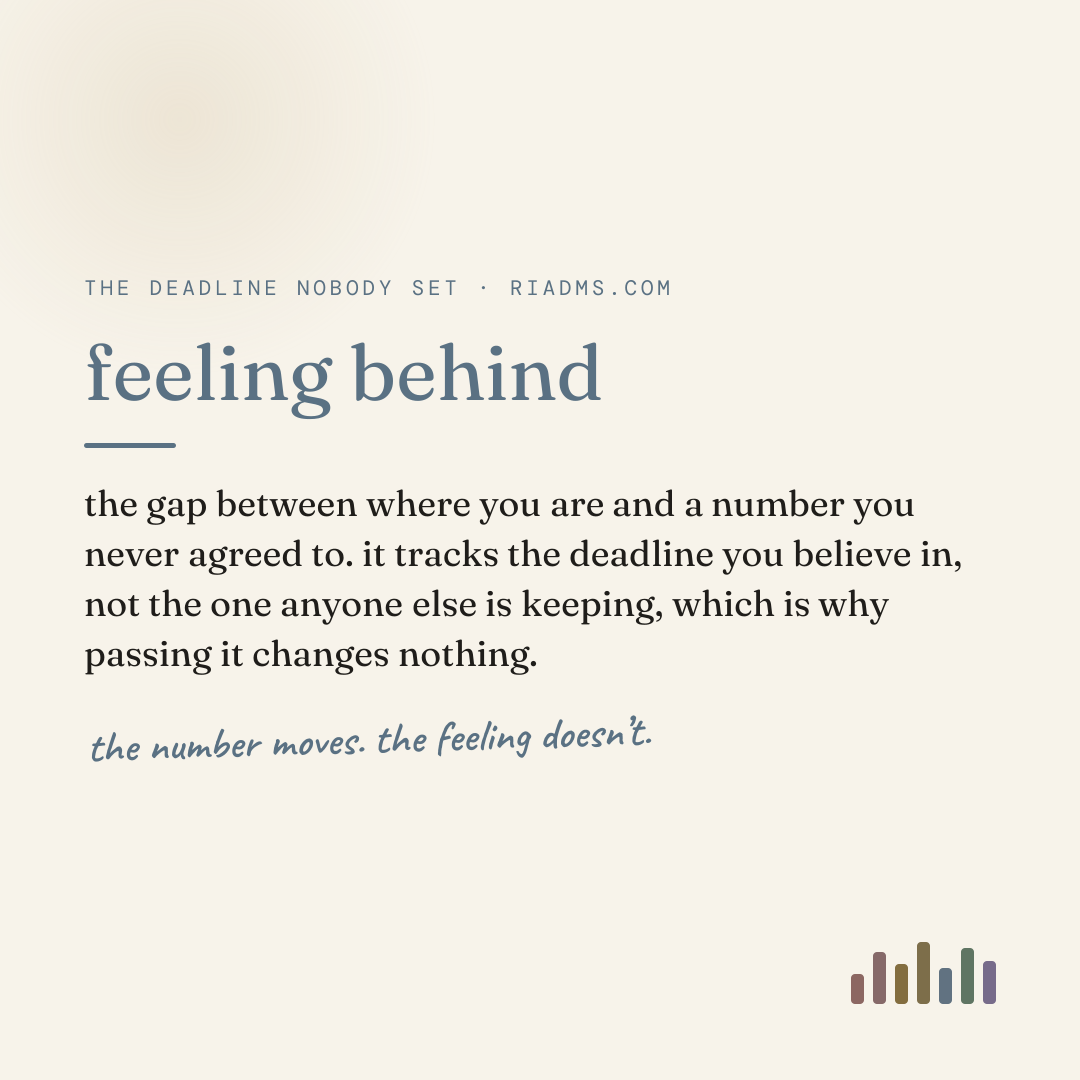
When you pass the deadline, it does not release you. It moves. You get to thirty and the new number is thirty five, and you feel exactly as behind as you felt at twenty nine. Which should have told you something, and the something is this: the number was never the problem. The number changed. The feeling did not.
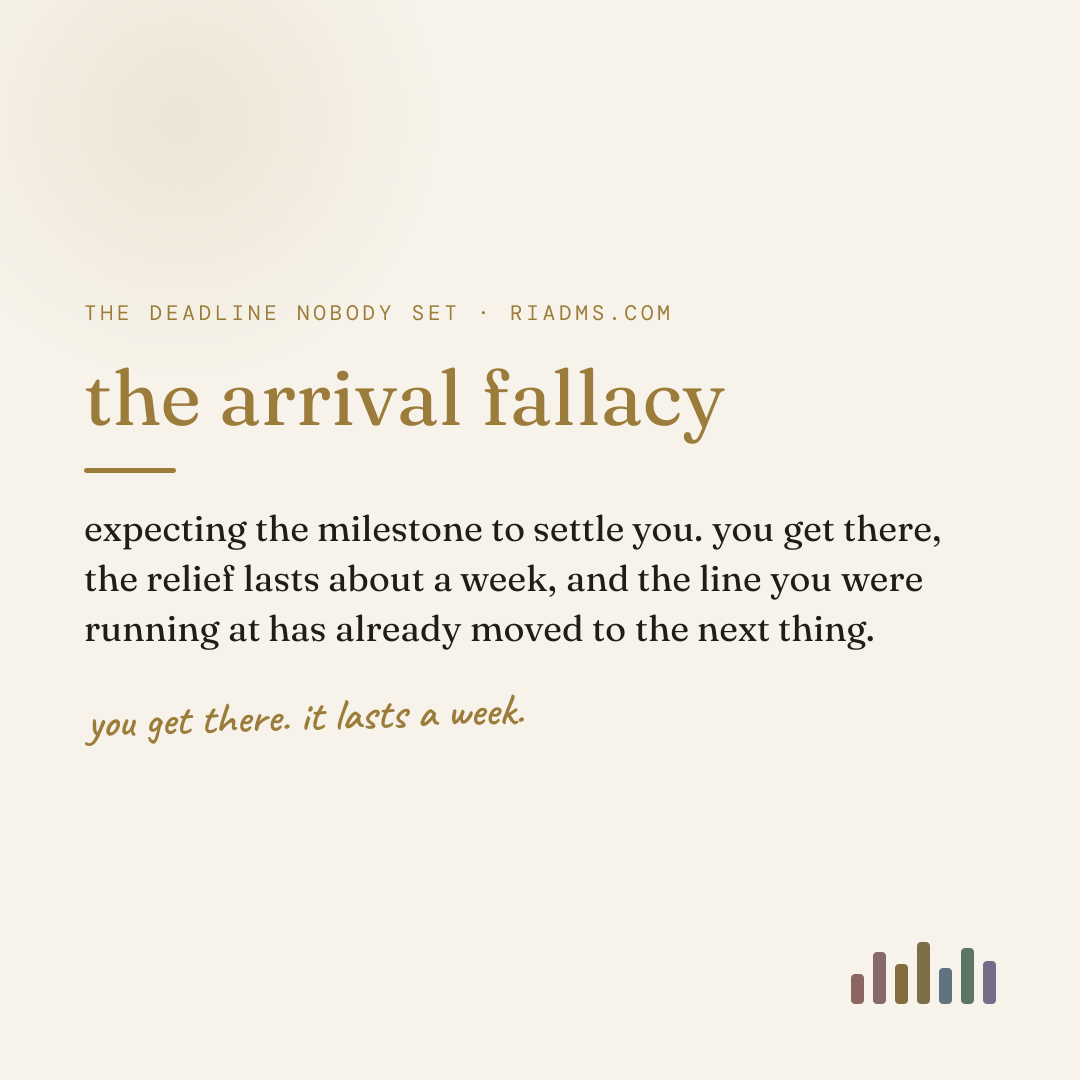
Popular psychology calls this the arrival fallacy, a phrase usually traced to Tal Ben-Shahar’s Happier. Let me be straight about its status, since almost nobody is. It is a good name for a real cluster of findings, and it has never been tested as a construct in its own right. Search the literature and you get essays citing the phrase, not experiments measuring it. The evidence sits one shelf over, under less catchy names.
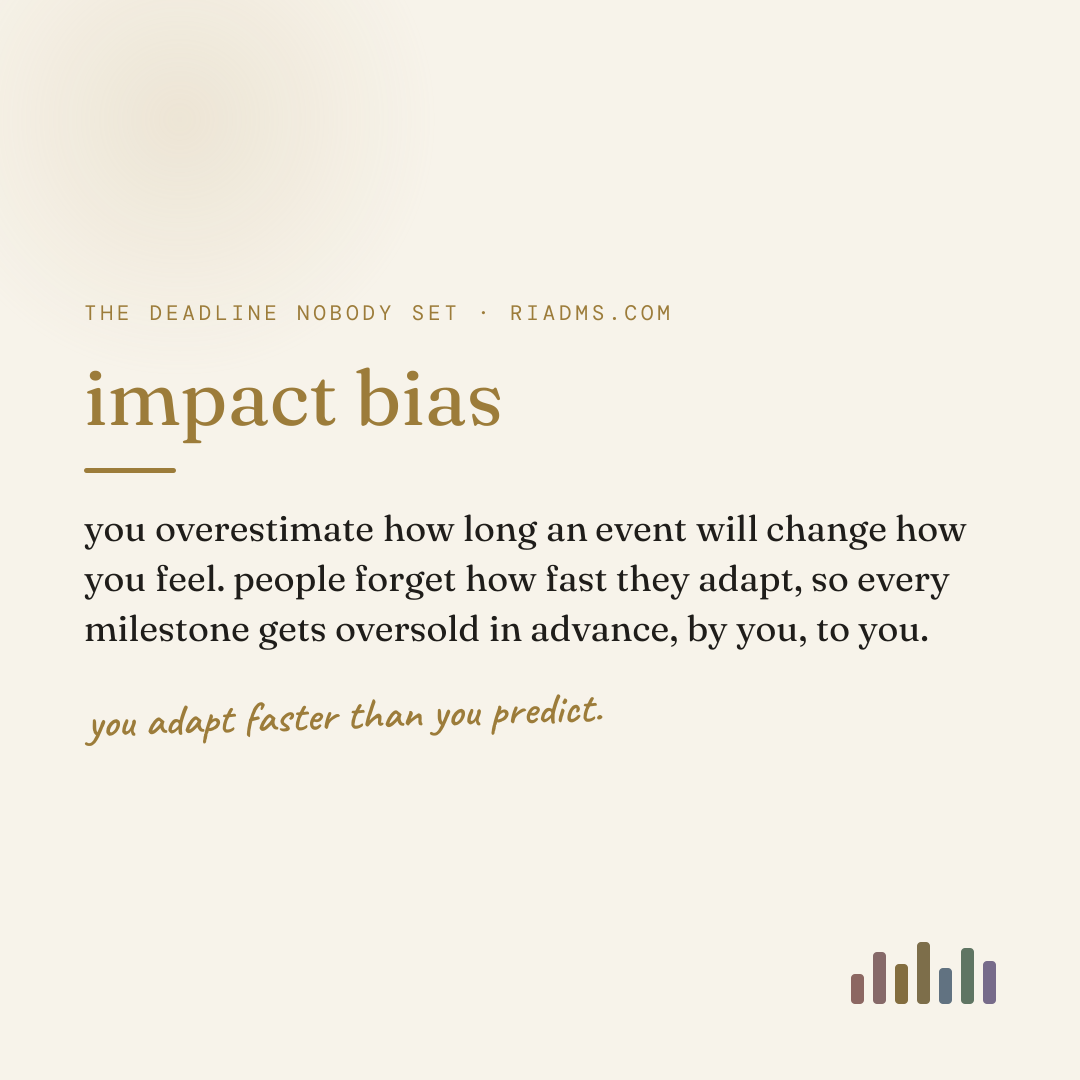
The best of it is Gilbert and colleagues on immune neglect. We overestimate how long an event will change how we feel, because we do not account for how fast we recover from it. Every milestone gets oversold in advance, and the person overselling it is you, to you.
The popular version overshoots here too, though, and that is worth correcting rather than passing on. “You always return to baseline” is not what the research says. The people who built the treadmill model revised it themselves in 2006: set points are not neutral, they differ between people, one person has several that can move in different directions, and they can change. And the largest pre-registered study of lottery winners found sustained gains in life satisfaction over more than a decade, with no sign of fading. Arriving somewhere is not nothing. It is just not an ending, and an ending is what you were promised.
the clock is real, and much softer than the version in your head
I am not going to tell you age norms are a myth. They exist and they persist, and they are measurable. But almost every strong claim built on top of them is softer than it sounds, and you have been living under the strong version.
Start with the deadlines. When Settersten and Hagestad asked 319 adults about age deadlines for marriage, parenthood and the rest, most did name one, and the answers clustered narrowly. Then comes their actual conclusion, which is the half nobody quotes: late timing was “generally thought to be acceptable, accompanied by little social tension, and without consequences”, and the deadlines worked as “flexible guidelines, not rigid, normative principles.” The table gets quoted for decades. The finding does not.
Then the punishment. The word “norm” implies a sanction, and the sanction is almost never measured. When Rook, Catalano and Dooley ran the direct test of whether departing from the social clock predicted distress, they reported “only limited support for social clock theory”. Off-time people in their sample had more support around them than on-time people, and were distressed anyway. So whatever was hurting them, it was not everybody else closing ranks.
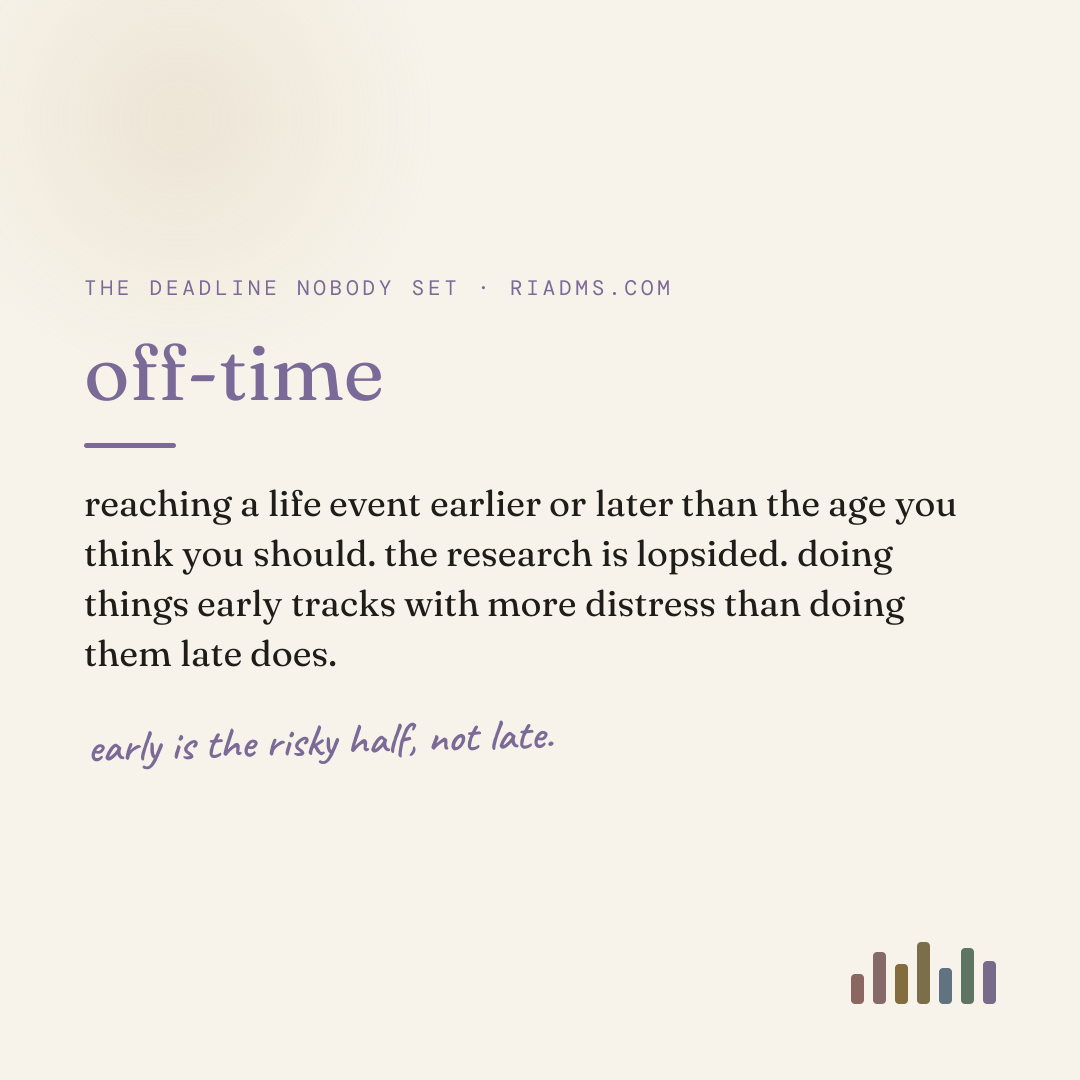
Then the direction, which is the one that surprised me most. Off-time is not symmetric, and being behind is the weaker half of it. A first birth well before the mid-twenties predicted more depression, and later births did not. Falling short of your own earlier expectation about work predicted depressive symptoms in more than ten thousand people, and overshooting it did not. Even the deadline research most often quoted as proof that missing it wrecks you, Heckhausen and colleagues on developmental deadlines, found something different: what predicted wellbeing past a deadline was whether the person let go of the goal. The harm was in the continued striving, not in the date.
The reference point that does the damage keeps turning out to be the private one. There is a 2024 study finding that deviation from the standardized social clock had no significant association with depression at all, and only deviation from a person’s own perceived clock did. It is cross-sectional and it is in a minor journal, so hold it loosely. It points the same way as the better-powered work: it is not being behind that hurts. It is believing you are.
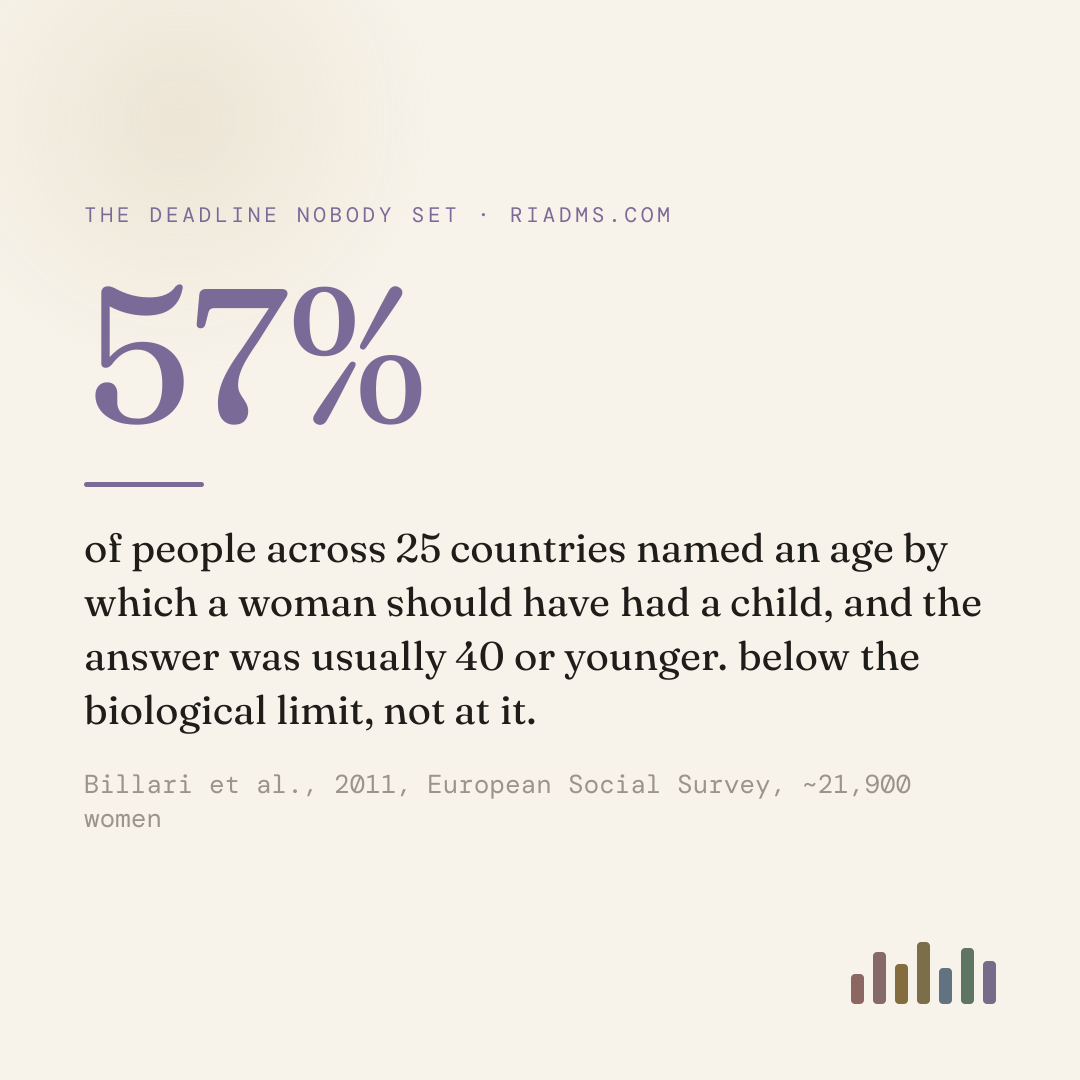
And the clock people carry is not even the physical one. Across 25 countries in the European Social Survey, 57.2% of women named an age by which a woman should have had a child, and the answer usually landed at 40 or younger, below the biological limit rather than at it. A deadline set tighter than the body’s is a deadline set by people. You can tell, because biology does not round down to a nicer number.
the number you are late for is from a different decade
One last thing, and it is the most checkable of all of them. The middle of the distribution has moved a long way, and the deadline in your head has almost certainly not moved with it.
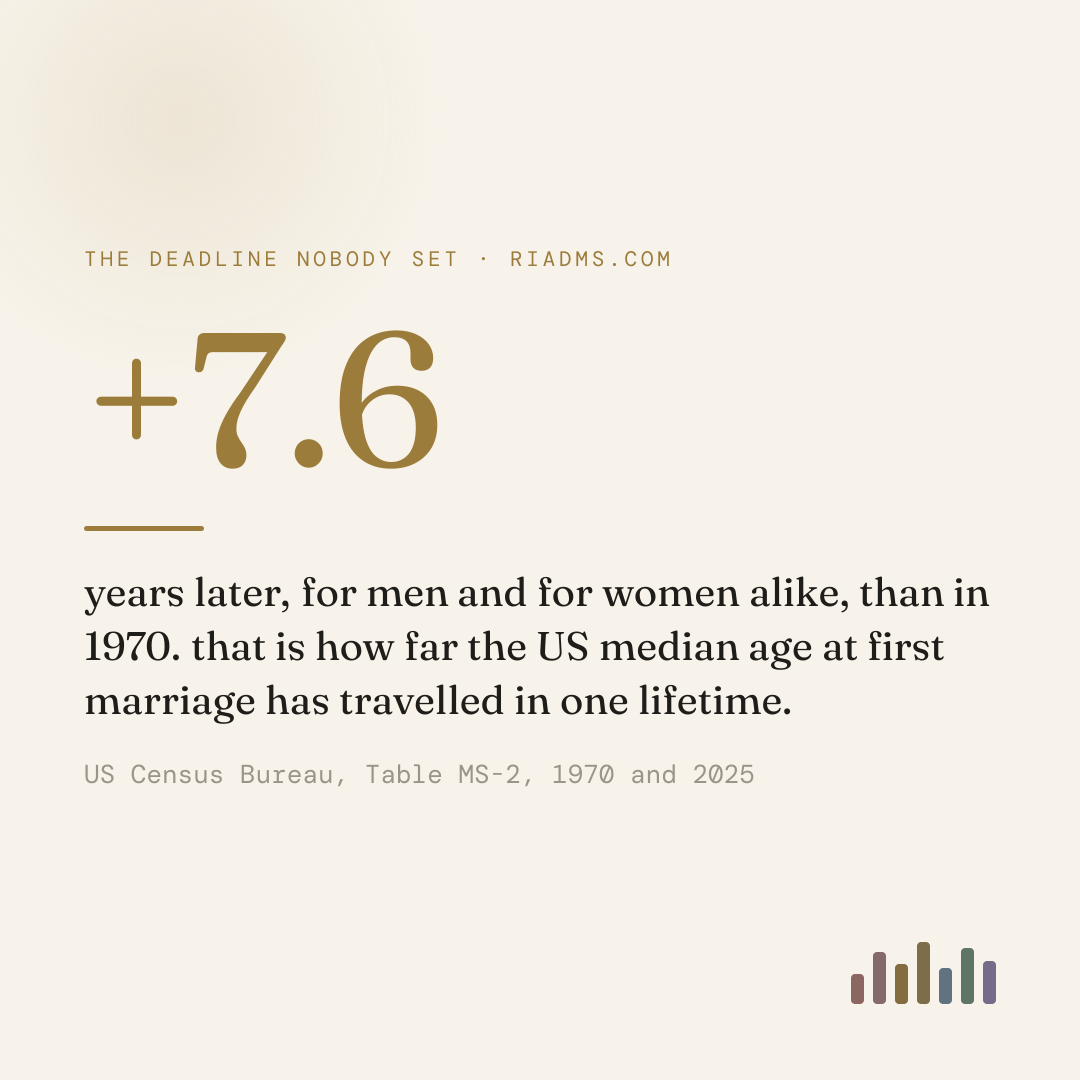
In the United States, the median age at first marriage in 1970 was 23.2 for men and 20.8 for women. In 2025 it is 30.8 and 28.4. That is the same 7.6 year shift on both, inside a single lifetime. And the mean age of a first-time mother went from 21.4 in 1970 to 27.6 in 2024, which is the highest it has ever been recorded.
In England and Wales, the most recent ONS figures, covering 2023, put the mean age at first marriage at 34.7 for men and 33.0 for women. Those are first marriages specifically; counting remarriages pushes it to 39.0 and 36.8, which is a different question wearing the same words. And the average age of a first-time mother in 2025 was 29.6, provisional, on ONS’s age-standardised measure.
Two honest notes on those. The US and UK averages are computed differently, so do not stack them against each other, and I am not going to pretend they are one number. And none of it is an argument that anybody should be doing anything later. It is one narrow fact, and it is this: if your deadline came down from your parents, it is calibrated to a decade when the middle of the distribution sat somewhere else entirely. That is not you running late. That is a schedule that expired.
keep reading
If you take one book from this, take Four Thousand Weeks, which goes after the thing underneath the deadline, the belief that one day you will be on top of your own life. If you want the research rather than the philosophy, Stumbling on Happiness is the readable version of the forecasting work, written by the person who ran it. And the single study to read is Settersten and Hagestad, because reading a paper conclude that late timing carries “little social tension” while you personally feel like a fugitive from a schedule is a useful ten minutes.
The chapters closest to this one are why you’re single, for what the deadline does to dating, and how lonely adulthood actually is, for the part where everyone scatters onto different timelines and stops being a reference group at all.
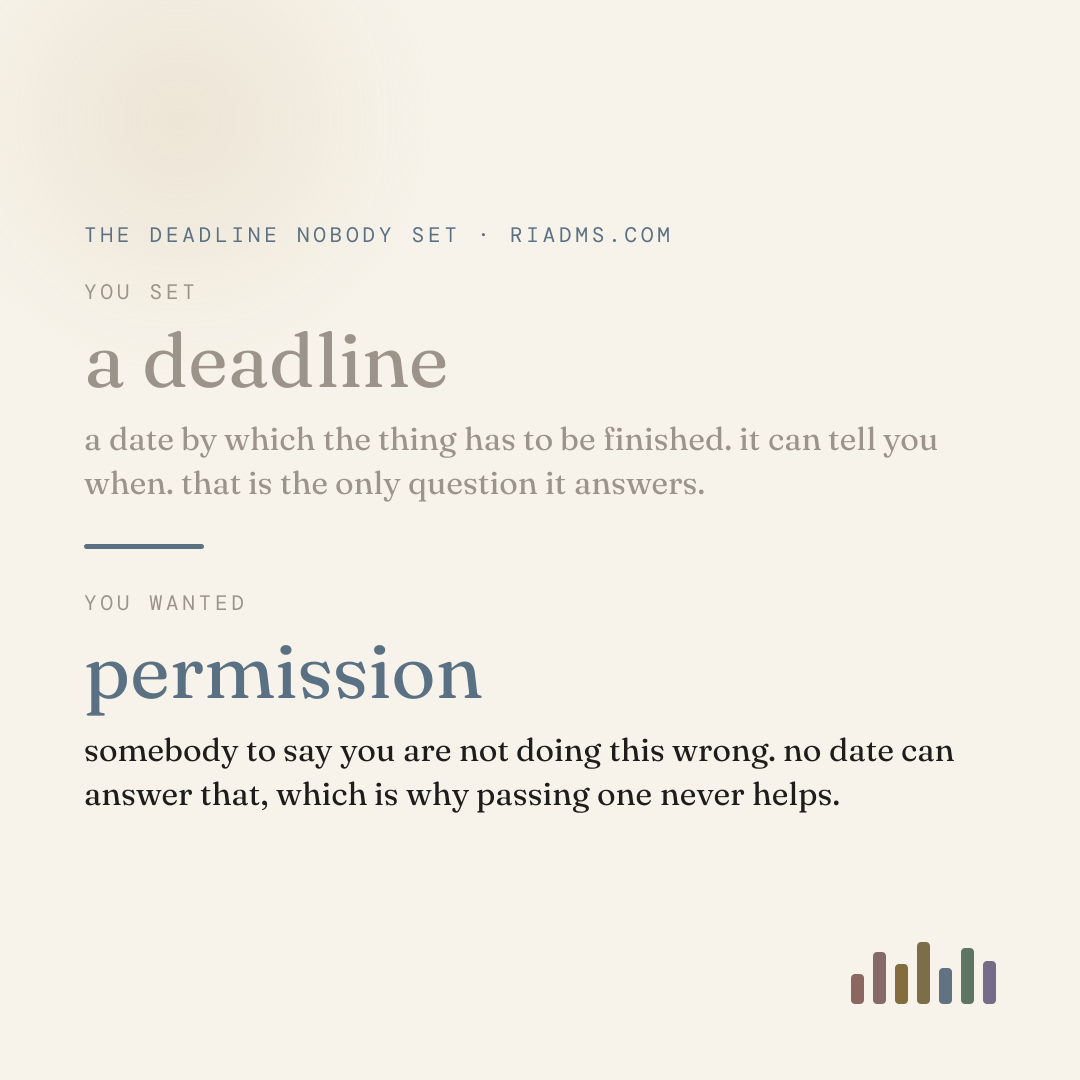
So maybe the deadline was never about time. It was a way of promising yourself that the uncertainty would end, and a date was the only shape that promise could take. You could not ask for the real thing, because the real thing has no unit and cannot be scheduled, so you converted it into something that could be: a number, and a countdown, and a way to be failing at it.
A deadline tells you when something has to be finished. What you actually wanted was to be told that you are not doing this wrong. Those are two different requests, and only one of them can be answered by a number. The other one you can just have.

