I have three friends I love and have never said it to.
Not “love you” tacked onto the end of a phone call, which does not count and which I do anyway. The sentence. Said on purpose, to their face, meaning it.
And I know exactly what stops me. It is not that I do not mean it. It is not that they would mind, because they would not. It is that there would be about four seconds afterwards where it was weird.
Four seconds. That is the whole obstacle. I have run that calculation and decided four seconds was too expensive, over and over, for years, about people I would get on a plane for.
This page is about where those four seconds came from, because they did not come from me.
the photographs
There is a whole genre of book that is nothing but old photographs of men touching each other.
The scholarly one is David Deitcher’s Dear Friends: American Photographs of Men Together, 1840-1918, published by Abrams in 2001 and built out of more than a hundred vintage photographs that had never been printed before. The publisher’s own framing is that it is the first book to show how ordinary it was for nineteenth-century American men to mark a close friendship by going together to the local photographer. Not a snapshot. A sitting. Something you scheduled and paid for.
And a portrait was frequently not something you kept. It was something you sent. The Metropolitan Museum’s account of the daguerreotype era describes the ordinary customer paying for a likeness “to keep for himself, or more likely, to send to a loved one as the era’s most enduring pledge of friendship”. By the Civil War the Library of Congress records the same habit in cheaper form: tintypes “were fairly durable and could be sent home in a letter”, and soldiers sat for photographers in camp in order to post themselves home.
So the picture was not private. A man paid for it knowing somebody else would open it.
The men in them are sitting in each other’s laps. Arms all the way round. Holding hands, on purpose, looking straight down the lens.
The other one is Loving: A Photographic History of Men in Love, 1850s-1950s, published by 5 Continents in 2020. It reproduces 320 photographs out of a collection that Hugh Nini and Neal Treadwell, a married couple, started by accident in the late 1990s when they found one picture of two men embracing in a Dallas antique shop. By 2020 the publisher put the collection at over 2,700 photographs. By the time the Smithsonian wrote about it in 2023 it was more than 4,000, from 36 countries.
Here is the part I did not expect. Those two books are looking at the same kind of picture and they completely disagree about what you are allowed to conclude from it.
Nini and Treadwell say you can tell. Their stated selection rule is “sometimes the embrace leaves no doubt that the relationship exceeds friendship or fondness. But if in doubt, we look into their eyes.” They excluded ordinary friendship photographs on purpose. Their whole collection is a claim that love is legible on a face a century later.
Deitcher says you cannot tell, and that not being able to tell is the actual subject. Linda Nochlin’s description of what he does is the clearest one: he “refuses to read these images either as evidence of gay relationships or as merely standard poses of comradeship,” and works “the unexplored territory between these two poles” instead.
I find Deitcher’s position harder and better. What interests me is not whether those particular men were in love. It is that in 1860 you could sit in another man’s lap in a photograph without anyone needing to work out which of those two things it was, and now you cannot.
come think with me
one letter a week.
the word for one feeling you’ve had but couldn’t name, and why it works that way. the same thing you just read, in your inbox, once a week.
- one letter a week, about a ten minute read
- all nine printable workbooks, free
- the research, with its caveats kept in
- hit reply and it reaches me. i read every one
no pressure, no spam, no gatekeeping. unsubscribe anytime · riadumitrescu.substack.com
all of this is free and it stays free. if it gave you a word you didn’t have, you can buy me a coffee.
what actually changed, and how well we know it
The claim underneath all of that, and underneath every version of it you have seen on the internet, comes from one book: John Ibson’s Picturing Men: A Century of Male Relationships in Everyday American Photography, Smithsonian Institution Press in 2002 and Chicago in paperback. He tracks American men in photographs from roughly 1850 to 1950 and argues the physical closeness drains out across it. His chapter titles say it plainly: “The Lost Ritual,” “Straightening Up,” “Whatever Happened to Intimacy?”
His argument, as Peter Boag summarised it reviewing the book in the Journal of American History, is that “the growth of physical and emotional distance between American males is the result of the social construction of homosexuality and the concomitant development of homophobia.”
And now the part that usually gets left off, which I am putting in because leaving it off is how a real finding turns into a meme.
Ibson’s evidence is 142 photographs, drawn from his own private collection. Boag’s verdict in the same review is that “his thesis is not new, but Ibson contributes a significant, if necessarily selective, visual record of the phenomenon.” Necessarily selective is a reviewer saying, politely, that a man who collected these pictures himself chose which ones to print.
So: the change is real, it is documented by a historian in a university-press book, and the record it rests on is a curated one rather than a systematic sample. Sources also do not agree on when the turn happens. I have seen the 1920s and I have seen the mid-1950s, and I could not reconcile them, so I am not giving you a date.
nobody passed a law
conceptromantic friendshipThe historians’ name for intense, physically affectionate, openly loving friendship that a culture treats as ordinary. Common between men in the nineteenth century, and understood to sit alongside marriage rather than compete with it.Rotundo, Journal of Social History (1989) ↗ is the historians’ name for what is happening in those photographs. The backbone citation is E. Anthony Rotundo’s Romantic Friendship: Male Intimacy and Middle-Class Youth in the Northern United States, 1800-1900, and it runs on letters and diaries rather than pictures.
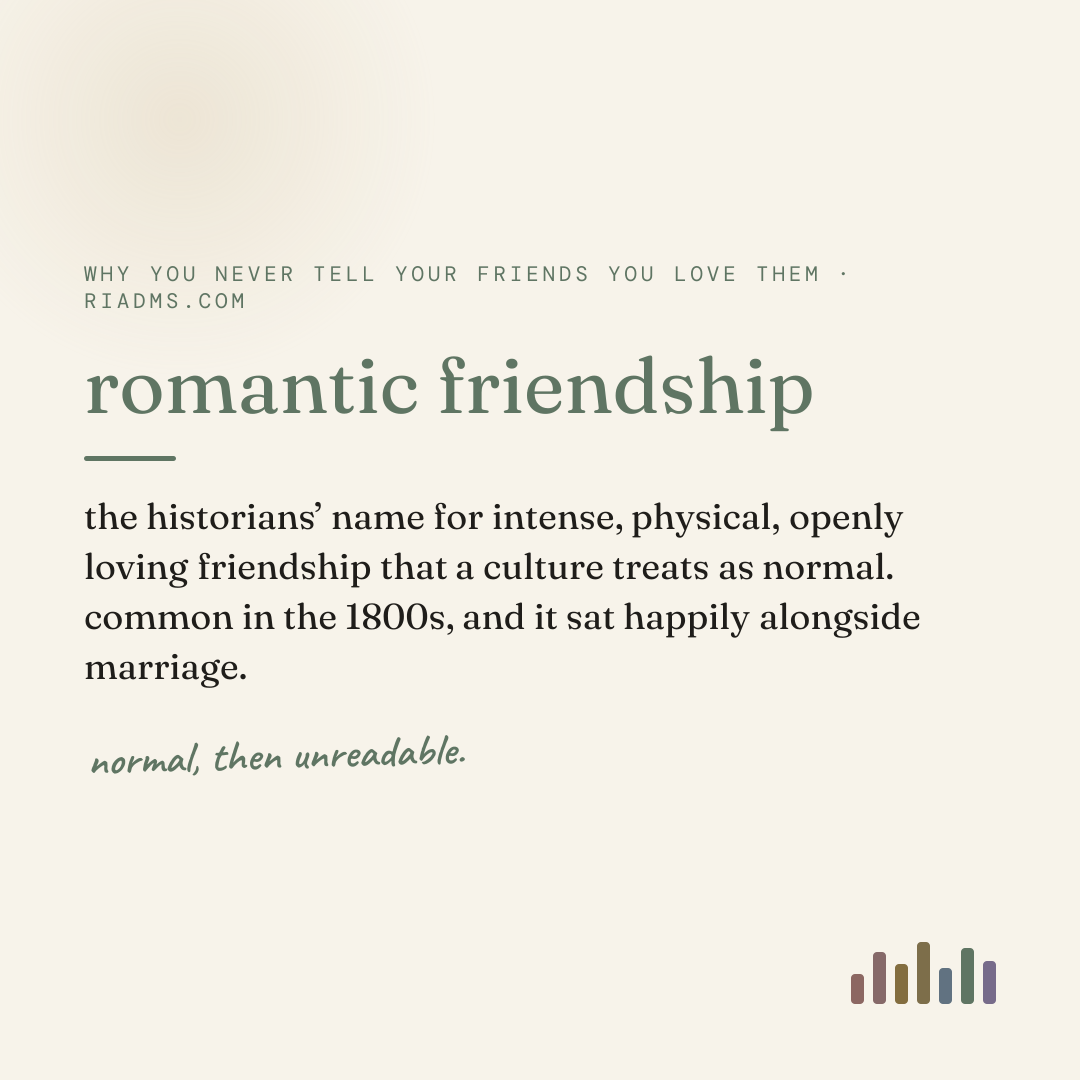
Rotundo’s finding is warmer and stranger than the summary version. This intimacy was socially accepted, and it sat alongside marriage to a woman without competing with it. But it was understood as belonging to one stage of life. Youth. It was expected to end when you married. So even at its most permissive, this was not a culture with no rules about male closeness. It had different ones.
Then the category arrives. The word homosexual was coined in German by Karl-Maria Kertbeny, privately in an 1868 letter and in print in 1869 in an anonymous pamphlet arguing against a Prussian sodomy statute. It reaches English in the early 1890s through the medical literature. And Foucault gives the shift its most quoted sentence, in The History of Sexuality: “The sodomite had been a temporary aberration; the homosexual was now a species.”
That is the line everyone uses, and I want to be careful with it, because the tidy version of what it means is not what the historians actually hold.
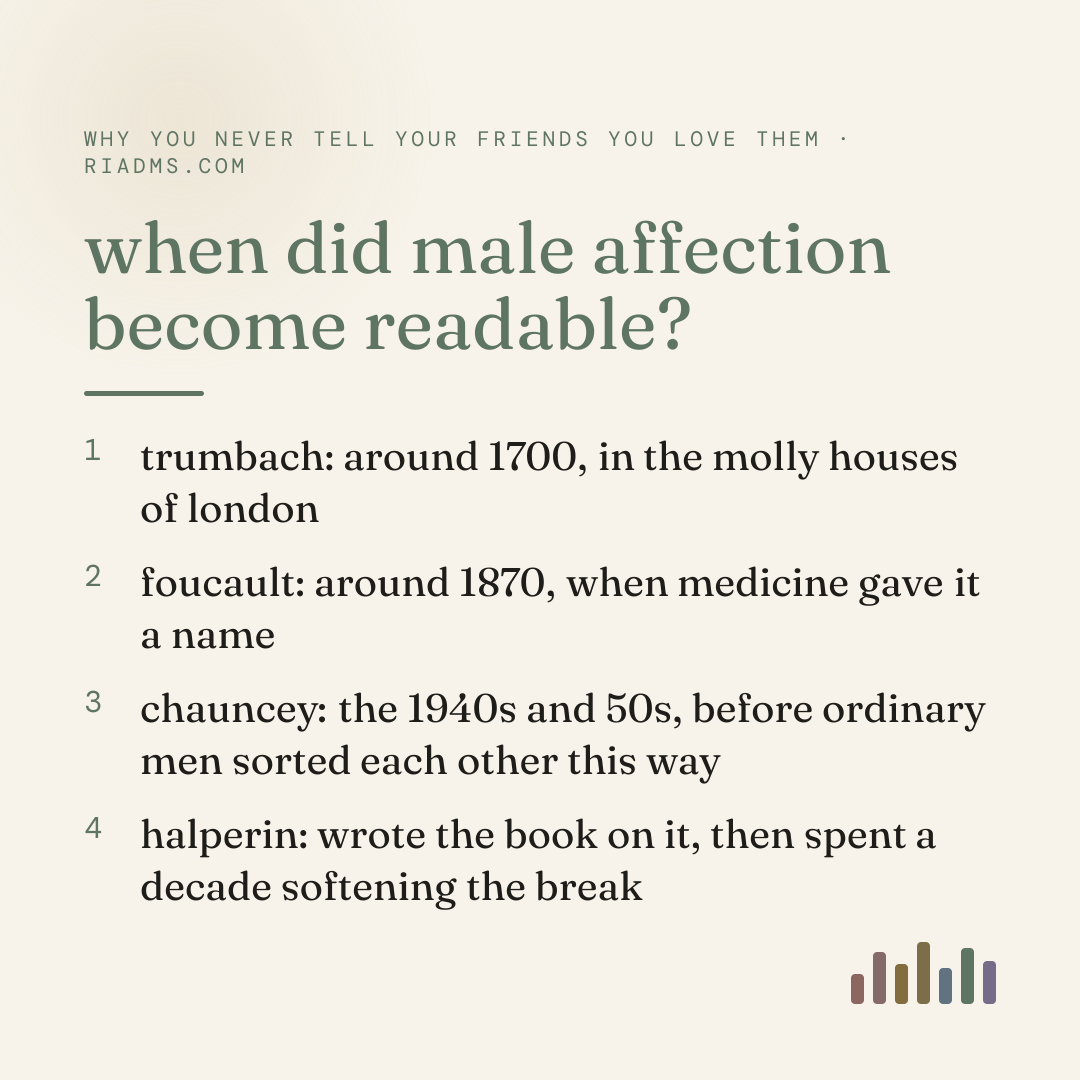
Randolph Trumbach puts the break around 1700, in the molly houses of London, and reads it as a gender revolution rather than a medical one. Foucault points at about 1870. George Chauncey, in Gay New York, argues that ordinary men were still sorting each other by gender presentation rather than by who they slept with until around the middle of the twentieth century, which puts a fifty-year gap between the word existing and the word reorganising anybody’s life. David Halperin, who wrote the book called One Hundred Years of Homosexuality, spent the next decade walking back how total he had made the rupture sound.
So “the homosexual was invented in 1869” is not a thing anyone in this field believes in that form. What they broadly agree on is smaller and, for our purposes, worse: a way of behaving turned into a way of being. Alan Bray’s The Friend makes the mechanism visible. The same signs, the kiss, the shared bed, the sworn brotherhood, the joint burial, could be read as honourable friendship or as sodomy depending entirely on the surrounding context. Nothing about the gesture changed. What changed was that the gesture became answerable.
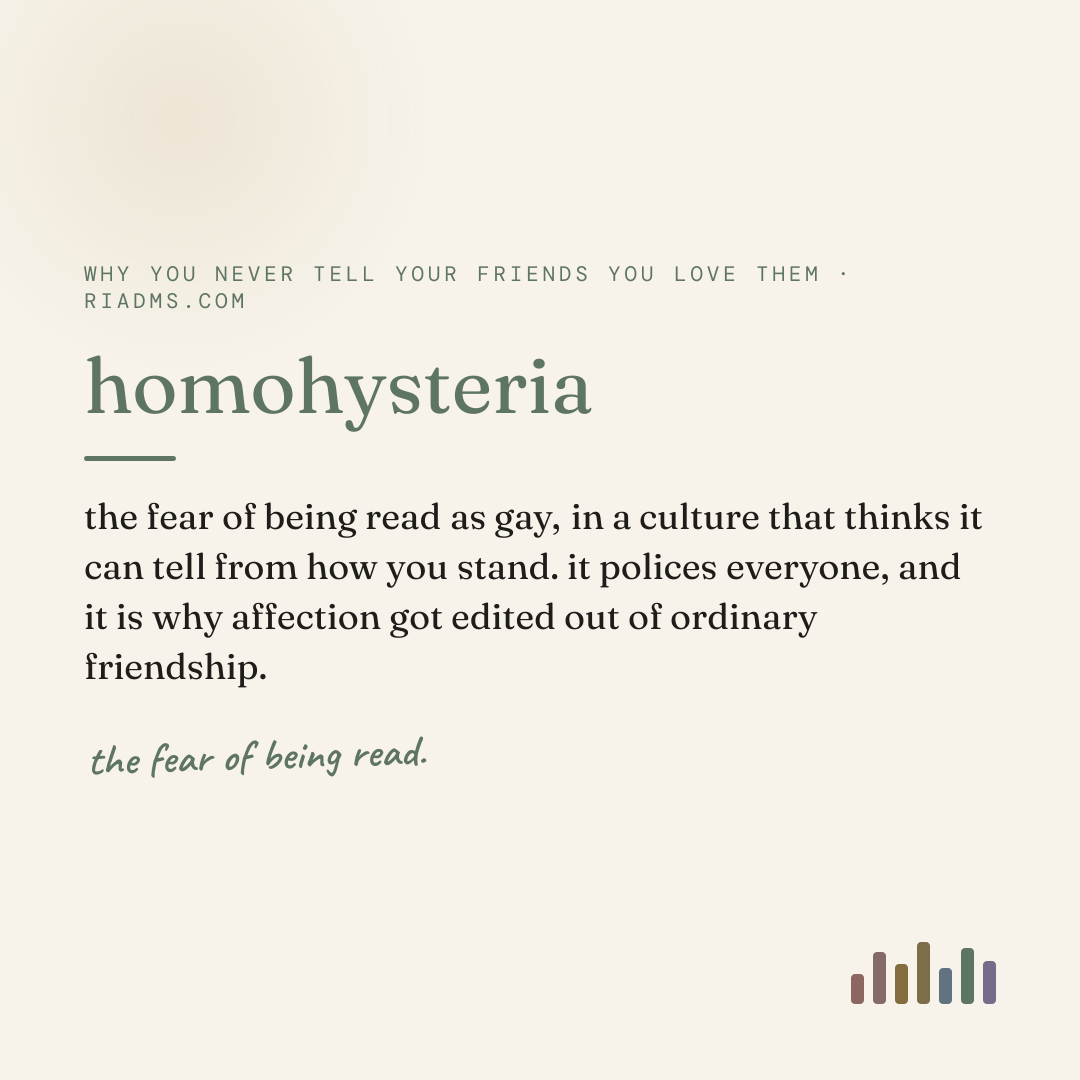
That is the whole engine, and it does not need a villain. Once a gesture can be read as evidence about what kind of person you are, everybody starts editing their gestures. Nobody announces it. Nobody agrees to it. You just learn, without being taught, that there is a reading now, and you start writing for it.
I should say clearly that the cause is the softest part of all this. Rotundo gives at least as much weight to industrial competition and market individualism, men becoming rivals rather than intimates, as he does to the new category. There is no single study that isolates when male affection declined and proves what killed it. State the change, hold the cause loosely.
the part where it stops being about men
I am not a man and neither are the three people I have not said this to. But the edit is not confined to the people it was aimed at.
The current numbers are not good. The Survey Center on American Life’s State of American Friendship report found the share of men with six or more close friends fell from 55% thirty years ago to 27%, and the share with no close friends at all rose from 3% to 15%. In the week before the survey, 30% of men had shared personal feelings with a friend, against 48% of women.
Those numbers do not test homophobia as a cause and the author does not claim they do. Put them next to the photographs and you have two facts, not a proof.
There is a genuinely live argument that the direction has reversed for young people. Mark McCormack and Eric Anderson interviewed 40 male student-athletes at a British university and 37 of the 40 said they had cuddled with another man. That is 37 of 40, at one university, not a population rate, and other researchers have argued the optimism outruns the data.
What I will say from where I sit is this. Being asexual means I have spent my whole life watching people file every kind of closeness under one of two headings, and being unable to use either. When the only two boxes are friends and together, an enormous amount of real feeling has nowhere to go, and the response is not to build a third box. It is to lower the feeling until it fits in the first one.
You are running somebody else’s fear, from a century before you were born, on your own friendships, in your own kitchen.
the four seconds, measured
Now the good news, and it is better than I expected.
There is a real body of research on what happens when people express affection, and it converges. In 2018 Amit Kumar and Nicholas Epley had people write gratitude letters and predict how the recipient would feel, then asked the recipients. The writers substantially underestimated how positive the letter would make someone feel, and overestimated how awkward it would be to receive. On a 0 to 10 scale, writers predicted awkwardness at 2.95. Recipients reported 1.95.
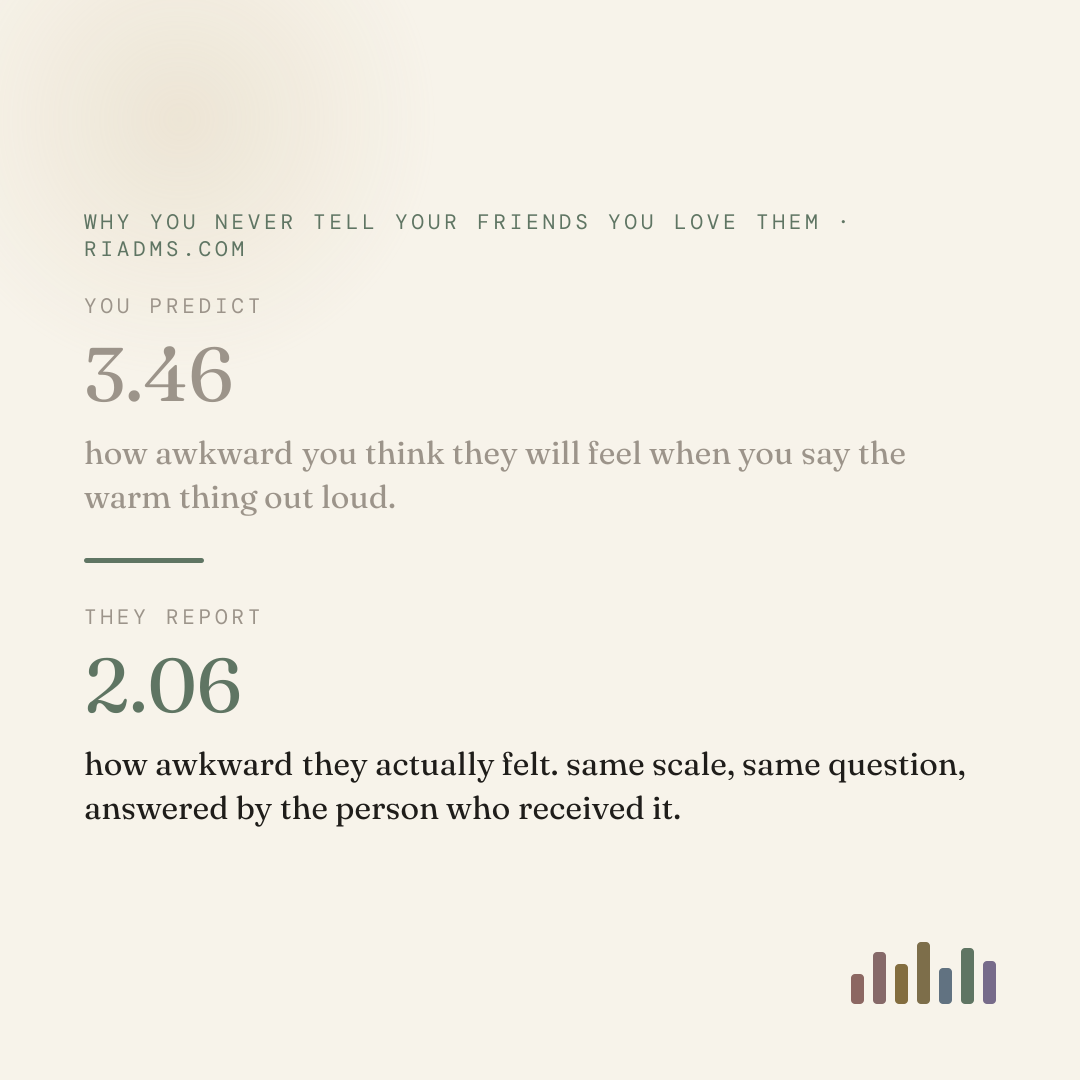
Xuan Zhao and Nicholas Epley ran nine experiments on compliments, including one in a public park with 210 people aged 19 to 91, which is a far less student-shaped sample than this literature usually gets. Same shape. Expressers predicted awkwardness at 3.46. Recipients reported 2.06.
Two findings inside that work are the ones I keep going back to.
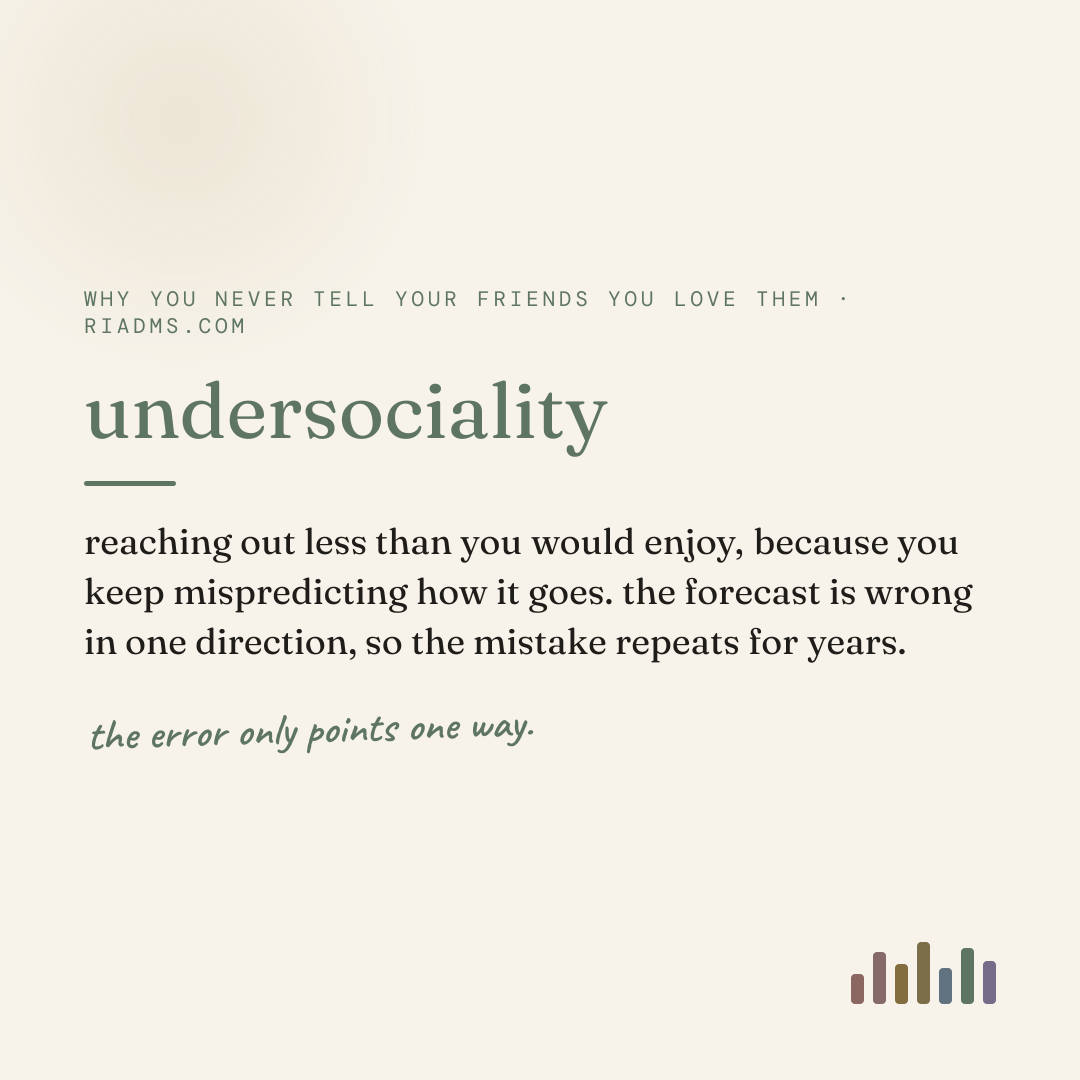
The first is why people get it wrong. Zhao and Epley found the miscalibration was not mostly about warmth. Expressers underrated how competent their compliment would seem. They were not afraid the feeling would be unwelcome. They were afraid of saying it badly. The four seconds is not a fear of the sentence. It is a fear of fumbling the sentence.
The second is from Erica Boothby and Vanessa Bohns, who ran the same test on compliments to strangers and added a condition nobody else did. They asked uninvolved third parties to predict how the recipient would feel. The third parties were accurate. The error was not a general human failure to model other people. It belonged specifically to the person doing the complimenting.
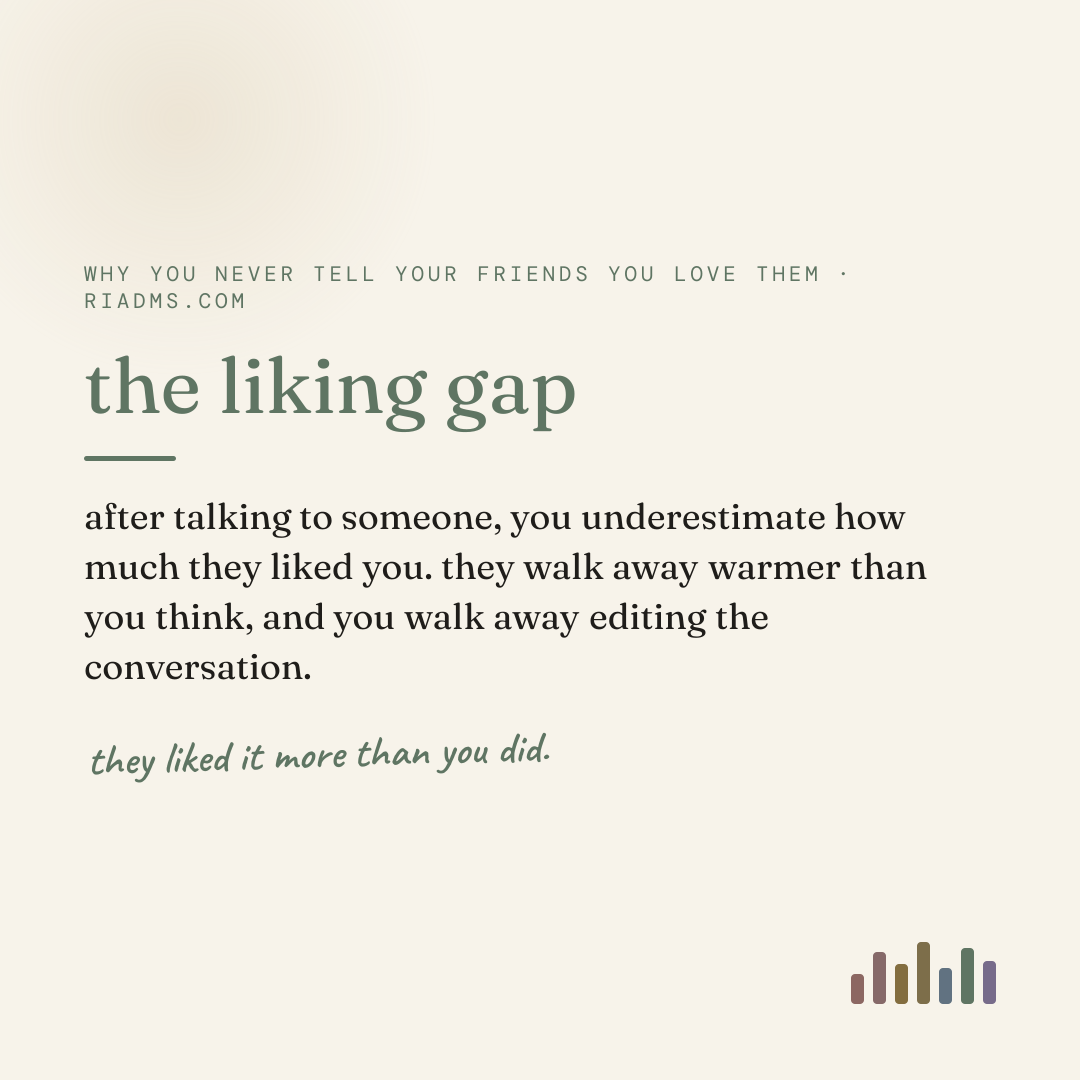
And there is a finding aimed straight at the awkwardness itself. Michael Kardas, Kumar and Epley put strangers into deep conversations and found they were less awkward and more connecting than anyone predicted, with the misprediction biggest for the deepest conversations. The dread scales with the depth. The actual awkwardness does not.
what this research does not say
I want to hand you the caveats rather than have you find them.
The awkwardness half is the weaker half. The finding that recipients feel more positive than you predicted is large and consistent. The finding that they feel less awkward is smaller and sometimes absent. In Kumar and Epley’s own 2023 kindness paper, the awkwardness gap did not reach significance at all, and the authors write that it “seem[s] to vary by context.” If you take one number from this page, take the positive one.
Almost none of it has been independently replicated. The exception is good news: Peggy Liu and colleagues’ finding that people underestimate how much an old friend appreciates being reached out to was directly replicated with 742 people, and held, at about 80% of the original effect size.
Nobody has studied this exact sentence. There is no research on how “I love you” lands between friends. Everything above is gratitude, compliments, kindness and reaching out. It is the nearest evidence there is and it points one way, but I am extrapolating and you should know that I am. It is also all US and UK, and norms about saying warm things out loud are not universal.
keep reading
If you read one thing: Ibson’s Picturing Men is the book the photographs argument comes from, and Deitcher’s Dear Friends is the one that will not let you have the easy version of it. Read the second one after the first.
If you read one study: Zhao and Epley’s compliments paper is the most useful, because the park sample is the least strange one in the field and because the competence finding tells you what the fear is actually made of.
Say the four seconds out loud and it is obviously a bad trade. Four seconds against a person you would get on a plane for. Nobody would take that deal written down.
But you are not comparing four seconds to a friendship. You are comparing four seconds now, which is specific and about to happen, against nothing in particular later, because the friendship is already there and already fine and does not present itself as a thing that could be lost.
The repair is not complicated, and that is somehow worse. Somebody has to say the sentence, be embarrassed, and then survive it. There is no version where you get to skip the four seconds.
And nobody currently alive is responsible for it. Every person who had a reason to build this is dead, which means there is nobody left to be angry at and nobody left to ask for permission.
I have not done it yet. I am telling you before I have done it, which I know is the least impressive way to tell you.