People call A Little Life trauma porn, and I get it. It’s 700 pages, and a lot of those pages are about a man being hurt, and I’ll admit I take something like pleasure in reading it. That’s an uncomfortable thing to say out loud. People also call it the saddest book ever written, or the book they’ll never recover from. All of that is sort of true.
It’s also not what the book is about.
What I think it actually is: the most convincing argument I’ve read that a friendship can be the central love of a whole human life. And inside that, one of the best portraits in modern fiction of a relationship where sex gets taken out and the love doesn’t die. So it’s strange that the most common thing people say about its main character is that he’s asexual. He isn’t. And the difference is the reason I make videos at all.
four men, one secret
Four men meet at university and the novel follows them for about thirty years. Willem is an actor. JB is a painter. Malcolm is an architect. And Jude St. Francis is a litigator, and he’s the centre of the book, and the other three know almost nothing about him.
Jude was abandoned as a baby at a monastery. What happened to him after that is the horror the novel is built around: abuse by the monks, then years of being trafficked by a man who told him it was love, and then a car driven into him on purpose, and that’s where his ruined legs come from. He tells nobody in his adult life any of it.
That’s the engine. You see all of Jude’s inner world, and you watch the people around him love him and want to know what he’s carrying, and they never get the chance. Seven hundred pages of people loving a man they barely know.
And about the length, because it’s the other thing everyone complains about. The book is long on purpose. It wants you to feel duration: what it costs to keep a secret for thirty years, and what it costs to be loved, patiently, by people who aren’t going to leave. You can’t do that in two hundred pages. You have to keep the secret alongside him for long enough that it gets heavy.
Not everyone buys this, and I don’t want to pretend they do. Daniel Mendelsohn’s long review in the New York Review of Books is the strongest case against it: that the suffering is out of proportion to anything the book does with it, and that the novel exists mostly to make its reader feel terrible. Ten years later the argument is still going, and this piece in The Conversation is a good map of it. I think he’s describing something real. I just think he’s missing what the pain is in service of.
come think with me
one letter a week.
the word for one feeling you’ve had but couldn’t name, and why it works that way. the same thing you just read, in your inbox, once a week.
- one letter a week, about a ten minute read
- all nine printable workbooks, free
- the research, with its caveats kept in
- hit reply and it reaches me. i read every one
no pressure, no spam, no gatekeeping. unsubscribe anytime · riadumitrescu.substack.com
all of this is free and it stays free. if it gave you a word you didn’t have, you can buy me a coffee.
friendship in the middle, and left there
Almost every novel treats friendship as the stuff around the edges of the real story, and the real story is a romance, even when the book isn’t a romance novel. Friends are the support cast. They exist to tell the heroine she’s making a mistake about the man.
A Little Life puts friendship in the middle and leaves it there for the whole book.
The clearest evidence is Harold. He’s Jude’s old law professor, and over years he becomes something like a father to him, and then he and his wife Julia formally adopt Jude. Jude is thirty. A grown man, a successful lawyer with money, gets adopted, and it’s one of the most moving stretches of the book. It makes its argument with the plot instead of with a speech: the family that ends up being yours might arrive late, it might be put together completely on purpose, and it counts just as much as the one you were born into. Maybe more.
JB is the other proof. In the middle of the book he does something to Jude that’s hard to forgive, and the novel doesn’t write him out for it. The friendship survives. Worse, and imperfect, and for years. That’s what actually happens with people you’ve known for decades.
So the proposition, as I read it, is that the love that carries a life isn’t necessarily the romantic one. It’s the accumulated, stubborn, unglamorous fact of people who keep showing up.
I’m not the only one who read it this way. Garth Greenwell, reviewing it for The Atlantic, wrote that the men’s bonds don’t fit the usual names we have for relationships, and that Willem comes to see his friendship with Jude as a life partnership. And Yanagihara herself, talking to Electric Literature, said part of what holds these friendships together is not wanting to know too much about each other. Which is the secret again, from the other side.
they stop, and it works
This is the part I’ve never seen anyone talk about.
Willem and Jude have been friends for decades when Willem tells Jude he’s in love with him. They become partners. And then they have sex, and for Jude it’s unbearable, because his body understands sex as the thing that was done to him, for years, by a man who called it love.
He doesn’t tell Willem. He endures it, because he thinks it’s the rent he has to pay for being loved. His self-harm gets worse. And Willem finds out.
And then the book does something I don’t think I’d read anywhere before. They stop. They take sex out of the relationship, like it’s that easy, because it is that easy, and the stretch after that is written as the happiest period of Jude’s adult life.
I haven’t read another literary novel where a sexless partnership is anything other than a tragedy or a problem somebody needs to fix. Here, two people notice that one part of their relationship is doing serious harm, and they remove it, and they keep everything else. And everything else turns out to be almost all of it.
For me, reading that as an asexual person, it did something I’d genuinely never felt from a book. Because the message everywhere is that a relationship without sex has a hole in it. And here’s one of the most celebrated novels of the century saying no. You can take that out, and what’s left can be the best years of somebody’s life.
If you know another book that does this, tell me. I’ve looked.
jude is not asexual
Search around and you’ll find a lot of people saying Jude is asexual, sometimes as “asexual by choice”, which isn’t a thing. I understand the instinct completely. Here’s a man who doesn’t want sex, who’s happiest without it, inside a loving partnership. From the outside, the pattern matches.
It’s still wrong, and the reason is the one I come back to in every video like this.
Asexuality is not experiencing sexual attraction. It’s about the absence of a pull toward people. Sexual aversion is something else: a negative reaction to sex itself. They’re different axes. You can have either, both, or neither. The asexual community’s own definition is exactly that: someone who doesn’t experience sexual attraction. And aversion, in the clinical writing, is avoidance driven by fear or disgust, the kind of thing that gets treated, which tells you it’s a different kind of thing.
Jude doesn’t lack attraction, or at least the book never gives him the chance to find out. He loves Willem. He wants to be close to him, and to be touched by him, in every way that isn’t that one. What he has is a body that learned, correctly, from the evidence it was given, that one specific act means annihilation. That’s not an identity. That’s an injury.
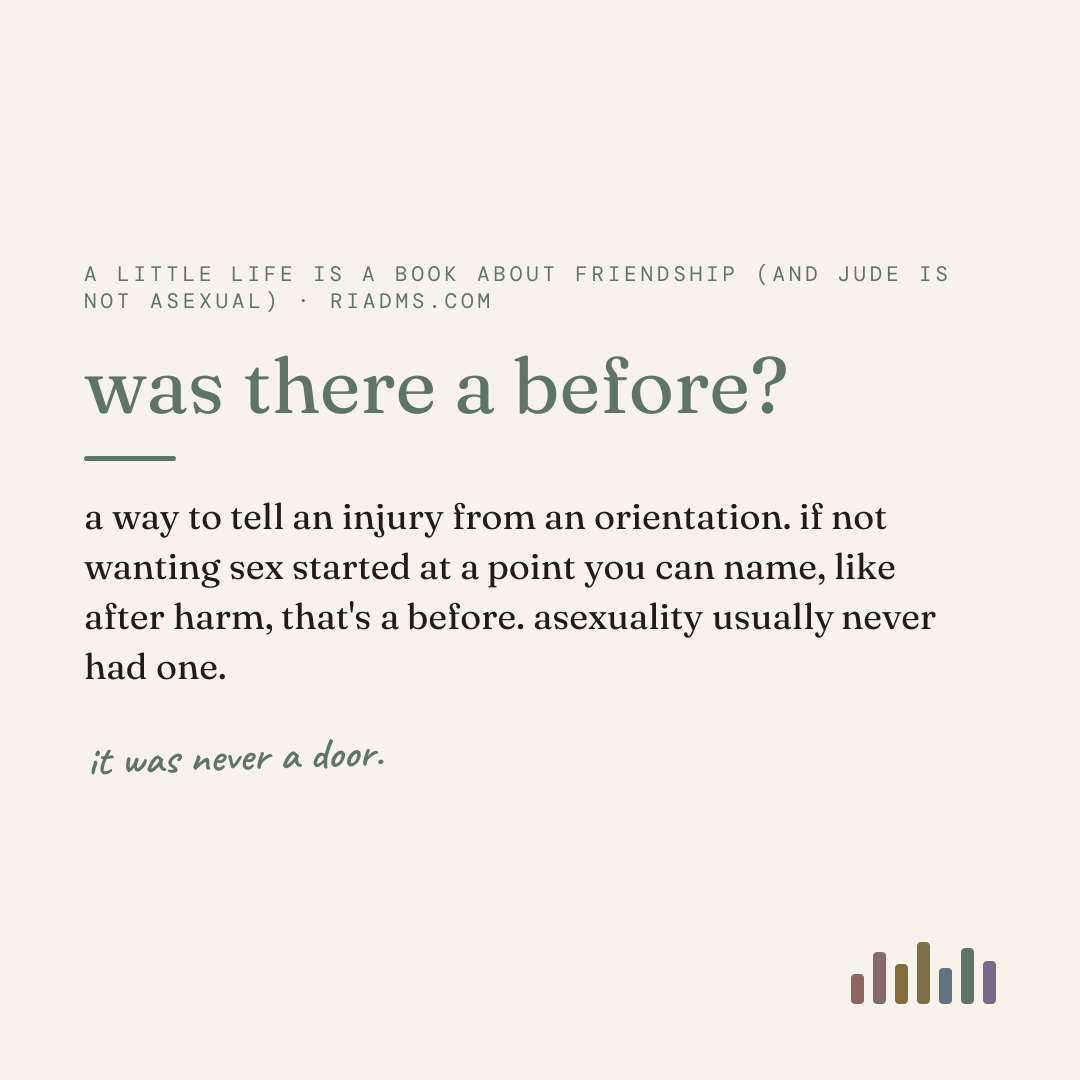
The test I use for all of this is simple: was there a before? Jude’s before is a childhood. There’s a line in his life, and everything on one side of it was done to him. That’s what damage looks like. Asexuality usually doesn’t have a before. It isn’t a door that got shut. For most of us, it was never a door.
So why do I care about a fictional man’s label?
Because the same mix-up happens to real people, in both directions, every day. Asexual people get told their orientation is trauma they haven’t dealt with, that there’s a wound under it and they’d want what everyone else wants if they healed properly. And calling Jude asexual agrees with that, because it matches the trauma to the identity. The research doesn’t support that either. When Lori Brotto and Morag Yule went through the evidence in 2017, they found no good reason to treat asexuality as a disorder, and concluded it most likely meets the conditions for a sexual orientation.
It goes the other way too. Survivors get handed “asexual” as a neat word for something that’s actually an injury, and an injury might deserve support they then don’t go looking for. And the injury doesn’t always touch attraction at all. It might change what you can do, and what your boundaries are, without changing who you’re drawn to. A review of twelve studies on men who were abused as children found exactly that mix: some saw lower desire or arousal problems, and others found no link at all.
Both mistakes cost somebody something real. Reading Jude accurately is practice for reading people accurately.
the letter
One last thing, and it’s the detail that undid me, and it’s the biggest spoiler of all.
Jude dies. Two years after Willem is killed in a car crash, Jude takes his own life. The final section is narrated by Harold, an old man now, talking about a son he outlived. And afterwards Harold finds a letter Jude wrote and hid, and in it is everything. The whole story. Every fact about himself that he couldn’t say out loud to anyone, across a lifetime of being loved by people who wanted to know.
He couldn’t speak it. He could write it.
I love books where people are known through letters, and I think this is why: writing lets you be known without being seen. For most characters that’s a romance. For Jude it was the only way it ever worked, and he could only use it once he was gone.
The book doesn’t save him, and I respect it for that. In a lot of novels love fixes people. In real life it usually doesn’t, and it’s not always enough, especially when someone played with love when you were small. But he was known. At the end, on paper, in his own words, he let himself be known, and the person who found it was a man who chose to be his father when he was thirty.
keep reading
If you’ve read it, the two pieces worth reading next are the ones that disagree: Greenwell in The Atlantic for it, and Mendelsohn in the NYRB against it. If this page was about you more than about Jude, if you’ve been sitting with the difference between not wanting and not being able to want, the one-pager at riadms.com/ace is free and it has the vocabulary and room to write down where each part lands for you.
Is it the saddest book ever written? Probably. I’m not going to talk anyone into reading it who isn’t up for it. But calling it a sad book undersells what it’s claiming, and what it’s claiming is hopeful and pretty unfashionable. That a person can be loved enormously, for decades, by people who chose him. That the great love of a life can be a friend. That you can remove the part that’s hurting and keep the rest, and the rest can be almost everything.

