You have friends, good ones, people you could call at five in the morning and they’d pick up, and you might even have a nice conversation. You’re not ungrateful. But you still get off the phone feeling like nobody was there.
It’s not that they don’t care. It’s that you have a head full of things, a business idea, a philosophical question, a book you want to write, and you can’t share any of it with them. Or you try, and the answer comes back vague, or it misses the point, or it comes with a gentle “be realistic.” So now you bring the smaller version, the one that fits any conversation, and you go home with the rest of it to think through alone, or with AI.
This kind of loneliness isn’t the one anybody talks about. I want to name it, because I think a lot of you are in it and calling it something else. I’m arrogant. I’m ungrateful for what I have. I need to get over myself. That’s what I called it too.
loneliness got split in two in 1973
Start with what’s already established, because it’s solid and it gets you most of the way.
In 1973, a sociologist named Robert Weiss published a book called Loneliness: The Experience of Emotional and Social Isolation, arguing that we’d been using one word to describe two different feelings.
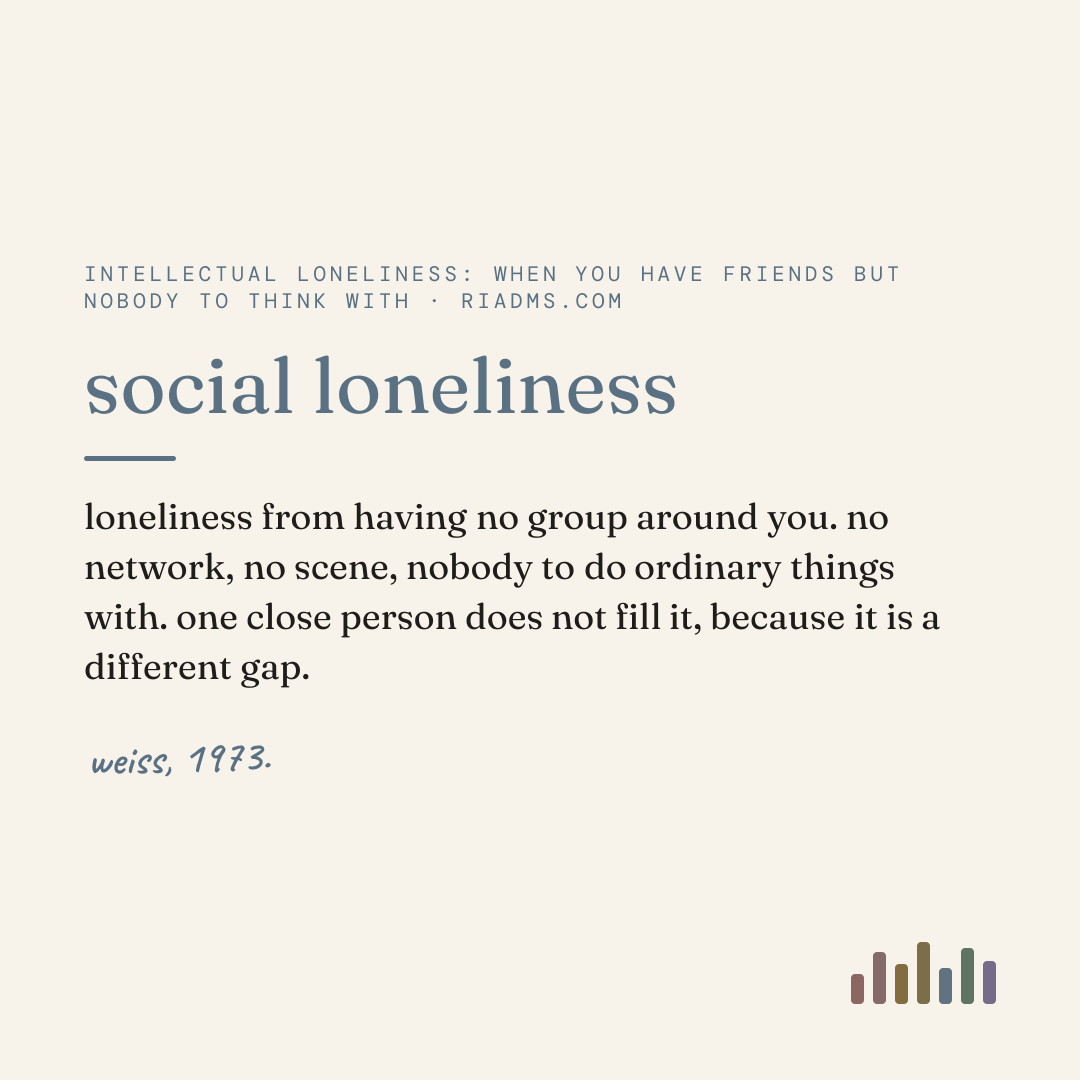
Social loneliness is not being connected to a group. No network, no scene, nobody to do ordinary things with.
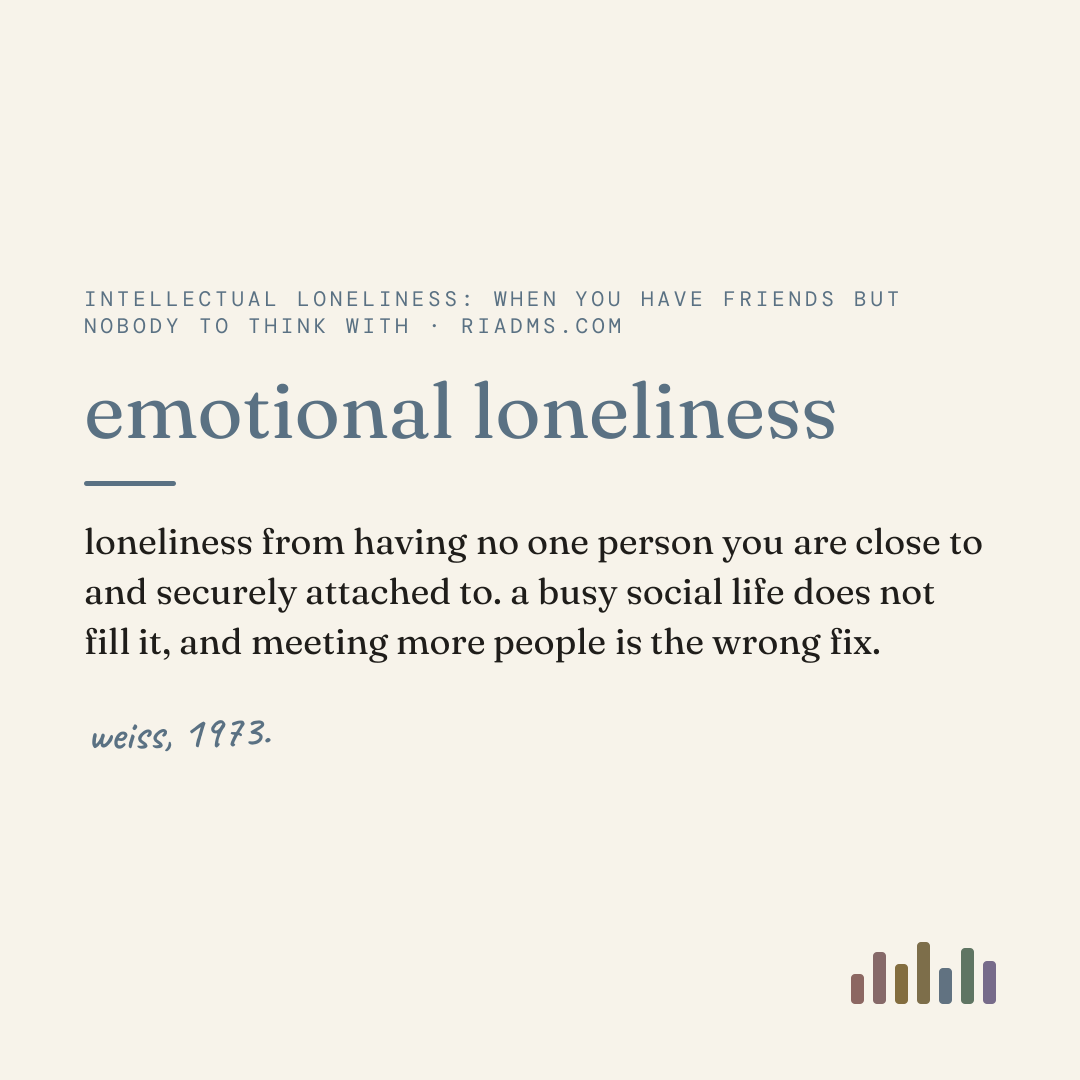
Emotional loneliness is not having one specific person you feel close to and securely attached to. Weiss built this half on attachment theory. That’s why it’s about one person and not about numbers.
His point is that the two don’t stand in for each other. You can have a huge social life and still be starving for one close person. You can have one person who knows everything about you, and you know everything about them, and still feel like you don’t have a place in the world.
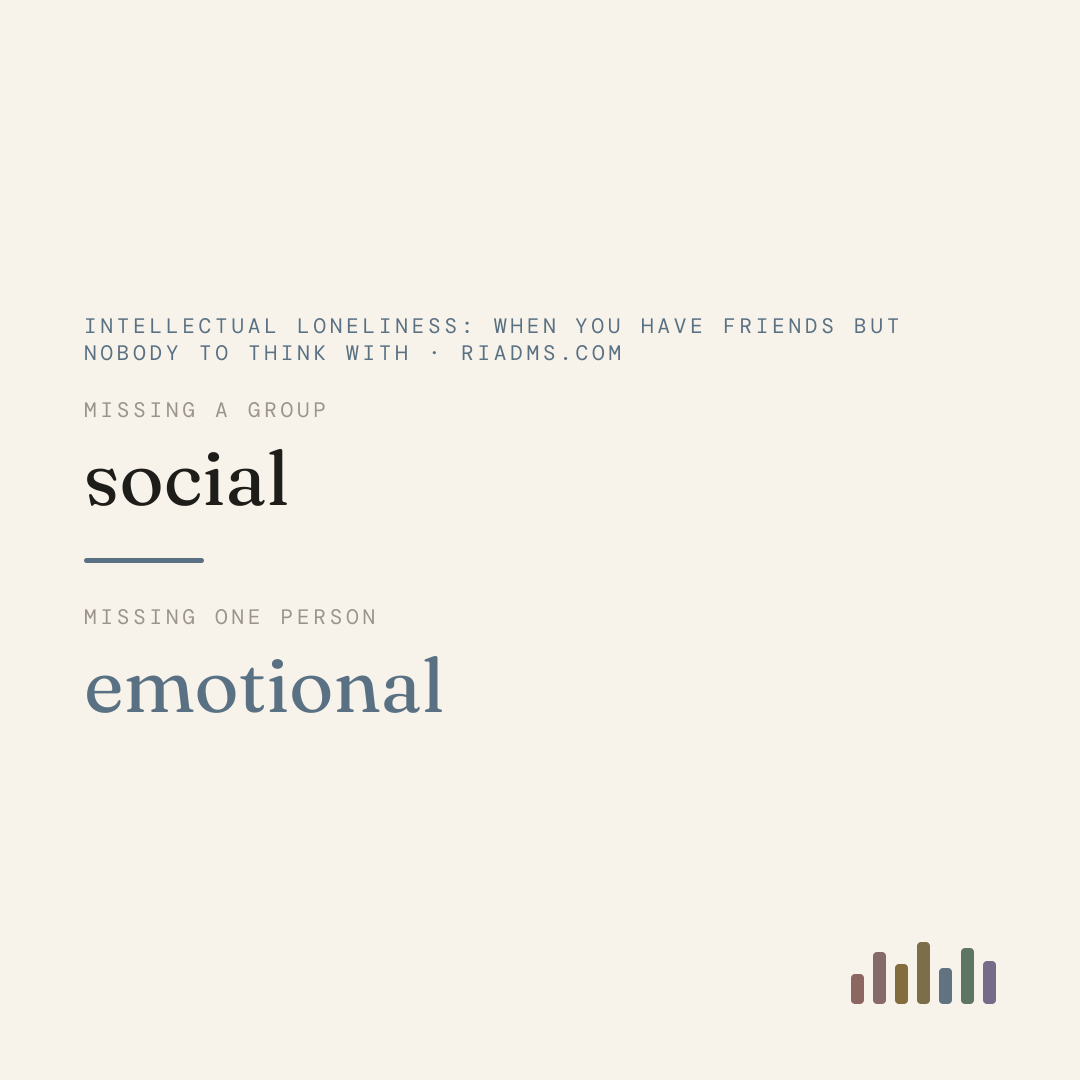
It held up when people tested it. In 1984 a team led by Daniel Russell surveyed university students and found that the two kinds share a common core, the lonely feeling itself, but they come from different gaps. Social loneliness tracked missing friendships. Emotional loneliness tracked missing romantic and intimate ties. Later researchers split the emotional half again, into family and romantic loneliness, and built a scale for adults that measures all three.
There’s one more idea under all of this that’s worth having. Psychologists usually define loneliness as the gap between the relationships you have and the ones you want. Not a headcount. So you can be lonely when you’re surrounded by people, and fine when you’re alone. If you’ve been telling yourself you have no right to feel this because you have people, the definition disagrees with you.
That split explains why “just go out more” does nothing for someone who’s missing one close person. They were never short on people.
But I keep meeting people, and I’m one of them, who don’t fit either box. Socially fine. One person who knows them completely, also fine. And still, very specifically, alone with their own thoughts.
come think with me
one letter a week.
the word for one feeling you’ve had but couldn’t name, and why it works that way. the same thing you just read, in your inbox, once a week.
- one letter a week, about a ten minute read
- all nine printable workbooks, free
- the research, with its caveats kept in
- hit reply and it reaches me. i read every one
no pressure, no spam, no gatekeeping. unsubscribe anytime · riadumitrescu.substack.com
all of this is free and it stays free. if it gave you a word you didn’t have, you can buy me a coffee.
the third one, which is mine and not science’s
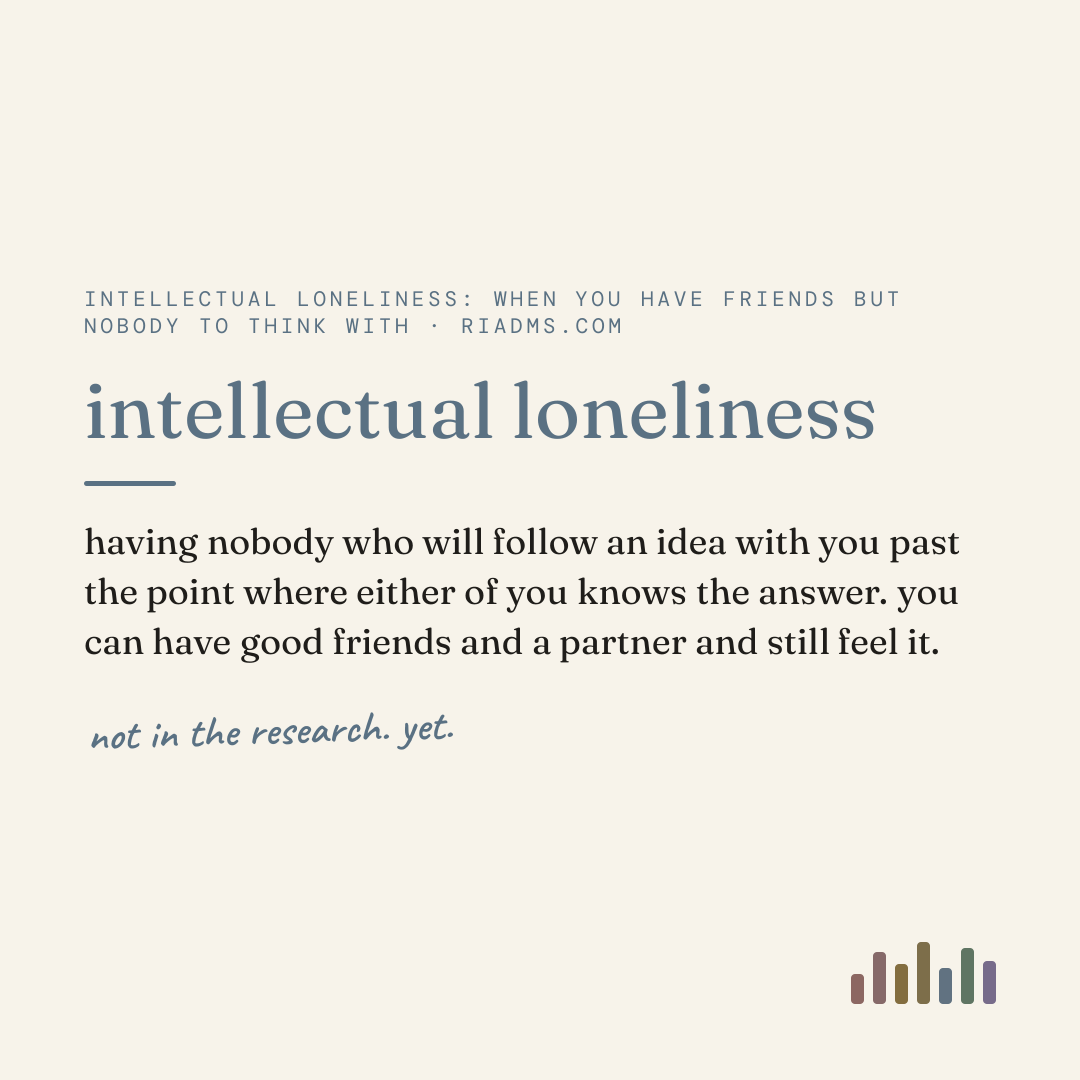
Intellectual loneliness is having nobody who will follow an idea with you past the point where either of you knows the answer.
So what isn’t it?
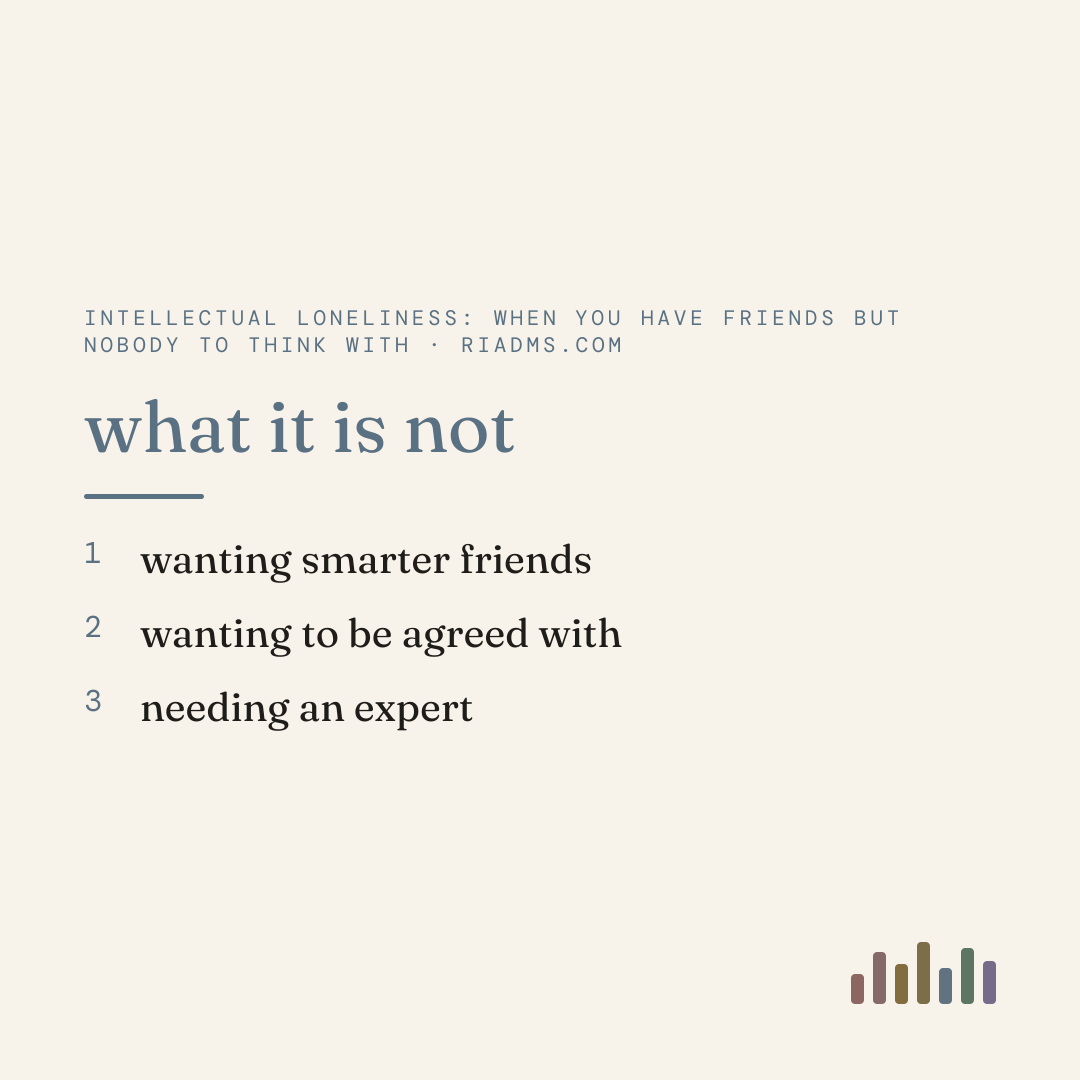
It’s not wanting smarter friends. That’s the assumption people make, and it’s why this is rarely said out loud, because it sounds like snobbery. It has nothing to do with anyone’s intelligence. A lot of very smart people can’t do this at all.
It’s not about being agreed with. It’s the opposite. Agreement ends the conversation. What you’re missing is someone who’ll push back on your idea until it turns into something you could act on.
It’s not needing an expert either. A lecture can be helpful, but it’s not what you’re looking for. You want to build something with someone, two unfinished ideas put together with no certainty behind either of them.
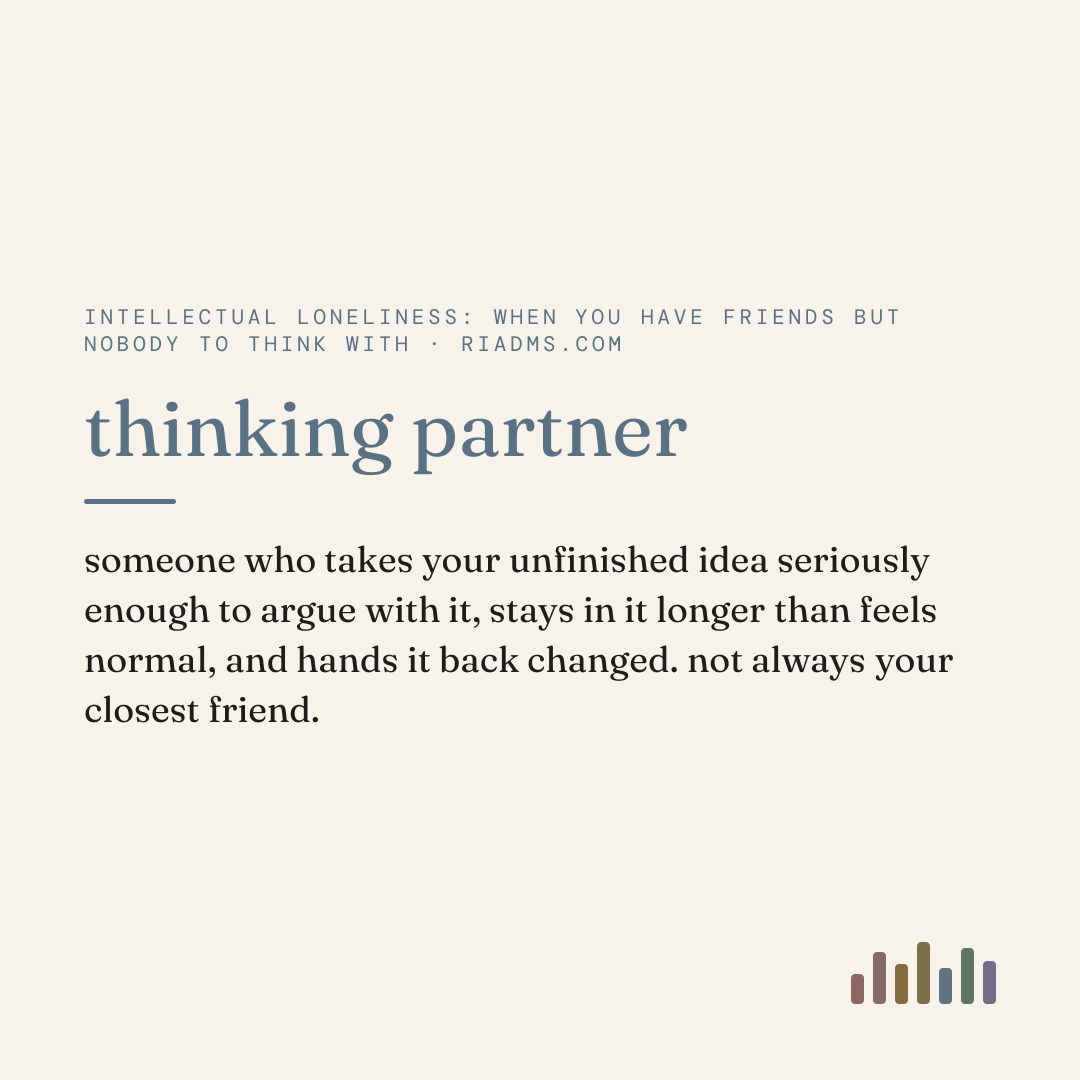
So what is it? You have a thought that isn’t fully formed, and it might even be wrong. You want to share it with someone who’ll take it seriously enough to disagree, stay in it longer than feels comfortable, and hand it back to you changed. That person is a thinking partner. They don’t have to be your closest friend.
the tell is editing, not sadness
Here’s how you know you’re in it. You probably won’t feel sad. You’ll feel misunderstood, and you’ll notice you’re editing.
You’ve got a pile of ideas. Maybe you want to publish a book or start a YouTube channel, and you’ve already thought through ten ways to do it. But you can’t walk into a dinner and have that conversation with everyone. So you shrink it. You make it smaller and more plausible, and you say “anyway, it’s not that deep” before anyone else can.
Then you feel unseen. You feel like the only person on the planet thinking like this. But they never saw it, because you never showed them. That’s the trap. The editing is what makes you lonely, and the loneliness is what makes you edit.
why nobody gives you this, and it isn’t their fault
Two reasons, and neither of them means your friends are shallow.
The first is that adult conversations move toward closure. Somebody brings up a topic and everyone else’s job is to resolve it. Give advice, agree, wrap it up, move on. Sitting in an open question for forty minutes with no conclusion reads as a conversation that failed. I see this in arguments too. A lot of them are two people who can’t stand a question staying open. Psychologists have studied the personal version of this, the need for closure: a wish for a firm answer and a discomfort with ambiguity, and it goes up when people are tired or rushed. So the very thing you need, following an idea with no conclusion in sight, is the thing most rooms reward you for ending.
The second is time. Thinking with someone takes at least an hour, and the first thirty minutes are both of you saying the obvious thing. Most adult meetups run ninety minutes or less. And you probably haven’t seen this person in a while, so most of that goes to catching up on their life. And it should.
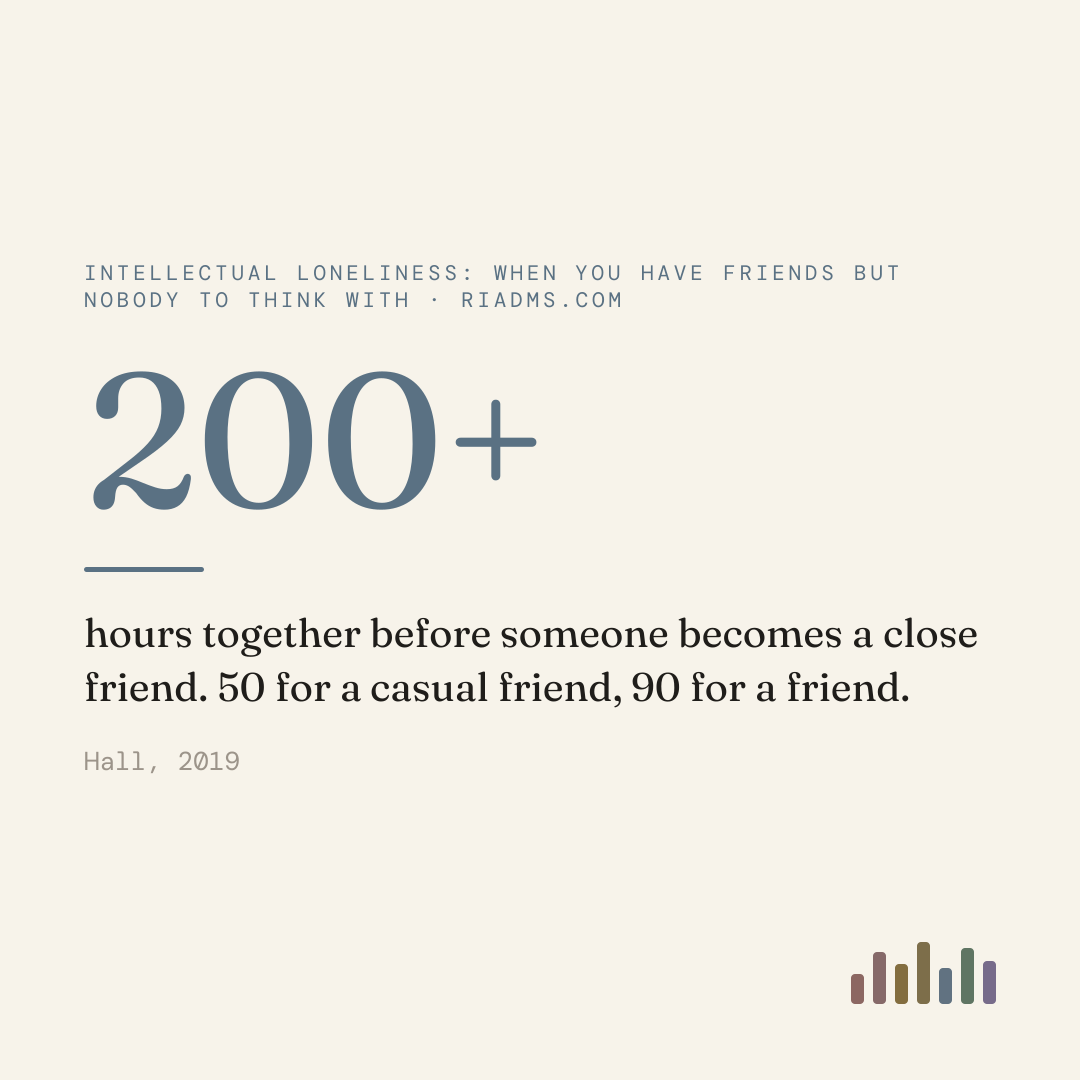
Friendship itself runs on hours. Jeffrey Hall at the University of Kansas tracked adults who had just moved to a new city and students in their first weeks of university. It took roughly 50 hours together to go from acquaintance to casual friend, 90 to become a friend, and more than 200 to become a close friend. And the kind of time mattered. Hanging out and joking around counted. Hours spent working side by side counted much less.
That’s why these conversations happen at night in college. You’ve just finished an exam, or you’re avoiding one. You’re tired, you don’t care what time it is, and you just want someone to talk to. Nobody is keeping score of the hours, so the hours happen.
So I want to take something off you. If you’ve been feeling like you’re too much, or like you should want less from a conversation, I don’t think that’s true. You want a normal thing. The way adult friendship is set up just doesn’t leave room for it.
why i noticed it early, as an asexual person
I think I noticed this earlier than most people, and it’s because I’m asexual.
I don’t have the usual physical pull toward people, so the main attraction I feel is intellectual. It’s the long conversation where we don’t reach a conclusion but I come out understanding the world a bit more through someone else. I’ve been drawn to a lot of minds in my life, and I’ve had a lot of these connections. I’ve also realized I can’t have them with most people. A lot of people seem to want them. Fewer open themselves up to having them.
When your main way of connecting is through someone’s mind, not having a mind to be with isn’t a small thing. It’s the loneliness.
I spent a while confused by it. There were stretches when I didn’t have anyone to bounce ideas off, and I felt empty, and I’d actually choose not to go out. I have ADHD, so I’ll get completely absorbed in one thing for a few weeks or even two months. Right now it’s YouTube. That’s why I’m posting so much. In those stretches I barely talk to anyone, because I know I’ll be too excited and have too many ideas that might never turn into anything. What if I wrote a rom-com and made it into a movie. That kind of idea. And I already know the answer I’ll get: the industry will stop you.
Being asexual gave me one more habit. Our community had to build its own words for attraction, because one word was covering several different feelings and it was making people feel broken. So I’m used to this move. When a feeling has no name, you don’t have a personality problem. You have a word problem, and those get fixed in completely different ways.
what actually helps
Ask for it, out loud. This is the one thing that works, and everyone skips it. I’m the kind of person who’ll text you at two in the morning, “are you awake,” and if you are, I’ll be at your door talking about a book I just finished, and then you’ll tell me about yours. You can be less extreme than me. You can say to a friend, “I want to think out loud at you for twenty minutes. I don’t want advice, I want you to argue with me.”
Research says you’re probably underestimating how well that’ll go. In a set of experiments, Michael Kardas, Amit Kumar and Nicholas Epley had strangers talk about deep things instead of making small talk. People expected it to be awkward. It was less awkward than they thought, and they felt more connected and happier than they expected. The gap came from one mistake: people thought the other person would care less about what they shared than they actually did.
Stop auditioning one person for everything. My partner can do these conversations with me sometimes, and it’s one of the things I really appreciate about him. He can’t always. A lot of what I need from people, he isn’t the one to give me, and that’s fine. He’s not meant to be the one person for all of it. You can have friends who are sharp and a little scary to bring an idea to, who pull it apart, and you leave thinking, okay, I need to go think about that. And you can have friends who just want to spend eight hours with you doing nothing in particular. Both are real. Neither one has to be the other.
Do it in writing. You can answer this kind of loneliness with letters. I did this as a teenager and I still do it a bit. If I have an idea, I write it as an essay and send it to people. And now I get some of it from the comments here, because I put ideas out and people write back about them. You can find one person to write back and forth with who doesn’t need to live anywhere near you.
Write even when nobody reads it. Writing a novel no one will read can still give you some of that spark. It can feel like a conversation with your characters, and you learn from them. It doesn’t have to be fiction. And if you do publish it, even better, because then other people’s ideas come back to you.
One honest caution. Sometimes the person is right there and you never gave them the chance, because you decided in advance they wouldn’t get it. It’s worth testing that before you decide you’re surrounded by the wrong people.
keep reading
If you want the source this all stands on, read Weiss’s book. It’s from 1973 and it still reads clearly. For why asking works, read the Kardas, Kumar and Epley paper. And for why adult friendship leaves so little room, I wrote the long version on adulthood and loneliness, and a companion piece on falling for someone’s mind.
So you have good people around you, and you still feel like nobody’s in there with you.
That’s not ingratitude, and it’s not arrogance, and you’re not too much. It’s one specific missing thing. It’s been confusing because you’ve been trying to fix it with more closeness, and closeness was never what was missing. You don’t need to be understood more. You need someone to think with. Those are different needs, and it’s completely okay to want both.
This week, take the thought you’ve been keeping small and give someone the long version. Tell them you don’t want advice. And if you finished this and felt it, the comments under the video are full of people who want the same thing. Go find one of them.


