Some part of you believes that being fully known is the last step before somebody loses interest.
Nobody says this out loud, because it sounds insane when you write it down. You want to be known. It is the whole thing you say you want, and you would say it in a survey, and you would mean it.
But watch what you actually do. You keep a little back. You are slightly better in the first three months than you ever are again, and you know it, and you tell yourself it is just the newness wearing off.
I want to take this one apart properly, because there is a real research literature under it, and it is messier than either the folk version or the reassuring version. One famous study says the thing you are afraid of does happen. A rebuttal in the same journal says the opposite. And in 2025 somebody re-ran the original with eight hundred people and got nothing at all.
the behaviour, before the belief
Before the belief, there is a set of small habits, and you probably do not file them as one thing.
You have a story you tell about a hard year, and it is the smooth version, and you have never told the other one. You round your opinions down. You wait a beat before saying what you think of a film, to check what they thought of it first. You have a rule about how much you can text back before it gets embarrassing. When someone asks how you are, there is a true answer and a shorter answer, and you give the shorter one to people you are trying to keep.
You do not call any of that fear. You call it mystery, or independence, or not wanting to be too much.
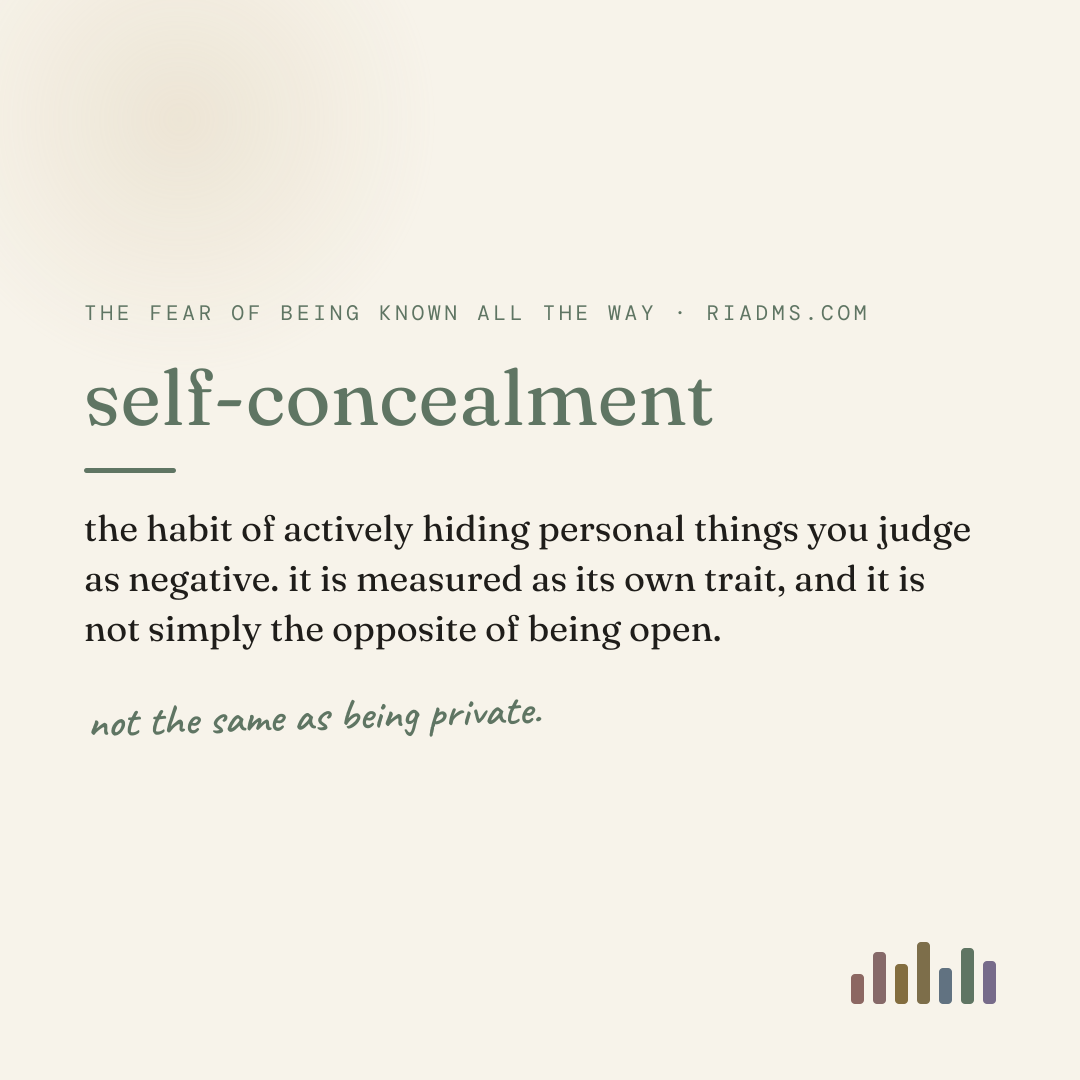
It has a name and a scale. Larson and Chastain built a ten-item measure of self-concealment in 1990, and the useful part of that paper is conceptual rather than clinical: self-concealment came out as its own measurable thing, not simply the low end of self-disclosure. Being closed is an act. It is not what is left over when you stop being open.
come think with me
one letter a week.
the word for one feeling you’ve had but couldn’t name, and why it works that way. the same thing you just read, in your inbox, once a week.
- one letter a week, about a ten minute read
- all nine printable workbooks, free
- the research, with its caveats kept in
- hit reply and it reaches me. i read every one
no pressure, no spam, no gatekeeping. unsubscribe anytime · riadumitrescu.substack.com
all of this is free and it stays free. if it gave you a word you didn’t have, you can buy me a coffee.
the song
Here is where I think the belief comes from, and it is not from anything anyone did to you.
You have watched something get less good as it got more familiar. Everyone has. The song you played until it stopped working. The view from the window you no longer see. The joke that killed the first time and was dead by the time you told it again.
And then, at some point, without ever saying it in words, you looked at yourself and thought: I am also a thing that can be played too many times.
So you ration. You stay slightly unfinished on purpose.
what habituation actually requires
The song wearing out is real, and it has a name, and I want to be careful with it, because this is the exact place where a metaphor usually gets dressed up as science.
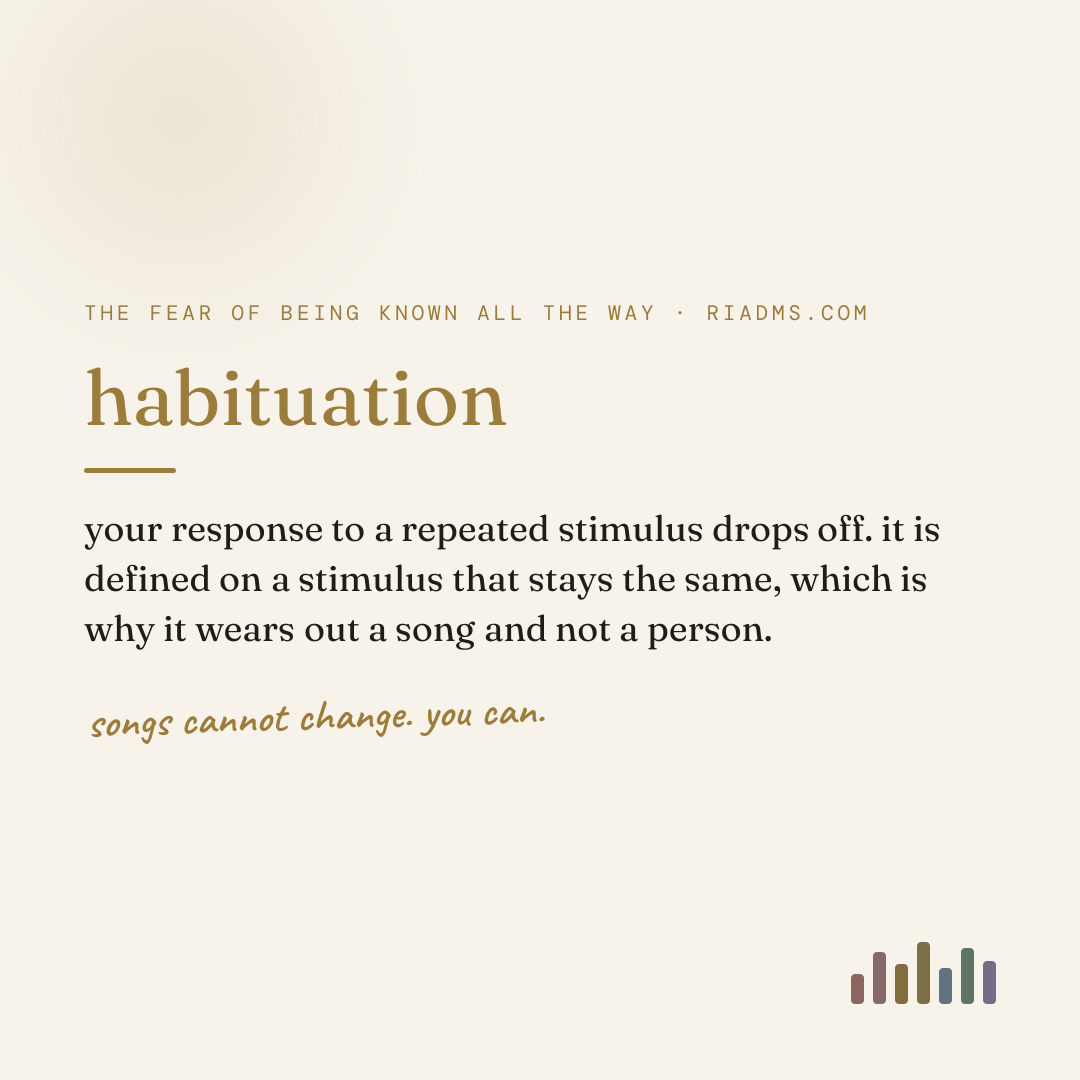
Habituation is one of the oldest and best-characterised effects in behavioural science. In 2009 a group of fourteen researchers published a revised description of it, listing the ten characteristics that define it. Two of the ten do something to this whole idea.
The first is that habituation is defined on a stimulus that repeats without changing. That is the setup. A tone, a tap, a light, delivered again and again, identical each time, and the response to it drops off.
The second is that the drop-off is stimulus-specific. Present something different and the response comes back. They call that dishabituation, and they treat the specificity as the thing that separates habituation from ordinary fatigue.
So here is the honest version. Your song wearing out is habituation. The window is habituation. Both of those are correct and neither is a metaphor. But there is no characteristic in that list about a person, and nothing in that literature tests habituation to a partner. The work is on reflexes, startle responses, sea slugs and worms. Extending it to being known by somebody is an analogy. It is not a finding, and anyone who tells you it is has not read the list.
the part where the analogy breaks
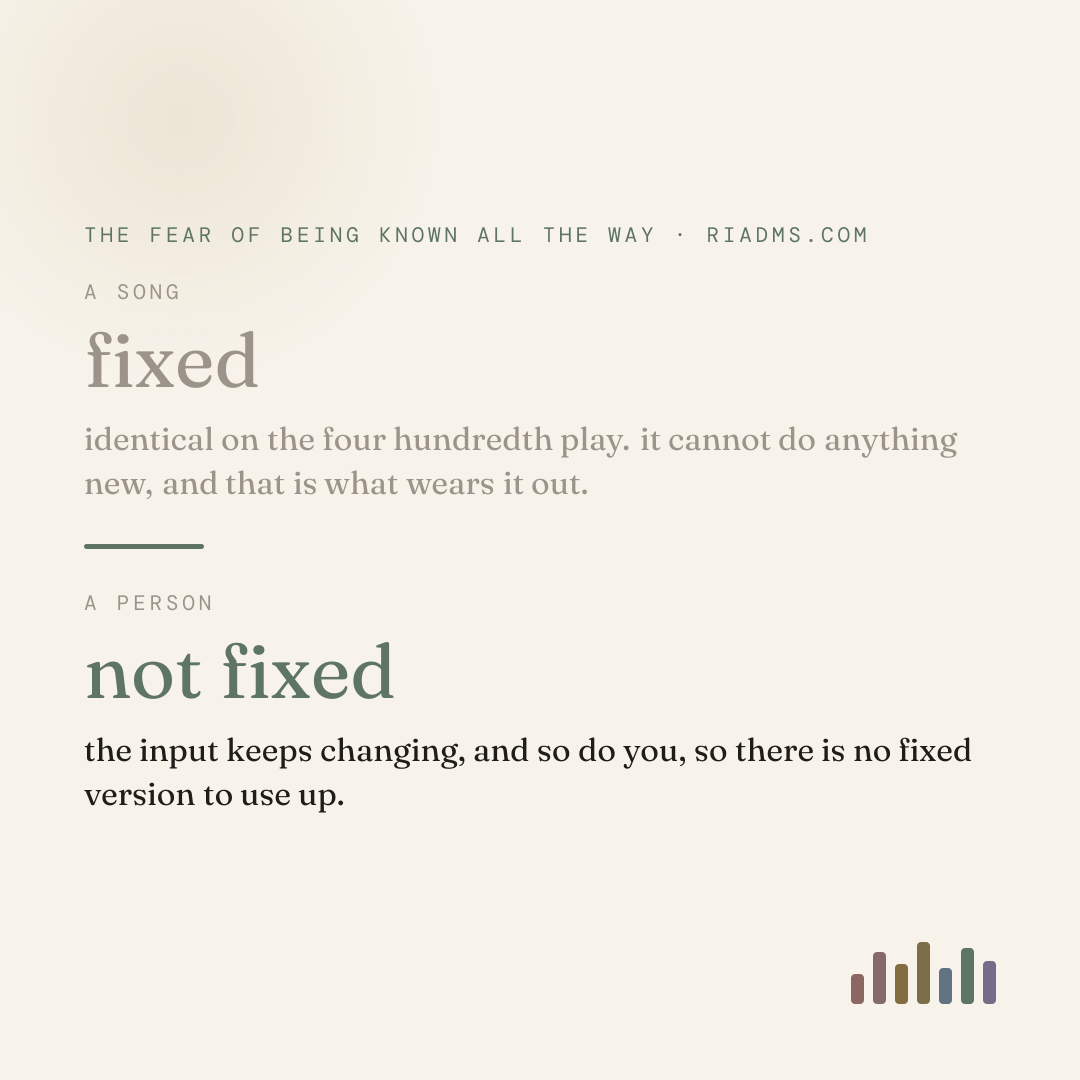
The thing about a song is that it cannot do anything new.
That is what a song is. A fixed object, identical on the four hundredth play, and the only variable in the room is you. Same with the window. The view does not learn anything between Tuesday and Thursday.
A person is not that, and I do not mean it in the inspirational sense. I mean it structurally. The input is not constant, so the condition the whole effect is defined on is not present.
There is research that goes further than that. Drigotas, Rusbult, Wieselquist and Whitton called it the Michelangelo phenomenon: across four studies, people who felt affirmed by a partner were closer to the self they had wanted to become. It is correlational, so read it as association rather than cause. But it describes something a song structurally cannot do. The person changes, and part of what changes them is the relationship they are being known inside.
the study your fear is quoting, and what happened to it
Now the interesting part, because the fear does have a citation, and almost nobody who repeats it knows how the story ended.
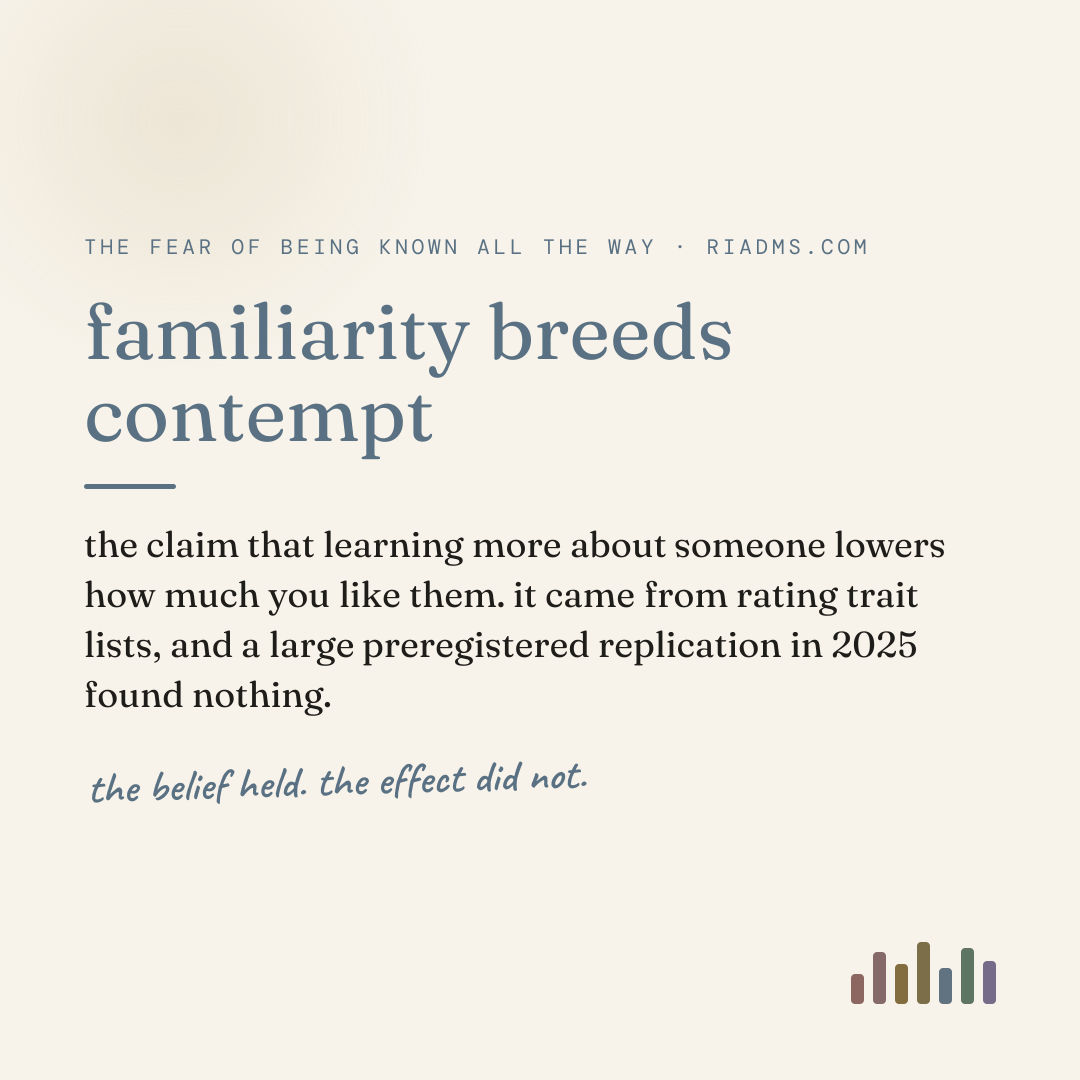
In 2007, Norton, Frost and Ariely published Less is more: the lure of ambiguity, or why familiarity breeds contempt. People rated lists of traits about a stranger, and the more traits they saw, the less they liked the person. The proposed mechanism was a cascade: hit one point of dissimilarity, and everything after it gets read as more dissimilarity.
That is your fear, in a journal, with an effect size.
Four years later Reis, Maniaci, Caprariello, Eastwick and Finkel published Familiarity does indeed promote attraction in live interaction in the same journal. They put strangers in a room instead of handing them a list. The more people interacted, the more they liked each other. Three things carried the effect: perceived responsiveness, comfort during the conversation, and perceived knowledge.
Then it got properly argumentative. Norton and colleagues replied that live-interaction studies were not everyday interaction either. Reis and colleagues replied to the reply. Ullrich and colleagues came in from a third direction in 2013, arguing that if people simply average the information they get, the correlation between liking and number of traits should be zero, and that their data fit that better.
Two things closed it out. In 2015 both camps co-authored a paper together, an adversarial collaboration, concluding that whether familiarity helps or hurts depends on the stage of the relationship. And in 2025 a team ran a preregistered replication with 801 people.
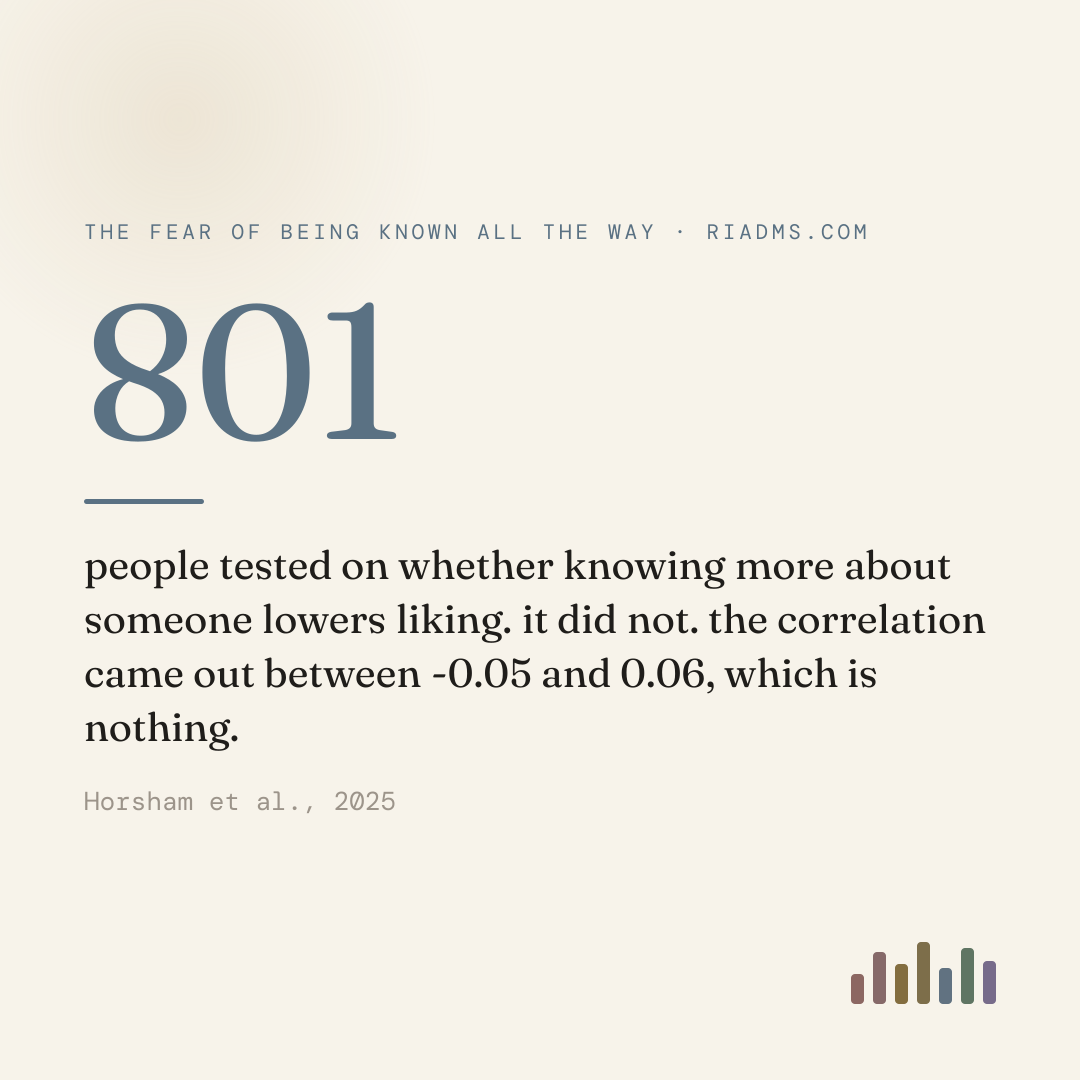
Here is what they found, and it is worth reading twice. The belief replicated: people confidently expect that they will like somebody more once they know more about them. The effect did not. The correlation between number of traits known and liking came out between -0.05 and 0.06, which is nothing. The original range had been -0.43 to -0.005, which is worth noticing too, because even in the original the low end was already zero.
So the sentence you have been running your relationships on is a real study. It just did not survive being tested properly, and its own authors had already agreed the picture was more complicated a decade before that.
what does wear out, and it is not you
I do not want to pretend nothing fades. Things fade, and telling you otherwise would be useless.
The paper that applies adaptation to relationships is Bao and Lyubomirsky, 2013. Be clear about what it is: a proposal and a research agenda, not an experiment. It reports no new data. But its mechanism is the thing I want you to take, and it is not the one you assumed. What they describe fading is the rate of new positive events a relationship produces, and the emotions those events generate. Early on there are constantly new ones. Later there are fewer. The events are the mediator. The partner is not the stimulus.
The empirical work points the same way. Tsapelas, Aron and Orbuch followed married couples and found that boredom at year seven predicted lower satisfaction at year sixteen. Look at what the boredom items asked about: doing the same things all the time, and rarely getting to do anything exciting together. That is a shortage of new experience. It is not a surplus of being known.
Which means the rationing does not even address the risk. If what erodes is novelty of experience, holding back the truth about yourself does nothing for it, and costs you the other thing.
the loop that actually builds it
Against all of that, the disclosure literature is unusually clear.
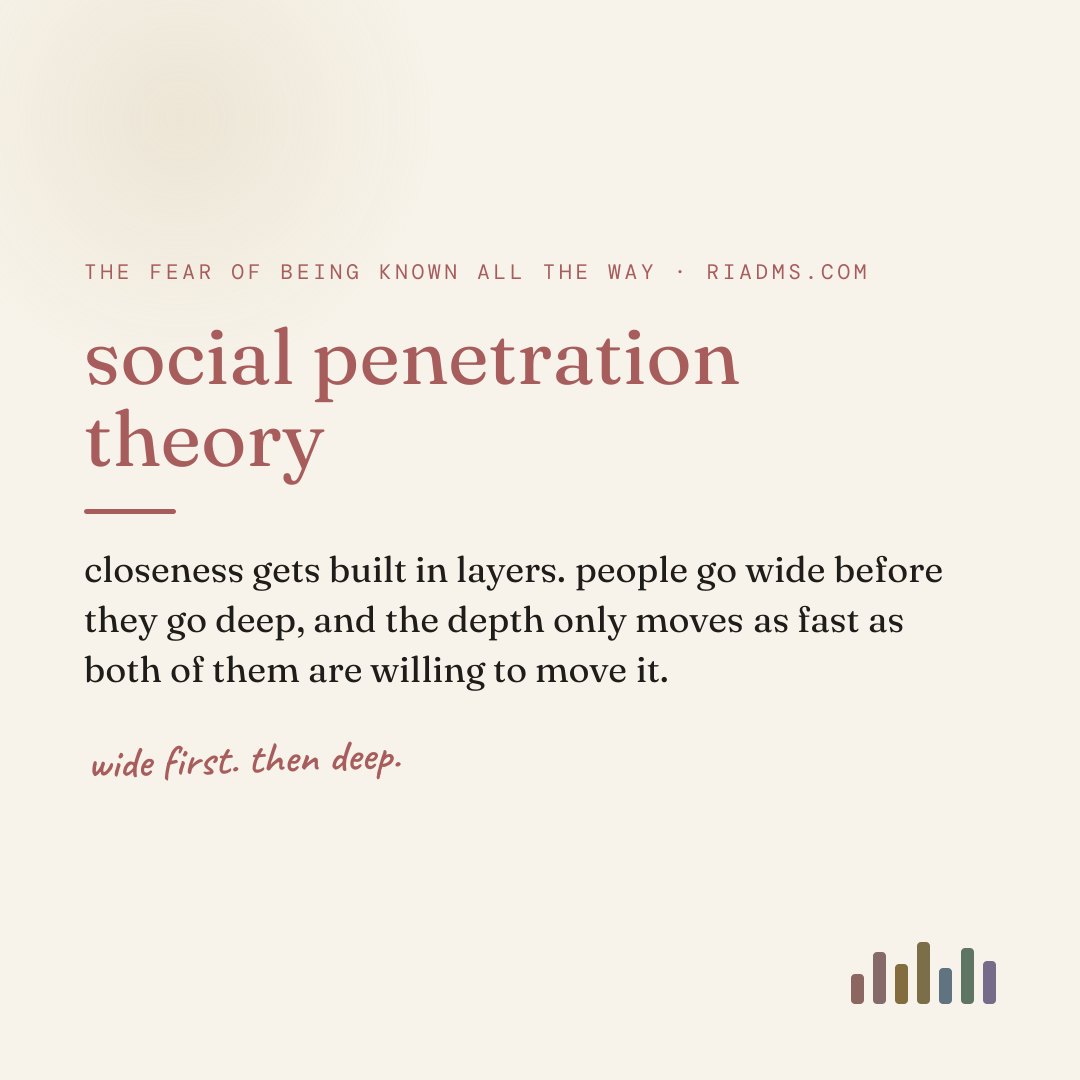
Altman and Taylor’s 1973 Social Penetration is where the layers model comes from: relationships develop by disclosure going wide first and then deep, at a pace both people set. Collins and Miller’s meta-analysis then found three things, and all three run against the fear. People who disclose more are liked more. People disclose more to those they already like. And people like others as a result of having disclosed to them.
But volume is not the working part, and this is the correction I would most want you to have.
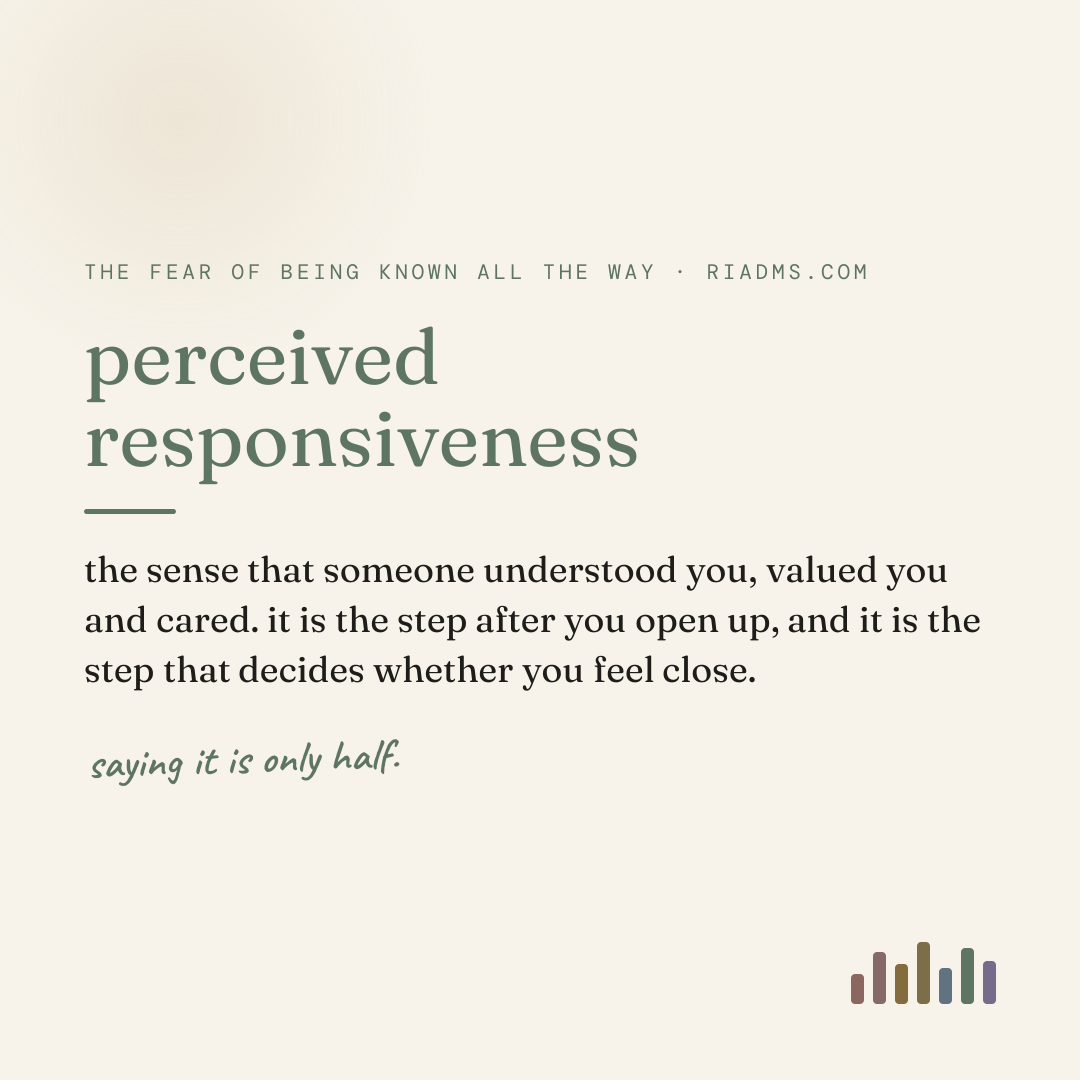
Laurenceau, Feldman Barrett and Pietromonaco ran diary studies of real interactions and found that intimacy is built from your disclosure and theirs, with the feeling that the other person understood and valued you carrying part of the effect. Partly, not wholly, and I am not going to overstate it. But notice that Reis and colleagues arrived at perceived responsiveness independently, from the familiarity side. Two separate literatures landing on the same variable is not nothing.
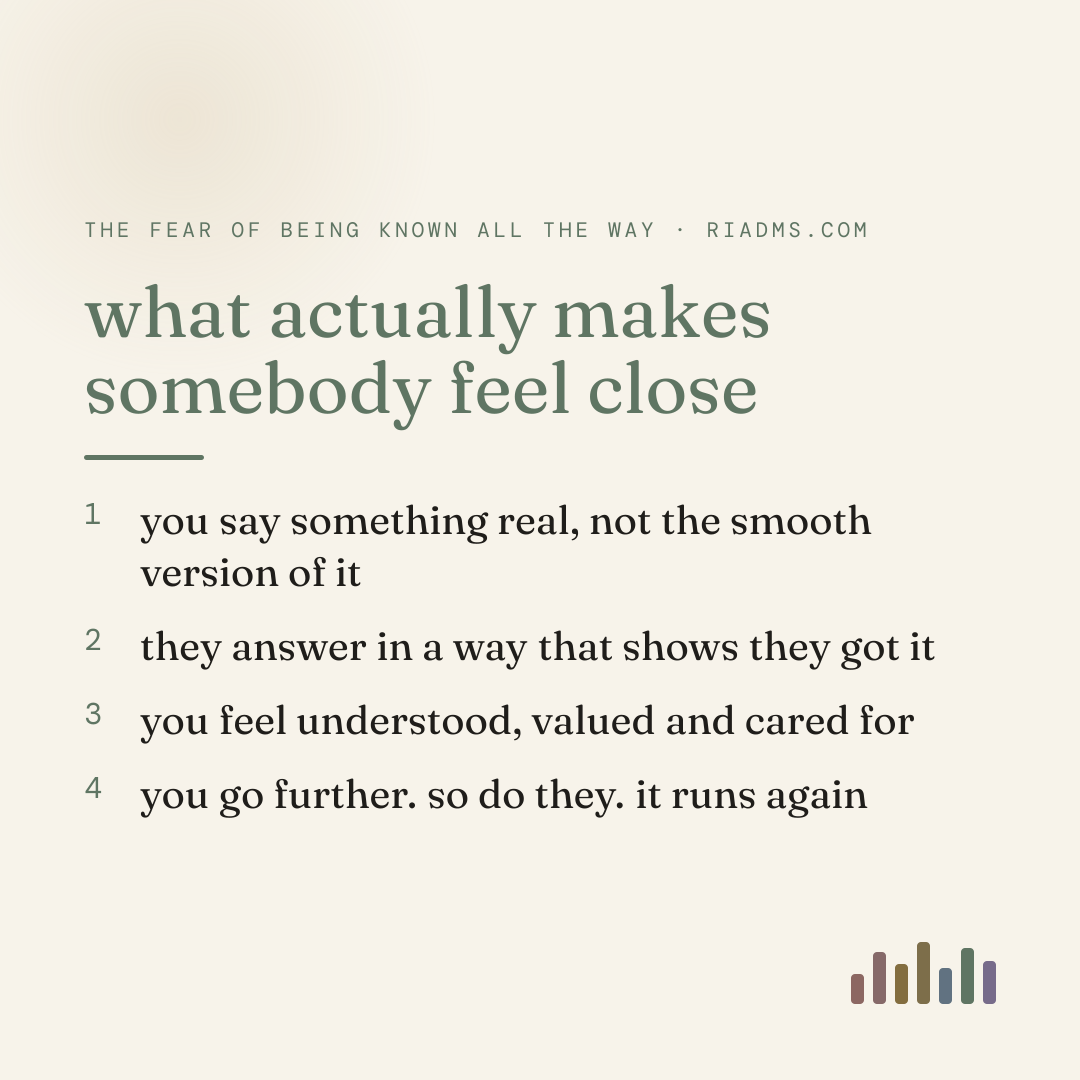
Sprecher and colleagues found the same shape in the turn-taking result: reciprocal, back-and-forth disclosure produced more liking than one person opening up while the other listened. And studythe 36 questionsA set of escalating questions shown to build closeness between strangers through mutual self-disclosure, proof intimacy can be built deliberately.what are the 36 questions that lead to love? →Aron et al., 1997 ↗ work by Aron and colleagues is escalating reciprocal disclosure, which produced more closeness than small talk in 45 minutes. Worth saying plainly, since the internet never does: the authors called those preliminary findings, and what they measured was closeness in a lab, not people falling in love.
So if you have opened up once and it went badly, the reading you probably took is that you were too much. The likelier reading is that you said it to somebody who did not answer. Openness aimed at a person who does not respond is not intimacy. It is exposure. Those feel identical from the inside and are not the same event.
you are the worst-placed person to judge your own openness
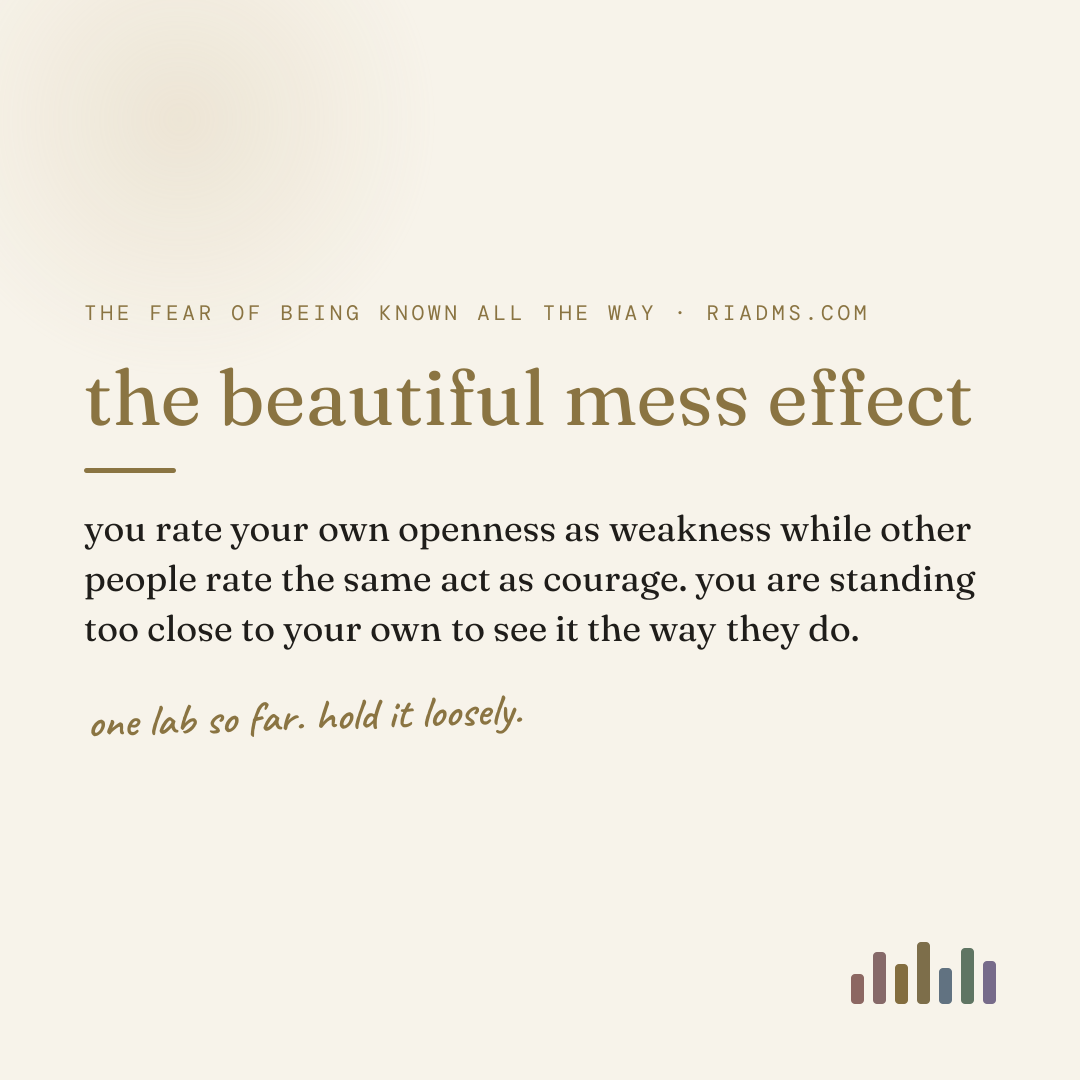
Bruk, Scholl and Bless ran seven studies on confessing love, admitting imperfections and asking for help, and found a consistent gap. Judging your own act of showing vulnerability, you see weakness. Judging the identical act in somebody else, you see courage. Their explanation is distance: your own is right in front of you and concrete, so the specific ugly details dominate, and someone else’s arrives further away and more abstract.
Even at that strength it is worth having, because it names an asymmetry you cannot see from where you are standing. The person you are rationing yourself in front of is not running your assessment of you.
keep reading
If you take one book, take How to Know a Person, because being known needs somebody doing the knowing, and it treats that as a skill rather than a temperament. If you want the argument this page is not making, read Mating in Captivity, where Esther Perel makes the strongest case that closeness and desire pull against each other and some distance is load-bearing.
And the one study to actually read is the 2025 replication. Ten minutes with a paper reporting that people firmly believe knowing more makes them like someone more, and that the effect they were afraid of measured out at roughly zero, does something no reassurance can.
Nearest chapters: the five types of intimacy for what you are actually rationing, and why we should fall in love slowly for the pacing question underneath all of this.
track three
So here is the correction I would make.
Maybe you are not at risk of being overplayed. You are at risk of never letting anyone get past track three.
That is the real cost, and it is not the one you were guarding against. You were guarding against being used up. What happens instead is that people meet the curated version of you, find it pleasant, and leave anyway, because a curated version is not enough to stay for. And then you read that as proof. You think it confirms the thing you were afraid of, when it was caused by what you did about the thing you were afraid of.
Being interesting is what makes somebody stay for a season. Being known is the only thing that has ever made anybody stay for a life.