I can’t tell if someone likes me. I don’t think I’m bad at it. I think I don’t have the equipment.
I’m asexual, so the thing that fires in other people when somebody is interested doesn’t fire in me. That small physical registration of oh, I might be attracted to this person, and they might be showing me something back. Nothing. So for years I did it the other way, the way you can do it on purpose: the lists. Eye contact. Laughing at your jokes. Leaning in. Remembering something you said.
Then I went and read the research on whether the lists work, and it’s worse than I expected. They don’t work for me because I’m missing the equipment. They don’t work for you either, and you have all of it.
the number is 28 per cent
In 2015 Jeffrey Hall, Chong Xing and Seth Brooks published Accurately Detecting Flirting in Communication Research. They put 52 pairs of opposite-sex heterosexual strangers in a room, let them talk for ten to twelve minutes, then asked each of them separately: were you flirting, and was your partner flirting?
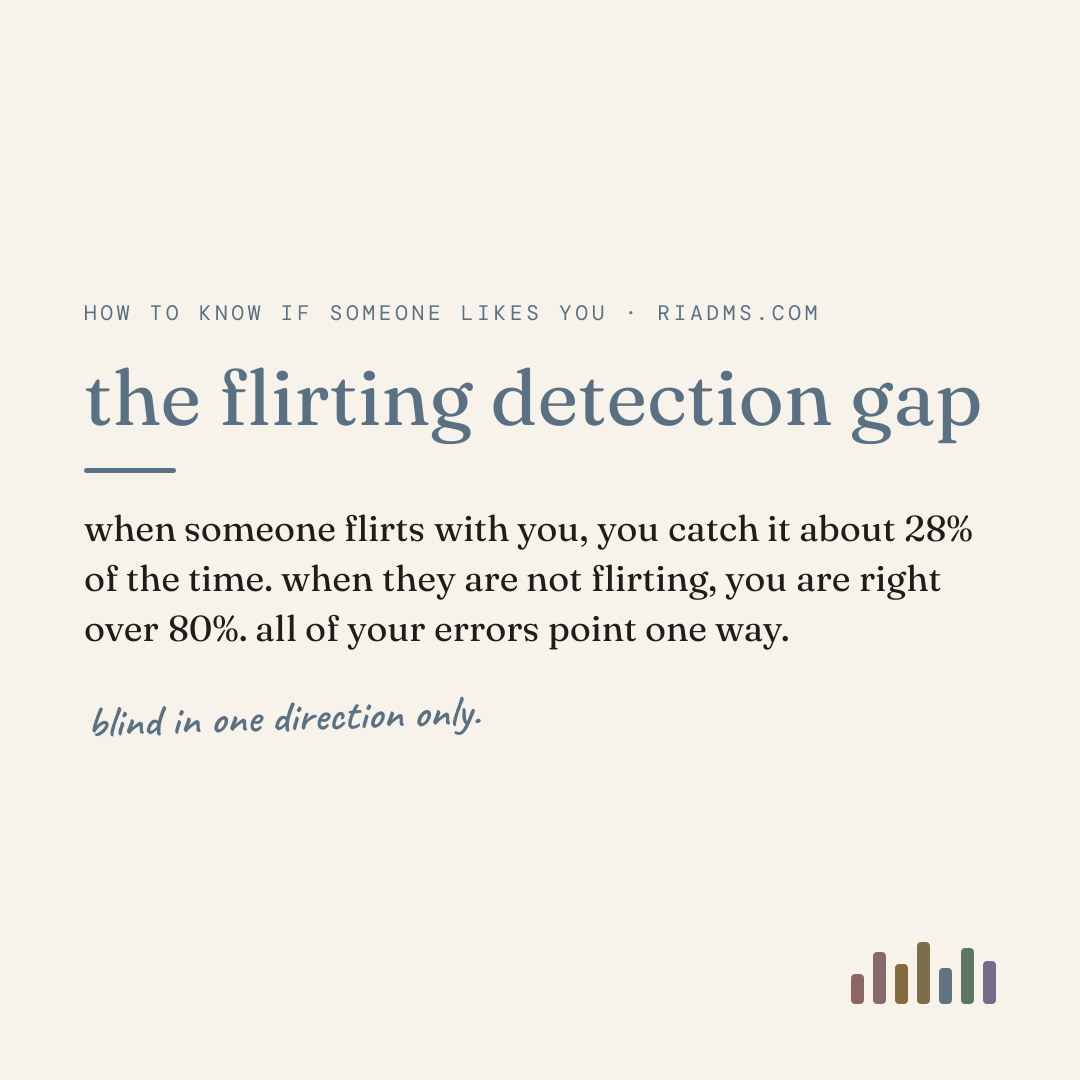
When flirting actually happened, the person on the other side caught it about 28 per cent of the time. The university’s own write-up splits it, and the split is worth having: men got it right 36 per cent of the time and women 18 per cent.
You’d get closer by flipping a coin.
And then the part I think matters more than the number. They were over 80 per cent accurate at spotting when their partner was not flirting. So it isn’t that we’re bad at reading people. We’re good at reading one direction and close to blind in the other.
Sit with that for a second, because it rewrites things. You know how to tell when somebody doesn’t like you. You don’t know how to tell when they do. Which means somebody probably did like you, and you didn’t see it. And that isn’t them failing to show you, and it isn’t you being stupid.
It’s also not only you in the room. A 2022 paper by Samara and colleagues in Current Psychology, Can third-party observers detect attraction in others, showed people videos of daters and asked who was attracted to whom. Across three experiments they landed at chance. So the confidence you have watching your friend’s situationship from the outside, where it’s all so obvious, is not earned.
come think with me
one letter a week.
the word for one feeling you’ve had but couldn’t name, and why it works that way. the same thing you just read, in your inbox, once a week.
- one letter a week, about a ten minute read
- all nine printable workbooks, free
- the research, with its caveats kept in
- hit reply and it reaches me. i read every one
no pressure, no spam, no gatekeeping. unsubscribe anytime · riadumitrescu.substack.com
all of this is free and it stays free. if it gave you a word you didn’t have, you can buy me a coffee.
why the lists fail, reason one
Every sign on every list is also just being a nice person.
Eye contact. Laughing. Remembering. Asking a follow-up. A hand on your arm. Those are behaviours of somebody who likes you, and they’re equally behaviours of somebody who’s warm, or well brought up, or in a good mood, or professionally friendly, or interested in the topic rather than in you.
A test that fires under both conditions isn’t a test. It’s a ritual. It’s something you do to feel like you’re doing something.
And the signs are real. This is the part the video didn’t have room for, and it makes the problem sharper rather than softer. Montoya, Kershaw and Prosser ran a meta-analysis across 286 studies in Psychological Bulletin in 2018, and the behaviours do track attraction: eye contact, smiling, nodding, closer proximity, starting the conversation. So the list isn’t made up.
It’s just that the correlation lives in an average across thousands of people, and you’re trying to read one person on one evening. The signal is real in the population. It’s buried in the noise at your table.
why the lists fail, reason two
The signal is partly manufactured by the person reading it.
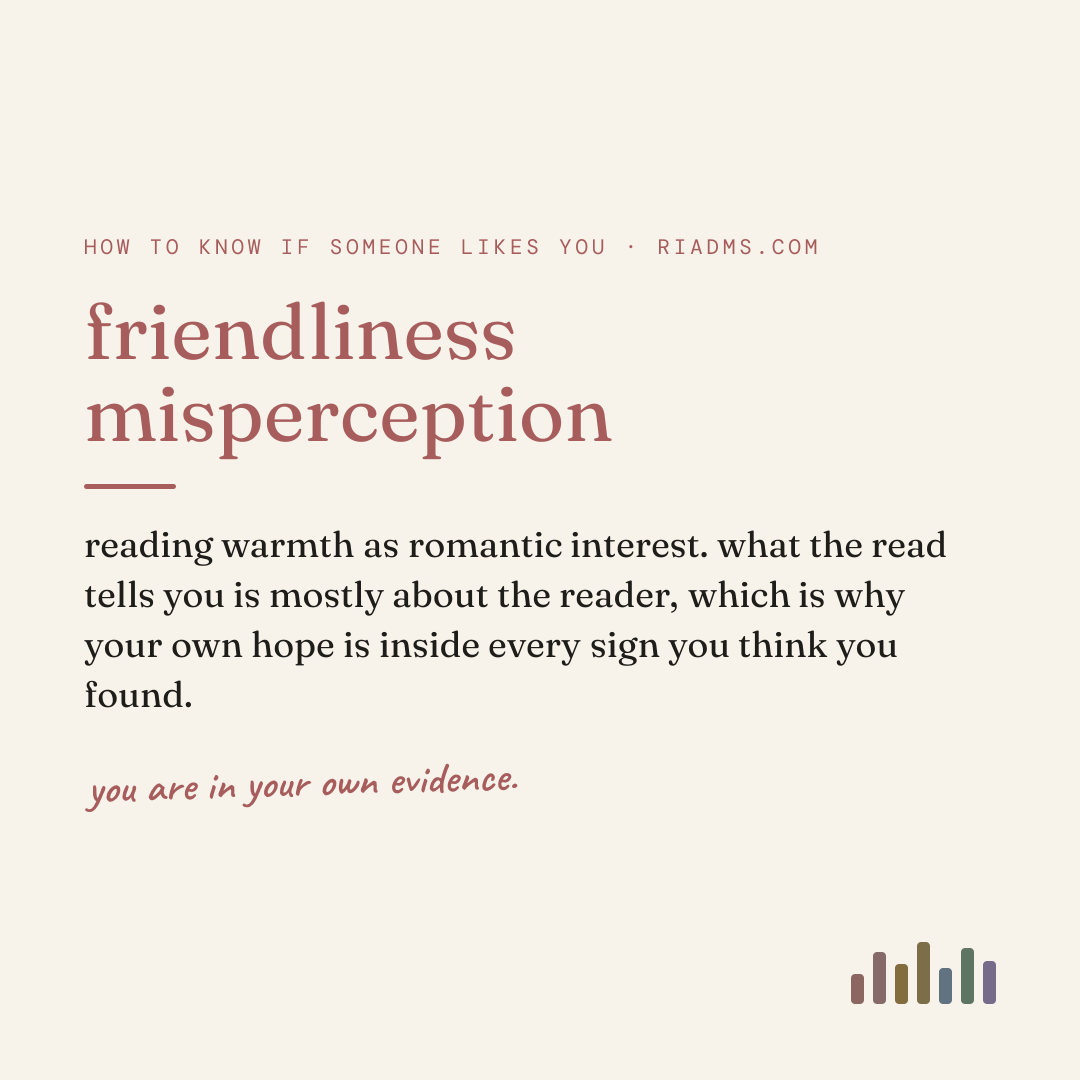
Go back to 1982. Antonia Abbey published Sex differences in attributions for friendly behavior in JPSP, and it’s the study everything since is built on: the same friendly behaviour gets read as sexual interest by some observers and as ordinary warmth by others. What the read tells you about is mostly the reader. Not him. You.
So when you’re going back over what he said, a lot of what you’re analysing is you. Your hope is in there, fused to the evidence, and by the time you get to an answer you can’t separate them.
Which is worth knowing about yourself, in advance. Are you the kind of person who reads interest where there isn’t any, or the kind who reads none where there is? You have a direction. Everybody does. Worth knowing which.
what actually carries information
You can’t read a state. States are internal, they don’t leak much, and they leak even less when you’re the one flooded with hormones.
You can read behaviour. And the behaviour that carries information is the behaviour that costs something, because cost is the one thing politeness won’t pay.
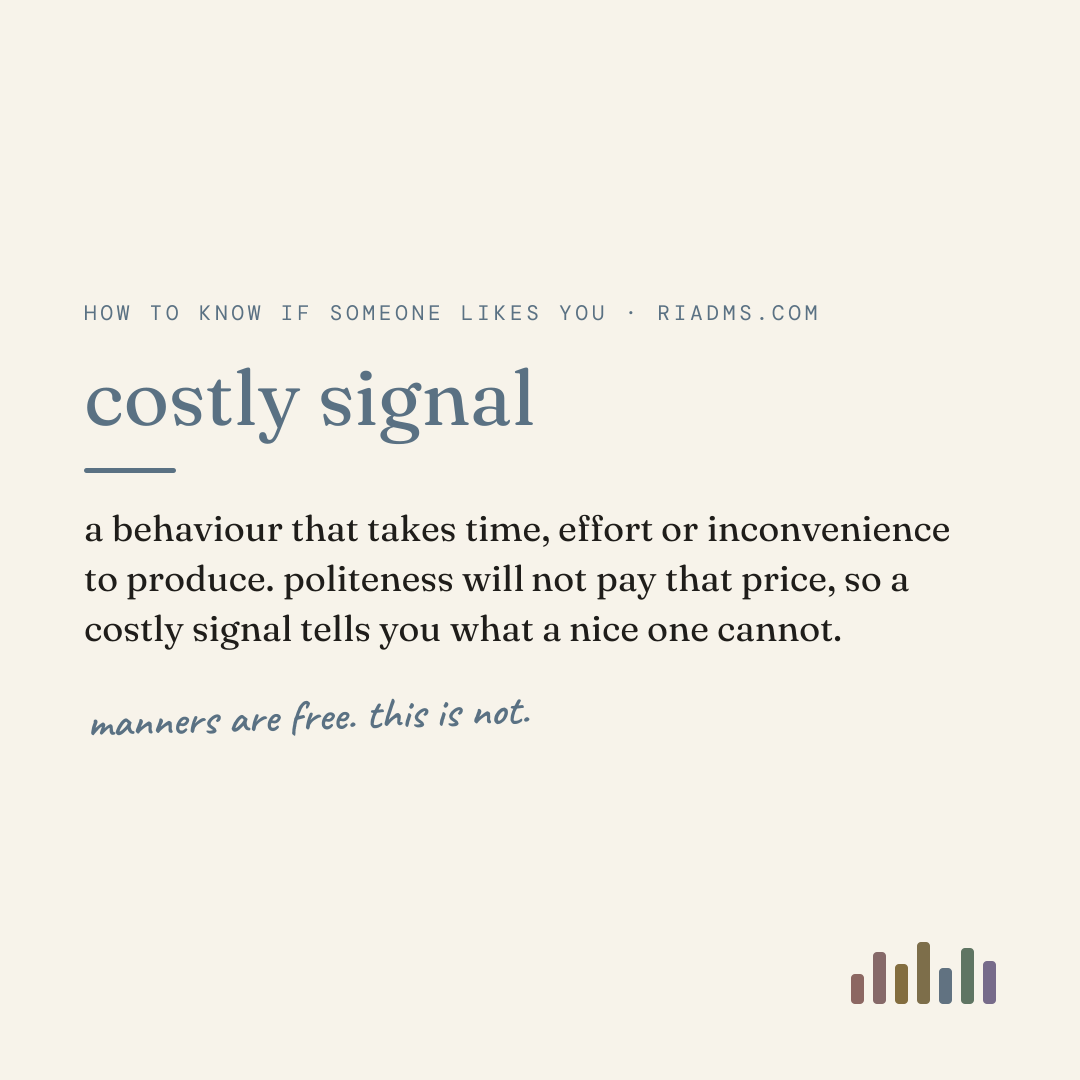
The shape of that idea comes out of biology, where it’s called the handicap principle: a signal is hard to fake when producing it is expensive. Worth saying that the biologists have been arguing about it for fifty years, and Penn and Számadó’s 2020 review makes a serious case that the cost isn’t what keeps signals honest, the trade-offs are. I’m not standing on the evolutionary story. I’m standing on the plain version: what does this behaviour cost the person doing it, and would somebody who was only being polite pay it?
Four things pass.
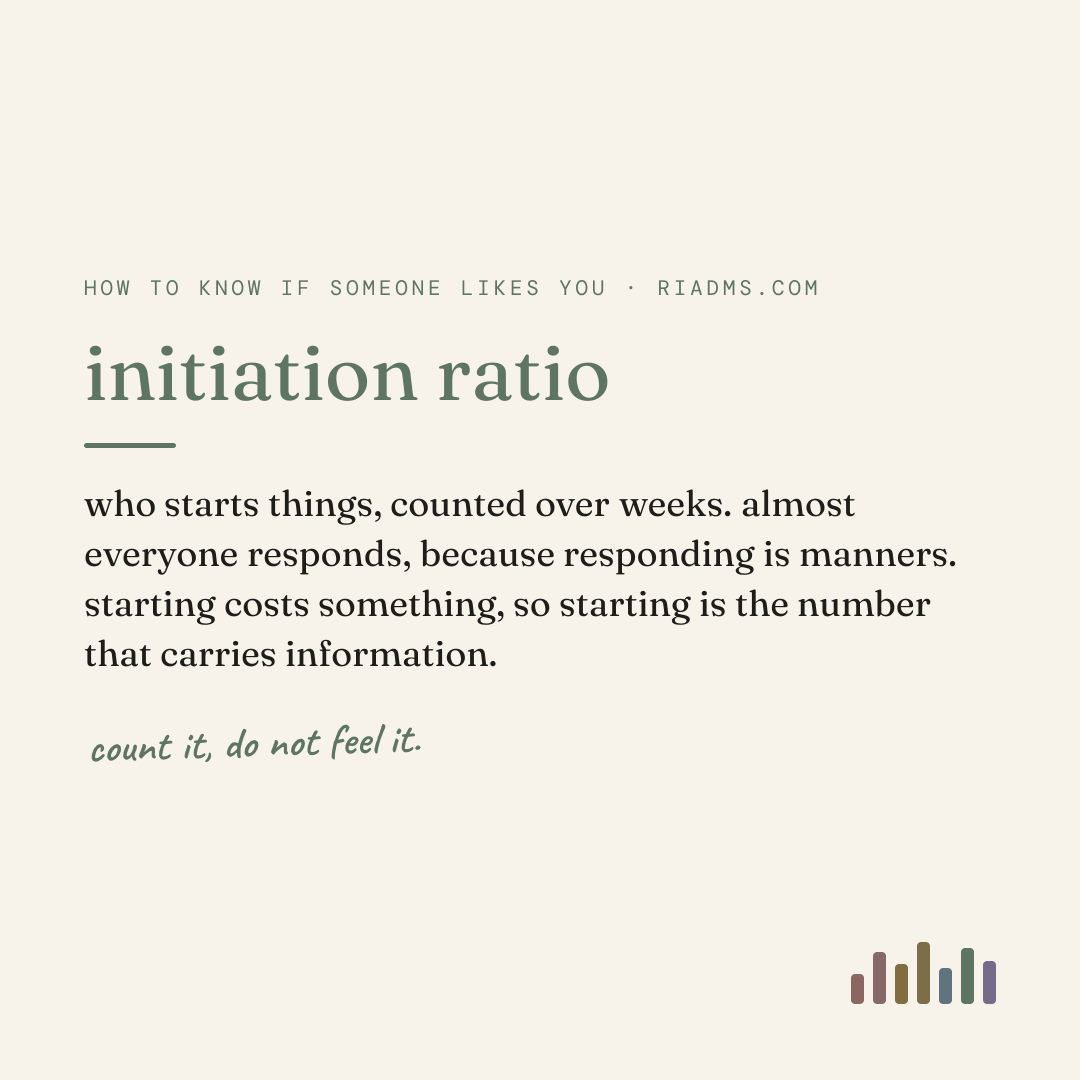
One, initiation and not response. Almost everyone responds, because responding is free and manners require it. The question is who starts. Over the last four weeks, what was the actual count of who started the conversation? Not the feel of it. The count. And if you’ve never found out what happens when you don’t text first, you don’t have data, you have a habit.
Two, cost. Time, inconvenience, rearranged plans, remembering something that took effort to remember. Interest that costs nothing is indistinguishable from politeness.
Three, specificity. Do they engage with the thing you said, or with the shape of a conversation? There’s a real difference between “oh that’s so interesting” and a follow-up built out of the content of what you just told them. The second one can’t be produced while thinking about something else.
Four, direction. Not the level, the gradient. Is there more of all of the above this month than last month, or less? A snapshot tells you almost nothing. A slope tells you a lot, and it’s hard to misread somebody getting more interested in you when you look at the history rather than the evening. This is also where hot and cold shows up: if it spikes one week and collapses the next, and that’s a pattern, that’s your answer too.
so ask. and I know how that sounds
You watched a whole video, or read a whole page, to be told to ask. Let me give you the argument properly, because it isn’t a non-answer.
Reading the signs runs at 28 per cent. So the choice in front of you is not between asking and knowing. It’s between asking and guessing with an instrument that performs worse than chance. Framed like that, asking isn’t brave. Staying is just choosing the less accurate method.
Then why doesn’t anyone ask? I don’t think it’s embarrassment.
In 2011 Whitchurch, Wilson and Gilbert published “He Loves Me, He Loves Me Not…” in Psychological Science. Women looked at profiles of men who’d supposedly already seen theirs. One group was told these men liked them a lot. One was told the men liked them an average amount. The third was told it was one or the other, with no way to know which.
The uncertain group was the most attracted. More than the group told they were liked a lot. And the mechanism was plain: the uncertain women thought about the men more. That’s it. The thinking did it.
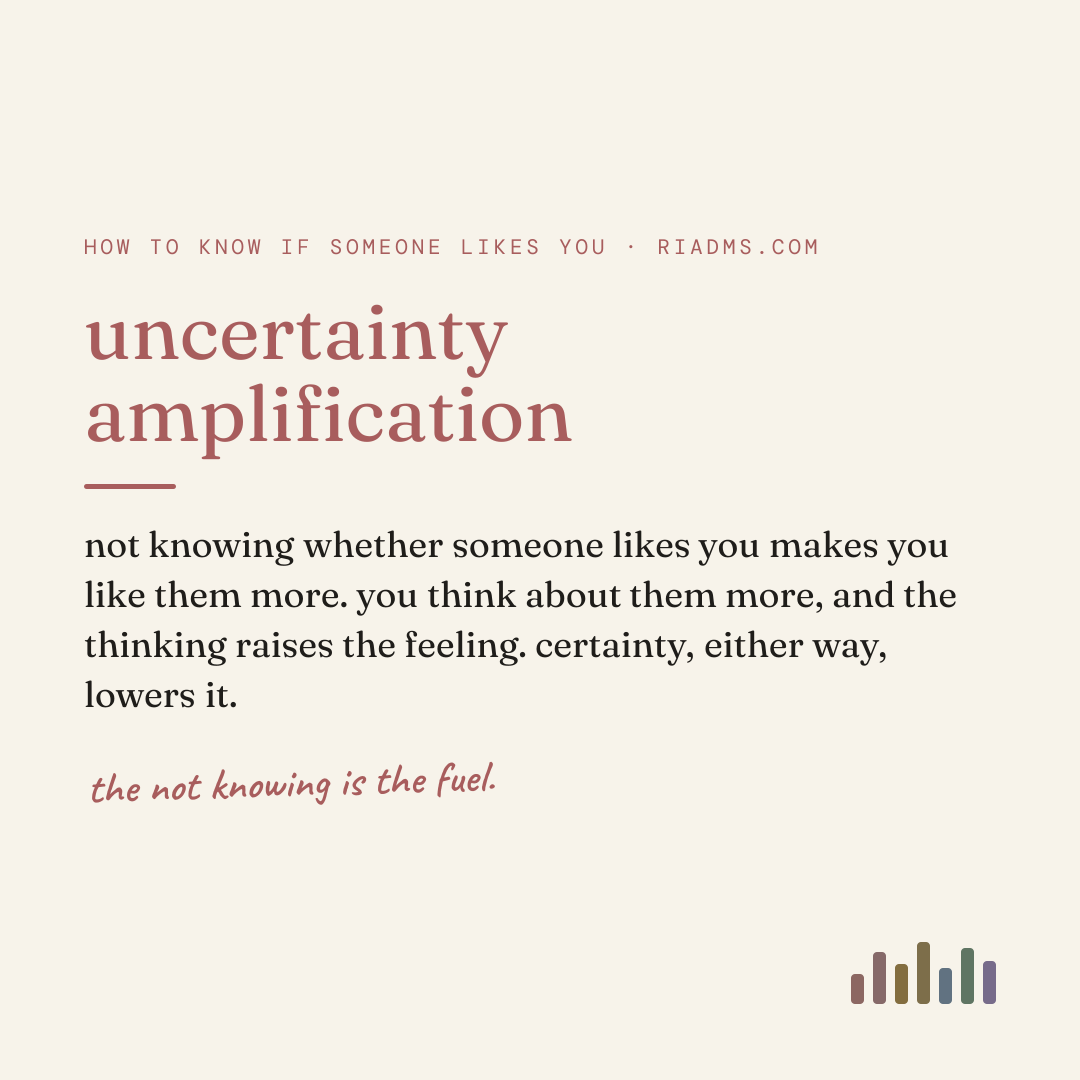
So the not knowing is doing work. It’s inflating the feeling, and the feeling is the good part, the part making your life feel more alive than it did in March. Asking collapses that into one answer, and either answer lowers it.
Which is my real read on the state you’re in. If you’re looking for signs and choosing not to ask, you’re not trying to find out whether they like you. You’re avoiding finding out, because finding out ends something that currently feels enormous. You can disagree with me. I think it’s true.
better ways to ask than “do you like me”
Report your own state instead of asking about theirs. “I genuinely can’t tell if this is a friendship or something else, and I’d like to find out, and if it’s the first one that’s fine, I’ll know what to do with that.” It’s not a question, so there’s nothing for them to deflect. It’s a fact about you, and the only available move is to answer from their own side.
Make an ask that costs something. Not “we should hang out sometime”. A day, a time, and a small inconvenience. The answer won’t tell you they’re in love with you. It will tell you where this sits in their week, which is most of what you wanted. I’d start here, because it’s the cheapest of the three and it still returns real information.
Ask for the category, not the verdict. “Is this a date?” is four words and it’s answerable. “Do you like me” isn’t answerable even by somebody who does, because nobody knows which of the fifteen meanings of like you mean.
And if the answer is no, you’ve lost the ambiguity. Going by the research above, the ambiguity was most of what was hurting you.
keep reading
If you read one thing, make it Hall, Xing and Brooks. It’s the 28 per cent and the 80 per cent in one paper, and the asymmetry is the finding that changes what you do.
If you want the one that explains your own behaviour rather than theirs, it’s Whitchurch, Wilson and Gilbert. Four pages, and you’ll recognise yourself in the uncertain condition.
And if what you’re actually holding is a feeling that got bigger the less you knew, that has a name and its own page: limerence.


