You’re having a completely normal day. Nothing bad happened. You slept okay, you ate something, the people you love are fine. And then, out of nowhere, a wave of dread. Or a heaviness in your chest. Or the specific flavor of sad that has no story attached to it at all.
So your brain does what it always does. It looks around for a reason. And it finds one, fast. “I’m sad because my life is going nowhere.” “I’m anxious because that text meant something.” “Everyone secretly finds me annoying.” It hands you that with total confidence, like it was the truth surfacing.
Here’s what I want you to understand. That reason is almost always invented. Not the feeling. The feeling is completely real. But the story your brain wraps around it gets made up after the fact, and once you can see how it’s made up, the feeling stops running your whole day.
the reason comes second
Notice the order, because the order is the whole thing.
The feeling came first. The reason came second. You did not feel bad because you realized your life is going nowhere. You felt bad, and then your brain went shopping for a why, and it grabbed the nearest wound it could find. Your relationship. Your body. Your future. Whatever was closest to the surface.
That is not a realization. That is a mood looking for a costume. And your panic is not a reliable narrator, so when the reason arrives, you are allowed to say: maybe. Or maybe this is a feeling that showed up on its own and the story is optional.
So if it isn’t your life falling apart, where does it actually come from? Mostly one of three places. None of them is “something is wrong with you.”
come think with me
one letter a week.
the word for one feeling you’ve had but couldn’t name, and why it works that way. the same thing you just read, in your inbox, once a week.
- one letter a week, about a ten minute read
- all nine printable workbooks, free
- the research, with its caveats kept in
- hit reply and it reaches me. i read every one
no pressure, no spam, no gatekeeping. unsubscribe anytime · riadumitrescu.substack.com
all of this is free and it stays free. if it gave you a word you didn’t have, you can buy me a coffee.
your body is running on empty
This is the one that changed how I think about all of it.
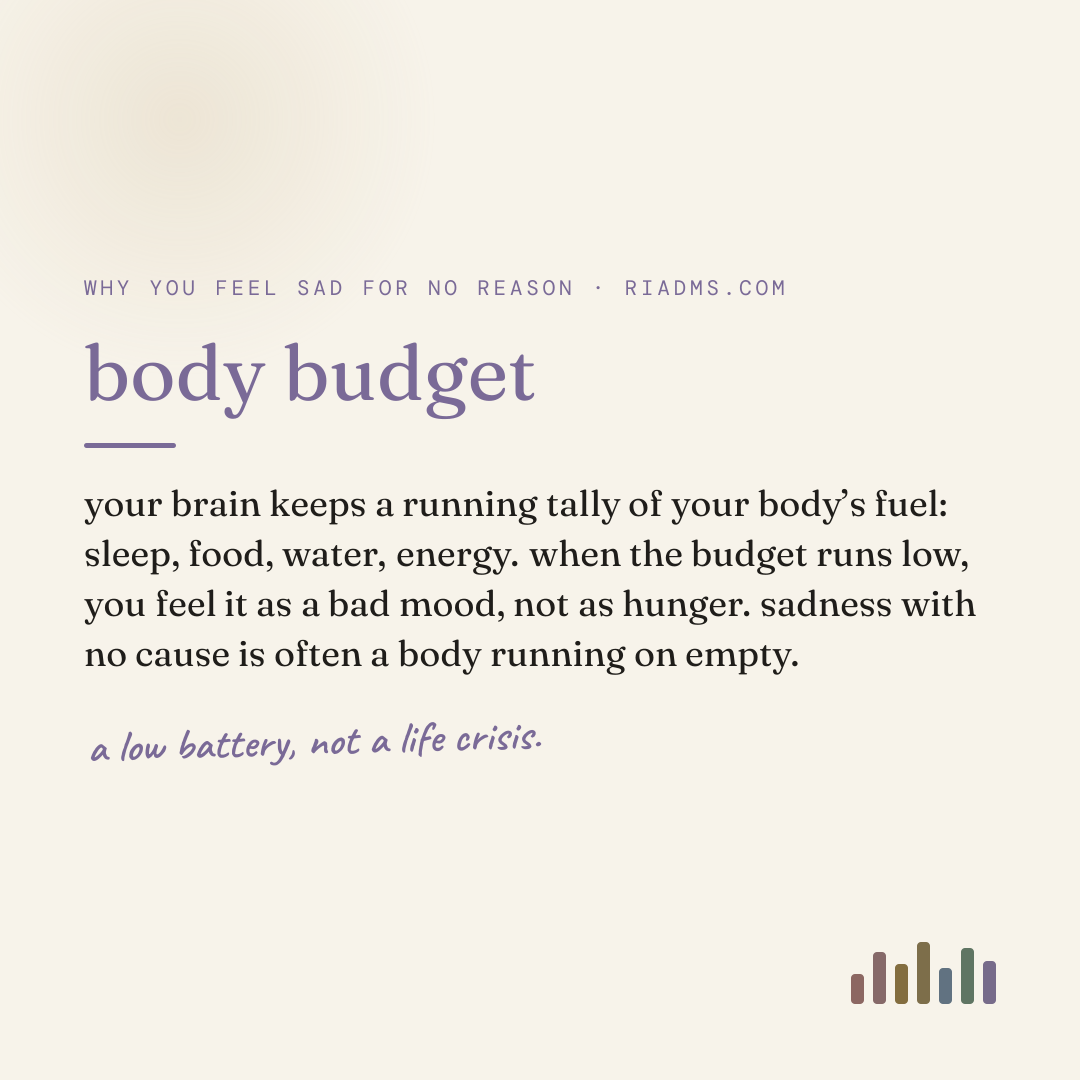
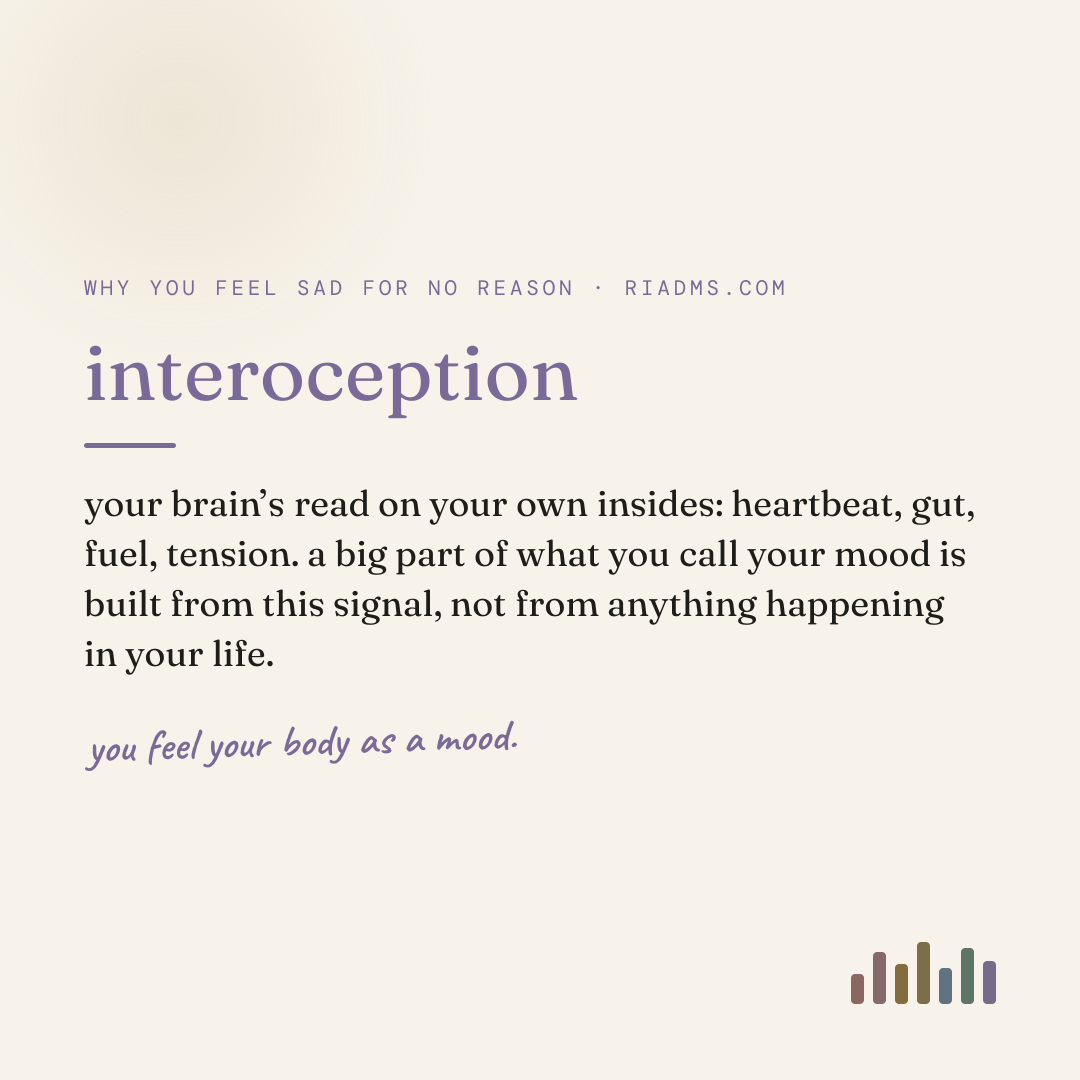
The neuroscientist Lisa Feldman Barrett describes something she calls your body budget. Your brain’s number one job is not thinking. It’s keeping your body running. So all day, underneath everything, it manages a budget of fuel: energy, sleep, water, blood sugar. And it reads the state of that budget constantly, a sense called interoception. The part that matters is that a huge amount of what you call your mood is built out of that reading.
So when the budget is low, underslept, skipped lunch, dehydrated, getting sick, day two of your period, your brain feels the deficit as a general bad feeling. And because it doesn’t arrive with a label that says you are low on fuel, your mind labels it for you. “I feel sad.” “Something is wrong.” That’s not sadness. That’s a low battery. Think of your phone at four percent, dimming the screen and closing apps in the background. It isn’t broken and it isn’t sad. It’s protecting what little charge is left. Your brain does the same thing, and then, unlike your phone, it makes up a story about why.
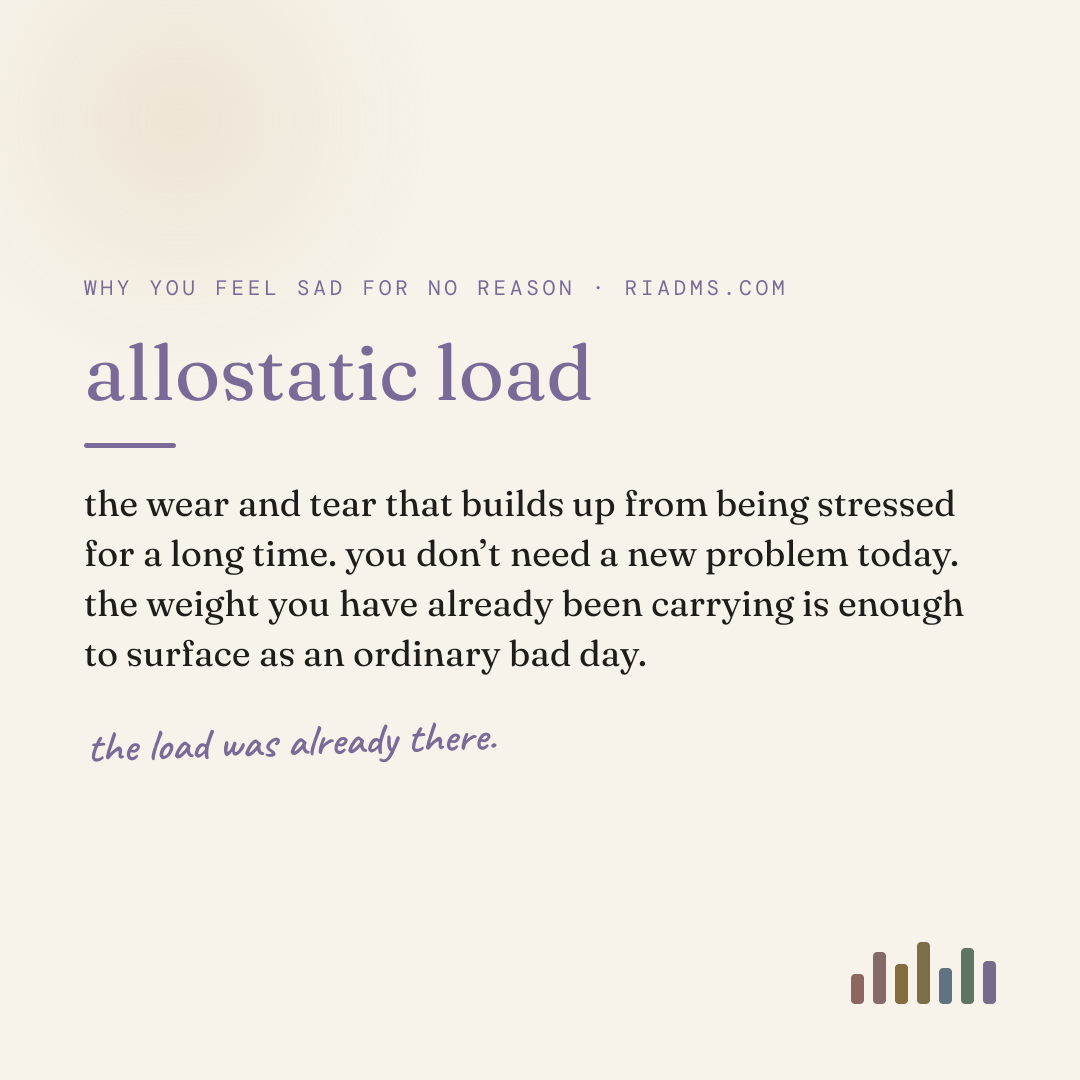
And it accumulates. The researcher Bruce McEwen named allostatic load, the wear and tear that builds up from being stressed for a long time, even quietly. You don’t need a fresh problem today for it to weigh on you. You’ve been carrying the load. So an ordinary Tuesday can sit on top of months of strain, and the feeling that surfaces has nothing to do with the Tuesday. Before you believe the story, check the budget. When did you last eat. How did you sleep. When did you last drink water. “I feel hopeless” and “I slept five hours and haven’t eaten since breakfast” are very often the same sentence.
it’s a feeling with no picture
Here’s the second source, and it explains the truly out-of-nowhere ones, the days you’re rested and it still hits.
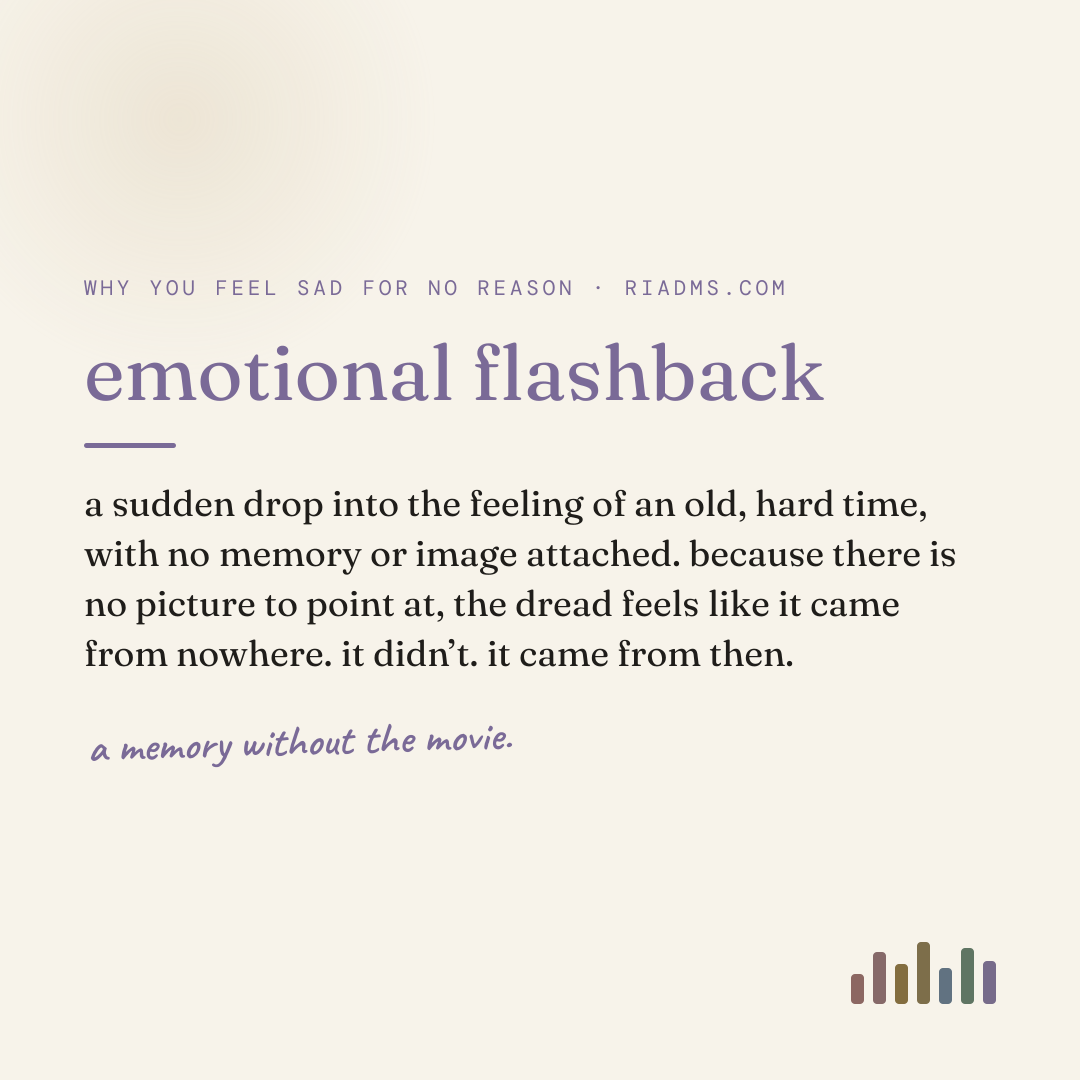
The therapist Pete Walker writes about something he calls an emotional flashback, and it is not what you picture. There’s no scene, no image, no memory playing like a movie. That’s exactly the point. A normal flashback comes with a picture. An emotional flashback is when you drop straight into the feeling of an old, hard time with none of the footage. Just the raw state. The smallness. The dread. The certainty you’re in trouble. Your body remembers a moment your mind isn’t showing you, and because there’s no picture to point at, it feels like it came from nowhere. It didn’t. It came from a long time ago and left the images behind. That’s not a mood. That’s a memory without the movie.
A tiny thing in the present can knock on a very old door. And what answers is not about the tiny thing.
the crash comes when you’re finally safe
Here’s the third one, and it’s almost funny once you see it, because it explains the most confusing version of all. You get through the hard thing completely fine, and then fall apart the moment it’s over.
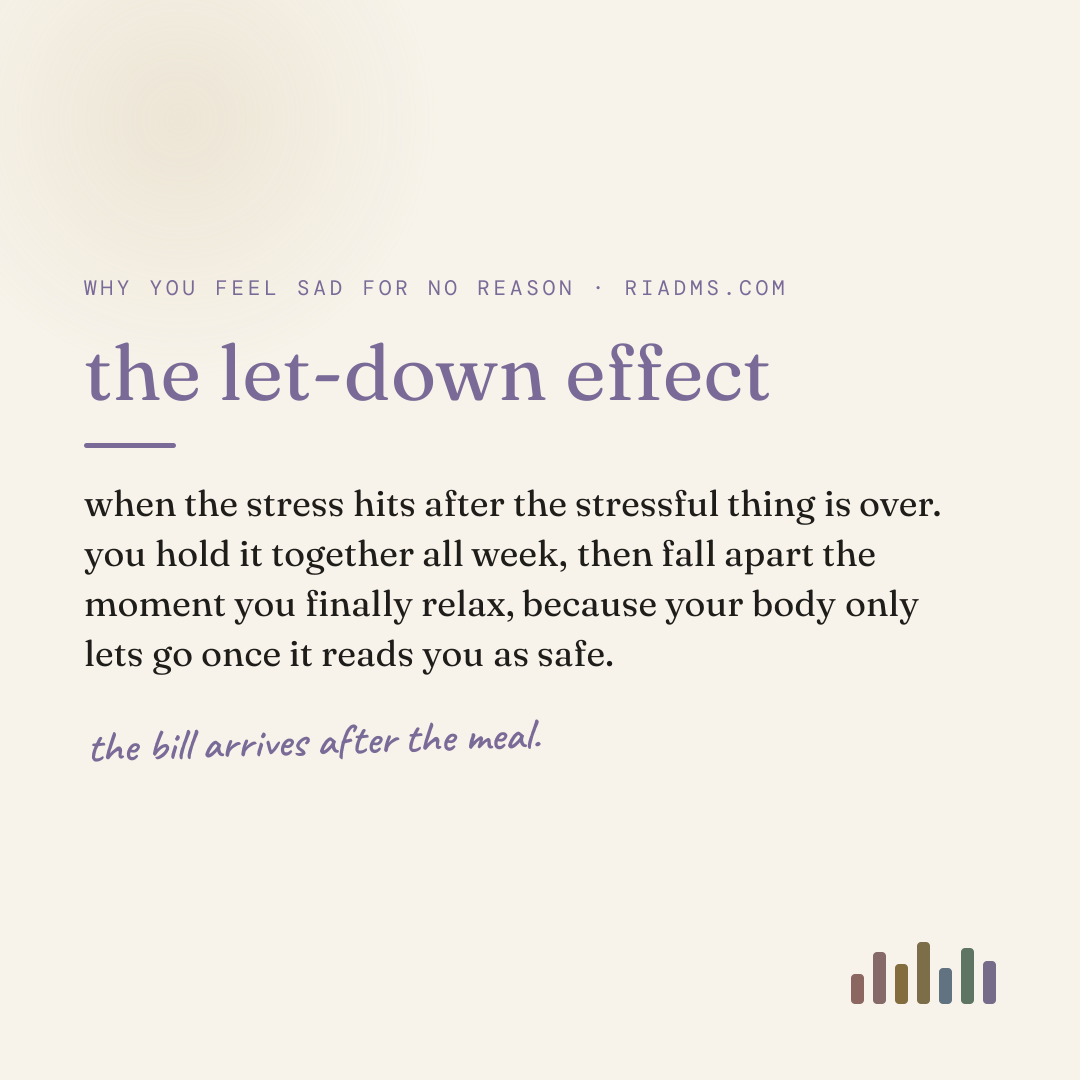
A brutal week that you hold together the whole way, and then Saturday you wake up flattened. The psychologist Marc Schoen named this the let-down effect: the stress doesn’t hit during the stress, it waits and lands when you finally relax. There’s early research pointing at it. One small study found that a drop in stress predicted a headache in the next several hours, not the stress itself. There’s a little research on leisure sickness too, people who reliably get ill the second the weekend starts. These are small studies, not settled law, so I won’t oversell them. But the pattern is so common that almost everyone recognizes it, and the reason is clean: your nervous system holds everything back while the pressure’s on, because falling apart mid-crisis isn’t allowed. Only once it reads the coast as clear does it let the backlog through. The crash isn’t weakness the moment things got easy. It’s the bill arriving after the meal.
There’s a smaller daily version too. Your stress hormone, cortisol, runs on a curve, spiking about half an hour after you wake and falling across the day. It’s not a perfect map of your mood, but there’s a reason so many people describe a specific 3pm dip or a heaviness that rolls in at night. Sometimes the feeling is just what time it is inside your body.
what to actually do with it
So a feeling shows up with no cause. What helps is smaller than you’d think.
There’s a classic idea in psychology, going back to Schachter and Singer in the 1960s, that a feeling is two things stuck together: a physical stir in your body, plus a label your mind puts on it. The same racing heart gets called excitement, or fear, or dread, depending on the story that’s handy. Those specific old studies are shakier than their fame, so I won’t oversell them, but the core is solid and useful: your body makes the arousal, your mind picks the label, which means you get a vote. “My heart is racing and my mind is calling it dread” is a very different place to stand than “everything is falling apart.” One you can work with.
Then check the body before you believe the mind. Run the list. Eaten. Slept. Water. Moved. Sick coming on. Where in your cycle. Just came off something stressful. Nine times out of ten, one of them is quietly lit up. And then give the feeling somewhere to go instead of a story to attach to. A walk. Some air. A hand on your chest, breathing slower than feels natural. You’re not forcing the feeling out. You’re letting your nervous system get the message that you’re safe, so it can stop bracing.
keep reading
If you take one book from this, make it Lisa Feldman Barrett’s How Emotions Are Made, or the shorter Seven and a Half Lessons About the Brain if you want the body-budget idea in one sitting. And for the feelings that turn out to be older than today, Bessel van der Kolk’s The Body Keeps the Score. If this is a thing that happens to you a lot, the two chapters closest to it are the social hangover and why you absorb everyone else’s emotions.
So the next time it comes, remember the order. The feeling came first. The reason came second. And the reason your brain hands you, the one about how you’re unlovable and behind and doomed, is not the truth surfacing. It’s a low battery, or an old feeling with no picture, or the bill for a hard week finally arriving. Nothing is wrong with you. Your body is just keeping a record your mind can’t read yet. The feeling is real. The reason is negotiable. Start there.