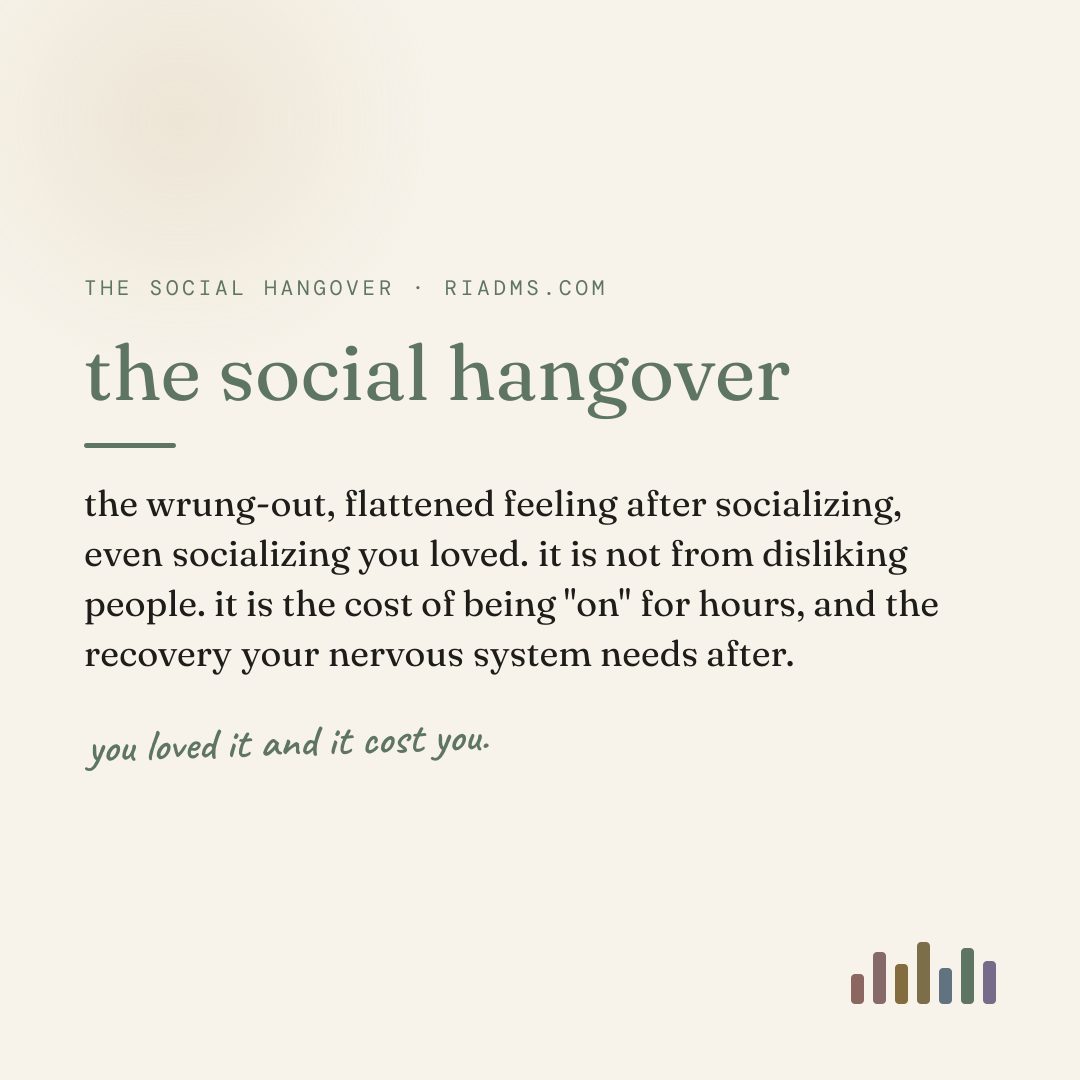
You had a great time. You mean this. You laughed for real, you loved the people you were with, you wouldn’t trade the night for anything. And then you get home, close the door, and feel like you got hit by a truck.
Flat. Wrung out. Weirdly sad, even. And a little guilty about it, because nothing went wrong and you wanted to be there. So why do you feel like you need three days in a dark room to recover from an evening you enjoyed?
The easy answer is “you’re an introvert.” It’s not that simple, and honestly it’s not the real answer. What you’re feeling has a shape, and it’s made of three specific things. None of them is “you didn’t actually like your friends.”
it’s not introversion, and here’s the proof
The easy story is that introverts lose energy around people and extroverts gain it. Clean, and mostly not true. There’s a study by two researchers, Leikas and Ilmarinen, who tracked people’s behavior and mood for twelve days. When people acted extroverted, chatty, warm, outgoing, they felt good in the moment. Better mood, less tired, right then. But about three hours later, that same sociable behavior predicted more fatigue. The crash came late. And here is the part that matters: it happened regardless of whether the person was an introvert or an extrovert.
The extroverts crashed too. They just crashed later, after the good feeling wore off, and they tend to book the next thing before the bill arrives. So this isn’t “you’re built wrong for people.” Everyone pays this. It’s not an introvert tax, it’s a human one. The social hangover is real, it just isn’t a diagnosis and it isn’t about your temperament. So what is it? Three things, starting with the heaviest.
come think with me
the word for one feeling you’ve had but couldn’t name, and why it works that way. the same thing you just read, in your inbox, once a week.
- one letter a week, about a ten minute read
- all nine printable workbooks, free
- the research, with its caveats kept in
- hit reply and it reaches me. i read every one
no pressure, no spam, no gatekeeping. unsubscribe anytime · riadumitrescu.substack.com
all of this is free and it stays free. if it gave you a word you didn’t have, you can buy me a coffee.
the masking tax
The first cost isn’t the people. It’s the version of you the room asked you to be.
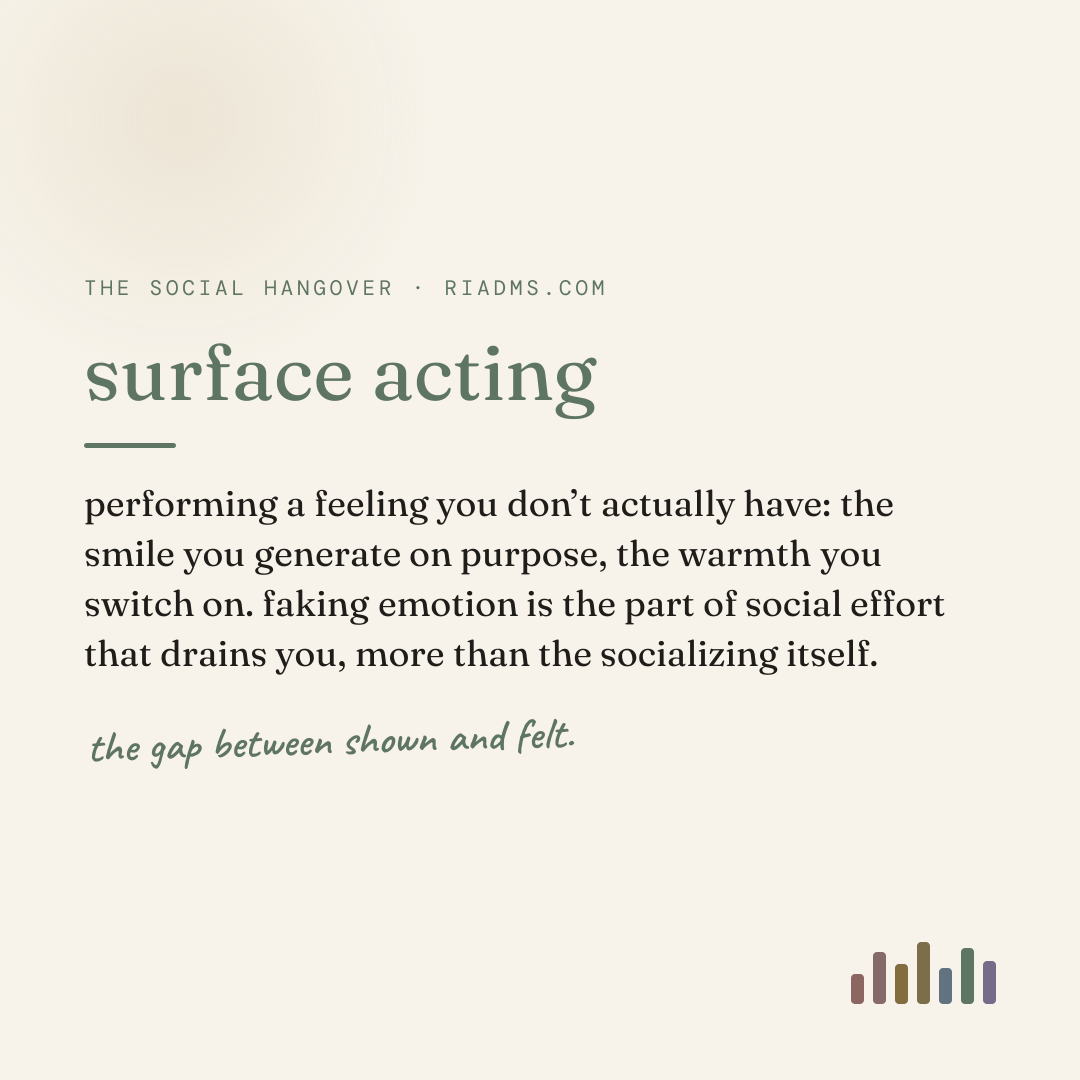
Think about what you’re actually doing in company, even good company. Managing your face. Timing your laugh. Reading the mood and adjusting. Being a slightly smoother, more “on” edition of yourself, mostly without noticing. The sociologist Arlie Hochschild studied people paid to perform warmth all day and gave us the phrase surface acting: displaying a feeling you’re not actually having. The research that followed her, Grandey, Brotheridge and Grandey, found the same thing over and over. Surface acting is what burns people out. Not the work. The faking. The gap between what you show and what you feel is the thing that drains the battery.
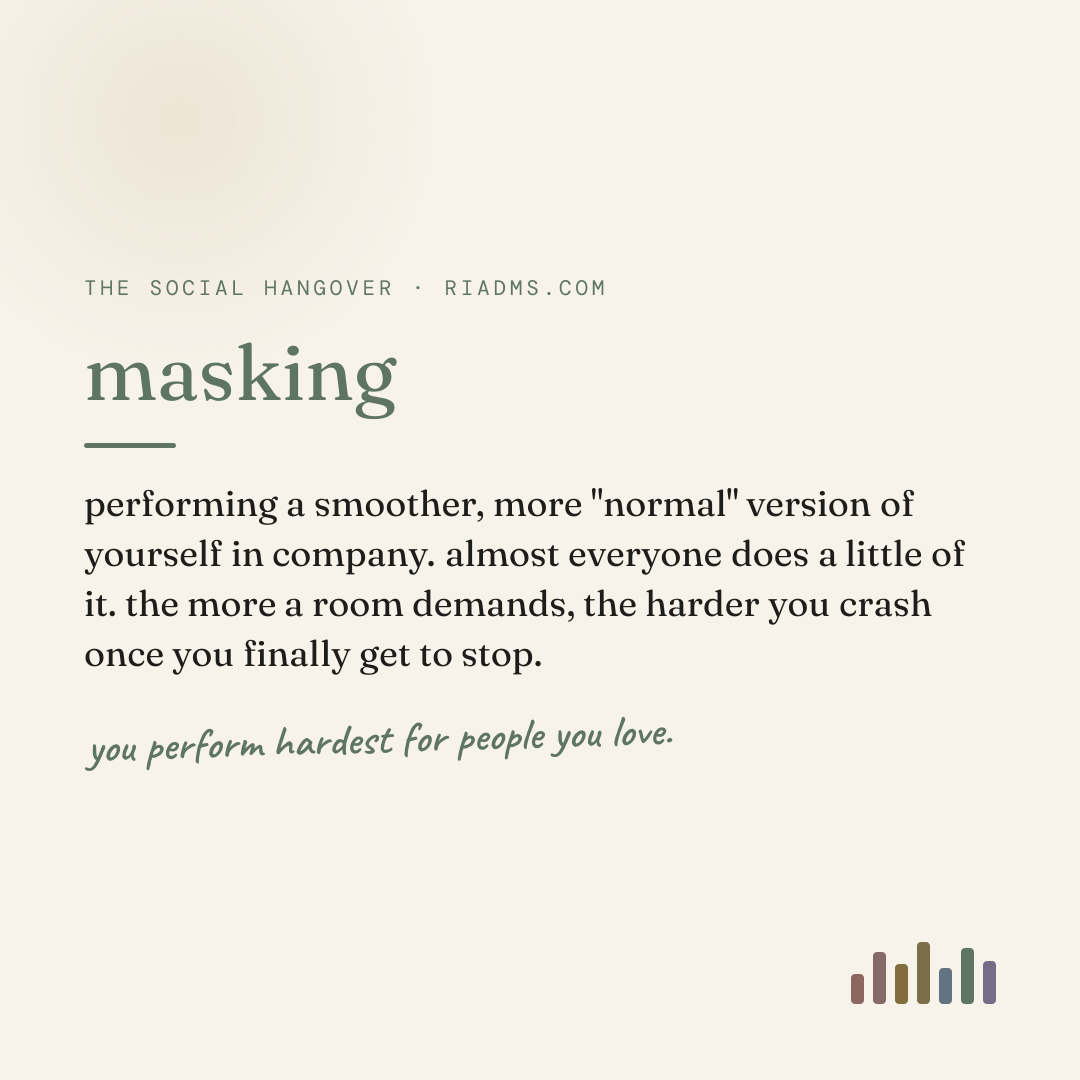
The clearest, most extreme version shows up in research on autistic adults, who often describe masking, spending all day performing “normal” to fit in. Study after study finds it’s exhausting and carries a real mental-health cost. Most people aren’t masking that intensely, but almost everyone does a lighter version, and the more a room requires, the harder the crash. Which is exactly why the hangover is often worse after a good night with people you love, and lighter after coffee with someone you don’t care about impressing. With people who matter, you’re more on, not less. You perform hardest for the people you most want to hold onto. That’s not the people draining you. That’s the effort of the self you performed for them.
socializing is attention, and attention gets tired
The second cost is the quiet one, because it doesn’t feel like effort while it’s happening.
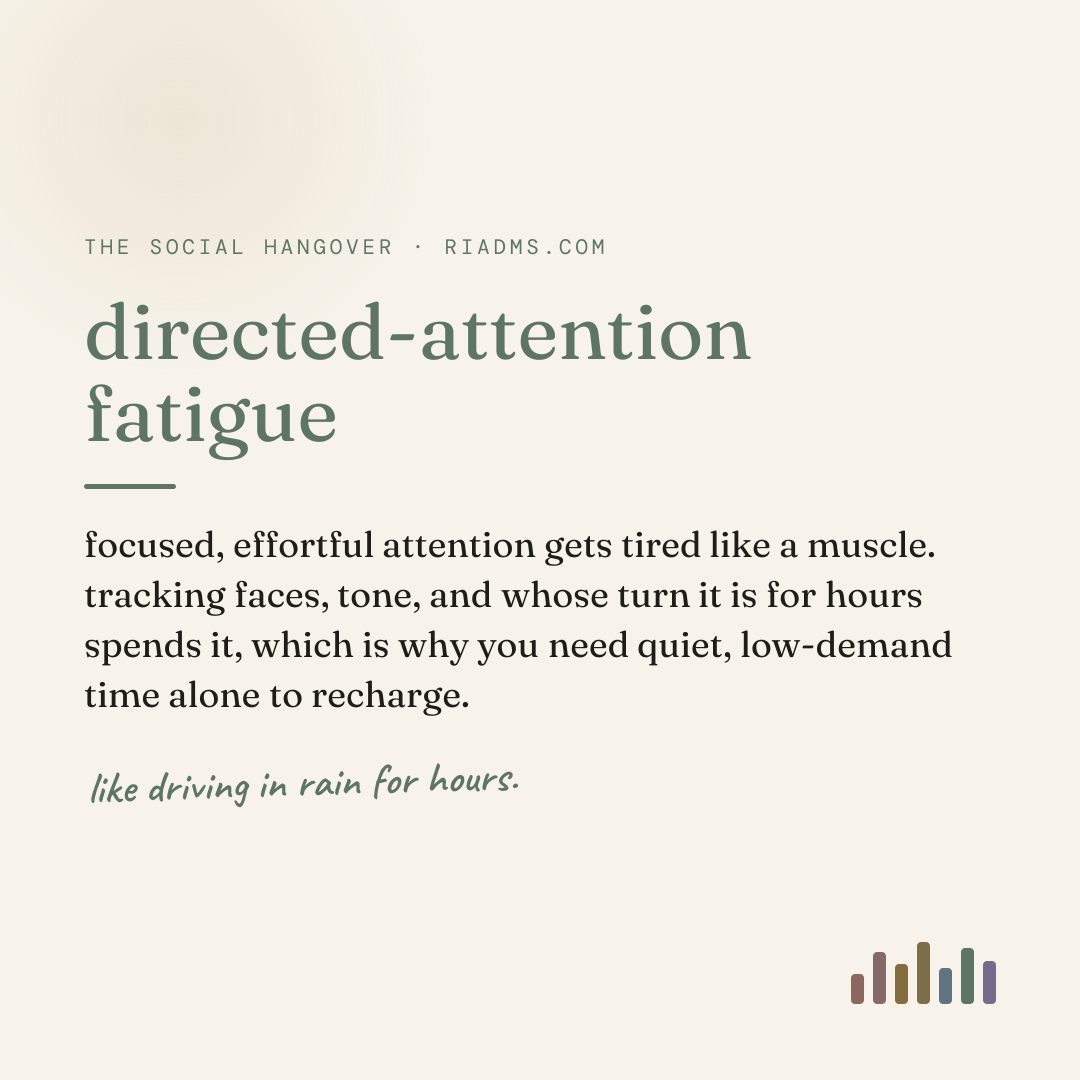
A conversation is an enormous amount of live processing. Tracking faces and tone. Following who’s talking and when it’s your turn. Catching the joke, choosing the response, watching the reaction, adjusting. In a group, multiply that by everyone in the circle, for hours. Now, you’ve probably heard that willpower is a fuel tank that runs empty. I want to be honest, because that specific idea, ego depletion, mostly fell apart when big teams tried to reproduce it. So I won’t tell you socializing “burns your willpower glucose.” But there’s a sturdier idea underneath: the kind of focused, effortful attention you use to track a conversation genuinely gets tired, and it recovers with low-demand rest.
Think about driving through heavy rain at night for three hours. You didn’t lift anything or run anywhere. You sat in a seat. And you get out completely wrecked, because you were on high alert the whole way. A long social night is that. You weren’t working, you were tracking, and tracking is work your body doesn’t file as work until you stop and feel the exhaustion all at once.
the recovery, and why it’s alone
So put it together. You performed a warmer, smoother self for hours. You ran a high-speed processing program the whole time. And you probably didn’t eat right, drink water, or sit still. Of course you feel hit by a truck. You just don’t have the receipt, so it feels like it came from nowhere. (If that “came from nowhere” feeling is familiar, there’s a whole chapter on it.)
And here’s why the recovery has to be alone, and why that has nothing to do with rejecting anyone. Being alone is the one setting where your attention system stops tracking and your performed self clocks out. No face to manage, no turn to wait for, no one to read. That specific nothingness is what recharges you. So, concretely: stop scheduling back to back, and protect the block after a big social thing the way you’d protect the event itself, because the recovery is the second half of the same activity. Recover with low demand, not more stimulation, since alone-and-doomscrolling is still your attention running. And drop the guilt, because the guilt is the part that turns a normal hangover into a spiral. You didn’t secretly hate it. You loved it and it cost you. Feeling wrecked after is not evidence you did something wrong. It’s evidence you showed up fully.
keep reading
If you want the accessible version of the arousal-and-overstimulation side, Susan Cain’s Quiet is the one, and for the fullest treatment of masking and its cost, Devon Price’s Unmasking Autism, useful even if you’re not autistic. The two chapters next to this one are why you feel sad for no reason and why you absorb everyone else’s emotions.
So you get home from the good night and you feel flattened. Now you know the shape of it. You performed a warmer you for hours, you tracked a room until your attention was spent, and your body is presenting the bill now that it’s finally safe to feel it. That’s not you being bad at people. That’s the cost of being good to them. Have the great night. Then give yourself the quiet after. You earned both.

