You know yours. Words of affirmation, acts of service, receiving gifts, quality time, physical touch. You took the quiz, you’ve said it out loud to somebody, possibly on a first date, and it felt like handing over something true about yourself.
I want to defend the idea and take it apart in the same page, because it isn’t one claim. It’s three, and they are not equally true. One is basically fine. One is shaky. And the one the entire industry is built on doesn’t hold up at all.
where it actually comes from
The Five Love Languages was published in 1992 by Gary Chapman, a pastor and marriage counsellor. It has sold an absurd number of copies and it’s probably the most influential idea about romantic relationships of the last fifty years.
Chapman did not derive the five from research. He arrived at them from years of counselling notes: he noticed what couples complained about, and he sorted the complaints into five groups.
That is a completely normal way to generate a hypothesis. Plenty of good ideas start with a practitioner noticing a pattern. The problem is what happened next, which is that it went from a hypothesis to a quiz to a personality type to a thing you say on a first date, and nobody stopped anywhere along that line to check whether it was true.
come think with me
one letter a week.
the word for one feeling you’ve had but couldn’t name, and why it works that way. the same thing you just read, in your inbox, once a week.
- one letter a week, about a ten minute read
- all nine printable workbooks, free
- the research, with its caveats kept in
- hit reply and it reaches me. i read every one
no pressure, no spam, no gatekeeping. unsubscribe anytime · riadumitrescu.substack.com
all of this is free and it stays free. if it gave you a word you didn’t have, you can buy me a coffee.
the three claims, separated
Pull them apart and they’re obviously different sizes.
- There are five. People give and receive love in roughly five ways.
- You have one. Each person has a primary language, it’s stable, and it’s meaningfully different from the other four.
- Matching matters. Couples do better when partners speak each other’s language.
Claim three is the product. It’s what the quizzes are for, what the workbooks sell, and what people are doing when they compare results on a date.
what happened when relationship scientists checked
The cleanest summary is a 2024 review in Current Directions in Psychological Science by Emily Impett, Haeyoung Gideon Park and Amy Muise, called Popular Psychology Through a Scientific Lens. Their conclusion is not hedged. There is very little empirical work on love languages at all, and what exists does not give strong support to any of the three assumptions.
The specifics are the interesting part.
On claim two, that you have one. People endorse all five, meaningfully. In the work reviewed, fewer than half of participants even had an identifiable primary language. And the five correlate with each other far too highly for five distinct things: people who like words of affirmation also like quality time. Say it plainly and you get why: all five are versions of being kind to somebody. Every relationship should have all of them. So should friendships.
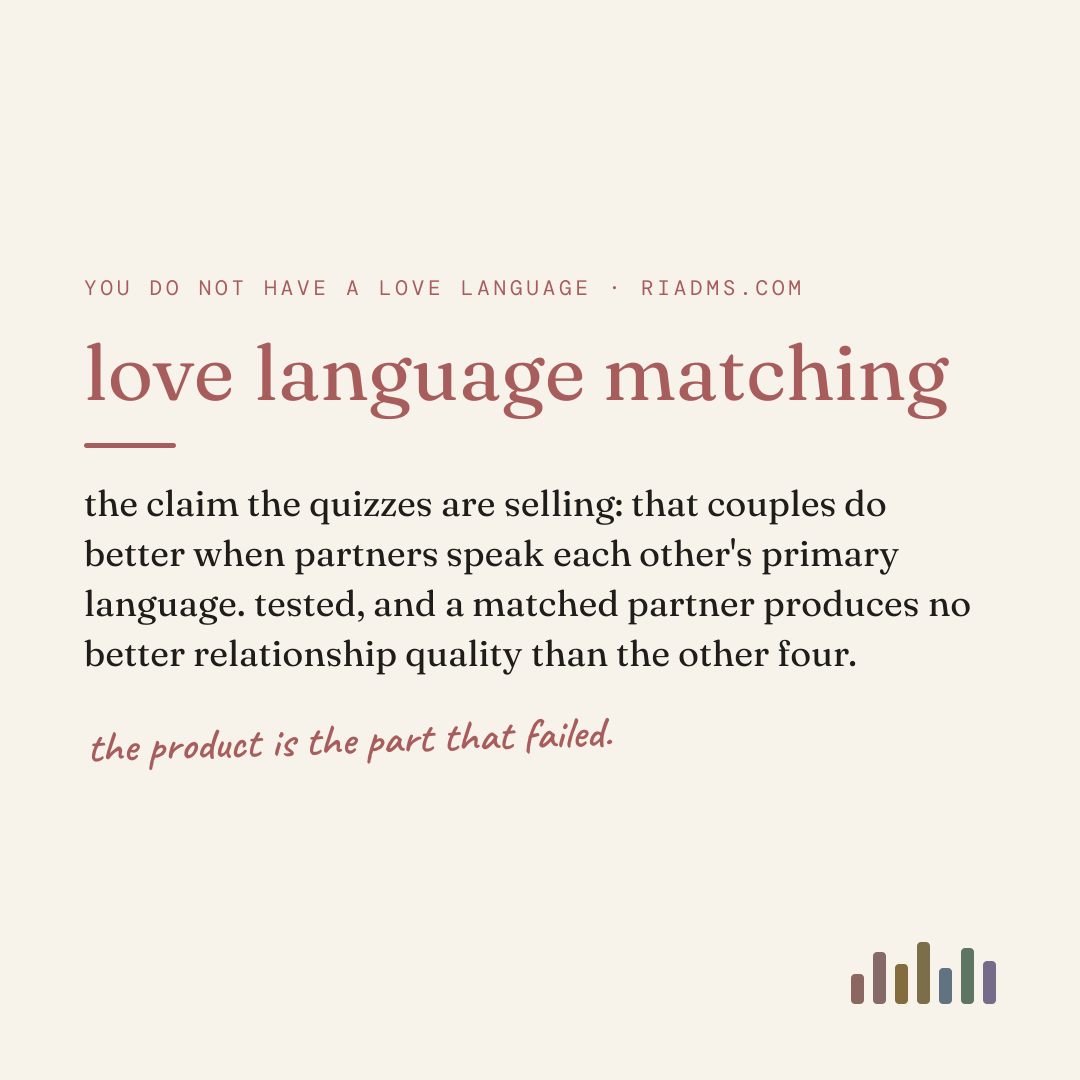
On claim three, the matching. Being with a partner who speaks your supposed primary language does not produce better relationship quality than any of the other four. That cuts the promise out from under it. Is somebody selling you a product whose value rests on matching? That is marketing.
On claim one, whether there are five. This is where it survives. A 2022 study in Communication Reports by Pett, Lozano and Varga, Revisiting the Languages of Love, took 648 open-ended answers from 324 participants and tested the typology properly. It found substantial support for the structure, plus evidence of a sixth.
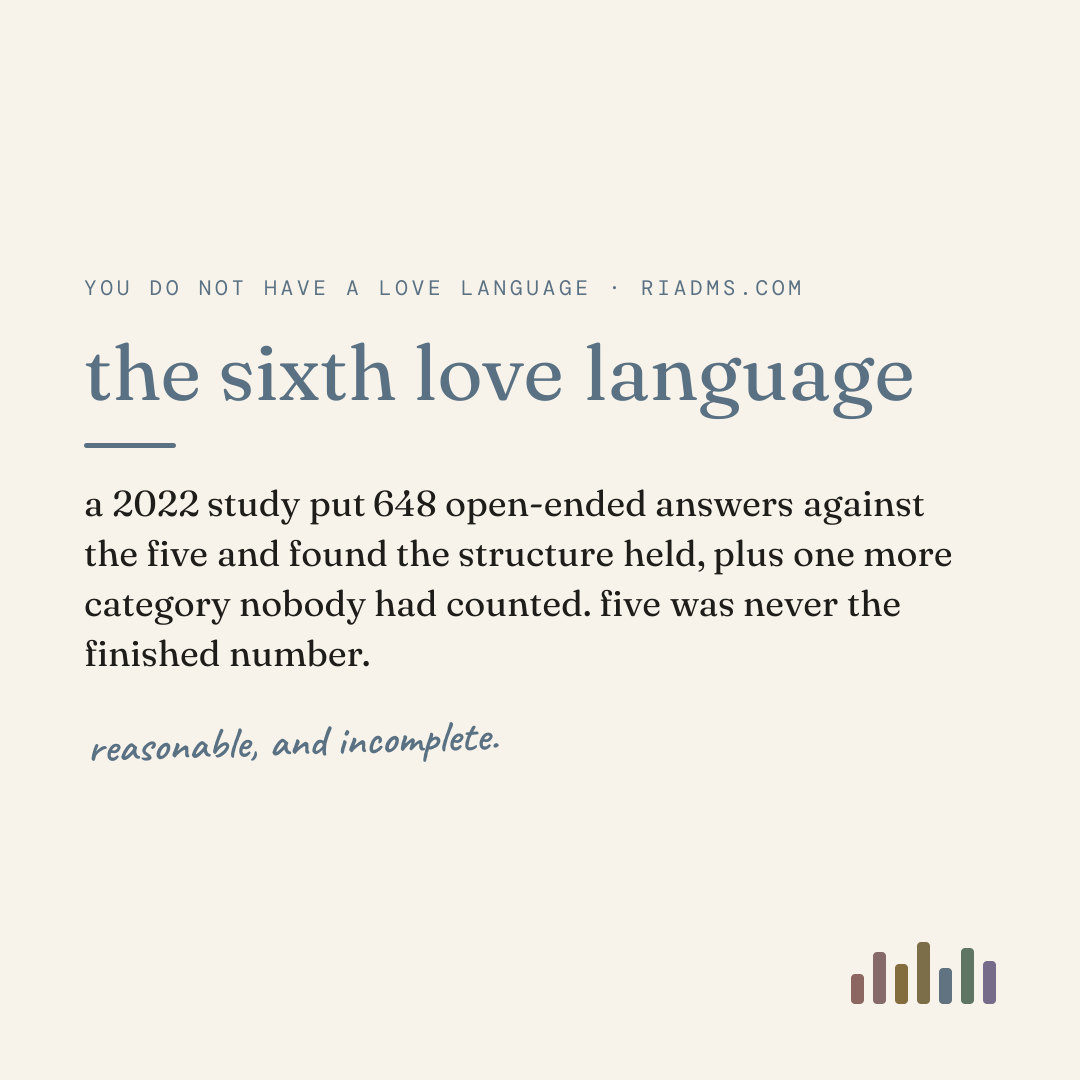
So the categories aren’t nonsense. They’re reasonable and probably incomplete. That is a very different thing from a personality type.
and physical touch is two things in one box
This is the part I made the video for.
In the quiz, physical touch means hand-holding, hugs, a hand on your back, sitting close. It also means sex. Same box. Same score.
Those are not the same axis. You can want to be held by your friends. You can want that from a partner without wanting anything sexual before or after it. You can have an enormous amount of one and none of the other, in either direction. There’s a separate system in the body for affectionate touch, with its own nerve fibres, that is not a diluted version of the sexual one.
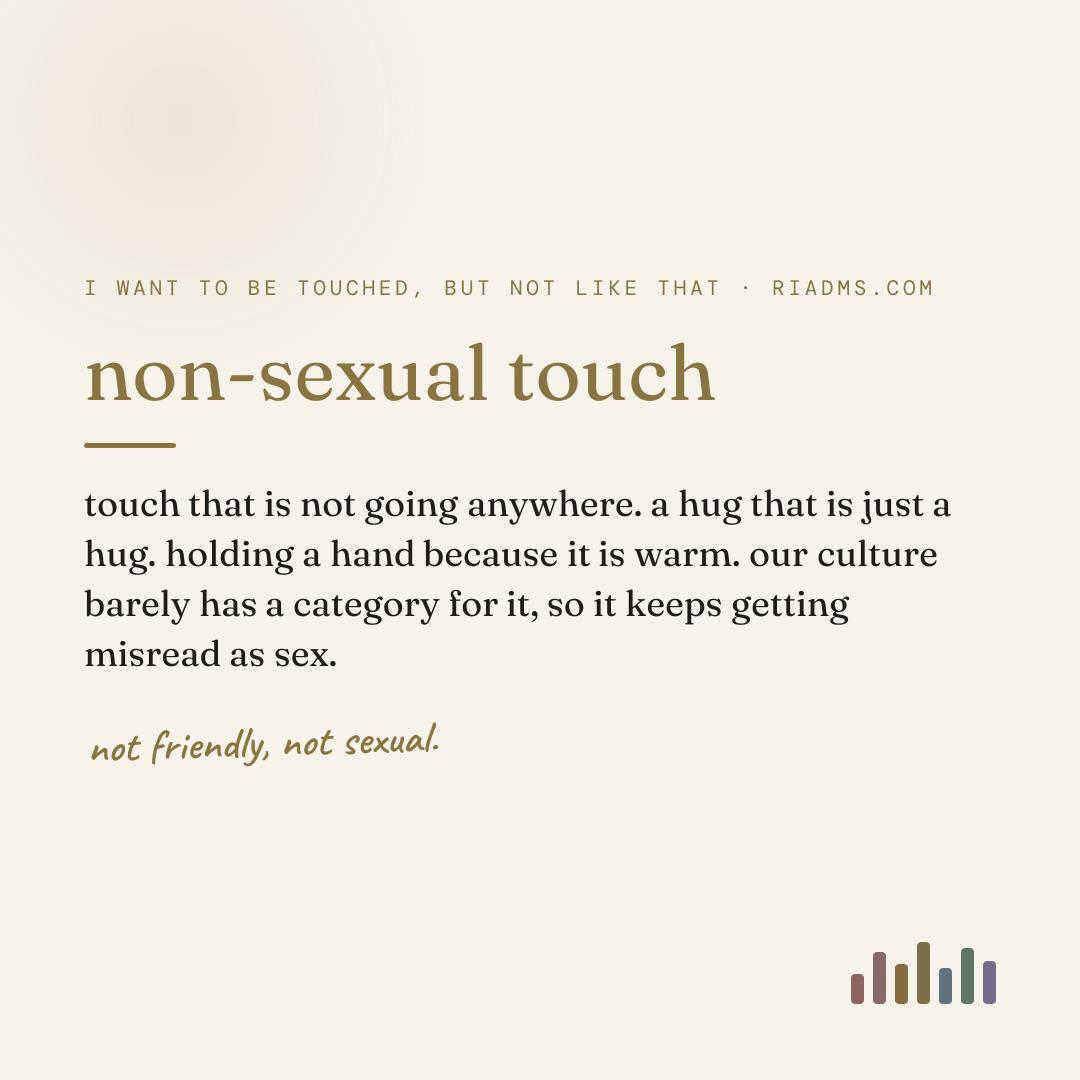
I found this by taking the quiz. I’d get to physical touch and I couldn’t tick it, because in that question it implied sex, and I’m asexual, so the box went away. And then I’d look at my actual life, which is full of touch: I want to be hugged when I’m sad and when I’m happy, I hold hands, I sit against people.
One word, two experiences, and one of them made the other invisible. If you split it, the framework gets better. Split it enough times and it stops being a framework at all. That is rather the point.
what the idea is pointing at, because it is pointing at something
I don’t want to leave you with nothing, because Chapman noticed something real before he packaged it.
People really do differ in what registers as love. Not five types. A continuum, context-dependent, changing across a lifetime. Some things you do will land as love and others will be too much or too little for that person on that day. And the ones that land are often not the ones that cost you the most effort.
And most people give love the way they want to receive it. That’s probably the most useful sentence here. If you want to know what someone registers as being loved, watch what they do for people. That is the language they’re fluent in, and it’s usually the one they’re waiting to be spoken to in.
So two people who love each other can both be trying, constantly, and both feel unseen. Nobody is failing. They are speaking past each other in different registers and calling it incompatibility.
the better question, and it is not the quiz
Don’t ask what someone’s love language is. Most people haven’t done the introspection and will report a quiz result.
Ask this instead:
tell me about a time you felt most loved. by anyone.
You’ll get a specific event, and a specific event is worth more than a category, because it has several things scattered inside it and you can hear which ones mattered. It also tells you the thing the quiz can’t: that it actually happened, to them, and it worked.
So: you don’t have a love language. You almost certainly don’t have one. You have all five or six or seven at once in different amounts, and they move. And matching them with your partner does nothing measurable for your relationship.
What does something is talking about it. Not the label. The conversation the label was standing in for.
keep reading
If you read one thing, make it the Impett, Park and Muise review. It’s short, it’s a straight look at a popular idea, and you can compare the science and the pop version line by line, which almost never happens.
And if the physical touch box was your problem too, sensual attraction is the whole argument for splitting it, with the biology underneath.