This one isn’t for the asexual people. This one is for the person dating one.
Because half the messages I get about my relationship aren’t from ace people at all. They’re from someone going, my girlfriend just told me she’s asexual and I don’t know what that means for us. My boyfriend might be ace and I’m scared. I love this person, I’m not asexual, and nobody is telling me how to do this. So here it is, from the ace side of a relationship that is genuinely, boringly happy.
their asexuality is not a verdict on you
The wound most partners carry in is the same one. If they don’t feel that pull toward me, then I’m not desirable, I’m not enough, I did something. This is rejection wearing a clinical word.
It isn’t rejection. Here’s the proof, quickly, because it has its own chapter. Sexual attraction and sexual desire are two different systems. Attraction is the part that points at a specific person. Your partner not having it isn’t them looking at you and feeling nothing. It’s them not having that aiming mechanism for anyone. It was never installed. You didn’t uninstall it.
Once you actually believe that, in your body and not just as a nod, the whole thing gets lighter. You’re not trying to fix a problem you caused. There is no problem you caused.
come think with me
one letter a week.
the word for one feeling you’ve had but couldn’t name, and why it works that way. the same thing you just read, in your inbox, once a week.
- one letter a week, about a ten minute read
- all nine printable workbooks, free
- the research, with its caveats kept in
- hit reply and it reaches me. i read every one
no pressure, no spam, no gatekeeping. unsubscribe anytime · riadumitrescu.substack.com
all of this is free and it stays free. if it gave you a word you didn’t have, you can buy me a coffee.
stop guessing. the word tells you less than you think
Here’s the mistake my own boyfriend made, and he’s brilliant, so if he did it, anyone will.
When I told him I was asexual, he built a whole person in his head. He decided asexual meant I didn’t want to be touched, that I’d flinch when he hugged me, that I wanted deep conversations and nothing physical. He thought we were fundamentally incompatible and just didn’t say so. And he was completely wrong. I love being touched. The gap between what he assumed the word meant and what I actually am was enormous. We only found that out because we eventually just talked about it. Three hours on a bus. Not before.
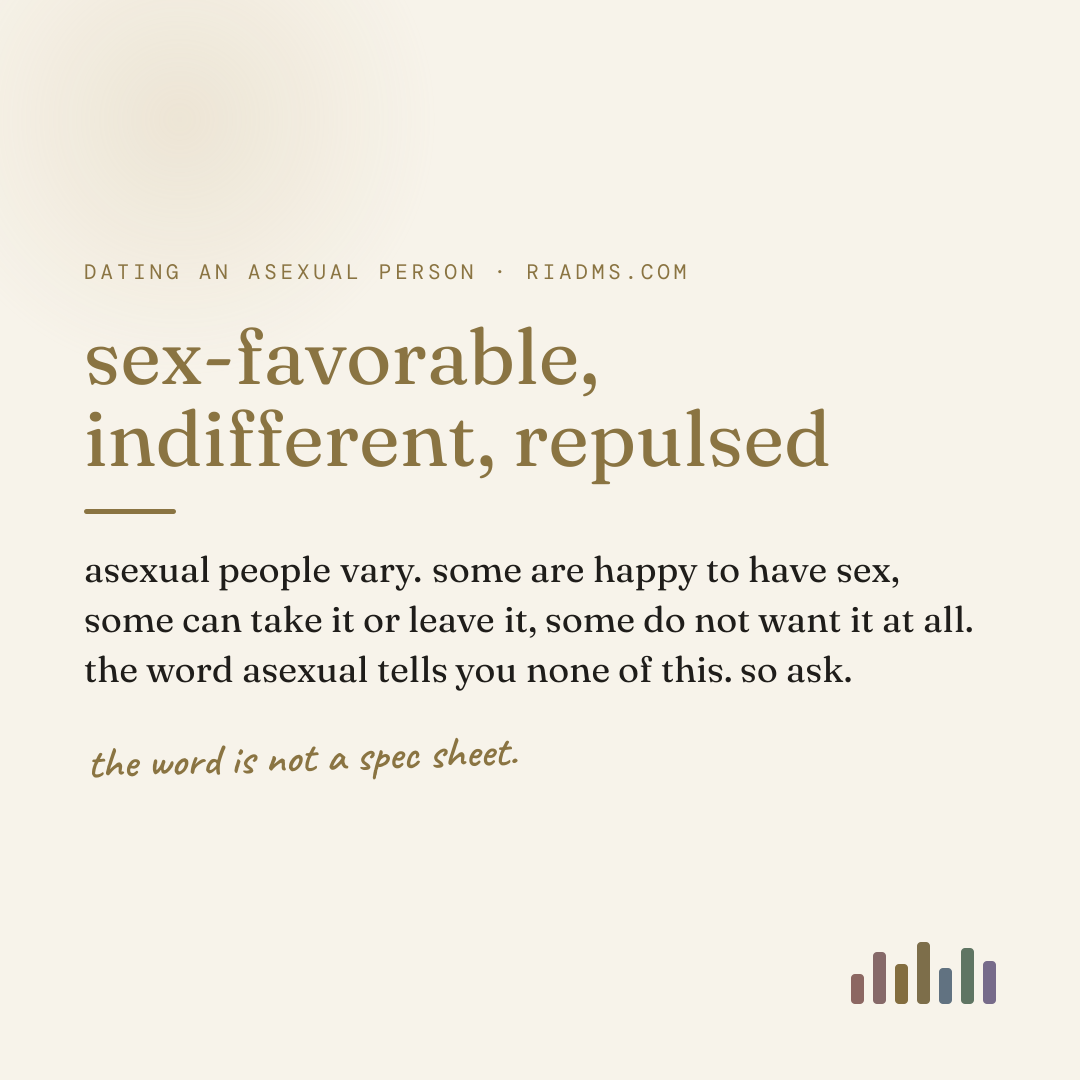
So here’s the instruction. Asexual is not a spec sheet. It tells you one thing: no sexual attraction. It tells you nothing automatically about what your partner wants physically. Because ace people are all over the map. Some are sex-favorable and happily have sex. Some are indifferent. Some are repulsed and it’s off the table. Some love kissing and cuddling, some want none of it. These are completely different relationships, and the only way to find out which one you’re in is to ask the actual human in front of you. Not the word. The human.
the skill isn’t sex. it’s talking about it before you have to
Here’s what actually decides whether these relationships make it, and it’s not chemistry. It’s a skill, it’s learnable, and honestly every couple needs it.
You have to be able to talk about intimacy directly, warmly, before it becomes a fight. Most couples can’t. They let it build in silence until someone explodes or shuts down. A relationship where one of you is ace just removes your ability to avoid the conversation, which is secretly a gift.
There’s a reason so many happy ace people started as friends with their partner first. The research on the friends-to-lovers pathway found most couples were friends before they were anything else. When you’re friends first, you build a habit of telling each other the truth with zero romantic stakes, so by the time the hard conversations come, the muscle is already there.
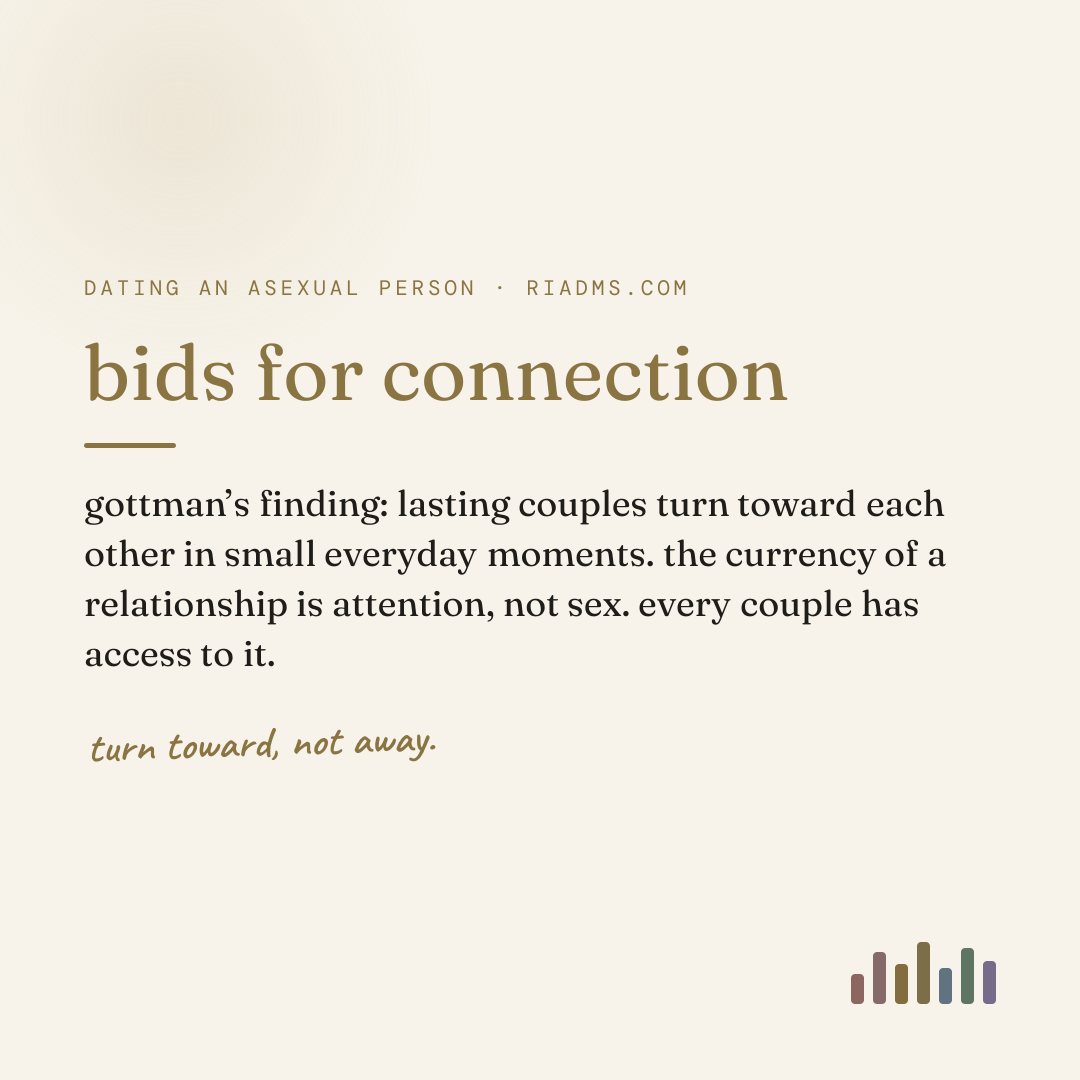
If you didn’t start as friends, you build the same muscle on purpose. John Gottman spent decades in a room watching couples, and the thing that separated the ones who lasted was almost embarrassingly small: how they answered little everyday bids for connection. Turning toward each other in the small moments.
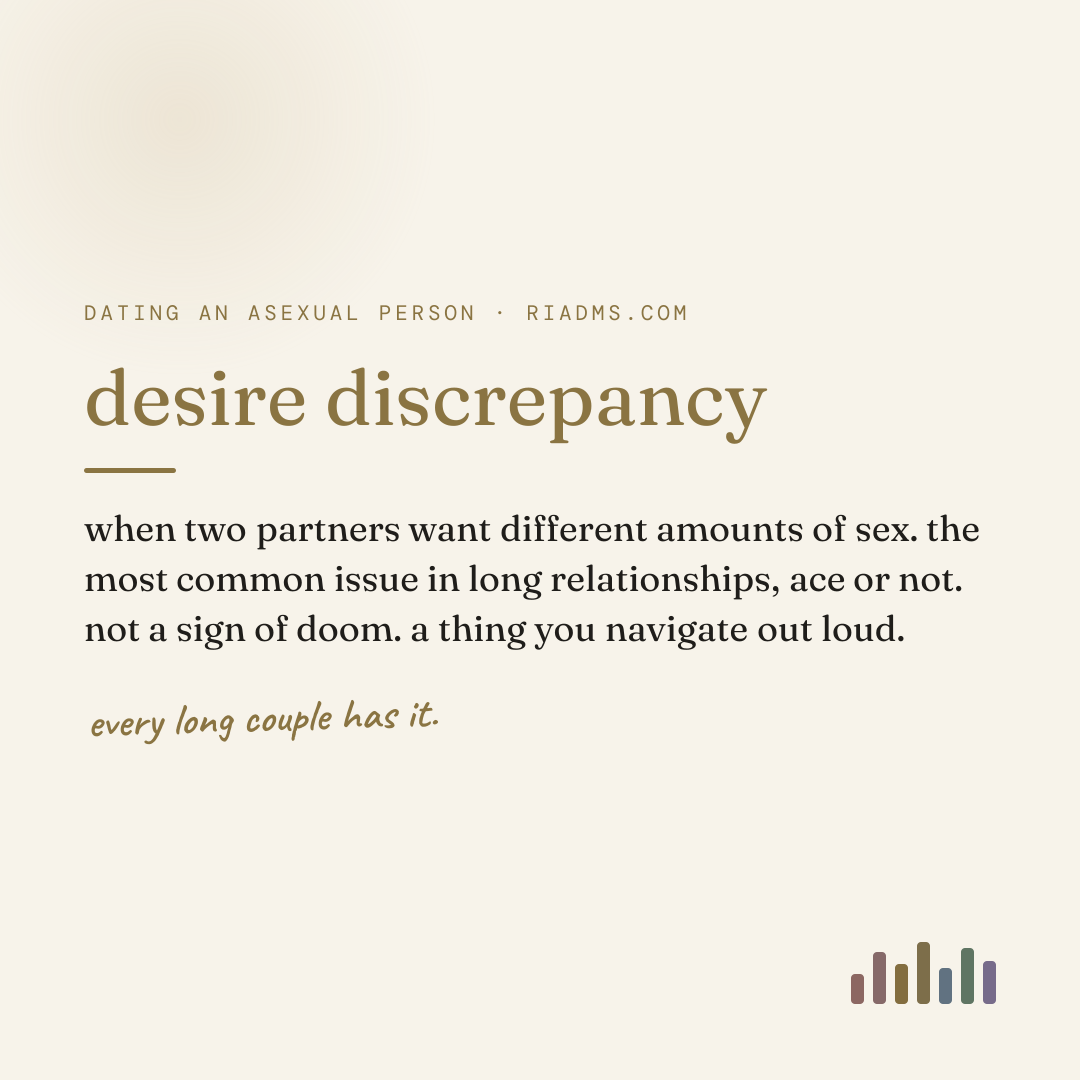
And the reframe I’d put on a wall: desire mismatch is not an ace problem. It’s a long-relationship problem. Two allosexual people ten years in are almost always navigating different levels of wanting. You’re just being handed that conversation earlier, and more honestly, than most couples ever are.
what it actually looks like, day to day
People imagine something clinical and sad. Here’s the boring reality.
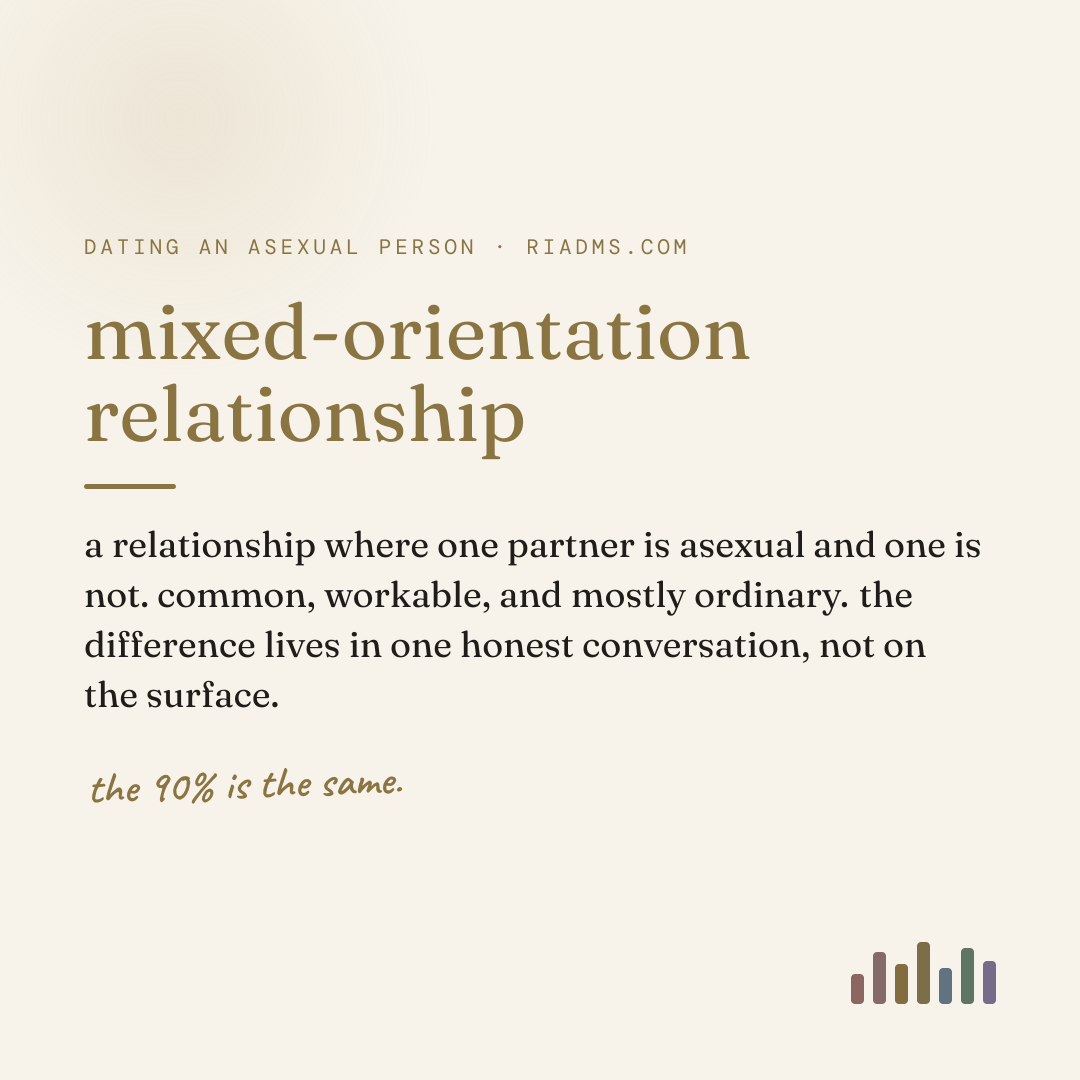
My relationship is about 90% identical to any other. We date, we travel, we argue about normal stupid things, we’re building a life, we’re affectionate constantly. If you watched us for a week you couldn’t find the asexual part, because it doesn’t live on the surface. The 10% that’s different is ours, and it’s private, and the point is that we designed it instead of defaulting into it. We said out loud what he needs, what I’m happy to give, what’s off the table, and then it just became the normal shape of us. No countdown timer. No resentment quietly filling up in the corner.
Because the alternative, the version where nobody says anything and everyone hopes, is what actually kills these relationships. Not the difference. The silence about the difference.
the honest part, because I won’t lie to you
I won’t pretend it’s effortless for everyone, because that’s a disservice if you’re struggling.
Sometimes the needs genuinely don’t line up. If you’re allosexual, your desire for a sexual connection is not shameful and not a character flaw. And if your partner is sex-repulsed, their no is not cruelty. Two people can both be completely valid and still have to do real work to find a shape that fits. Sometimes you find it. Sometimes, with total love and respect, you find out you’re not compatible, and that’s allowed to be true too. Wanting different things doesn’t make either of you the villain.
All I’m asking is: don’t decide it’s doomed on day one because of a word. And don’t decide it’s fine and then never talk about it. Both of those are just ways of not being in the actual relationship. The real one is in the middle, in the conversation, and it’s better than either fantasy.
keep pulling the thread
Angela Chen’s Ace has some of the clearest writing anywhere on ace and allo partners, and Julie Sondra Decker’s The Invisible Orientation has a whole section written for the non-asexual partner, without panic. If you want the mechanics of the intimacy itself, the five types of intimacy chapter is the one to read next, because physical is only one of them.
So if someone you love is asexual and you’re not: breathe. Their orientation is not a review of you. The word tells you almost nothing until you ask them the rest. And the skill that makes it work is one every strong couple needs anyway. You’re just learning it sooner. My relationship is 90% the same as any other. The other 10% we talk about. That’s the whole secret.

