I’ve asked myself this question more times than I can count, and sometimes I still do. Am I asexual, or am I just not attracted to men?
It’s hard to tell apart, and I understand why. Being tired of men is very normal right now. Women can give themselves most of what men used to give them, without the risks that come with it. So many things can go wrong in a relationship with a man, and in a lot of them the woman ends up being his mother. So of course you wonder whether what you’re missing is desire, or just desire for men.
If you ask the internet, you usually get one of two answers. The first says you’re not asexual, you’re hurt, and you should get over it and see a gynecologist. The second says you’re a lesbian and sends you to a page explaining what that means. One calls you bitter. The other says you’ve confused your own identity. Neither gives you the full picture, so this is my try at it.
you are not the first person to ask this
Before the test, I want you to know this is not a made-up question. People have argued about it for about 50 years, and I think knowing that takes some of the shame out of asking.
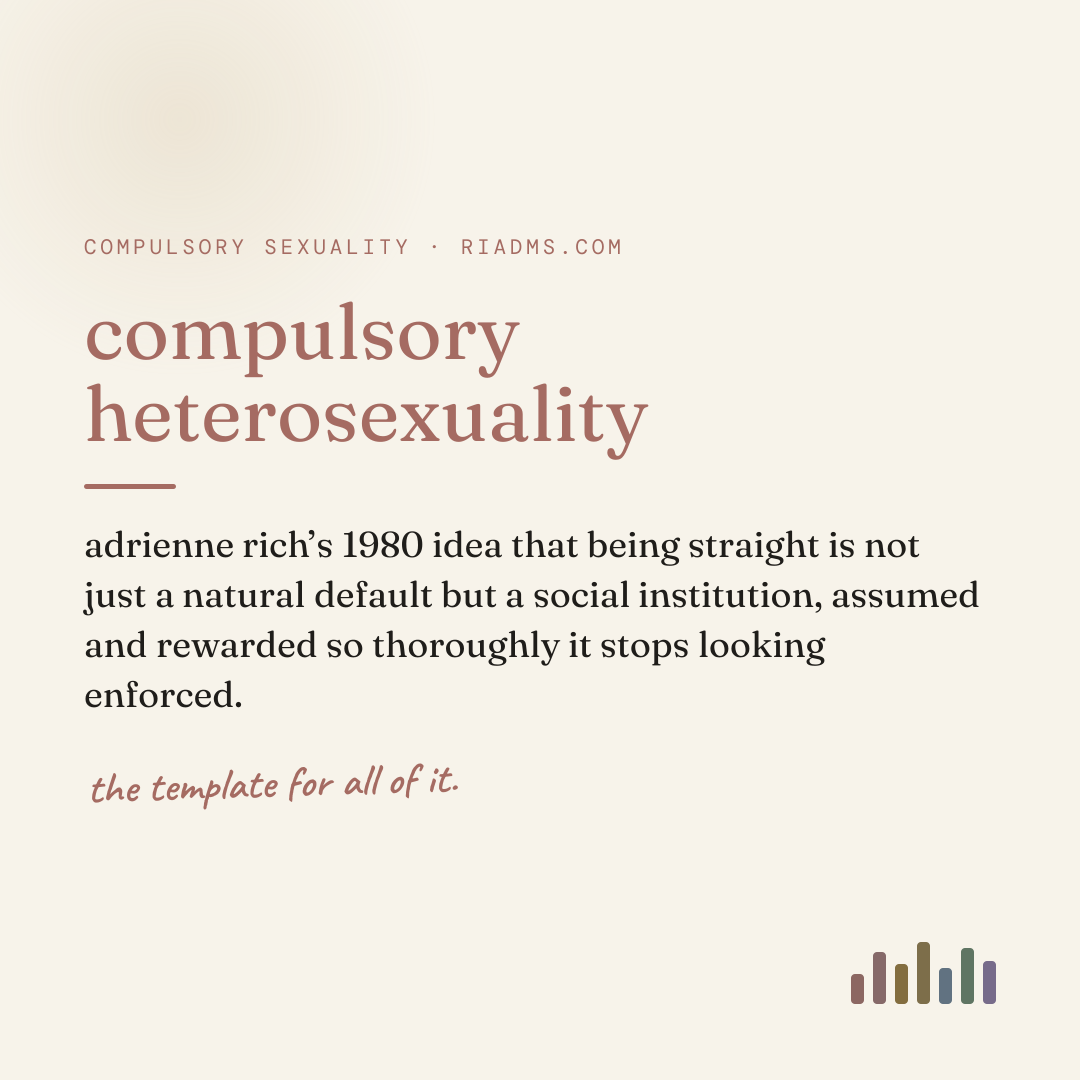
In 1980 the poet Adrienne Rich published an essay called “Compulsory Heterosexuality and Lesbian Existence” in the journal Signs. Her argument was that being straight isn’t only a choice women make. It’s also an institution. Women get steered toward it by so many lessons, so heavily, that they can’t tell whether they want it or were taught to want it.
A year before that, in 1979, a British group called the Leeds Revolutionary Feminist Group wrote a pamphlet called “Political Lesbianism: The Case Against Heterosexuality.” They went further. They said women should stop sleeping with men as a political act, and they defined a lesbian as a woman who doesn’t sleep with men. I don’t agree with that definition. But it shows how long the idea has been around that your orientation might be a verdict on men in general.
In 2018 a teenager on Tumblr called Angeli Luz wrote a Google Doc over about two days while trying to work out her own sexuality. It became the Lesbian Masterdoc, and in 2020 it went enormously viral on TikTok.
Then in 2019 the writer Asa Seresin named something called heteropessimism in The New Inquiry. It’s when straight women distance themselves from being straight with regret or embarrassment or hopelessness, and the “men are trash” jokes, while almost never actually leaving.
So look at what’s in the air we’re all breathing. Four serious frameworks, all saying some version of “maybe it’s men.” Of course you’re asking. The question is built into our culture.
come think with me
one letter a week.
the word for one feeling you’ve had but couldn’t name, and why it works that way. the same thing you just read, in your inbox, once a week.
- one letter a week, about a ten minute read
- all nine printable workbooks, free
- the research, with its caveats kept in
- hit reply and it reaches me. i read every one
no pressure, no spam, no gatekeeping. unsubscribe anytime · riadumitrescu.substack.com
all of this is free and it stays free. if it gave you a word you didn’t have, you can buy me a coffee.
the actual test
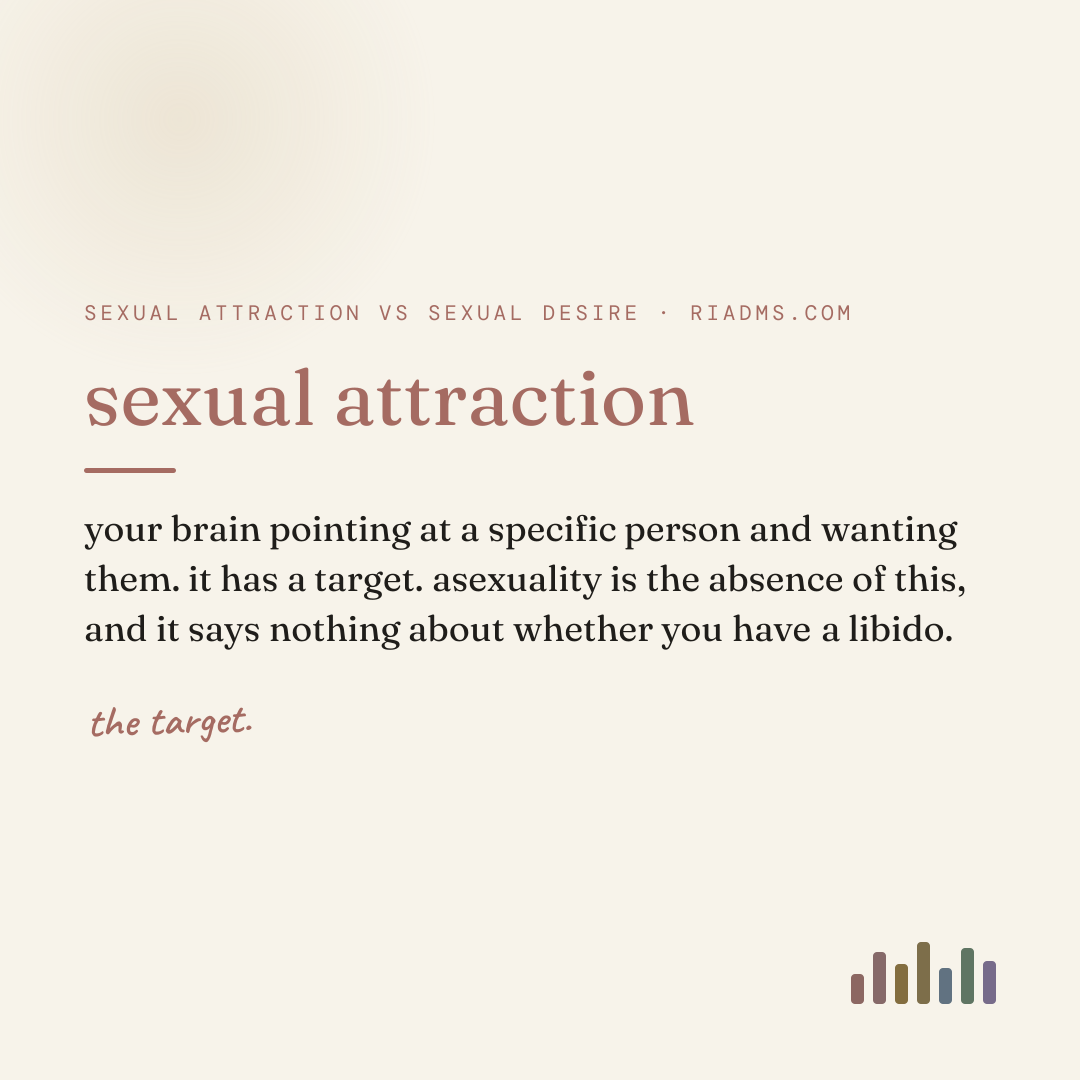
Asexuality isn’t defined by not being attracted to men. It’s defined by not being sexually attracted to anyone. That’s basically the whole test.
When the researcher Anthony Bogaert did the foundational work that put asexual people at about 1% of the population, what he counted was people who had never felt sexual attraction to anyone. The word “anyone” carries the whole definition. “I’m not attracted to men” is a direction. “I’m not attracted to anyone” is an absence. Those are very different things to live with.
the order of the questions matters
If the first question you ask yourself is “would I date a woman,” you’ll probably end up confused. That question is loaded. It has fear in it, and your family, and what your whole life would look like. All of that can bend your sense of what’s true.
Ask the smaller, more physical question first. Has there ever been a pull toward anyone, any gender, at any point in my life, even for a few seconds? Romantic or sexual doesn’t matter yet. Then you can work out whether you’re aromantic or asexual or neither.
I don’t mean an “I admire her” kind of pull. I know when women are hot. I can look at a hot woman and be mesmerized, and I don’t want to do anything about it. That’s not the pull I mean.
Be honest with yourself here, because information is never something to be scared of. It always gives you more options than you had before. And you don’t have to act on what you find. If you keep dating men even though you suspect you’re not attracted to them, that’s fine. At least you know.
If the answer is no, you’ve never felt a pull toward anyone and never wanted to try anything sexual with anyone, then maybe you’re asexual. I’ve never felt that pull. My friends have, and they describe something very specific. You probably know whether you’ve felt it, or whether you’re a bit confused. Either way, look back at your past without judging it and without thinking about the future, and just notice your patterns until now.
the third answer nobody names
There’s a third possibility, and almost nobody says it out loud. You might not be asexual, and you might not be a lesbian. You might be exhausted.
Desire can switch off when you’re tired, or overwhelmed, or disappointed in the same way 40 times, after doing all the emotional work of every relationship since you were 15. I understand that fully. I see it everywhere, and sometimes I see it in myself.
So ask yourself whether the pull was there before. Did you want something with men before you ended up this tired? If you did, that doesn’t mean you have to change anything. We’re entitled to be exhausted by men, and until they change there isn’t much we can do about it. But you have the information.
The second tell is frustration. Exhaustion usually comes with anger, the kind you feel when you want something and can’t get it because of how men are. Asexuality feels more like confusion. If what you feel is frustration, maybe you are attracted to men and just don’t want to be around them. That isn’t an orientation. It’s a decision, and I support you in it.
the orgasm gap is part of this
There’s one more thing, and the numbers are wild. In 2018 David Frederick and his colleagues published a study in the Archives of Sexual Behavior of more than 52,000 adults in the US. They asked how often people usually or always orgasm during sex. 95% of straight men said yes. For lesbian women it was 86%. For straight women it was 65%.
Sit with that gap for a second. The problem isn’t in women’s bodies. If sex with men has been disappointing again and again, why would you still want it? You’re not refusing to eat. You’ve just been starved of the good part for so long that you’ve stopped wanting to try.
if you’re still sitting with it
I made a free worksheet with the questions I’d ask myself, in order, if this wasn’t enough and you want a more structured way to think it through.
And tell me in the comments under the video whether you’ve ever asked yourself this, and what you found. I think it’s one of the most common questions there is right now, and I’d love to hear how different people have answered it.