the library · asexuality
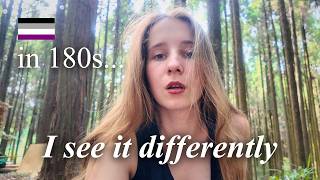
asexuality: the video I wish existed when I was 15
the plain, kind introduction to asexuality she needed and didn’t have.
watch on youtube ↗ read: on asexuality →
full transcript
So, I'm asexual, and I've been asexual for my whole life, but I just learned the word when I was 17. And I'm also in a romantic relationship, and I've been in this very amazing healthy relationship for the past 1 year and a half. And every time someone asks me about asexuality, or even if I tell them what asexuality is, they usually come up with these questions. And it's usually the same five questions over and over and over again.
A lot of people have a lot of assumptions. A lot of people are kind of confused when I even tell them anything about asexuality. And a lot of straight people cannot understand it. And I think whether you're curious about asexuality, or you're questioning if you're ace, or maybe someone you love is asexual, this is for you.
And honestly, I feel like it should be a very well-known topic, because it literally redefines how love is experienced, and how love is portrayed, because a lot of the media is showing love in a very very sexual way. And I'm going to be honest about everything, and not gatekeep literally anything. Like, I have no filter in this video, hopefully. So, asexuality means you're experiencing little to no sexual attraction to other people.
And that's literally it. This does not mean I hate sex. I am afraid of sex. I'm broken.
I cannot have a romantic relationship. I cannot have a relationship at all. I haven't met the right person. I have a medical condition.
I should go to the gynecologist. I'm celibate for religious reasons. I've never been in a relationship. It just means that you're feeling zero to some little sexual attraction for another person.
And you just cannot feel sexual attraction to other people. Like, it's that easy. What it does mean is that whenever people feel a pull that they want to be sexually active with someone, or just have a sexual connection with a person, or be sexually intimate with that person, I do not feel that pull at all. And I feel like a lot of asexual people feel this way.
It's just that we don't experience that pull towards sexual things, anything. Like, I do not enjoy intimacy quite Like, it is just not something that I think about. I honestly used to think that people were exaggerating and like making up when they were talking about sexual attraction and wanting to do all of these things with other people because in my mind it was just something that they do in the movies or that they're performing it for social reasons or that they're doing it just to get someone to be romantically attracted to them. Like I never thought it was genuine.
And I think that that was a the biggest sign that I was asexual and then I realized that because I could not understand anyone, any of my friends, any of my girlfriends, any anyone literally that was saying that they truly want to have these sexual intimate moments. I just never had desire. And like we can think about it in for example coffee way. You know how some people don't like coffee.
They're not sick. They're not scared of coffee. They didn't have a bad experience with coffee. They just don't want it and their body is just telling them that they do not need the coffee.
And that's literally what asexuality is. It's not about coffee but it's about sexual attraction but it's just that. It's just I do not want it. It's that.
That simple. Of course asexuality is a spectrum and it isn't a single box. It has a lot of identities. You can be asexual fully, little to no sexual attraction to anyone.
It doesn't matter who that person is and this is me but you can also be demisexual and only experience sexual attraction after you've been in a deep emotional bond with someone and formed that bond. They're not attracted to strangers or acquaintances but they are attracted to people who have spent so much time and so much energy and so much connection with them. So now the real emotional intimacy turns on the sexual part. And even then it might not.
Like demisexuality is also a spectrum. There's also gray asexuality and that's basically when you're in the spectrum of you're between asexual and allosexual. Allosexual means when you're like experiencing sexual attraction on a daily basis no matter the person. Maybe they feel attraction rarely or on very specific circumstances.
Maybe it's very faint, not powerful at all. It kind of exists in this gray area. There are asexual people who like sex, and maybe they don't feel the sexual attraction, but they like sex for other reasons. Physical sensation, intimacy with a partner, like it can be so many different things.
There are sex-indifferent asexual people, so they're like take it or leave it. They can eat food, but they don't necessarily enjoy it or hate it. It's just kind of in the middle. And there's also sex-repulsed asexual people who actually do not want to have anything to do with sex or have a very strong aversion towards sex.
And I think this is the stereotype that a lot of people imagine when they're thinking about asexual people, and I think this is also what kind of drives a lot of people to think that they're asexual because it is a very strong anti-society feeling to have. Like it's very outside of the box. It's very outside of what romantic relationships think they should be. And for example, I am somewhere in this area, and I've been questioning my entire existence because of this until I found the word asexuality because I just don't fit the norm of what is expected from a romantic relationship.
But this is only one part of the spectrum, and the spectrum is very large, very, very large. I think the point here is that there's no right way to be asexual, and if you're feeling like this identity is something that you want to explore, then no matter in which category you are, you're still asexual. You can still define yourself as that, and you can still redefine asexuality in any moment that you are going through your life to people or to yourself to make it easier for you because the word vocabulary piece to literally make it easier for you to communicate your boundaries, your feelings, what you want. And two ace people can have very completely different relationships.
My relationship is probably very different from whatever relationship you will have. What we share is a lack of sexual attraction, not necessarily a lack of sexual activity. Another thing that I wanted to talk about is asexuality and aromanticism. So, there's asexual and then there's aromantic and those are two very different categories.
Sexual attraction and romantic attraction are not the same thing and I feel like a lot of straight people and I'm saying straight because usually if you're non-straight, then you understand how it feels to not have sexual attraction towards someone that you're supposed to have sexual attraction towards, but most straight people do not understand this because they are separate. Romantic attraction and sexual attraction are separate. You can feel one without the other. Sexual attraction means that you want sexual contact with another person and romantic attraction means that you want a relationship, a romantic relationship with another person.
Dates, hand-holding, partnerships, emotional intimacy, building a life together, those are very different things. Insanely different things. Most people experience both at the same time towards the same people and this is why we confuse them and they've never had a reason to separate them, of course. But for ace people, this split is so obvious.
It's insanely obvious. It's for me, sexual attraction seems just like a evolutionary need that people have and that I don't have and that romantic attraction is actually the thing that bonds you with another person. You can feel sexual attraction towards anyone, right? I don't know.
Maybe I shouldn't be speaking about this, but while I do not experience sexual attraction, I experience so much romantic attraction. I can be falling in love with any character in any book that I'm reading. Like I'm not I'm not kidding at all. I get butterflies.
I want to hold hands and talk until 3:00 a. m. I want to have romantic dates. I want to get flowers.
I just don't feel the sexual pull that sometimes accompanies this with for most people, right? I don't feel the emotional tension, the sexual tension that accompanies these butterflies. I just feel the butterflies. And this also means that I can have different romantic orientations.
I can be heteroromantic >> >> and this is means that I'm romantically attracted to a person of a different sex, right? I can can homoromantic. I can be biromantic. I can be aromantic.
Romantic is just that you don't experience romantic attraction. All of these are valid. All of these exist. I'm bi.
And once you understand that these types of attractions are very different, they're very different experiences, a lot of the human problems that we're experiencing in terms of how we connect with other people will start making sense. And I'm definitely going to make a video about different types of attraction because I feel like it's so important. Not just for ace people, for literally everyone because this is why cheating happens. This is why so many things happen.
Like it's it's insane. And this is why we also don't understand how they happen. And I want to talk about my experience and how I've kind of lived through this and figured out this through myself and by myself and in my life. So, I didn't know really growing up that I was different, right?
I thought everyone was pretending to like sex. I thought they were pretending because they watched a lot of movies and they thought that was the correct way to do romantic relationships. When my friends started talking about crushes and what was hot, I didn't really understand what hot even meant. I thought hot meant you have muscles.
Like that was my like for the longest time, I swear to god, I thought hot means that you have muscles. And I thought, yeah, sure, whatever you're pointing to, yeah, that guy has some muscles. And then when the guy did not have muscles, I still didn't understand how he can be hot, right? Because all hot guys need to have muscles because muscles equal hot.
Anyway, definitely problems, definitely problems with >> >> my understanding of how other people experience this attraction. I didn't really feel like I pull any desire, any nothing towards people. I did feel a lot of desire to connect deeply with people. I felt so strong to get to know them and understand them and understand their brain and understand help them, just help them.
Like I had a lot of crushes growing up, but I just never had sexual attraction. Like I never wanted to Honestly, I never even wanted to be in a romantic relationship with someone because I thought it was automatically attached to sexual relationships. I actually had a lot of relationships when I was younger. Like I don't even know, like 10 to 15, and all all of those relationships kind of ended in like a week or two.
And yeah, I was young, so I don't even count them as relationships, but it used to end because that's the moment that the person wanted something sexual from me. And the moment that they did that, I was so repulsed, I was so against whatever they wanted, I was so like literally disgusted by them that I just stopped liking them romantically, too. I thought I was a late bloomer, and I think my mother and my family also thought that, too. They thought like, "Oh, I haven't met the right person.
I'll be different when I get to college or high school or whatever." It never changed. Like right now I'm in a very healthy relationship, and I still have zero sexual attraction. Maybe some very little, like maybe 1% of sexual attraction, I might say.
When I found the word asexual, everything kind of clicked, but then it was very hard to explain it to other people because in Romania, not many people know what this means. And I think I also became sad because I would do want to experience what everyone else experiences as love, right? And I feel like there is a big part of life that a lot of people make it so big, right? For me, I don't understand why it's so big, but a lot of people make it so big, and I cannot have that experience because I just don't enjoy it.
I just don't feel it in the way that people feel it. I just don't. And this is not to say that I've never tried to have sex. I did try to have sex, but it's just it's not the experience that everyone else experiences.
It's quite the opposite, I would say. It's like having an entire part of life that is just away from you, taken away from you, or like never given to you in the first place. It's interesting, but it's also weird. But at the same time, I'm kind of glad for it because there's a lot of other parts of life that I never wish I would have, right?
Like I cannot cheat physically, and I never have to think about that. I also don't need to be in a relationship because I do not have the need of having sexual interactions. So, I was single for like 4 years, I never had any problem. Like I never even thought about being in a relationship.
And now that I chose to be in a relationship, this relationship is purely giving me a huge advantage, and not necessarily a sexual advantage, but a life advantage, a career, an emotional advantage, growth advantage. Like I feel like it has so many other things than just the sexual need. And for the relationship, I feel like our relationships look the same as the other people's, like 90% of it. The only 10% that is different is the sexual part.
And I feel like in every sexual relationship, depending on if both people are all of the people included are asexual or not, look very different in those 10%. The rest of it is the same. We go on dates, we have jokes, we watch movies, we do crazy things together, we travel together, we live together, we plan things together, we talk about our lives together, we spend most of our time together. It's the same thing, basically.
And I want to talk about some myths that are kind of surrounding this area, and I want to clear them up. I don't know if this will work if the people creating these myths and pushing these myths forward are watching this video, but I hope they are. Okay, so the first myth is that you haven't found the right person. This is one that every single asexual person will hear once in their life.
And I think this is the most exhausting. I feel like it's the same as telling a gay person that they haven't found the right person of the opposite sex, right? It's exhausting. It's a myth.
It's not like my life is not a waiting room. I would have felt it. It's I'm not a late bloomer. I'm 21.
I've never felt it before. I'm not going to feel it now. My hormones are fully developed, theoretically, right? There's nothing that can be changed.
The second myth is that asexuality is a medical condition. And actually, asexuality used to be a medical condition, but was removed from the manual that psychologists used to diagnose mental disorders. Like it was removed as a disorder. It's explicitly recognized as a valid orientation.
Low libido can be a medical issue if you treat it as an issue. But asexuality is not the same as low libido. It's not like my drive is broken. It's not like I've had it before and now it's no longer existent.
It's that I never had it. I just don't have attraction. But then again, if you want to go to the doctor and kind of understand it from that perspective, too, you can definitely do that, and I highly encourage it. The third myth is that asexual people cannot be in a relationship with a straight person.
Obviously not true. The fourth myth is that asexual people are scared of sex or intimacy. I think asexuality has nothing to do with fear. I have never been traumatized and I still am asexual.
Every single sexual interaction or intimacy that I had was on my own terms. I still didn't enjoy it. The fifth myth is that asexuality is created by trauma. And while this can be true, some ace people have experienced trauma, but so have some straight people, some bi people, some gay people.
Trauma can affect your relationship to sex, but I don't think it can make you asexual. It does not create your orientation. It creates problems in your relationship. It creates differences in your relationship, but it does not create an orientation.
The vast majority of asexual people are ace regardless of their past experiences. The sixth myth is that all asexual people are sex-repulsed. Of course, this is not true. A lot of people think that asexuality is celibacy.
Celibacy is a choice, usually a religious choice, to abstain from sex, right? Asexuality is an orientation. It's who you are, not what you choose to do. You can choose to have sex even if you're asexual, but your enjoyment of it will be different based on your asexuality.
A celibate person might be so needing sex and wanting sex so much, but they choose to refrain from it. An asexual person might never have that desire at all. A lot of people think that asexuality is not in LGBTQ+. It is in the plus.
And I think it makes sense because I feel like "Are you ace or not a valid sexual orientation?" It's sad, but I feel like all we can do is just spread more information about it and then people will start acknowledging us. So, how to support asexual people? If someone comes out to you and they say that they're asexual, what do you do?
Please do not say, "Maybe you'll change your mind. Maybe you haven't met the right person. Have you tried? But you're so attractive.
How does your partner deal with it? Oh my god, that's so sad. Do not say that. But what you can say is thank you for telling me.
What does it mean for you personally? Where do you identify on the spectrum? Is there anything that you want me to understand? And if you are dating an asexual person and you're not asexual, ask them what you're they're comfortable with.
Do not assume. Understand that their lack of sexual attraction is not your fault. It does not mean that they don't love you. Have the uncomfortable conversations very early.
Like I had conversations about asexuality with my boyfriend before he became my boyfriend. Don't treat it as a problem to solve, although you can treat it as something to work around and find options around, but don't treat it as a problem to solve. And you can educate yourself. Learn about it.
Watch more videos like this one. Read some articles. And if you are ace, there's not a test to pass to become asexual. There's no minimum amount of not feeling attraction to be able to consider yourself as asexual.
Read about it. Watch videos from ace creators. See if the experience is similar. Do you feel a pull towards someone else that is more sexual and intimate?
Do you not? Do you just want to have a romantic relationship with them? Reflect on it. I hope you enjoyed this video.
I hope you learned something from it. And if you want to watch more about asexuality and asexual experiences, then I'm going to make a playlist here. I love you guys. Have the best day of your life.
Kisses. Bye-bye.
before you go
there’s a written version, and it goes deeper.
the essay takes this apart with the research under it. the card is yours to keep. and one letter a week, the word for a feeling you’ve had but couldn’t name.
read: on asexuality → the “am i asexual?” walk-through →
no spam, unsubscribe anytime.